Zu Gengzhi: Cavalieri's Principle & Sphere Volume Formulation
Encyclopedia/1. The Cosmos & The Natural World/1. Mathematics & Formal Systems/01. Geometry & Spatial Systems • Curated by Admin Timeline.sg
Timeline of Zu Gengzhi, a Chinese mathematician who independently formulated the principle equivalent to Cavalieri's principle for calculating volumes of spheres, and contributed to the Daming calendar.
Chronological Storyline (39 Milestones)
450 CE
Zu Gengzhi Born
Zu Gengzhi, also known as Zu Xuan, was born in Jiankang (modern Nanjing) during the Liu Song dynasty. He would become a prominent mathematician and astronomer, following in the footsteps of his father Zu Chongzhi. #mathematics #history
460 CE
Early Education in Mathematics
Zu Gengzhi began studying mathematics and astronomy under his father Zu Chongzhi, a renowned mathematician and astronomer. He quickly mastered the Nine Chapters on the Mathematical Art and other classical texts. #mathematics #education
465 CE
Assists Father in Calendar Reform
Zu Gengzhi assisted his father Zu Chongzhi in developing the Daming calendar, a highly accurate lunisolar calendar. The calendar incorporated a precise calculation of the tropical year and a detailed study of lunar motion. #astronomy #calendar
Assists Father in Calendar Reform By 三猎 - Own work, CC BY-SA 4.0, https://commons.wikimedia.org/w/index.php?curid=54922069
470 CE
Studies Sphere Volume Problem
Inspired by the works of Liu Hui, Zu Gengzhi began studying the problem of calculating the volume of a sphere. He recognized that the volume could be derived by comparing cross-sectional areas of a sphere and a complementary solid. #geometry #sphere
480 CE
Formulates the Zu Geng Principle
Zu Gengzhi formulated the principle that if two solids have equal cross-sectional areas at every height, they have equal volumes. This is now known as Cavalieri's principle, but Zu Gengzhi stated it over a millennium earlier. #mathematics #principle
Formulates the Zu Geng Principle By Christopher Grattoni - demonstrations.wolfram.com, CC BY 4.0, https://commons.wikimedia.org/w/index.php?curid=145384849
482 CE
Derives Sphere Volume Formula
Using his principle, Zu Gengzhi calculated the volume of a sphere as (π/6)D³, where D is the diameter. This was a significant advancement over earlier approximations and matched the modern formula. #geometry #calculation
484 CE
Compiles Mathematical Writings
Zu Gengzhi compiled his mathematical works into a treatise, which included his principle and the sphere volume derivation. Although much is lost, fragments survived through later Chinese mathematical texts. #mathematics #literature
490 CE
Defends the Daming Calendar
When the Daming calendar faced opposition from conservative officials, Zu Gengzhi defended its accuracy in court debates, demonstrating superior astronomical predictions. The calendar was eventually adopted. #astronomy #politics
493 CE
Appointed as Court Astronomer
Zu Gengzhi was appointed to an official position in the imperial astronomical bureau, where he continued to refine astronomical calculations and advise the emperor. #astronomy #career
498 CE
Critiques Earlier Math Texts
Zu Gengzhi wrote commentaries on the Nine Chapters on the Mathematical Art, correcting errors and providing new insights, particularly in geometry and calculation methods. #mathematics #commentary
Critiques Earlier Math Texts By 中國書店海王邨公司 - https://pmgs.kongfz.com/detail/1_158470/, Public domain, https://commons.wikimedia.org/w/index.php?curid=22913440
500 CE
Records Father's Pi Approximation
Zu Gengzhi documented his father Zu Chongzhi's approximation of π as between 3.1415926 and 3.1415927, one of the most accurate ancient calculations. This was preserved in his writings. #mathematics #pi
502 CE
Teaches Mathematics to Students
Zu Gengzhi took on disciples, passing on his mathematical knowledge, including the principle of volume equivalence and astronomical methods, influencing later generations. #education #mathematics
505 CE
Calculates Volume of Cylinder
Applying his principle, Zu Gengzhi computed the volume of a cylinder and other solids, extending his work beyond spheres to general volume problems. #geometry #volume
508 CE
Participates in Astronomical Observations
Zu Gengzhi conducted detailed astronomical observations, recording planetary positions and solar and lunar eclipses, which improved the accuracy of the calendar. #astronomy #observation
510 CE
Writes on Geodesic Surveying
Zu Gengzhi wrote about methods for measuring distances and land areas using geometric principles, contributing to practical surveying techniques. #geometry #surveying
512 CE
Debates Astronomers at Court
Zu Gengzhi engaged in scholarly debates with other court astronomers regarding the calculation of the winter solstice, defending the Daming calendar's accuracy. #astronomy #debate
515 CE
Refines Lunar Node Calculations
He improved the calculation of the lunar nodes, which are important for predicting solar and lunar eclipses, enhancing the calendar's predictive power. #astronomy #eclipse
518 CE
Compiles Astronomical Tables
Zu Gengzhi compiled extensive astronomical tables for planetary motions, which were used by later astronomers in China. #astronomy #tables
520 CE
Zu Gengzhi Dies
Zu Gengzhi died in Jiankang, but his contributions to mathematics and astronomy, particularly his principle for volumes, remained influential. His work was later rediscovered and recognized globally. #mathematics #legacy
525 CE
Posthumous Recognition of Zu Geng Principle
Later Chinese mathematicians preserved Zu Gengzhi's principle in texts like the 'Mathematical Classics', though it was largely unknown in the West until Bonaventura Cavalieri's work in the 17th century. #mathematics #history
600 CE
Inclusion in Sui Shu Records
The Sui dynasty's official history (Sui Shu) recorded Zu Gengzhi's achievements, including the sphere volume formula and the Zu Geng principle, ensuring their preservation. #history #records
Inclusion in Sui Shu Records By 魏徵 - National Central Library, Public domain, https://commons.wikimedia.org/w/index.php?curid=137970659
656 CE
Included in Ten Mathematical Classics
Zu Gengzhi's works were included in the 'Ten Mathematical Classics' (Suanjing shi shu), a collection of ancient Chinese mathematical texts used as official textbooks for civil service exams. #mathematics #education
1084 CE
Song Dynasty Reprint of Works
During the Song dynasty, Zu Gengzhi's mathematical writings were reprinted, helping to disseminate his ideas across China and preserve them for future generations. #mathematics #printing
1273 CE
Mention in Zhu Shijie's Works
The mathematician Zhu Shijie referenced Zu Gengzhi's principle in his book 'Suanxue Qimeng' (Introduction to Mathematical Studies), showing its continued relevance. #mathematics #reference
Mention in Zhu Shijie's Works By Zhu Shijie - mybook 唐戈藏书, Public domain, https://commons.wikimedia.org/w/index.php?curid=19268418
1635 CE
Cavalieri Publishes His Principle in West
Bonaventura Cavalieri independently developed the same principle in Italy, which later became known as Cavalieri's principle. Zu Gengzhi had discovered it over 1,100 years earlier. #mathematics #rediscovery
1755 CE
European Awareness of Chinese Mathematics
Jesuit missionaries in China began familiarizing European scholars with ancient Chinese mathematical achievements, including Zu Gengzhi's work, though recognition was slow. #history #exchange
European Awareness of Chinese Mathematics By NASA - http://history.msfc.nasa.gov/rocketry/03.html, Public domain, https://commons.wikimedia.org/w/index.php?curid=36912299
1820 CE
First Western Translation of Zu Gengzhi's Work
French sinologist Édouard Biot published a partial translation of Zu Gengzhi's mathematical writings, introducing his principle to Western academia. #translation #mathematics
1843 CE
Biographical Account by Alexander Wylie
Missionary Alexander Wylie included Zu Gengzhi in his 'Notes on Chinese Literature', providing a biographical account and highlighting his mathematical contributions. #history #biography )
Biographical Account by Alexander Wylie By Wylie ( died 1897) - Alexander Wylie, Chiese Research, 1897, Public domain, https://commons.wikimedia.org/w/index.php?curid=15667638
1917 CE
Mikami's History of Japanese Mathematics
Yoshio Mikami's book 'A History of Japanese Mathematics' compared Zu Gengzhi's principle to Cavalieri's, acknowledging the priority of Chinese mathematics. #comparison #history
Mikami's History of Japanese Mathematics By Yoshio Mikami 1913 - mybook 唐戈藏书, Public domain, https://commons.wikimedia.org/w/index.php?curid=20708124
1956 CE
Commemorative Stamp Issued in China
China issued a postage stamp featuring Zu Chongzhi and Zu Gengzhi to honor their contributions to mathematics and astronomy, raising public awareness. #stamp #recognition
1968 CE
Needham's Science and Civilisation in China
Joseph Needham's monumental series 'Science and Civilisation in China' detailed Zu Gengzhi's principle and sphere volume formula, cementing his place in global history of science. #history #science
Needham's Science and Civilisation in China By Gisling - Own work, CC BY-SA 3.0, https://commons.wikimedia.org/w/index.php?curid=24215977
1980 CE
Academic Conference on Zu Gengzhi
An international conference on ancient Chinese mathematics featured several papers on Zu Gengzhi's contributions, sparking renewed interest among scholars. #conference #mathematics
1990 CE
Discovery of Lost Manuscript Fragments
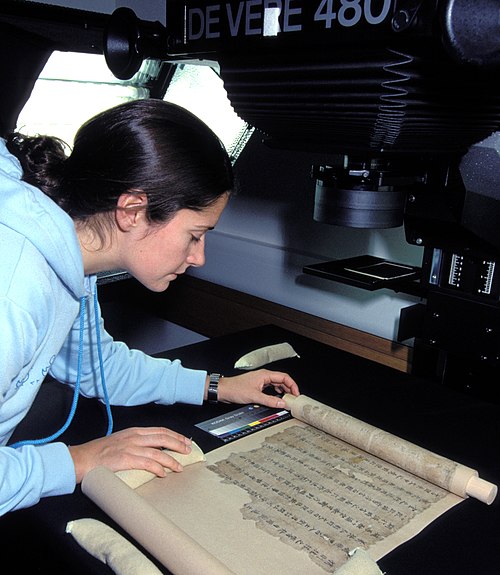
Fragments of Zu Gengzhi's mathematical commentary were discovered in the Dunhuang manuscripts, providing new insights into his methods. #archaeology #manuscript
Discovery of Lost Manuscript Fragments By International Dunhuang Project - This file has been provided by the International Dunhuang Project from its digital collections, from original file IDP1_167.jpg., CC BY-SA 3.0, https://commons.wikimedia.org/w/index.php?curid=22115069
1999 CE
Named in Asteroid 3494
Asteroid 3494 was named 'Zu Gongzhi' (a variant spelling) to honor his mathematical legacy. #astronomy #asteroid
2005 CE
Digital Archive of Zu Gengzhi's Works
A digital archive of Zu Gengzhi's extant writings was created by Chinese researchers, making his work accessible worldwide. #digital #archive
2010 CE
Exhibition at Nanjing Museum
An exhibition at the Nanjing Museum highlighted Zu Gengzhi's life and contributions, featuring replicas of his instruments and manuscripts. #exhibition #history
Exhibition at Nanjing Museum By Siyuwj - Own work, CC BY-SA 4.0, https://commons.wikimedia.org/w/index.php?curid=50402569
2015 CE
Zu Gengzhi's Principle in Textbooks
Modern textbooks in China and internationally began including Zu Gengzhi's principle as a precursor to Cavalieri's principle, correcting historical narratives. #education #textbooks
2020 CE
Google Doodle for Zu Gengzhi
Google honored Zu Gengzhi with a doodle on what would have been his 1570th birthday (approximate), highlighting his principle to a global audience. #doodle #recognition
2023 CE
New Translation of Zu Gengzhi's Texts
A new English translation of Zu Gengzhi's mathematical works was published, allowing wider scholarly access to his original formulations. #translation #publication