Zhou Dynasty: Mandate of Heaven, Ritual Bronze Culture & Hundred Schools of Thought
Encyclopedia/3. History, Societies & Civilizations/01. East Asian Civilizations/01. Chinese Dynasties • Curated by Admin Timeline.sg
The Zhou Dynasty (c. 1046–256 BCE) established the Mandate of Heaven, developed a ritual bronze culture, and saw the flourishing of the Hundred Schools of Thought during the Spring and Autumn and Warring States periods, shaping Chinese philosophy and governance.
Chronological Storyline (40 Milestones)
1046 BCE
Battle of Muye
King Wu of Zhou defeats the last Shang king, establishing the Zhou Dynasty. This battle is a key event in Chinese history, often cited as the founding moment of Zhou rule. #history #China
Battle of Muye By SY - Own work, CC BY-SA 4.0, https://commons.wikimedia.org/w/index.php?curid=62649514
1045 BCE
Duke of Zhou's Regency
After King Wu's death, his young son King Cheng ascends, with the Duke of Zhou as regent. The Duke consolidates power, quells rebellions, and codifies Zhou governance. #history #China
Duke of Zhou's Regency By Unknown author - 《歷代名臣像解》, Public domain, https://commons.wikimedia.org/w/index.php?curid=117212149
1042 BCE
Fengjian System Established
The Duke of Zhou formalizes the feudal system (fengjian), enfeoffing relatives and allies to govern territories, establishing a hierarchical state structure. #history #China
1041 BCE
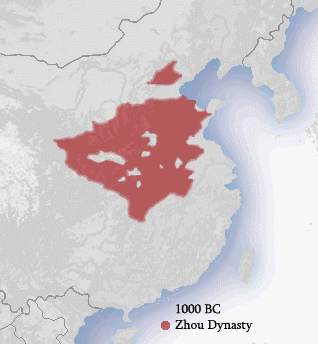
Conquest of the East
Zhou forces subdue rebellious Shang loyalists and eastern tribes, expanding Zhou territory and solidifying control over the Yellow River valley. #history #China
Conquest of the East By Territories_of_Dynasties_in_China.gif: Ian Kiu - Territories_of_Dynasties_in_China.gif: Albert Herrmann (1935). History and Commercial Atlas of China. Harvard University Press. from "The Chou Dynasty, 11th-9th Centuries B.C.", CC BY-SA 3.0, https://commons.wikimedia.org/w/index.php?curid=13309273
1036 BCE
Chengzhou Built
The secondary capital Chengzhou (near modern Luoyang) is constructed to administer the eastern territories, becoming a political and ritual center. #history #China
Chengzhou Built By Rialfver Original uploader was Rialfver at nl.wikipedia - Transferred from nl.wikipedia (Original text : Eigen werk), CC BY-SA 3.0, https://commons.wikimedia.org/w/index.php?curid=4810278
1027 BCE
Mandate of Heaven Codified
The concept of the Mandate of Heaven (Tianming) is articulated to justify Zhou rule and rebellion against the Shang, influencing Chinese political thought for millennia. #philosophy #history
Mandate of Heaven Codified By Peenwald - Own work, CC0, https://commons.wikimedia.org/w/index.php?curid=151812316
1000 BCE
Ritual Bronze Vessel Peak
Western Zhou bronze casting reaches its apex, producing intricately decorated ritual vessels (e.g., ding and gui) inscribed with important texts. #art #history
Ritual Bronze Vessel Peak By Unknown author - This file was donated to Wikimedia Commons as part of a project by the Metropolitan Museum of Art. See the Image and Data Resources Open Access Policy, CC0, https://commons.wikimedia.org/w/index.php?curid=57850733
841 BCE
Gonghe Regency
King Li of Zhou is exiled after a rebellion, and the Dukes of Zhou and Shao rule jointly as regents, marking the first reliably dated period in Chinese history. #history #China
Gonghe Regency By Unknown author - https://digitalarchive.npm.gov.tw/Integrate/IIIFViewer?id=17964&dep=P&imageName=476143^^^979968895, Public domain, https://commons.wikimedia.org/w/index.php?curid=185403230
827 BCE
King Xuan of Zhou Restores Order
King Xuan ascends and implements reforms to revitalize Zhou authority, but his reign later declines due to military failures. #history #China
781 BCE
King You of Zhou Succeeds
King You's reign is marked by favoritism toward his concubine Bao Si, leading to political instability and the eventual fall of the Western Zhou. #history #China
King You of Zhou Succeeds By Unknown author - https://baike.sogou.com/v8347.htm, CC BY-SA 4.0, https://commons.wikimedia.org/w/index.php?curid=116674542
771 BCE
Western Zhou Fall / Sack of Haojing
The Western Zhou capital Haojing is sacked by Quanrong barbarians and rebel vassals; King You is killed, ending the Western Zhou period. #history #China
770 BCE
Eastern Zhou Capital Moved to Luoyi
King Ping moves the capital east to Luoyi (Luoyang), beginning the Eastern Zhou era, which includes the Spring and Autumn and Warring States periods. #history #China
Eastern Zhou Capital Moved to Luoyi By Unknown author, CC BY-SA 3.0, https://commons.wikimedia.org/w/index.php?curid=353825
722 BCE
Spring and Autumn Annals Begin
The chronicle of the State of Lu, known as the Spring and Autumn Annals, begins its records, covering events from 722 to 481 BCE. #history #literature
Spring and Autumn Annals Begin By AnonymousUnknown author - Replica before 1938, Public domain, https://commons.wikimedia.org/w/index.php?curid=9903668
685 BCE
Duke Huan of Qi Becomes Hegemon
Duke Huan of Qi becomes the first of the Five Hegemons, using the slogan 'Honor the King, Expel the Barbarians' to dominate other states. #history #China
Duke Huan of Qi Becomes Hegemon By Unknown author - https://www.dpm.org.cn/collection/impres/231853, Public domain, https://commons.wikimedia.org/w/index.php?curid=144383420
632 BCE
Battle of Chengpu
The State of Jin defeats Chu at Chengpu, securing Jin's role as a hegemon and reshaping the balance of power in the Spring and Autumn period. #history #China
Battle of Chengpu By SY - Own work, CC BY-SA 4.0, https://commons.wikimedia.org/w/index.php?curid=60838055
597 BCE
Battle of Bi
Chu defeats Jin at Bi, cementing Chu's hegemony and challenging the traditional leadership of the northern states. #history #China
Battle of Bi By SY - Own work, CC BY-SA 4.0, https://commons.wikimedia.org/w/index.php?curid=62701018
551 BCE
Confucius Begins Teaching
Confucius opens his school, accepting disciples from all social classes, promoting education and moral self-cultivation. #philosophy #education
551 BCE
Birth of Confucius
Confucius (Kong Qiu) is born in the State of Lu, whose teachings on ethics, filial piety, and governance become the foundation of Chinese philosophy. #philosophy #history
Birth of Confucius By Wu Daozi, 685-758, Tang Dynasty. - https://i.pinimg.com/originals/77/95/19/7795198cc338e4642d2ce7ac965458b2.jpg, Public domain, https://commons.wikimedia.org/w/index.php?curid=857482
544 BCE
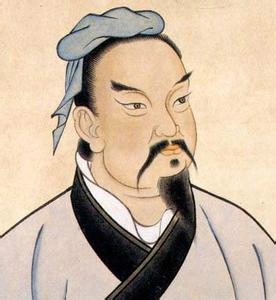
Birth of Sun Tzu (Traditional)
Sun Tzu, author of The Art of War, is traditionally said to have been born around this time, though exact dates are uncertain. #philosophy #military
Birth of Sun Tzu (Traditional) By Unknown author - Qing Palace Collection Picture Book. Beijing: Palace Museum Press. 1994., Public domain, https://commons.wikimedia.org/w/index.php?curid=57088337
541 BCE
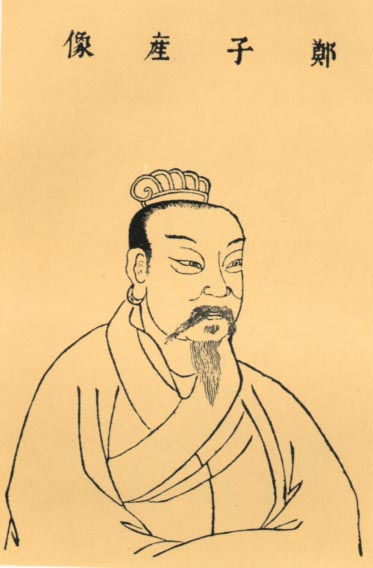
First Recorded Cuneiform-type Chinese Text?
No, instead: Zichan, a statesman of Zheng, reforms laws and codifies them on bronze vessels, a milestone in legal thought. #history #China
First Recorded Cuneiform-type Chinese Text? By 《三才圖會》,王圻及王思義撰寫 - http://hiphotos.baidu.com/%D4%AA%CB%A7%D7%DC%CB%BE%C1%EE/pic/item/b7515030b56bb752eac4af79.jpg, Public domain, https://commons.wikimedia.org/w/index.php?curid=12096312
536 BCE
Zichan Casts Law Code on Bronze Tripod
Zichan, a high minister of Zheng, castes a set of penal laws on a bronze tripod, one of the first known legal codifications in China. #history #law
481 BCE
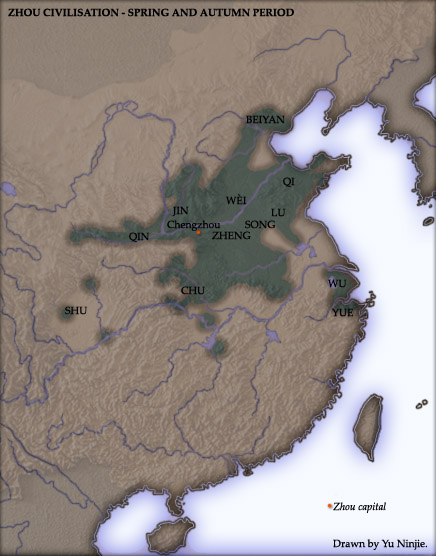
Spring and Autumn Period Ends
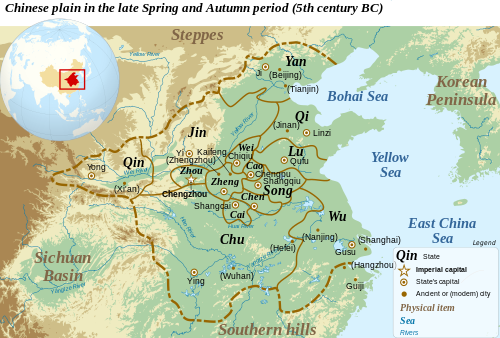
The Spring and Autumn Annals stop recording; traditionally marks the end of the Spring and Autumn period and beginning of the Warring States era. #history #China
Spring and Autumn Period Ends By Yug - Own work, *Background data: ETOPO1 + QGIS > then vectorized using Inkscape*Semantic data: some from Le Monde Chinois, Gernet, p58.or (en:) Gernet (1996) A History of Chinese Civilisation, Cambridge university press, p. 59, CC BY-SA 3.0, https://commons.wikimedia.org/w/index.php?curid=15585702
479 BCE
Death of Confucius
Confucius dies at age 72, but his disciples compile his teachings into the Analects, which become a cornerstone of Chinese culture. #philosophy #history
Death of Confucius By Confucius and his disciples, - From here., Public domain, https://commons.wikimedia.org/w/index.php?curid=2581568
453 BCE
Partition of Jin
The State of Jin is divided into three states: Han, Zhao, and Wei, an event that accelerates the Warring States competition. #history #China
403 BCE
Zhou King Confirms Partition
King Weilie of Zhou formally recognizes Han, Zhao, and Wei as independent states, marking a turning point in the Warring States period. #history #China
Zhou King Confirms Partition By Philg88 - Own work, CC BY-SA 3.0, https://commons.wikimedia.org/w/index.php?curid=11900403
400 BCE
Mozi Founds Mohism
Mozi develops a philosophical school emphasizing universal love, meritocracy, and pacifism, challenging Confucian ideas. #philosophy #history
Mozi Founds Mohism By Vjacheslav Rublevskiy - https://www.flickr.com/photos/193162016@N04/51221161306/, CC0, https://commons.wikimedia.org/w/index.php?curid=106219380
391 BCE
Birth of Mencius (approximate)
Mencius, a Confucian philosopher, is born. He later expands Confucianism with the doctrine of inherent human goodness. #philosophy #history
Birth of Mencius (approximate) By anonymous - Portraits of the Sage. Teacher Exemplar for a Myriad Generations: Confucius in Painting, Calligraphy, and Print Through the Ages (exhibit). Taipei: National Palace Museum., Public domain, https://commons.wikimedia.org/w/index.php?curid=64582790
386 BCE
Marquis Wen of Wei Promotes Legalism
Marquis Wen of Wei employs Legalist reformers like Li Kui, who writes the Book of Law, influencing the rise of Legalist thought. #history #law )
356 BCE
Shang Yang Reforms in Qin
Shang Yang introduces sweeping Legalist reforms in the State of Qin, centralizing power, promoting agriculture, and militarizing society. #history #China
Shang Yang Reforms in Qin By Taken by Fanghong - Own work, CC BY 2.5, https://commons.wikimedia.org/w/index.php?curid=844037
340 BCE
Birth of Zhuangzi (approximate)
Zhuangzi, foundational Daoist philosopher, is born. His writings emphasize spontaneity, relativism, and harmony with the Dao. #philosophy #taoism
334 BCE
Warring States Hegemonic Wars Intensify
Qin, Qi, Chu, and other states engage in massive conflicts, marking the peak of Warring States military rivalries. #history #China
323 BCE
King Wei of Qi Founds Jixia Academy
The Jixia Academy is established in the Qi capital, becoming a renowned center for philosophical debate and the Hundred Schools of Thought. #philosophy #education
King Wei of Qi Founds Jixia Academy By Vitsuha - Own work, CC0, https://commons.wikimedia.org/w/index.php?curid=171106204
312 BCE
Birth of Xunzi (approximate)
Xunzi, a Confucian philosopher who argues that human nature is evil and requires education, is born. His teachings influence Legalism. #philosophy #history
305 BCE
Warring States: Qi vs. Chu Conflicts
Ongoing wars reshape alliances; the states of Han, Wei, and Zhao align against Qi, while Chu expands southward. #history #China
295 BCE
King Wuling of Zhao Adopts Cavalry
King Wuling of Zhao implements military reforms, adopting nomadic cavalry tactics and archery, strengthening Zhao's army. #history #military
King Wuling of Zhao Adopts Cavalry By (I am a wild crane.) 我乃野云鹤 - Own work, CC BY-SA 4.0, https://commons.wikimedia.org/w/index.php?curid=61779431
286 BCE
Qin Conquest of Song
Qin annexes the State of Song, marking a major step in its westward expansion and dominance over the central plains. #history #China )
Qin Conquest of Song By Philg88 - Own work, CC BY-SA 3.0, https://commons.wikimedia.org/w/index.php?curid=11936378
279 BCE
King Zhaoxiang of Qin's Campaign
Qin launches a major campaign against Chu, defeating it at the Battle of Yanling and capturing vast territories. #history #China
King Zhaoxiang of Qin's Campaign By ChenDaoIsHere - Own work, CC0, https://commons.wikimedia.org/w/index.php?curid=145013436
263 BCE
Battle of Changping Begins
The Battle of Changping between Qin and Zhao begins, a grueling siege that ends with Zhao's defeat and the massacre of surrendered troops. #history #China
Battle of Changping Begins By SY - Own work, CC BY-SA 4.0, https://commons.wikimedia.org/w/index.php?curid=60821414
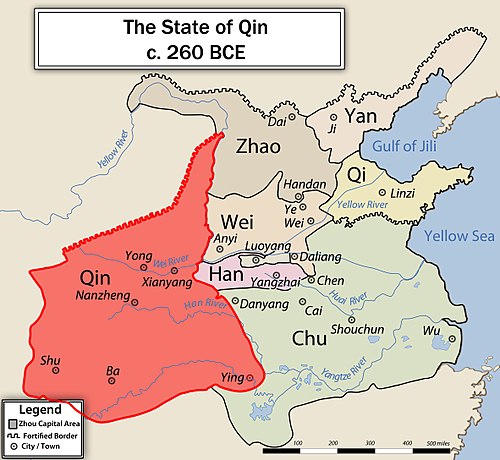
260 BCE
Battle of Changping Ends
Qin defeats Zhao at Changping; Zhao loses 400,000 soldiers, solidifying Qin's military supremacy and hastening its unification of China. #history #China
256 BCE
Qin Annexes Zhou
Qin conquers the remnant of the Eastern Zhou, ending the 800-year Zhou dynasty and paving the way for the Qin unification of China. #history #China