Western Epistemology & Ethics: Socrates, Plato, Aristotle, Kant & Existentialism
Encyclopedia/5. Human Thought & Philosophy/1. Philosophy, Religion & Ethics/03. Epistemology, Logic & Philosophy of Science • Curated by Admin Timeline.sg
This timeline traces the evolution of Western epistemology and ethics from Socrates to existentialism, highlighting key figures such as Plato, Aristotle, Kant, and Nietzsche, and their foundational works that shaped philosophical inquiry into truth, virtue, and meaning.
Chronological Storyline (41 Milestones)
469 BCE
Birth of Socrates
Socrates is born in Athens, Greece. He will become the foundational figure in Western philosophy, known for the Socratic method of questioning, though he left no writings. His ideas are primarily recorded by Plato. #philosophy #ethics
Birth of Socrates By Copy of Lysippos (?) - Eric Gaba (User:Sting), July 2005., Public domain, https://commons.wikimedia.org/w/index.php?curid=3569936
428 BCE
Birth of Plato
Plato is born into an aristocratic Athenian family. He will become a central figure in Western philosophy, founding the Academy and writing dialogues such as the Republic, which explore justice, the Forms, and the ideal state. #philosophy #plato
Birth of Plato By Marie-Lan Nguyen - Own work, Public domain, https://commons.wikimedia.org/w/index.php?curid=153003928
399 BCE
Socrates Executed
Socrates is forced to drink hemlock after being convicted of impiety and corrupting the youth. His death marks a pivotal moment in philosophy, inspiring Plato's dialogues and the Western tradition of moral inquiry. #philosophy #ethics
387 BCE
Plato Founds the Academy
Plato establishes the Academy in Athens, one of the first institutions of higher learning in the Western world. It will influence philosophy and science for centuries, producing figures like Aristotle. #philosophy #education
384 BCE
Birth of Aristotle
Aristotle is born in Stagira, Macedonia. He will become Plato's most famous student and a towering figure in philosophy, logic, biology, and ethics. His empirical approach and systematization of knowledge shape Western thought profoundly. #philosophy #science
Birth of Aristotle By After Lysippos - Jastrow (2006), Public domain, https://commons.wikimedia.org/w/index.php?curid=1359807
375 BCE
Plato Writes The Republic
Plato composes the Republic, a dialogue on justice and the ideal city. It introduces the Theory of Forms, the Allegory of the Cave, and explores the nature of reality and knowledge, becoming cornerstone texts in epistemology and political philosophy. #philosophy #epistemology )
Plato Writes The Republic By Plato - Henri Omont, Oeuvres philosophiques de Platon: Facsimilé en phototypie, à la grandeur exacte de l’original du Ms. grec 1807 de la Bibliothèque Nationale. Paris 1908., Public domain, https://commons.wikimedia.org/w/index.php?curid=28341705
367 BCE
Aristotle Enters Plato's Academy
Aristotle moves to Athens and joins Plato's Academy, where he studies for nearly 20 years. He initially embraces Platonism but later develops his own philosophy, emphasizing observation and categorization. #philosophy #education
335 BCE
Aristotle Founds the Lyceum
Aristotle establishes the Lyceum in Athens, a school focusing on empirical research and systematic philosophy. His works on ethics (Nicomachean Ethics), logic (Organon), and metaphysics become foundational in Western thought. #philosophy #ethics )
Aristotle Founds the Lyceum By Raphael - Raffaello Sanzio, Public domain, https://commons.wikimedia.org/w/index.php?curid=239234
322 BCE
Death of Aristotle
Aristotle dies in Chalcis, leaving a vast corpus covering logic, metaphysics, physics, biology, ethics, and politics. His works, preserved through Islamic translation, will later spark the Scholastic revival in medieval Europe. #philosophy #ethics
300 BCE
Zeno of Citium Founds Stoicism
Zeno of Citium begins teaching in the Stoa Poikile in Athens, founding Stoicism. This school emphasizes virtue as the highest good, living in accordance with nature, and rational self-control. Stoicism becomes a dominant philosophy in Rome and influences early Christianity. #philosophy #ethics
Zeno of Citium Founds Stoicism By Paolo Monti - Available in the BEIC digital library and uploaded in partnership with BEIC Foundation. The image comes from the Fondo Paolo Monti, owned by BEIC and located in the Civico Archivio Fotografico of Milan., CC BY-SA 4.0, https://commons.wikimedia.org/w/index.php?curid=48067347
300 BCE
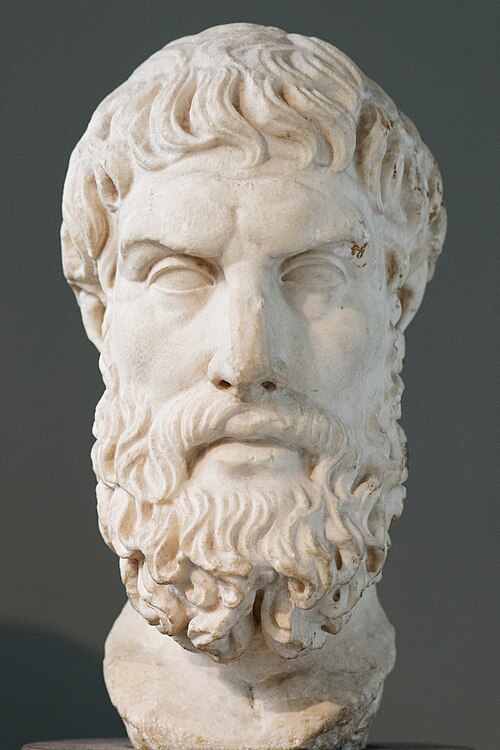
Epicurus Founds Epicureanism
Epicurus establishes his school in Athens, advocating that pleasure (ataraxia) and absence of pain are the highest goods. Epicureanism emphasizes atomism, friendship, and the pursuit of tranquility, influencing later hedonistic and materialist philosophies. #philosophy #ethics
Epicurus Founds Epicureanism By Unknown artist - Marie-Lan Nguyen (2011), Public domain, https://commons.wikimedia.org/w/index.php?curid=1447258
50 BCE
Lucretius Publishes De Rerum Natura
Roman poet Lucretius writes 'On the Nature of Things', a poetic exposition of Epicurean atomism and ethics. The work revives atomistic ideas and debates the nature of the soul and the pursuit of happiness, influencing later scientific and philosophical thought. #philosophy #science
Lucretius Publishes De Rerum Natura By In Latin, Copied by Girolamo di Matteo de Tauris for Sixtus IV, Italy, 1483 - https://www.ibiblio.org/expo/vatican.exhibit/exhibit/f-medicine_bio/Medicine_bio.html, Public domain, https://commons.wikimedia.org/w/index.php?curid=6510046
400 CE
Augustine Writes Confessions
Saint Augustine, a Christian theologian and philosopher, publishes his autobiographical Confessions, exploring memory, time, and the nature of evil. He integrated Platonic thought with Christian doctrine, shaping Medieval philosophy and theology. #philosophy #religion )
Augustine Writes Confessions By Confessiones VII, 2, 3, E.B. Pusey - www.ritmanlibrary.nl, Public domain, https://commons.wikimedia.org/w/index.php?curid=454159
1265 CE
Aquinas Begins Summa Theologica
Thomas Aquinas, a Dominican friar, works on the Summa Theologica, a comprehensive synthesis of Christian theology with Aristotelian philosophy. It discusses the nature of God, ethics, and natural law, becoming a cornerstone of Scholasticism. #philosophy #theology
Aquinas Begins Summa Theologica By Unknown author, Public domain, https://commons.wikimedia.org/w/index.php?curid=323691
1637 CE
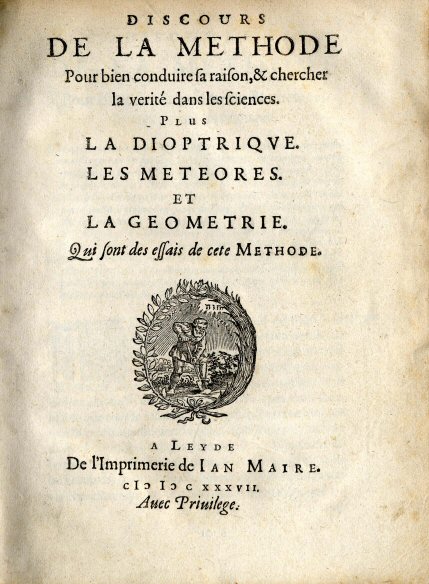
Descartes Publishes Discourse on Method
René Descartes publishes Discourse on the Method, outlining his radical skepticism and the famous 'Cogito, ergo sum' ('I think, therefore I am'). He establishes a rationalist foundation for knowledge, separating mind and body, and guiding modern epistemology. #philosophy #epistemology
Descartes Publishes Discourse on Method By Ian Maire - Leeds University Library, Public domain, https://commons.wikimedia.org/w/index.php?curid=1472528
1641 CE
Descartes Publishes Meditations on First Philosophy
Descartes releases Meditations, a series of six meditations that methodically doubt all beliefs to establish certain knowledge. He proves the existence of God and the soul, and articulates dualism, profoundly shaping early modern philosophy. #philosophy #epistemology
Descartes Publishes Meditations on First Philosophy By Bibliothèque Nationale de France, Public domain, https://commons.wikimedia.org/w/index.php?curid=14245842
1689 CE
Locke Publishes Essay Concerning Human Understanding
John Locke's Essay argues that the mind is a tabula rasa (blank slate) at birth, with knowledge derived from experience. This empiricist work rejects innate ideas, influencing epistemology and the development of British Empiricism. #philosophy #epistemology
Locke Publishes Essay Concerning Human Understanding By The original uploader was Olaf Simons at German Wikipedia. - Originally from de.wikipedia; description page is/was here., Public domain, https://commons.wikimedia.org/w/index.php?curid=1998578
1739 CE
Hume Publishes A Treatise of Human Nature
David Hume's Treatise attempts to introduce experimental reasoning into moral subjects, exploring human understanding, passions, and morality. Hume's skepticism about causality and induction challenges rationalist dogma and influences later empiricists and Kant. #philosophy #epistemology
Hume Publishes A Treatise of Human Nature By David Hume - http://www.sothebys.com/en/auctions/ecatalogue/2012/english-literature-history-l12408/lot.75.lotnum.html, Public domain, https://commons.wikimedia.org/w/index.php?curid=23502175
1781 CE
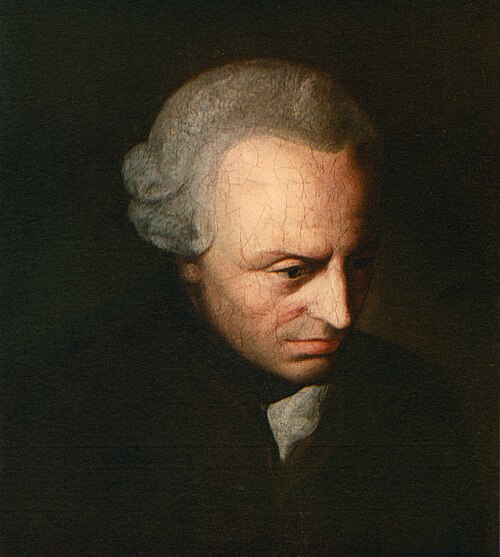
Kant Publishes Critique of Pure Reason
Immanuel Kant's magnum opus, the Critique of Pure Reason, synthesizes rationalism and empiricism. He argues that space and time are a priori forms of intuition, and introduces the transcendental idealism, revolutionizing epistemology and metaphysics. #philosophy #epistemology
Kant Publishes Critique of Pure Reason By Unknown, possibly Elisabeth von Stägemann (Anton Graff school) - original from the Norwegian Digital Learning Arena (NDLA) https://ndla.no/image/43900, Public domain, https://commons.wikimedia.org/w/index.php?curid=139262788
1785 CE
Kant Publishes Groundwork of the Metaphysics of Morals
Kant's Groundwork lays the foundation for his deontological ethics, introducing the concept of the categorical imperative. He argues that moral actions must be guided by universalizable maxims and respect for persons, profoundly influencing ethical theory. #philosophy #ethics
1788 CE
Kant Publishes Critique of Practical Reason
Kant's second critique addresses moral law and the existence of God from a practical standpoint. It develops the idea of the 'supreme principle of morality' and the necessity of free will, cementing his influence on ethical philosophy. #philosophy #ethics
1790 CE
Kant Publishes Critique of Judgment
Kant's Critique of Judgment bridges the gap between pure reason and practical reason, examining aesthetics and teleology. It introduces the concept of the sublime and explores the nature of beauty and purpose, influencing later German idealism and aesthetics. #philosophy #aesthetics
Kant Publishes Critique of Judgment By Immanuel Kant - The Hackett edition of the Critique of Judgment, Public domain, https://commons.wikimedia.org/w/index.php?curid=76037107
1807 CE
Hegel Publishes The Phenomenology of Spirit
Georg Wilhelm Friedrich Hegel's Phenomenology of Spirit traces the development of self-consciousness from sense-certainty to absolute knowledge, using the dialectical method. This work is a cornerstone of German Idealism, influencing Marx, existentialism, and later critical theory. #philosophy #idealism
Hegel Publishes The Phenomenology of Spirit By The original uploader was Nihil Kainer at German Wikipedia. - Transferred from de.wikipedia to Commons., Public domain, https://commons.wikimedia.org/w/index.php?curid=2068901
1818 CE
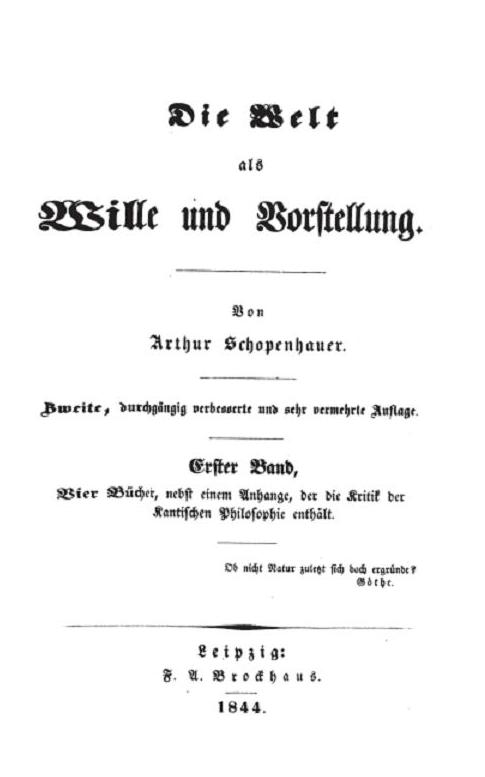
Schopenhauer Publishes The World as Will and Representation
Arthur Schopenhauer's main work presents a pessimistic philosophy, arguing that the world is driven by a blind, irrational 'Will'. He draws on Kant and Eastern thought, influencing Nietzsche and existentialists. #philosophy #pessimism
Schopenhauer Publishes The World as Will and Representation By Originally uploaded by User: (Transferred by Esculapio) - Originally uploaded on en.wikipedia, Public domain, https://commons.wikimedia.org/w/index.php?curid=18355598
1841 CE
Feuerbach Publishes The Essence of Christianity
Ludwig Feuerbach's work argues that God is a projection of human nature, criticizing religion and theology. It influences Karl Marx's materialist conception of history and existentialist critiques of religion. #philosophy #religion
Feuerbach Publishes The Essence of Christianity By The original uploader was Jimaingram at English Wikipedia. - Transferred from en.wikipedia to Commons by Sfan00_IMG using CommonsHelper., Public domain, https://commons.wikimedia.org/w/index.php?curid=4607853
1843 CE
Kierkegaard Publishes Fear and Trembling
Søren Kierkegaard, under pseudonym Johannes de Silentio, explores the story of Abraham and Isaac to discuss faith, ethics, and the 'teleological suspension of the ethical'. This work is a key text in existentialism, emphasizing individual subjectivity. #philosophy #existentialism
Kierkegaard Publishes Fear and Trembling By Caravaggio - Fear and Trembling (Penguin Classics) at Amazon.com (direct link), Public domain, https://commons.wikimedia.org/w/index.php?curid=75192330
1846 CE
Kierkegaard Publishes Concluding Unscientific Postscript
Kierkegaard's Postscript, under the pseudonym Johannes Climacus, argues against Hegelian system-building, asserting that 'truth is subjectivity'. It emphasizes the passionate individual's relationship to religious faith and becomes a foundational work of existentialism. #philosophy #existentialism
Kierkegaard Publishes Concluding Unscientific Postscript By Unknown author - http://sorenkierkegaard.org/IMG/covers/cvr-12.jpg, Public domain, https://commons.wikimedia.org/w/index.php?curid=56705682
Nov 24, 1859 CE
Darwin Publishes On the Origin of Species
Charles Darwin's work introduces the theory of evolution by natural selection, transforming biology and challenging religious and philosophical views of human nature. It influences ethics, epistemology, and the development of social Darwinism. #science #evolution
Darwin Publishes On the Origin of Species By John Murray, Publisher - This image has an extracted file: Origin of Species.jpg., Public domain, https://commons.wikimedia.org/w/index.php?curid=320416
1863 CE
Mill Publishes Utilitarianism
John Stuart Mill defends utilitarianism, arguing that actions are right in proportion to their promotion of happiness. He emphasizes higher pleasures and individual liberty, influencing ethical theory and political philosophy. #philosophy #ethics )
Mill Publishes Utilitarianism By John Stuart Mill - https://archive.org/details/a592840000milluoft, Public domain, https://commons.wikimedia.org/w/index.php?curid=76652566
1872 CE
Nietzsche Publishes The Birth of Tragedy
Friedrich Nietzsche's first book examines Greek tragedy as a synthesis of Apollonian and Dionysian forces, critiquing Socratic rationalism. It prefigures his later ideas on the will to power and the affirmation of life, marking the beginning of his philosophical project. #philosophy #aesthetics
Nietzsche's The Gay Science includes his famous proclamation 'God is dead' and develops ideas of eternal recurrence and the will to power. It blends poetry and philosophy, influencing existentialism and postmodern thought. #philosophy #existentialism
Nietzsche Publishes The Gay Science By Unknown author, Public domain, https://commons.wikimedia.org/w/index.php?curid=579794
1883 CE
Nietzsche Publishes Thus Spoke Zarathustra
Nietzsche's philosophical novel follows the prophet Zarathustra as he proclaims the Übermensch (Overman) and the will to power. Written in a poetic style, it is a seminal text in existentialism, critiquing morality and traditional values. #philosophy #existentialism
Nietzsche Publishes Thus Spoke Zarathustra By Unknown author - https://www.lynge.com/en/philosophy/54128-also-sprach-zarathustra-ein-buch-fur-alle-und-keinen-in-drei-theilen/, Public domain, https://commons.wikimedia.org/w/index.php?curid=107746832
1886 CE
Nietzsche Publishes Beyond Good and Evil
Nietzsche critiques traditional morality, advocating for a revaluation of values and the perspectivism of knowledge. This work deepens his attacks on dogmatism and paves the way for existentialist and postmodern ethics. #philosophy #ethics
Nietzsche Publishes Beyond Good and Evil By C. G. Naumann, publisher - Dartmouth College Nietzsche Chronicle, 1886, http://www.dartmouth.edu/~fnchron/1886.html, Public domain, https://commons.wikimedia.org/w/index.php?curid=3345152
1887 CE
Nietzsche Publishes On the Genealogy of Morality
Nietzsche examines the origins of moral prejudices, contrasting master and slave morality. This genealogical approach reveals the psychological and historical roots of values, influencing later critical theory and existentialist ethics. #philosophy #ethics
Nietzsche Publishes On the Genealogy of Morality By C. G. Naumann, publisher - Dartmouth College Nietzsche Chronicle, 1887, http://www.dartmouth.edu/~fnchron/1887.html, Public domain, https://commons.wikimedia.org/w/index.php?curid=136081739
1889 CE
Nietzsche Publishes Twilight of the Idols
Nietzsche's concise polemic attacks philosophers like Socrates and Kant, declaring a revaluation of all values. It summarizes his critique of morality, religion, and philosophy, exemplifying his aphoristic style. #philosophy #ethics
Nietzsche Publishes Twilight of the Idols By Author: Friedrich Nietzsche and Publisher: Verlag von C. G. Naumann - www.nietzscheana.com.ar/gotzen-dammerung.gif, Public domain, https://commons.wikimedia.org/w/index.php?curid=3556238
1907 CE
Bergson Publishes Creative Evolution
Henri Bergson's Creative Evolution presents the concept of élan vital (vital impulse) to explain life's creative development. He challenges mechanistic views and emphasizes intuition over intellect, influencing process philosophy and existentialism. #philosophy #evolution )
Bergson Publishes Creative Evolution By Henri Bergson - https://archive.org/details/lvolutioncra00berg/page/n5/mode/2up, Public domain, https://commons.wikimedia.org/w/index.php?curid=176290650
1913 CE
Husserl Publishes Ideas I
Edmund Husserl's Ideas: General Introduction to Pure Phenomenology outlines his phenomenological method, focusing on intentionality and the epoché. Phenomenology becomes a major 20th-century movement, influencing existentialism and hermeneutics. #philosophy #phenomenology )
Ludwig Wittgenstein's Tractatus argues that philosophical problems arise from misunderstandings of language, proposing the picture theory of meaning and the limits of language. It deeply impacts logical positivism and analytic philosophy. #philosophy #logic
Wittgenstein Publishes Tractatus Logico-Philosophicus By Title etc. uncopyrightable; layout by Harcourt Brace. - Wittgenstein, Tractatus Logico-Philosophicus, New York: Harcourt, Brace, 1922. (via Google books), Public domain, https://commons.wikimedia.org/w/index.php?curid=11830531
1927 CE
Heidegger Publishes Being and Time
Martin Heidegger's magnum opus analyzes Dasein (human existence) and our being-in-the-world. It breaks with traditional metaphysics, exploring temporality, authenticity, and the meaning of Being, becoming a foundational text in existentialism and phenomenology. #philosophy #existentialism
Heidegger Publishes Being and Time By unknown - https://en.wikipedia.org/wiki/File:Being_and_Time_(German_edition).jpg, Public domain, https://commons.wikimedia.org/w/index.php?curid=145341631
1943 CE
Sartre Publishes Being and Nothingness
Jean-Paul Sartre's Being and Nothingness develops existentialist ontology, emphasizing radical freedom, the 'for-itself' consciousness, and bad faith. It argues that 'existence precedes essence', influencing ethics and political thought. #philosophy #existentialism
1946 CE
Sartre Delivers 'Existentialism is a Humanism'
Sartre's lecture defends existentialism against criticisms, asserting that humans are condemned to be free and must create their own values. It popularizes existentialist themes and affirms the ethical implications of radical choice. #philosophy #existentialism