The West African empires of Ghana, Mali, and Songhai dominated trans-Saharan trade in gold and salt from the 8th to 16th centuries, fostering rich cultural and intellectual hubs like Timbuktu with its Sankore University.
Chronological Storyline (41 Milestones)
700 CE
Rise of the Ghana Empire
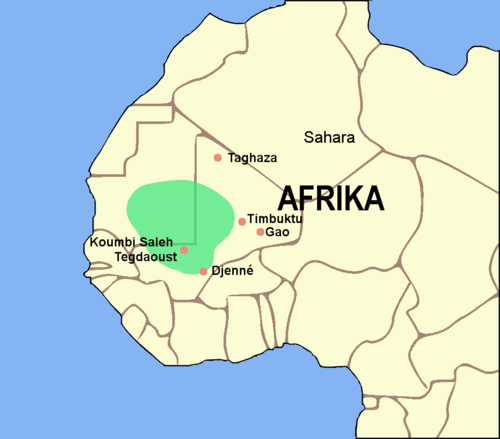
The Ghana Empire emerges as a powerful state in West Africa, controlling trans-Saharan gold and salt trade routes. Its wealth and military strength lay the foundation for future empires. #history #Africa
Rise of the Ghana Empire By Luxo - Image:BlankMap-World gray.svg, CC BY-SA 3.0, https://commons.wikimedia.org/w/index.php?curid=1097270
790 CE
Founding of Koumbi Saleh
The capital of the Ghana Empire, Koumbi Saleh, becomes a major commercial center with a population estimated at 15,000–20,000, featuring stone buildings and a thriving market. #history #architecture
800 CE
Trans-Saharan Trade Flourishes
The trans-Saharan trade network intensifies, with Ghana exporting gold, ivory, and slaves in exchange for salt, copper, and textiles from North Africa and Europe. This trade enriches the empire. #trade #history
Trans-Saharan Trade Flourishes By Pierre Trémaux - CROPPED mat from “Sketch of Central and Eastern Africa” - original is File:Esquisse de l'Afrique centrale et orientale - dressée par P(ier)re Trémaux d'après ses propres voyages et renseignements et ceux de... ; gravé chez Erhard, r(ue) Bonaparte 42 - btv1b8468336v.jpg, Public domain, https://commons.wikimedia.org/w/index.php?curid=123517923
830 CE
Al-Yaqubi Describes Ghana
Arab geographer Al-Yaqubi writes one of the earliest external accounts of the Ghana Empire, noting its power and wealth. His writings provide valuable historical insight. #history #geography
900 CE
Ghana Empire at Its Peak
The Ghana Empire reaches its zenith, with a strong central government and control over gold mines in Bambuk and Wangara. The king is described as 'master of gold' by Arab chroniclers. #history #gold
990 CE
Conversion to Islam in Ghana
The Soninke king of Ghana converts to Islam, influenced by Muslim traders and scholars. However, traditional beliefs persist among the populace, creating a dual religious system. #religion #history
1050 CE
Al-Bakri Describes Ghana
Andalusian scholar Al-Bakri provides a detailed description of the Ghana Empire, including its court ceremonies and wealth. His work remains a key primary source. #history #literature
1076 CE
Almoravid Invasion of Ghana
The Almoravids, a Berber Muslim dynasty from the Sahara, attack the Ghana Empire, weakening its power and contributing to its eventual decline. The capital Koumbi Saleh is sacked. #war #history
Almoravid Invasion of Ghana By Rowanwindwhistler - Own work Base map (coast, territory, rivers...) from Natural Earth Location of towns from Wikipedia Projection: Africa Lambert conformal conic, CC BY-SA 4.0, https://commons.wikimedia.org/w/index.php?curid=50658698
1100 CE
Decline of Ghana Empire
The Ghana Empire fragments into smaller states due to internal rebellion, Almoravid pressure, and loss of trade routes. The empire finally collapses around the 13th century. #history
1200 CE
Rise of the Mali Empire
The Mali Empire begins its ascent under the leadership of Sundiata Keita, who unites the Mandinka people and establishes a powerful kingdom. #history #Africa
Rise of the Mali Empire By HetmanTheResearcher - Own work, CC BY 4.0, https://commons.wikimedia.org/w/index.php?curid=143761923
1235 CE
Battle of Kirina
Sundiata Keita defeats the Sosso king Soumaoro Kanté at the Battle of Kirina, founding the Mali Empire. This victory is celebrated in the Epic of Sundiata, an oral tradition. #history #war #epic
1240 CE
Sundiata Captures Kumbi Saleh
Sundiata Keita captures the former Ghana capital Kumbi Saleh, incorporating it into the Mali Empire and solidifying control over trade routes. #history
1255 CE
Death of Sundiata Keita
Sundiata Keita dies, but his legacy continues through the Mali Empire's expansion and the oral Epic of Sundiata, which becomes a cornerstone of West African culture. #history #literature
1300 CE
Mali Empire Gold Trade Booms
Under Mansa (Emperor) control, the Mali Empire becomes the world's largest producer of gold, exporting it across the Sahara to Europe and the Middle East. #trade #gold
1312 CE
Mansa Musa Becomes Emperor
Mansa Musa ascends the throne of the Mali Empire. His reign marks the apogee of Mali's wealth, power, and cultural influence. #history
Mansa Musa Becomes Emperor By attributed to Abraham Cresques - This file comes from Gallica Digital Library and is available under the digital ID btv1b55002481n, Public domain, https://commons.wikimedia.org/w/index.php?curid=107077167
1324 CE
Mansa Musa's Hajj to Mecca
Mansa Musa embarks on a lavish pilgrimage to Mecca, distributing so much gold in Cairo that its value depreciates for years. His journey puts Mali on the map of the Islamic world. #history #religion #gold
1325 CE
Construction of Djingareyber Mosque
Mansa Musa commissions the Djingareyber Mosque in Timbuktu, designed by the Andalusian architect Abu Ishaq al-Sahili. It becomes a center of Islamic learning. #architecture #religion
1337 CE
Death of Mansa Musa
Mansa Musa dies; his successors struggle to maintain the empire's unity and wealth. However, Timbuktu continues to thrive as a scholarly hub. #history
1350 CE
Timbuktu Becomes a Center of Learning
Timbuktu emerges as a major center for Islamic scholarship, with the Sankore University attracting scholars from across Africa and the Middle East. #education #history
Timbuktu Becomes a Center of Learning By Flickr user: Emilio Labrador Santiago de Chile https://www.flickr.com/people/3059349393/ - Flickr: https://www.flickr.com/photos/3059349393/3331431933/, CC BY 2.0, https://commons.wikimedia.org/w/index.php?curid=22534570
1352 CE
Ibn Battuta Visits Mali
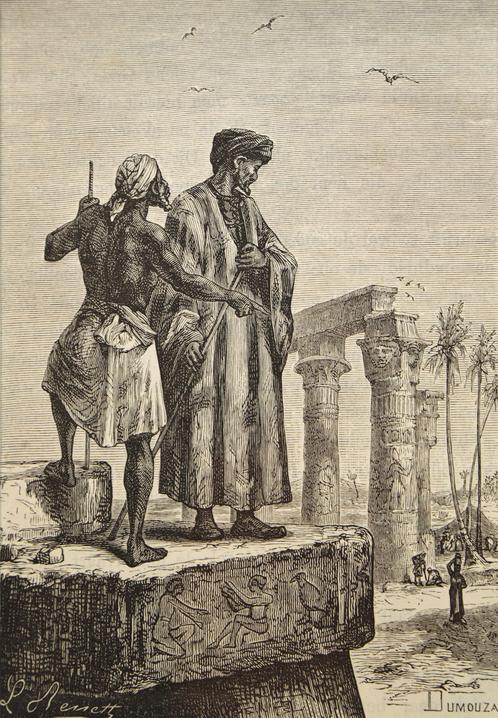
The Moroccan explorer Ibn Battuta travels to the Mali Empire, providing a detailed account of its court, customs, and hospitality in his famous Rihla (travelogue). #exploration #history
Ibn Battuta Visits Mali By Léon Benett - Verne, Jules (1878). Les Grands voyages et les grands voyageurs. Découverte de la Terre. Paris: J. Hetzel. Page 81 available from Gallica.Immediate source: http://www.artfinder.com/work/ibn-battuta-in-egypt-hippolyte-leon-benett/, Public domain, https://commons.wikimedia.org/w/index.php?curid=17332982
1400 CE
Decline of the Mali Empire
Internal strife, succession disputes, and rebellions weaken the Mali Empire. The empire gradually loses control over peripheral regions, including the important trade city of Gao. #history
1430 CE
Tuareg Capture of Timbuktu
The Tuareg people capture Timbuktu from the weakening Mali Empire, but they allow the city's scholarly institutions to continue functioning. #history
1464 CE
Rise of Songhai Empire
Sunni Ali becomes ruler of the Songhai Empire, which had been a vassal state. He begins a campaign of expansion, conquering the remnants of Mali and other territories. #history
1468 CE
Sunni Ali Captures Timbuktu
Sunni Ali captures Timbuktu from the Tuareg, bringing the city under Songhai control. He is critical of the scholars, but the city remains a center of learning. #war #history
1473 CE
Conquest of Jenne
Sunni Ali conquers the prosperous city of Jenne after a siege, integrating its trade networks into the Songhai Empire. #history
Conquest of Jenne By qiv - https://www.flickr.com/photos/qiv/1544181533/, CC BY-SA 2.0, https://commons.wikimedia.org/w/index.php?curid=101618250
1492 CE
Death of Sunni Ali
Sunni Ali dies under mysterious circumstances. His son Sunni Baru succeeds him but is soon overthrown by Askia Mohammad I. #history
1493 CE
Askia Mohammad I Seizes Power
Askia Mohammad I, a general of Soninke origin, overthrows Sunni Baru and establishes the Askia dynasty, ushering in the golden age of the Songhai Empire. #history
Askia Mohammad I Seizes Power By HetmanTheResearcher - Own work, CC BY-SA 4.0, https://commons.wikimedia.org/w/index.php?curid=143758809
1496 CE
Askia's Pilgrimage to Mecca
Askia Mohammad I makes a pilgrimage to Mecca, but with less ostentation than Mansa Musa. He is appointed as the Caliph of the Sudan by the Abbasid caliph. #religion #history
1500 CE
Songhai Becomes Largest Empire in West Africa
Under Askia Mohammad I, the Songhai Empire reaches its greatest extent, incorporating territories from the Atlantic to Lake Chad, and from the Sahara to the forest regions. #history
1500 CE
Sankore University Flourishes
The Sankore University in Timbuktu becomes a world-renowned center of Islamic scholarship, with thousands of students and manuscripts on law, astronomy, medicine, and literature. #education #history
Sankore University Flourishes By Anne and David - https://www.flickr.com/photos/annedavid2012/1299279844/, Public domain, https://commons.wikimedia.org/w/index.php?curid=98491261
1510 CE
Leo Africanus Visits Timbuktu
The Moroccan traveler Leo Africanus visits Timbuktu and writes a glowing account of its wealth, learning, and libraries. His work introduces the city to Europe. #exploration #history
Leo Africanus Visits Timbuktu By Sebastiano del Piombo - Downloaded from the NGA website, Public domain, https://commons.wikimedia.org/w/index.php?curid=3087098
1528 CE
Askia Mohammad I Overthrown
Askia Mohammad I is deposed by his son Askia Musa, leading to a period of instability and decline for the Songhai Empire. #history
1539 CE
Death of Askia Mohammad I
Askia Mohammad I dies in exile. His legacy includes a centralized administration, standardized trade, and promotion of Islam. #history
1549 CE
Askia Dawud's Reign Begins
Askia Dawud takes the throne and restores stability to the Songhai Empire. He is a patron of scholarship and oversees the compilation of the Tarikh al-Sudan. #history
1550 CE
Timbuktu Manuscript Libraries Expand
Private and public libraries in Timbuktu accumulate thousands of manuscripts on diverse subjects, many written by local scholars like Ahmed Baba. #literature #history
Timbuktu Manuscript Libraries Expand By Elias Altmimi - EurAstro : Mission to Mali, Public domain, https://commons.wikimedia.org/w/index.php?curid=8654070
1582 CE
Death of Askia Dawud
Askia Dawud dies, and a succession crisis ensues, leading to the weakening of Songhai central authority. #history
1591 CE
Battle of Tondibi
The Moroccan army, equipped with firearms, defeats the Songhai army at the Battle of Tondibi, leading to the fall of the Songhai Empire and the occupation of Timbuktu. #war #history
1591 CE
Moroccan Occupation of Timbuktu
Moroccan forces occupy Timbuktu, looting its wealth and suppressing its scholars. The city's golden age ends, though it remains a center of learning for a time. #history
1593 CE
Ahmed Baba Exiled to Morocco
The renowned scholar Ahmed Baba, one of Timbuktu's greatest intellectuals, is arrested and exiled to Morocco for refusing to cooperate with the occupation. #history #literature
1599 CE
Songhai Resistance Crushed
The last major Songhai resistance is defeated, and the empire dissolves into smaller states. The trans-Saharan trade shifts eastward, diminishing the region's importance. #history
1600 CE
Decline of Timbuktu as a Learning Center
The Moroccan occupation and political instability lead to the decline of Timbuktu's scholarly community. Many manuscripts are lost or dispersed, though some survive in family libraries. #history #education