Werner Heisenberg: Matrix Mechanics, Uncertainty Principle & Quantum Physics
Encyclopedia/1. The Cosmos & The Natural World/2. Physics & Chemistry/13. Physical & Chemical Biographies • Curated by Admin Timeline.sg
Biographical timeline of Werner Heisenberg, German theoretical physicist who pioneered quantum matrix mechanics and formulated the Uncertainty Principle, spanning his birth in 1901 to his death in 1976.
Chronological Storyline (37 Milestones)
Dec 5, 1901 CE
Birth of Werner Heisenberg
Werner Karl Heisenberg is born in Würzburg, Germany, to August Heisenberg and Annie Wecklein. #physics #quantum
Birth of Werner Heisenberg By Unknown author - This image was provided to Wikimedia Commons by the German Federal Archive (Deutsches Bundesarchiv) as part of a cooperation project. The German Federal Archive guarantees an authentic representation only using the originals (negative and/or positive), resp. the digitalization of the originals as provided by the Digital Image Archive., CC BY-SA 3.0 de, https://commons.wikimedia.org/w/index.php?curid=187307971
1911 CE
Attends Maximiliansgymnasium
Heisenberg enters the Maximiliansgymnasium in Munich, where he excels in mathematics and physics. #education
1920 CE
Begins Studies at University of Munich
Heisenberg enrolls at the Ludwig Maximilian University of Munich, studying under Arnold Sommerfeld. #physics
1922 CE
Attends Bohr's Lecture in Göttingen
Heisenberg attends Niels Bohr's lecture in Göttingen, sparking his interest in quantum atomic theory. #quantum
Jul 1, 1923 CE
Doctorate in Physics
Heisenberg earns his doctorate from the University of Munich with a thesis on turbulent fluid flow. #physics
1924 CE
Postdoc with Max Born in Göttingen
Heisenberg works as an assistant to Max Born at the University of Göttingen, delving into quantum theory. #physics
Jun 1, 1925 CE
Heligoland Breakthrough
Suffering from hay fever, Heisenberg retreats to Heligoland island and develops the foundations of matrix mechanics. #quantum #matrixmechanics
Heisenberg works with Niels Bohr at the University of Copenhagen as a lecturer and collaborator. #physics
Mar 23, 1927 CE
Uncertainty Principle Published
Heisenberg submits his paper on the uncertainty principle, stating Δx Δp ≥ h/4π, a cornerstone of quantum mechanics. #uncertaintyprinciple #quantum
Uncertainty Principle Published By Unknown author - This image was provided to Wikimedia Commons by the German Federal Archive (Deutsches Bundesarchiv) as part of a cooperation project. The German Federal Archive guarantees an authentic representation only using the originals (negative and/or positive), resp. the digitalization of the originals as provided by the Digital Image Archive., CC BY-SA 3.0 de, https://commons.wikimedia.org/w/index.php?curid=5436254
1927 CE
Appointed Professor at Leipzig
At age 25, Heisenberg becomes the youngest full professor in Germany at the University of Leipzig. #academia
1928 CE
Publishes Ferromagnetism Theory
Heisenberg develops a quantum mechanical theory of ferromagnetism using the exchange interaction. #physics #magnetism
1929 CE
Heisenberg and Pauli on Quantum Field Theory
Heisenberg and Wolfgang Pauli publish the first paper on quantum field theory, laying groundwork for particle physics. #quantumfieldtheory
Heisenberg and Pauli on Quantum Field Theory By Joel Holdsworth (Joelholdsworth) - Non-Derived SVG of Radiate gluon.png, originally the work of SilverStar at Feynmann-diagram-gluon-radiation.svg, updated by joelholdsworth., Public domain, https://commons.wikimedia.org/w/index.php?curid=1764161
1932 CE
Nobel Prize in Physics
Heisenberg is awarded the Nobel Prize for 1932 for the creation of quantum mechanics, though the prize is announced in 1933. #nobel #physics
Dec 10, 1933 CE
Receives Nobel Prize in Stockholm
Heisenberg receives his Nobel Prize in Stockholm, delivering his lecture on the uncertainty principle. #nobel
1935 CE
Marries Elisabeth Schumacher
Heisenberg marries Elisabeth Schumacher; they will have seven children. #personal
1937 CE
Nazi Criticism of 'Jewish Physics'
Heisenberg is attacked in the SS newspaper for teaching 'Jewish physics' (relativity and quantum mechanics). #history
1938 CE
Cleared by Heinrich Himmler
After an investigation, Himmler clears Heisenberg of political suspicion, allowing him to continue teaching. #history
Sep 1, 1939 CE
Drafted into German Nuclear Research
With the start of WWII, Heisenberg joins the German nuclear energy project (Uranium Club). #nuclear #history
Drafted into German Nuclear Research By Unknown author - http://www.lardc.com/aveboo/Pages/elivil.html, Public domain, https://commons.wikimedia.org/w/index.php?curid=1415127
1941 CE
Visit to Niels Bohr in Copenhagen
Heisenberg travels to Copenhagen to meet Niels Bohr; the controversial conversation about the German nuclear project becomes famous. #history
1942 CE
Director of Kaiser Wilhelm Institute for Physics
Heisenberg becomes director of the Kaiser Wilhelm Institute for Physics in Berlin, leading nuclear research. #physics
Director of Kaiser Wilhelm Institute for Physics By Fridolin freudenfett (Peter Kuley) - Own work, CC BY-SA 3.0, https://commons.wikimedia.org/w/index.php?curid=18058567
1944 CE
Evacuation of Institute to Hechingen
As Allied bombing intensifies, the institute moves to Hechingen in southern Germany. #history
May 3, 1945 CE
Captured by Allied Forces
Heisenberg is captured by U.S. troops and interned in England at Farm Hall with other German scientists. #history
Captured by Allied Forces By Jonathan Thacker - Geograph Britain and Ireland, CC BY-SA 2.0, https://commons.wikimedia.org/w/index.php?curid=154773938
Jan 1, 1946 CE
Return to Germany
Heisenberg returns to Germany and becomes director of the Max Planck Institute for Physics in Göttingen. #physics
Return to Germany By Church of emacs - Own work, CC BY-SA 4.0, https://commons.wikimedia.org/w/index.php?curid=10206485
1947 CE
Professor at University of Göttingen
Heisenberg is appointed professor at the University of Göttingen. #academia
Professor at University of Göttingen By Unknown author - Georg August University of Göttingen, Public domain, https://commons.wikimedia.org/w/index.php?curid=15492626
1949 CE
Publishes 'Physics and Philosophy'
Heisenberg publishes 'Physics and Philosophy', a book on the implications of quantum mechanics. #philosophy #physics
1950 CE
Elected Foreign Member of Royal Society
Heisenberg is elected a Foreign Member of the Royal Society. #awards
1955 CE
Signs Mainau Declaration
Heisenberg signs the Mainau Declaration against nuclear weapons. #peace #nuclear
1957 CE
Göttingen Manifesto
Heisenberg and 17 other German scientists sign the Göttingen Manifesto opposing nuclear armament for West Germany. #peace
1958 CE
Max Planck Institute Moves to Munich
The Max Planck Institute for Physics relocates to Munich, and Heisenberg becomes a professor at the University of Munich. #physics
1960 CE
Publishes 'The Physical Principles of the Quantum Theory'
Heisenberg publishes a revised edition of his classic work on quantum theory principles. #quantum
1963 CE
Receives Pour le Mérite
Heisenberg is awarded the Pour le Mérite for Sciences and Arts. #awards
Receives Pour le Mérite By Borodun - Own work, CC BY-SA 4.0, https://commons.wikimedia.org/w/index.php?curid=57223967
1964 CE
Publication of 'Physics and Beyond'
Heisenberg publishes his autobiography, 'Physics and Beyond: Encounters and Conversations'. #autobiography
1967 CE
President of the Alexander von Humboldt Foundation
Heisenberg serves as president of the Alexander von Humboldt Foundation until 1971. #sciencepolicy
President of the Alexander von Humboldt Foundation By Wolkenkratzer - Own work, CC BY-SA 3.0, https://commons.wikimedia.org/w/index.php?curid=32291217
1970 CE
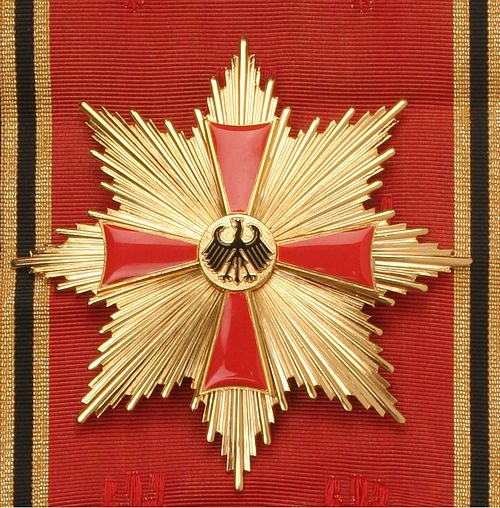
Awarded Order of Merit of the Federal Republic of Germany
Heisenberg receives the Grand Cross of the Order of Merit of the Federal Republic of Germany. #awards
Awarded Order of Merit of the Federal Republic of Germany By Národní museum, Praha, Attribution, https://commons.wikimedia.org/w/index.php?curid=9656119
1973 CE
Heisenberg's Unified Field Theory Attempt
Heisenberg publishes a unified field theory of elementary particles, though it gains limited acceptance. #physics #unifiedtheory
Feb 1, 1976 CE
Death of Werner Heisenberg
Werner Heisenberg dies at his home in Munich at age 74 from cancer. #physics