Encyclopedia/1. The Cosmos & The Natural World/3. Astronomy & Planetary Science/06. Astronomical Biographies • Curated by Admin Timeline.sg
Timeline of Danish nobleman and astronomer Tycho Brahe, whose unparalleled naked-eye observations and construction of Uraniborg Observatory revolutionized astronomy and enabled Kepler's laws of planetary motion.
Chronological Storyline (33 Milestones)
Dec 14, 1546 CE
Tycho Brahe Born at Knudstrup Castle
Tycho Brahe is born at Knudstrup Castle in Scania, Denmark (now Sweden), to noble parents Otte Brahe and Beate Bille. He would later become the greatest naked-eye astronomer of the Renaissance. #history #astronomy
Tycho Brahe Born at Knudstrup Castle By Unknown author - LSH 90153 (sm_dig3678), Public domain, https://commons.wikimedia.org/w/index.php?curid=28918733
Apr 1, 1559 CE
Enters University of Copenhagen
At age 12, Tycho begins studying at the University of Copenhagen, where he is exposed to the humanities and the basics of astronomy. His uncle Jørgen Brahe sponsors his education. #education #astronomy
Aug 21, 1560 CE
Partial Solar Eclipse Sparks Interest
Tycho observes a partial solar eclipse, which occurs exactly as predicted by astronomical tables. This event inspires him to pursue astronomy more seriously, realizing the power of mathematical prediction. #astronomy #eclipse
Mar 1, 1562 CE
Sent to University of Leipzig
Tycho's family sends him to the University of Leipzig to study law, but he continues his astronomical observations in secret, using a small celestial globe. #astronomy #education
Aug 1, 1563 CE
Observes Jupiter-Saturn Conjunction
Tycho records a conjunction of Jupiter and Saturn, noting that the Prutenic Tables are off by several days. This leads him to believe that accurate observations are needed to correct astronomical tables. #astronomy #observations
1565 CE
Begins Studies at University of Wittenberg
Tycho enrolls at the University of Wittenberg, a center of Lutheran learning, where he deepens his knowledge of mathematics and astronomy, though he does not stay long. #history #astronomy
Dec 29, 1566 CE
Loses Part of Nose in Duel
At a Christmas party in Rostock, Tycho duels with a fellow nobleman, Manderup Parsbjerg, over a mathematical dispute. Tycho's nose is partially cut off, and he later wears a prosthetic made of brass or silver. #history #controversy
1567 CE
Returns to Denmark, Begins Building Instruments
After his studies abroad, Tycho returns to Denmark and starts constructing large astronomical instruments, including a sextant and a quadrant, to improve observational accuracy. #astronomy #instruments
1571 CE
Moves to Herrevad Abbey
Tycho's father dies, and he inherits estates. He moves to Herrevad Abbey in Scania, where his maternal uncle Steen Bille assists him in setting up a laboratory and observatory. #history #astronomy
Nov 11, 1572 CE
Discovers Supernova in Cassiopeia
While walking home from his alchemical laboratory, Tycho spots a brilliant new star (SN 1572) in the constellation Cassiopeia. He begins meticulous observations, proving it is beyond the Moon and thus challenging Aristotle's celestial perfection. #astronomy #supernova
Discovers Supernova in Cassiopeia By NASA/CXC/Rutgers/J.Warren & J.Hughes et al. - http://chandra.harvard.edu/photo/2005/tycho/; see also https://www.flickr.com/photos/smithsonian/2941525398/, Public domain, https://commons.wikimedia.org/w/index.php?curid=6706920
1573 CE
Publishes De Nova Stella
Tycho publishes a short book, 'De Nova Stella' (On the New Star), describing his observations and conclusions about the supernova. The work establishes his reputation as a leading astronomer. #astronomy #publication
1573 CE
Begins Relationship with Kirsten Jørgensdatter
Tycho begins a common-law marriage with Kirsten Jørgensdatter, a woman of lower social standing. They have eight children, but the marriage is not considered legal under Danish law, affecting Tycho's noble status. #history #family
1574 CE
Gives Lectures at University of Copenhagen
King Frederick II invites Tycho to give a series of lectures on astronomy at the University of Copenhagen. Tycho uses the platform to advocate for the reform of astronomy based on precise observations. #astronomy #education
1575 CE
Travels to European Cities and Observatories
Tycho travels through Germany, visiting astronomers and observatories in cities like Augsburg and Kassel. He exchanges ideas with other scholars, including the Landgrave Wilhelm IV of Hesse-Kassel. #astronomy #travel
Feb 11, 1576 CE
King Frederick II Grants Hven Island
Impressed by Tycho's work, King Frederick II grants him the island of Hven in the Øresund Strait, along with funds to build a major observatory and research center. This secures Tycho's legacy. #history #patronage
King Frederick II Grants Hven Island By Stanlekub - taken from Tycho's Astronomiae instauratae mechanica (1598) (http://www.landskrona.se/kultur/tychopressrum/high/uraniborgskiss.jpg.sit), Public domain, https://commons.wikimedia.org/w/index.php?curid=572899
May 23, 1576 CE
Construction of Uraniborg Begins
Tycho breaks ground on Uraniborg, an elaborate castle-observatory on Hven. The building includes living quarters, a library, an alchemical laboratory, and precise observation platforms. #astronomy #architecture
Nov 1, 1577 CE
Observations of the Great Comet of 1577
Tycho observes a brilliant comet and measures its parallax, demonstrating that it is farther away than the Moon. This supports the idea that the celestial realm is changeable, contradicting Aristotelian physics. #astronomy #comet
Observations of the Great Comet of 1577 By Jiřrí Jakubuv Dačický - Zentralbibliothek Zürich, Public domain, https://commons.wikimedia.org/w/index.php?curid=70591808
1580 CE
Uraniborg Completed and Fully Operational
Uraniborg becomes the world's finest observatory, equipped with giant quadrants, sextants, and other instruments. Tycho and his assistants begin systematic observations of the planets and stars. #astronomy #observatory
1581 CE
Builds Stjerneborg Underground Observatory
To avoid vibrations and wind, Tycho constructs Stjerneborg (Star Castle), an underground observatory adjacent to Uraniborg. It houses his largest instruments, including the great mural quadrant. #astronomy #architecture
Builds Stjerneborg Underground Observatory By Tycho Brahe - Tycho Brahe's observatory on Ven: Johan Blaeu, Atlas Major, Amsterdam, 1662-DET KONGELIGE BIBLIOTEK, Public domain, https://commons.wikimedia.org/w/index.php?curid=573307
1582 CE
Proposes the Tychonic System
Tycho begins developing a new cosmological model, the Tychonic system, where the Sun and Moon orbit Earth, but other planets orbit the Sun. This hybrid model attempts to reconcile biblical geocentrism with Copernican observations. #astronomy #cosmology
Proposes the Tychonic System By AnonymousUnknown author - https://web.archive.org/web/20080607070954/http://www.galilean-library.org/manuscript.php?postid=43821 and http://quickbeamoffangorn.files.wordpress.com/2008/01/tychonian.gif, Public domain, https://commons.wikimedia.org/w/index.php?curid=6429763
1584 CE
Publishes 'De Mundi Aetherei Recentioribus Phaenomenis'
Tycho publishes a book on the 1577 comet and other celestial phenomena, further arguing against the immutability of the heavens. The work includes arguments for his geo-heliocentric system. #astronomy #publication
1588 CE
Delegates Observational Work to Assistants
With Uraniborg operating at full capacity, Tycho supervises a team of assistants, including his sister Sophie Brahe, who aids in astronomical and alchemical research. #history #science
1590 CE
Refines Star Catalog with 777 Stars
Tycho and his assistants compile a precise star catalog containing positions of 777 stars, far surpassing previous catalogs in accuracy. This catalog is later expanded to 1000 stars. #astronomy #catalog
1592 CE
Visit from King James VI of Scotland
King James VI of Scotland visits Uraniborg and Tycho, seeking his advice on astrology. The visit underscores Tycho's international reputation. #history #royalty
Apr 4, 1596 CE
Death of King Frederick II
Frederick II dies, and his son Christian IV becomes king. The new monarch is less supportive of Tycho's lavish spending, leading to a decline in patronage. #history #patronage
Apr 29, 1597 CE
Leaves Hven and Denmark
After losing royal support, Tycho abandons Uraniborg and Stjerneborg. He leaves Denmark with his family and instruments, eventually finding refuge with Count Heinrich Rantzau in Germany. #history #exile
1598 CE
Completes Star Catalog with 1,000 Stars
Tycho finalizes his star catalog, now containing 1,000 stars, with positions accurate to about 1 arcminute. This catalog is the most precise ever made before the telescope. #astronomy #catalog
1598 CE
Publishes 'Astronomiae Instauratae Mechanica'
Tycho publishes a description of his instruments and methods, titled 'Astronomiae Instauratae Mechanica' (Instruments for the Restored Astronomy). The book details his observatories and instruments in words and woodcut illustrations. #astronomy #publication
Jun 1, 1599 CE
Appointed Imperial Mathematician in Prague
Holy Roman Emperor Rudolf II appoints Tycho as Imperial Mathematician and grants him a pension and a castle near Prague (Benátky nad Jizerou). Tycho moves there with his family and instruments. #history #patronage
Feb 4, 1600 CE
Johannes Kepler Arrives as Assistant
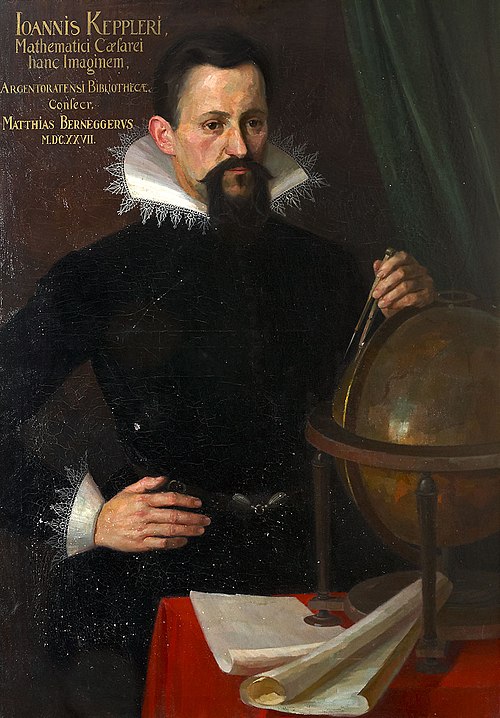
Johannes Kepler visits Tycho at Benátky and is employed as an assistant. Tycho assigns Kepler the task of analyzing the orbit of Mars, which leads to Kepler's first two laws of planetary motion. #astronomy #collaboration
Johannes Kepler Arrives as Assistant By August Köhler [1] - Kepler-Museum in Weil der Stadt, Public domain, https://commons.wikimedia.org/w/index.php?curid=9406242
1600 CE
Tensions with Kepler Over Data Access
A strained relationship develops between Tycho and Kepler, as Tycho is reluctant to share his full set of observations. Kepler eventually gains access to the Mars data, leading to revolutionary discoveries after Tycho's death. #history #conflict
Oct 24, 1601 CE
Death of Tycho Brahe in Prague
Tycho dies suddenly at the age of 54 after a brief illness, possibly from a burst bladder or kidney failure. Kepler inherits his observational data and uses them to formulate the laws of planetary motion. #history #science
Oct 1, 1601 CE
Tycho's Last Words and Legacy
According to legend, Tycho's last words are 'Ne frustra vixisse videar' (May I not seem to have lived in vain). He is buried in the Church of Our Lady before Týn in Prague. His observations become the foundation for Kepler's laws. #history #legacy