Traditional Asian Painting & Calligraphy: Gu Kaizhi to Song Landscape & Ukiyo-e Woodblocks
Encyclopedia/4. Arts & Literature/2. Visual Arts, Architecture & Design/02. Traditional Asian Painting & Calligraphy • Curated by Admin Timeline.sg
This timeline traces the evolution of traditional Asian painting and calligraphy from the 4th century to the 19th century, highlighting masterpieces from China and Japan including Wang Xizhi's running script, Tang figure paintings, Song Dynasty ink wash landscapes, and Ukiyo-e woodblock prints.
Chronological Storyline (41 Milestones)
303 CE
Birth of Wang Xizhi, Sage of Calligraphy
Wang Xizhi, revered as the greatest Chinese calligrapher, was born. His work, especially the Lantingji Xu, set the standard for running script calligraphy. #calligraphy #ChineseArt
Birth of Wang Xizhi, Sage of Calligraphy By Unknown Chinese artist - https://www.philamuseum.org/collection/object/42768, Public domain, https://commons.wikimedia.org/w/index.php?curid=148608240
353 CE
Lantingji Xu Composed by Wang Xizhi
Wang Xizhi wrote the Lantingji Xu (Preface to the Poems Composed at the Orchid Pavilion) during a gathering of literati. This masterpiece of running script calligraphy became the most celebrated work in Chinese calligraphy history. #calligraphy #ChineseArt
Lantingji Xu Composed by Wang Xizhi By Unknown author, Public domain, https://commons.wikimedia.org/w/index.php?curid=42348
400 CE
Gu Kaizhi Paints the Admonitions Scroll
The Chinese painter Gu Kaizhi created the Admonitions of the Instructress to the Court Ladies, a handscroll illustrating moral stories. It exemplifies early Chinese figure painting with refined linework. #ChineseArt #painting
Gu Kaizhi Paints the Admonitions Scroll By Gu Kaizhi - The Yorck Project (2002) 10.000 Meisterwerke der Malerei (DVD-ROM), distributed by DIRECTMEDIA Publishing GmbH. ISBN: 3936122202., Public domain, https://commons.wikimedia.org/w/index.php?curid=153581
618 CE
Tang Dynasty Established; Golden Age of Figure Painting Begins
The Tang dynasty (618–907) became a high point for Chinese figure painting, with artists like Yan Liben and Zhang Xuan capturing court life and Buddhist themes. #ChineseArt #TangDynasty
Tang Dynasty Established; Golden Age of Figure Painting Begins By Johnbod - Own work, CC BY-SA 3.0, https://commons.wikimedia.org/w/index.php?curid=27189761
630 CE
Yan Liben Paints the Thirteen Emperors Scroll
Yan Liben, a Tang court painter, created the Thirteen Emperors Scroll, depicting Chinese rulers from Han to Sui dynasties. It showcases Tang figure painting's emphasis on portraiture and moral didacticism. #ChineseArt #painting
Yan Liben Paints the Thirteen Emperors Scroll By Eugene a - Own work, Public domain, https://commons.wikimedia.org/w/index.php?curid=9974372
700 CE
Wu Daozi, 'Sage of Painting', Active
Wu Daozi, famed for his dynamic brushwork, created Buddhist murals and figure paintings. His style influenced generations, though few originals survive. #ChineseArt #painting
720 CE
Zhang Xuan Paints Court Ladies
Tang painter Zhang Xuan specialized in courtly scenes, notably 'Court Ladies Adorning Their Hair with Flowers'. His works influenced later Song dynasty figure painting. #ChineseArt #TangDynasty
Zhang Xuan Paints Court Ladies By Zhang Xuan - Richard M. Barnhart, Three Thousand Years of Chinese Painting, Yale University Press, 2002., Public domain, https://commons.wikimedia.org/w/index.php?curid=1115176
907 CE
Five Dynasties and Ten Kingdoms Period: Landscape Painting Emerges
After Tang's fall, landscape painting gained prominence. Artists like Jing Hao and Guan Tong developed monumental landscape styles, laying groundwork for Song ink wash. #ChineseArt #landscape
Five Dynasties and Ten Kingdoms Period: Landscape Painting Emerges By Huang Quan (903-965) - item 131479 (This is a higher-resolution version than the one that was uploaded at zh:写生珍禽图.jpg, Public domain, https://commons.wikimedia.org/w/index.php?curid=9450311
960 CE
Northern Song Dynasty Founded; Rise of Literati Painting
The Song dynasty (960–1279) became the era of literati painting (wenrenhua), emphasizing personal expression and ink wash landscapes over realistic depiction. #ChineseArt #SongDynasty
Northern Song Dynasty Founded; Rise of Literati Painting By Emperor Huizong of Song - File:Songhuizong8.jpg https://minghuaji.dpm.org.cn/paint/detail?id=na7xf64uvkwrsd5fj2z2ynzcek8iqtbb, Public domain, https://commons.wikimedia.org/w/index.php?curid=138799095
1000 CE
Fan Kuan Paints 'Travelers Among Mountains and Streams'
Fan Kuan, a Northern Song master, created this monumental hanging scroll, epitomizing the monumental landscape style with towering peaks and precise brushwork. #ChineseArt #landscape
1020 CE
Guo Xi Writes 'The Lofty Message of Forests and Streams'
Guo Xi, a Song landscape painter, authored this treatise on painting theory, advocating for 'three distances' in composition. His work 'Early Spring' exemplifies his atmospheric style. #ChineseArt #theory
Guo Xi Writes 'The Lofty Message of Forests and Streams' By Guo Xi - http://www.npm.gov.tw/en/collection/selections_02.htm?docno=48&catno=15, Public domain, https://commons.wikimedia.org/w/index.php?curid=7644391
1072 CE
Guo Xi Paints 'Early Spring'
Guo Xi's landscape 'Early Spring' displays his mastery of ink wash and atmospheric perspective, capturing the awakening of nature after winter. #ChineseArt #landscape )
1101 CE
Emperor Huizong, Patron of the Arts, Reigns
Huizong, a Song emperor and accomplished painter/calligrapher, promoted the Imperial Painting Academy and refined the 'slender gold' calligraphy style. #ChineseArt #calligraphy
Emperor Huizong, Patron of the Arts, Reigns By Unknown author - 宋徽宗坐像 軸. National Palace Museum Open Data. Taipei: National Palace Museum., Public domain, https://commons.wikimedia.org/w/index.php?curid=81745323
1127 CE
Southern Song Dynasty: Intimate Landscapes and Ma-Xia School
After the Jin invasion, Southern Song painters like Ma Yuan and Xia Gui developed 'one-corner' compositions with misty, lyrical landscapes. #ChineseArt #landscape
1190 CE
Ma Yuan Paints 'Walking on a Mountain Path in Spring'
Ma Yuan's album leaf exemplifies Southern Song style: a solitary figure amidst misty mountains, with minimal brushwork evoking vastness. #ChineseArt #landscape
1200 CE
Xia Gui Active; 'Pure and Remote Views of Streams and Mountains'
Xia Gui, along with Ma Yuan, defined the Ma-Xia school. His handscroll 'Pure and Remote Views' showcases bold ink washes and empty spaces. #ChineseArt #landscape
Xia Gui Active; 'Pure and Remote Views of Streams and Mountains' By Xia Gui - http://depts.washington.edu/chinaciv/painting/4ptgssla.htm, Fu Xinian, ed., Zhongguo meishu quanji, Huihua bian 4: Liang Song huihua, xia (Beijing: Wenwu chubanshe, 1988), pl. 78, p. 111., Public domain, https://commons.wikimedia.org/w/index.php?curid=3508167
1260 CE
Zen Buddhism Influences Ink Painting in Japan
Zen monks introduced Chinese ink wash painting (suiboku) to Japan, featuring spontaneous brushwork and minimalism. Artists like Sesshū later developed Japanese ink painting. #JapaneseArt #Zen
1279 CE
Fall of Song Dynasty; Rise of Yuan Literati Painting
Under Mongol rule, literati painters like Zhao Mengfu revived archaic styles and emphasized calligraphic brushwork in painting, influencing later Ming and Qing art. #ChineseArt #painting
1300 CE
Zhao Mengfu's 'Autumn Colors on the Qiao and Hua Mountains'
Zhao Mengfu's landscape deliberately uses antique styles, integrating calligraphy and painting. He advocated for 'painting with calligraphic lines' (shuhua tongyuan). #ChineseArt #calligraphy
Zhao Mengfu's 'Autumn Colors on the Qiao and Hua Mountains' By 楊叔謙繪 (Yang Shuqian) - "Annotation of Zhao Weigong's statue and Gong's self-book re-recotling Shangshu collection", album page, color setting, paper, longitudinal 27.5cm, horizontal 15.5cm., Public domain, https://commons.wikimedia.org/w/index.php?curid=79600952
1350 CE
Ni Zan, Master of Austere Landscapes, Active
Ni Zan, a Yuan literati painter, created sparse, dry ink landscapes with pavilions and distant mountains, epitomizing the 'lofty and remote' ideal. #ChineseArt #landscape
Ni Zan, Master of Austere Landscapes, Active By Unknown, Yuan Dynasty - National Palace Museum, Taipei、Yuan Four Masters, 1984, Public domain, https://commons.wikimedia.org/w/index.php?curid=56490589
1368 CE
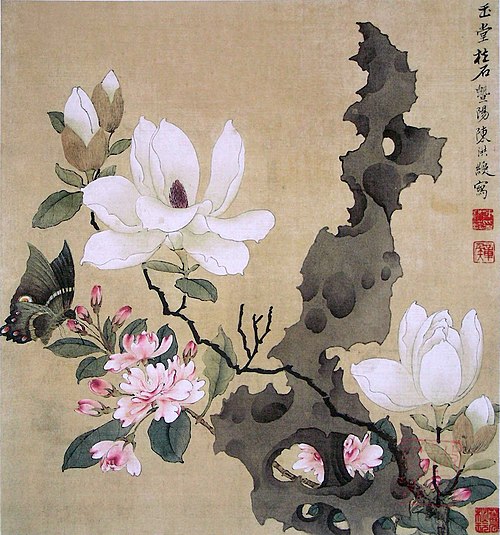
Ming Dynasty: Revival of Song Academic Painting and Zhe School
The Ming dynasty saw a revival of Song academic styles, with the Zhe School (e.g., Dai Jin) continuing the Ma-Xia tradition, while Wu School emphasized literati ideals. #ChineseArt #MingDynasty
Ming Dynasty: Revival of Song Academic Painting and Zhe School By Chen Hongshou - https://depts.washington.edu/chinaciv/home/3garplnt.htm#plnts, Zhongguo meishu quanji, Huihua bian 8: Mingdai huihua, xia (Beijing: Wenwu chubanshe, 1988), pl. 170, p. 191., Public domain, https://commons.wikimedia.org/w/index.php?curid=3508697
1400 CE
Sesshū Travels to China, Returns to Shape Japanese Ink Painting
Japanese monk-painter Sesshū studied Chinese painting in Ming China and upon return, developed a distinct Japanese style of ink wash, exemplified by 'Landscape of the Four Seasons'. #JapaneseArt #Zen
Sesshū Travels to China, Returns to Shape Japanese Ink Painting By 不詳 unknown - 雪舟<新潮日本美術文庫 1>, Public domain, https://commons.wikimedia.org/w/index.php?curid=6710708
1495 CE
Sesshū Paints 'Long Scroll of Landscapes'
Sesshū's masterpiece handscroll 'Long Scroll of Landscapes' (also known as 'Sansui Chokan') demonstrates his mastery of ink wash and Zen spontaneity. #JapaneseArt #landscape
1500 CE
Kano School Founded in Japan
The Kano school, established by Kano Masanobu, became the dominant style of Japanese painting for centuries, blending Chinese ink wash with Japanese decorative elements. #JapaneseArt #painting
Kano School Founded in Japan By Kano Eino (1631 - 1697) – Painter (Japan) Born in Kyoto. Died in Kyoto. Details on Google Art Project - HAH419XvUJ6XRw at Google Cultural Institute maximum zoom level, Public domain, https://commons.wikimedia.org/w/index.php?curid=21985534
Kano Eitoku, a leading Kano painter, developed bold, large-scale screen paintings (byobu) with gold leaf and vibrant colors, popular in castles. #JapaneseArt #painting
Kano Eitoku Creates Monumental Sliding Screen Paintings By Kanō Eitoku - https://emuseum.nich.go.jp/detail?content_base_id=100144, Public domain, https://commons.wikimedia.org/w/index.php?curid=145167040
1600 CE
Edo Period Begins; Rise of Ukiyo-e and Rinpa School
The Edo period (1603–1868) saw the flourishing of ukiyo-e woodblock prints and the Rinpa school, known for decorative, bold designs (e.g., Tawaraya Sōtatsu). #JapaneseArt #Ukiyoe
1620 CE
Tawaraya Sōtatsu Paints 'The Tale of Genji' Screens
Sōtatsu revived classical themes with vibrant colors and gold, influencing the Rinpa school. His work on 'The Tale of Genji' screens is iconic. #JapaneseArt #painting
1660 CE
Ogata Kōrin, Master of Rinpa, Active
Ogata Kōrin expanded Rinpa with bold compositions, like 'Irises' and 'Red and White Plum Blossoms', using gold backgrounds and rhythmic patterns. #JapaneseArt #Rinpa
1680 CE
Hishikawa Moronobu, Founder of Ukiyo-e, Active
Moronobu pioneered ukiyo-e woodblock prints, initially in monochrome, depicting Edo pleasure quarters and kabuki actors. #JapaneseArt #Ukiyoe
Hishikawa Moronobu, Founder of Ukiyo-e, Active By Hishikawa Moronobu - http://kyonan-info.jp/hishikawa/hishikawa/ 鋸南町, Public domain, https://commons.wikimedia.org/w/index.php?curid=68063749
Harunobu developed multi-color woodblock printing (nishiki-e), producing delicate prints of beautiful women (bijin-ga). #JapaneseArt #Ukiyoe
Suzuki Harunobu Popularizes Nishiki-e (Full-Color Prints) By Suzuki Harunobu - scan from a postcard, Public domain, https://commons.wikimedia.org/w/index.php?curid=18800664
1780 CE
Torii Kiyonaga Refines the Bijin-ga Genre
Torii Kiyonaga depicted elegant, tall figures of women in his ukiyo-e prints, influencing later artists like Utamaro. #JapaneseArt #Ukiyoe
Torii Kiyonaga Refines the Bijin-ga Genre By Torii Kiyonaga, 1752–1815 derivative work: Torsodog (talk) - Kiyonaga_bathhouse_women.jpg, Public domain, https://commons.wikimedia.org/w/index.php?curid=5875995
1790 CE
Kitagawa Utamaro Creates Sensual Bijin-ga Prints
Utamaro's close-up portraits of courtesans, like 'Ten Types of Women's Physiognomies', elevated bijin-ga to new heights of sensuality and composition. #JapaneseArt #Ukiyoe
Kitagawa Utamaro Creates Sensual Bijin-ga Prints By attributed to Chōbunsai Eishi (1756 - 1829) - British Museum - https://www.britishmuseum.org/collection/object/A_1913-0501-0-402, Public domain, https://commons.wikimedia.org/w/index.php?curid=115353167
1800 CE
Tōshūsai Sharaku's Mysterious Actor Portraits
Sharaku produced striking, oversized portraits of kabuki actors with exaggerated expressions, only active for a brief period around 1794–95. #JapaneseArt #Ukiyoe
Tōshūsai Sharaku's Mysterious Actor Portraits By Sharaku - Metropolitan Museum of Art, Public domain, https://commons.wikimedia.org/w/index.php?curid=119732
1814 CE
Katsushika Hokusai Begins 'Thirty-six Views of Mount Fuji'
Hokusai's series, including 'The Great Wave off Kanagawa', revolutionized landscape ukiyo-e and influenced Western art. #JapaneseArt #Ukiyoe
Katsushika Hokusai Begins 'Thirty-six Views of Mount Fuji' By After Katsushika Hokusai - Restored version of File:Great Wave off Kanagawa.jpg (rotated and cropped, dirt, stains, and smudges removed. Creases corrected. Histogram adjusted and color balanced.), Public domain, https://commons.wikimedia.org/w/index.php?curid=5576388
1831 CE
Hokusai Publishes 'The Great Wave off Kanagawa'
Hokusai's iconic print, part of the 'Thirty-six Views' series, depicts a towering wave with Mount Fuji in the background. It became the most famous Japanese artwork globally. #JapaneseArt #Ukiyoe
Hokusai Publishes 'The Great Wave off Kanagawa' By Katsushika Hokusai - Metropolitan Museum of Art: entry 45434, Public domain, https://commons.wikimedia.org/w/index.php?curid=2798407
1832 CE
Utagawa Hiroshige Starts 'The Fifty-three Stations of the Tōkaidō'
Hiroshige's series of landscape prints along the Tōkaidō road captured seasonal scenes and weather, influencing later Impressionists. #JapaneseArt #Ukiyoe
1835 CE
Hiroshige Paints 'One Hundred Famous Views of Edo' (Start)
Hiroshige's later series 'One Hundred Famous Views of Edo' depicted Tokyo scenes with innovative perspectives. #JapaneseArt #Ukiyoe
Hiroshige Paints 'One Hundred Famous Views of Edo' (Start) By Utagawa; Hiroshige (I) , Utagawa died 1858; Uoya Eikichi Hiroshige (I) - http://www.rijksmuseum.nl/collectie/RP-P-1956-743 (handle), Public domain, https://commons.wikimedia.org/w/index.php?curid=33364940
1856 CE
Hiroshige's 'Sudden Shower over Shin-Ōhashi Bridge and Atake'
This print from 'One Hundred Famous Views of Edo' uses vertical rain and bold composition, showcasing Hiroshige's mastery of atmosphere. #JapaneseArt #Ukiyoe
1867 CE
Japanese Woodblock Prints Shown at Paris Exposition
Ukiyo-e prints were exhibited at the 1867 Paris Exposition, sparking Japonism and influencing Western artists like Monet and Van Gogh. #JapaneseArt #Ukiyoe #Japonism
Japanese Woodblock Prints Shown at Paris Exposition By James Tissot - Unknown source, Public domain, https://commons.wikimedia.org/w/index.php?curid=2562522
1880 CE
Ukiyo-e Declines with Meiji Restoration; Shin-hanga Movement Begins
As Japan modernized, traditional ukiyo-e waned, but the shin-hanga (new prints) movement later revived it, focusing on landscapes and beauties. #JapaneseArt #Ukiyoe
Ukiyo-e Declines with Meiji Restoration; Shin-hanga Movement Begins By Goyō Hashiguchi - Library of Congress, Public domain, https://commons.wikimedia.org/w/index.php?curid=34604819
1885 CE
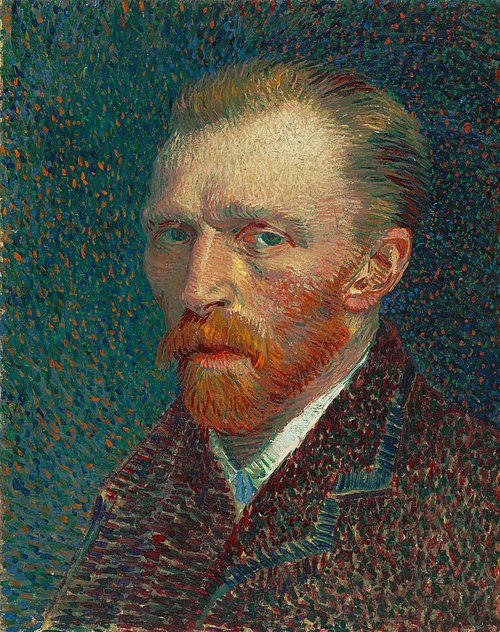
Vincent van Gogh Paints Copies of Japanese Prints
Van Gogh created oil copies of Hiroshige's prints, like 'The Bridge in the Rain', incorporating ukiyo-e aesthetic into his work. #WesternArt #Japonism
Vincent van Gogh Paints Copies of Japanese Prints By Vincent van Gogh - Google Arts & Culture — mwF3N6F_RfJ4_w, Public domain, https://commons.wikimedia.org/w/index.php?curid=21977797