Encyclopedia/1. The Cosmos & The Natural World/2. Physics & Chemistry • Curated by Admin Timeline.sg
This timeline traces the seminal contributions and legacies of leading figures in Thermodynamics & Statistical Mechanics, from ancient heat concepts to modern quantum thermodynamics, highlighting key milestones such as the Carnot cycle, laws of thermodynamics, Boltzmann entropy, Gibbs free energy, and cryogenics.
Chronological Storyline (46 Milestones)
250 BCE
Philo of Byzantium Describes Thermal Expansion
Philo of Byzantium describes the expansion of air when heated, an early observation of thermal effects. #physics #history
1600 CE
Galileo Galilei Builds Early Thermoscope
Galileo Galilei constructs a thermoscope, an early device indicating temperature changes, laying groundwork for thermometry. #physics #invention
Galileo Galilei Builds Early Thermoscope By Justus Sustermans - http://collections.rmg.co.uk/collections/objects/14174, Public domain, https://commons.wikimedia.org/w/index.php?curid=62614082
1650 CE
Otto von Guericke Invents Vacuum Pump
Otto von Guericke invents the vacuum pump, enabling experiments on pressure and heat, foundational for thermodynamics. #physics #invention
Otto von Guericke Invents Vacuum Pump By Anselm van Hulle / Cornelis Galle the Younger - Peace Palace Library, Public domain, https://commons.wikimedia.org/w/index.php?curid=32798824
1662 CE
Robert Boyle Formulates Boyle's Law
Robert Boyle publishes Boyle's Law, relating pressure and volume of a gas at constant temperature, a key gas law. #physics #science
Robert Boyle Formulates Boyle's Law By Johann Kerseboom - https://digital.sciencehistory.org/works/3r074v879, Public domain, https://commons.wikimedia.org/w/index.php?curid=27091904
1697 CE
Guillaume Amontons Studies Friction and Heat
Guillaume Amontons investigates friction and heat, contributing to early understanding of thermal phenomena. #physics #history
Guillaume Amontons Studies Friction and Heat By Émile Deschamps - https://images.fineartamerica.com/images-medium-large-5/amontons-and-optical-telegraphy-science-photo-library.jpg Original source: Figuier, Louis (1867-1891). Les Merveilles de la science: Ou description populaire des inventions modernes (Vol. 2). (6 volumes). Jouvet, & Cie (eds.). Librairie Furne., Public domain, https://commons.wikimedia.org/w/index.php?curid=101247756
1702 CE
Amontons Invents Air Thermometer
Guillaume Amontons invents an air thermometer based on gas pressure, improving temperature measurement. #physics #invention
1738 CE
Daniel Bernoulli Proposes Kinetic Theory of Gases
Daniel Bernoulli publishes Hydrodynamica, proposing that gas pressure results from molecular collisions, an early kinetic theory. #physics #science
Daniel Bernoulli Proposes Kinetic Theory of Gases By UnknownEdited by Bammesk - Basel Historical Museum Link: https://www.hmb.ch/en/museums/objects-in-the-collection/details/s/portraet-des-daniel-bernoulli/, CC BY-SA 4.0, https://commons.wikimedia.org/w/index.php?curid=114825929
1742 CE
Anders Celsius Proposes Centigrade Scale
Anders Celsius proposes the centigrade temperature scale, later named Celsius, standardizing temperature measurement. #physics #invention
Anders Celsius Proposes Centigrade Scale By Olof Arenius - https://richardnilsendotcom1.files.wordpress.com/2013/03/anders_celsius.jpg as thumbnailed by https://richardnilsen.com/2013/03/18/the-measure-of-humankind/, Public domain, https://commons.wikimedia.org/w/index.php?curid=60390366
1761 CE
Joseph Black Discovers Latent Heat
Joseph Black discovers latent heat and specific heat, concepts crucial for understanding heat transfer and calorimetry. #physics #science
Joseph Black Discovers Latent Heat By Rogers, J - http://ihm.nlm.nih.gov/images/B02979, Public domain, https://commons.wikimedia.org/w/index.php?curid=19132802
1798 CE
Count Rumford Demonstrates Heat as Motion
Benjamin Thompson (Count Rumford) shows that heat is generated by friction, challenging the caloric theory. #physics #science
Count Rumford Demonstrates Heat as Motion By After Moritz Kellerhoven - one or more third parties have made copyright claims against Wikimedia Commons in relation to the work from which this is sourced or a purely mechanical reproduction thereof. This may be due to recognition of the "sweat of the brow" doctrine, allowing works to be eligible for protection through skill and labour, and not purely by originality as is the case in the United States (where this website is hosted). These claims may or may not be valid in all jurisdictions. As such, use of this image in the jurisdiction of the claimant or other countries may be regarded as copyright infringement. Please see Commons:When to use the PD-Art tag for more information., Public domain, https://commons.wikimedia.org/w/index.php?curid=6364360
1824 CE
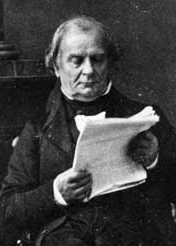
Sadi Carnot Publishes Reflections on the Motive Power of Fire
Sadi Carnot analyzes the efficiency of heat engines, introducing the Carnot cycle and laying foundations for the second law of thermodynamics. #physics #thermodynamics
1834 CE
Émile Clapeyron Reformulates Carnot's Work
Émile Clapeyron presents Carnot's ideas mathematically, introducing the Clapeyron equation and PV diagrams. #physics #thermodynamics
Émile Clapeyron Reformulates Carnot's Work By (Unknown) - http://www.annales.org/archives/x/clapeyron.html, Public domain, https://commons.wikimedia.org/w/index.php?curid=42737840
1840 CE
Germain Hess Formulates Hess's Law
Germain Hess states that the total enthalpy change in a chemical reaction is independent of the pathway, a precursor to the first law. #chemistry #thermodynamics
Germain Hess Formulates Hess's Law By Литография П. А. Смирнова - История Академии наук СССР. — М.−Л. : Наука, 1964. — Т. 2. — С. 129., Public domain, https://commons.wikimedia.org/w/index.php?curid=3534946
1842 CE
Julius Robert von Mayer States Conservation of Energy
Julius Robert von Mayer proposes the conservation of energy, relating heat and work, a key step toward the first law of thermodynamics. #physics #science
Julius Robert von Mayer States Conservation of Energy By Friedrich Berrer - taken from https://www.booksandthings.co.uk/Prints/meyer.php and cropped, Public domain, https://commons.wikimedia.org/w/index.php?curid=132081454
1843 CE
James Prescott Joule Measures Mechanical Equivalent of Heat
James Prescott Joule performs experiments establishing the mechanical equivalent of heat, confirming energy conservation. #physics #science
James Prescott Joule Measures Mechanical Equivalent of Heat By Henry Roscoe - The Life & Experiences of Sir Henry Enfield Roscoe (Macmillan: London and New York), p. 120, Public domain, https://commons.wikimedia.org/w/index.php?curid=3119134
1848 CE
Lord Kelvin Proposes Absolute Temperature Scale
William Thomson (Lord Kelvin) proposes the absolute temperature scale (Kelvin), based on Carnot's work. #physics #thermodynamics
Lord Kelvin Proposes Absolute Temperature Scale By T. & R. Annan & Sons; restored by Adam Cuerden[1] - National Galleries of Scotland Accession number: PGP 230.1, Public domain, https://commons.wikimedia.org/w/index.php?curid=141105716
1850 CE
Rudolf Clausius Formulates Second Law of Thermodynamics
Rudolf Clausius states the second law of thermodynamics: heat cannot spontaneously flow from cold to hot. #physics #thermodynamics
Rudolf Clausius Formulates Second Law of Thermodynamics By Picture taken by Theo Schafgans (1859–1907), Bonn; heliogravüre by Meisenbach, Riffarth & Co. Berlin. Scanned, image processed and uploaded by Kuebi = Armin Kübelbeck - Zeitschrift für Physikalische Chemie, Band 21, von 1896, Public domain, https://commons.wikimedia.org/w/index.php?curid=12026179
1854 CE
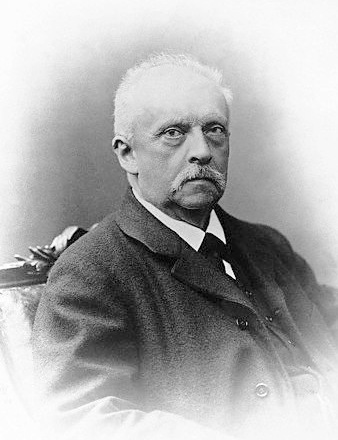
Hermann von Helmholtz on Conservation of Energy
Hermann von Helmholtz publishes a comprehensive formulation of the conservation of energy, influencing thermodynamics. #physics #science
Hermann von Helmholtz on Conservation of Energy By Unknown author, Public domain, https://commons.wikimedia.org/w/index.php?curid=74569
1856 CE
August Krönig Develops Kinetic Theory
August Krönig publishes a basic kinetic theory of gases, relating pressure to molecular motion. #physics #science
1857 CE
Rudolf Clausius Refines Kinetic Theory
Rudolf Clausius develops the kinetic theory of gases, introducing mean free path and molecular speeds. #physics #science
1859 CE
James Clerk Maxwell Derives Velocity Distribution
James Clerk Maxwell derives the Maxwell-Boltzmann distribution for molecular speeds in a gas. #physics #statisticalmechanics
James Clerk Maxwell Derives Velocity Distribution By Unknown author - https://www.researchgate.net/figure/James-Clerk-Maxwell-1831-1879_fig1_360164096, Public domain, https://commons.wikimedia.org/w/index.php?curid=129476608
1865 CE
Rudolf Clausius Coins Term 'Entropy'
Rudolf Clausius introduces the concept of entropy and coins the term, formulating the second law as entropy increase. #physics #thermodynamics
1872 CE
Ludwig Boltzmann Formulates H-Theorem
Ludwig Boltzmann publishes the H-theorem, providing a statistical basis for the second law of thermodynamics. #physics #statisticalmechanics
Ludwig Boltzmann Formulates H-Theorem By Unknown author - A version is at Uni Frankfurt. The new source is not linked, but note I did clean up some water damage at the edges., Public domain, https://commons.wikimedia.org/w/index.php?curid=865671
1873 CE
Johannes Diderik van der Waals Introduces Equation of State
Johannes Diderik van der Waals proposes an equation of state accounting for molecular size and attraction, explaining real gas behavior. #physics #chemistry
Johannes Diderik van der Waals Introduces Equation of State By Unknown author - Copied from w:Image:Johannes Diderik van der Waals.jpg, originally from here., Public domain, https://commons.wikimedia.org/w/index.php?curid=68283
1876 CE
Josiah Willard Gibbs Publishes On the Equilibrium of Heterogeneous Substances
Josiah Willard Gibbs publishes his seminal work on chemical thermodynamics, introducing Gibbs free energy and phase rule. #chemistry #thermodynamics
Josiah Willard Gibbs Publishes On the Equilibrium of Heterogeneous Substances By Unknown. Uploaded by Serge Lachinov (обработка для wiki) - Frontispiece of The Scientific Papers of J. Willard Gibbs, in two volumes, eds. H. A. Bumstead and R. G. Van Name, (London and New York: Longmans, Green, and Co., 1906), Public domain, https://commons.wikimedia.org/w/index.php?curid=7919387
1877 CE
Ludwig Boltzmann Relates Entropy to Probability
Ludwig Boltzmann formulates the statistical definition of entropy (S = k log W), linking thermodynamics to probability. #physics #statisticalmechanics
Svante Arrhenius presents his theory of electrolytic dissociation, applying thermodynamic concepts to solutions. #chemistry #science
Svante Arrhenius Proposes Electrolytic Dissociation By Photogravure Meisenbach Riffarth & Co. Leipzig. - Zeitschrift für Physikalische Chemie, Band 69, 1909., Public domain, https://commons.wikimedia.org/w/index.php?curid=96273
1889 CE
Walther Nernst Develops Nernst Equation
Walther Nernst derives the Nernst equation relating electrochemical potential to concentration, based on thermodynamics. #chemistry #physics
Walther Nernst Develops Nernst Equation By Unknown (Mondadori Publishers) - http://www.gettyimages.co.uk/detail/news-photo/portrait-of-the-german-chemist-and-physicist-walter-hermann-news-photo/141553142, Public domain, https://commons.wikimedia.org/w/index.php?curid=41260080
1893 CE
Wilhelm Wien Derives Wien's Displacement Law
Wilhelm Wien formulates Wien's displacement law for blackbody radiation, linking temperature and peak wavelength. #physics #thermodynamics
Wilhelm Wien Derives Wien's Displacement Law By Unknown author, Public domain, https://commons.wikimedia.org/w/index.php?curid=624094
1900 CE
Max Planck Introduces Quantum of Action
Max Planck proposes the quantum of action (Planck constant) to explain blackbody radiation, founding quantum theory and impacting statistical mechanics. #physics #quantum
Max Planck Introduces Quantum of Action By Hugo Erfurth - This file was derived from: Max Planck by Hugo Erfurth 1938cr.jpg Original source: https://www.dhm.de/lemo/bestand/objekt/max-planck, Public domain, https://commons.wikimedia.org/w/index.php?curid=153625300
1902 CE
Josiah Willard Gibbs Publishes Elementary Principles in Statistical Mechanics
Gibbs publishes his book on statistical mechanics, establishing the ensemble formalism and phase space concepts. #physics #statisticalmechanics
1905 CE
Albert Einstein Explains Brownian Motion
Albert Einstein publishes a paper on Brownian motion, providing evidence for atoms and linking statistical mechanics to observable phenomena. #physics #science
Albert Einstein Explains Brownian Motion By Orren Jack Turner - This image is available from the United States Library of Congress's Prints and Photographs division under the digital ID cph.3b46036.This tag does not indicate the copyright status of the attached work. A normal copyright tag is still required. See Commons:Licensing., Public domain, https://commons.wikimedia.org/w/index.php?curid=6372844
1906 CE
Walther Nernst States Third Law of Thermodynamics
Walther Nernst proposes the third law of thermodynamics: entropy approaches a constant as temperature approaches absolute zero. #physics #thermodynamics
Heike Kamerlingh Onnes discovers superconductivity in mercury at cryogenic temperatures, advancing low-temperature thermodynamics. #physics #cryogenics
Heike Kamerlingh Onnes Discovers Superconductivity By Unknown author - http://www.kb.nl/hkc/nobel/onnes/onnes.html . Further source: (cropped to 600×800), Museum Boerhaave, http://www.museumboerhaave.nl/contact/pers2a.html, Copyrighted free use, https://commons.wikimedia.org/w/index.php?curid=879737
1912 CE
Peter Debye Develops Debye Model for Specific Heat
Peter Debye introduces the Debye model for specific heat of solids, incorporating quantum effects and statistical mechanics. #physics #science
Peter Debye Develops Debye Model for Specific Heat By Unknown author - http://chem.ch.huji.ac.il/~eugeniik/history/debye.html, Public domain, https://commons.wikimedia.org/w/index.php?curid=1083819
1924 CE
Satyendra Nath Bose and Albert Einstein Propose Bose-Einstein Statistics
Satyendra Nath Bose sends his paper on photon statistics to Einstein, leading to Bose-Einstein statistics and condensation. #physics #quantum
Satyendra Nath Bose and Albert Einstein Propose Bose-Einstein Statistics By Unknown author - Picture in Siliconeer, Public domain, https://commons.wikimedia.org/w/index.php?curid=2201891
1925 CE
Enrico Fermi and Paul Dirac Formulate Fermi-Dirac Statistics
Enrico Fermi and Paul Dirac independently develop Fermi-Dirac statistics for particles obeying the Pauli exclusion principle. #physics #quantum
Enrico Fermi and Paul Dirac Formulate Fermi-Dirac Statistics By Department of Energy-Office of Public Affairs, restored by Yann - This tag does not indicate the copyright status of the attached work. A normal copyright tag is still required. See Commons:Licensing., Public domain, https://commons.wikimedia.org/w/index.php?curid=156854
1927 CE
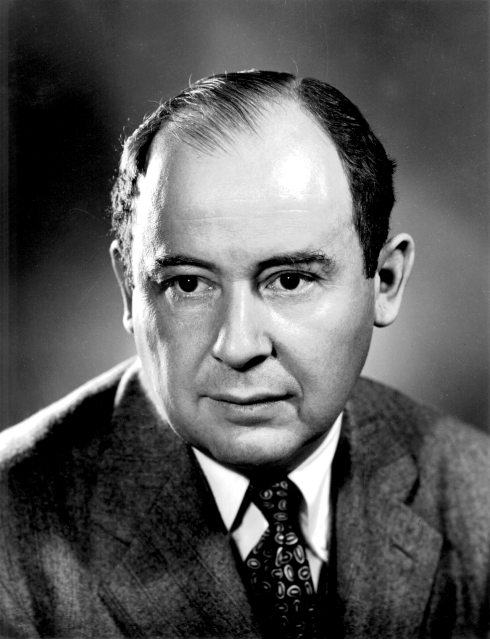
John von Neumann Develops Quantum Statistical Mechanics
John von Neumann publishes foundational work on quantum statistical mechanics, including the density matrix formalism. #physics #quantum
John von Neumann Develops Quantum Statistical Mechanics By LANL - http://www.lanl.gov/history/atomicbomb/images/NeumannL.GIF (archive copy at the Wayback Machine), Attribution, https://commons.wikimedia.org/w/index.php?curid=3429594
1931 CE
Lars Onsager Publishes Reciprocal Relations
Lars Onsager derives the reciprocal relations for irreversible processes, extending thermodynamics to non-equilibrium systems. #physics #thermodynamics
1937 CE
Pyotr Kapitsa Discovers Superfluidity in Helium-4
Pyotr Kapitsa observes superfluidity in liquid helium-4, a quantum phenomenon at low temperatures. #physics #cryogenics
Pyotr Kapitsa Discovers Superfluidity in Helium-4 By Unknown (Mondadori Publishers) - http://www.gettyimages.co.uk/detail/news-photo/portrait-of-the-russian-physicist-pjotr-kapitza-1930s-news-photo/141551184, Public domain, https://commons.wikimedia.org/w/index.php?curid=41222835
1944 CE
Lars Onsager Solves 2D Ising Model
Lars Onsager publishes the exact solution of the two-dimensional Ising model, a milestone in statistical mechanics. #physics #statisticalmechanics
1948 CE
Claude Shannon Publishes Mathematical Theory of Communication
Claude Shannon introduces information entropy, linking thermodynamics to information theory. #mathematics #physics
Claude Shannon Publishes Mathematical Theory of Communication By Unknown author - Tekniska Museet of Sweden, Item 43069 via Flickr, CC BY 2.0, https://commons.wikimedia.org/w/index.php?curid=190273293
1957 CE
John Bardeen, Leon Cooper, and Robert Schrieffer Propose BCS Theory
Bardeen, Cooper, and Schrieffer develop the BCS theory of superconductivity, explaining it via electron pairing and statistical mechanics. #physics #science
John Bardeen, Leon Cooper, and Robert Schrieffer Propose BCS Theory By Unknown author, CC BY-SA 2.5, https://commons.wikimedia.org/w/index.php?curid=657868
1972 CE
Kenneth Wilson Develops Renormalization Group
Kenneth Wilson applies renormalization group methods to critical phenomena, revolutionizing statistical mechanics. #physics #science
1995 CE
Eric Cornell and Carl Wieman Create Bose-Einstein Condensate
Eric Cornell and Carl Wieman produce the first Bose-Einstein condensate in rubidium gas, confirming a key prediction of quantum statistical mechanics. #physics #science
Eric Cornell and Carl Wieman Create Bose-Einstein Condensate By Vectorized version by AG Caesar, original by DG85 - Inspired by a work from Wikipedia User DG85 https://commons.wikimedia.org/wiki/File:QuantumPhaseTransition.png, Public domain, https://commons.wikimedia.org/w/index.php?curid=67110336
2012 CE
Gavin Crooks Develops Fluctuation Theorems
Gavin Crooks and others develop fluctuation theorems, extending thermodynamics to small systems and non-equilibrium processes. #physics #thermodynamics