Encyclopedia/1. The Cosmos & The Natural World/2. Physics & Chemistry/04. Thermodynamics & Statistical Mechanics • Curated by Admin Timeline.sg
A timeline of key milestones in thermodynamics and entropy, from Carnot's heat engine to Shannon's information entropy, covering a century of development.
Chronological Storyline (37 Milestones)
1824 CE
Carnot publishes 'Reflections on the Motive Power of Fire'
Sadi Carnot introduces the concept of the heat engine cycle and efficiency, laying the foundation for thermodynamics. )
1834 CE
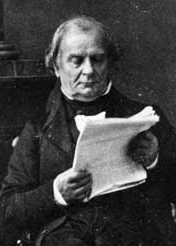
Clapeyron reformulates Carnot's cycle
Benoît Clapeyron presents Carnot's ideas in a graphical form, introducing the Clapeyron equation.
Clapeyron reformulates Carnot's cycle By (Unknown) - http://www.annales.org/archives/x/clapeyron.html, Public domain, https://commons.wikimedia.org/w/index.php?curid=42737840
1840 CE
Hess's law of heat summation
Germain Hess states that the total heat change in a chemical reaction is independent of the pathway.
Hess's law of heat summation By Wolfmankurd at English Wikipedia - Transferred from en.wikipedia to Commons., Public domain, https://commons.wikimedia.org/w/index.php?curid=1982170
1842 CE
Mayer states conservation of energy
Julius Robert von Mayer proposes the mechanical equivalent of heat and the conservation of energy, a precursor to the first law.
Mayer states conservation of energy By Friedrich Berrer - taken from https://www.booksandthings.co.uk/Prints/meyer.php and cropped, Public domain, https://commons.wikimedia.org/w/index.php?curid=132081454
1843 CE
Joule measures mechanical equivalent of heat
James Prescott Joule publishes his experiments establishing the quantitative relationship between work and heat.
Joule measures mechanical equivalent of heat By Henry Roscoe - The Life & Experiences of Sir Henry Enfield Roscoe (Macmillan: London and New York), p. 120, Public domain, https://commons.wikimedia.org/w/index.php?curid=3119134
1848 CE
Kelvin proposes absolute temperature scale
William Thomson (Lord Kelvin) defines the absolute temperature scale independent of substance properties.
Kelvin proposes absolute temperature scale By T. & R. Annan & Sons; restored by Adam Cuerden[1] - National Galleries of Scotland Accession number: PGP 230.1, Public domain, https://commons.wikimedia.org/w/index.php?curid=141105716
1850 CE
Clausius states the second law of thermodynamics
Rudolf Clausius states that heat cannot spontaneously pass from a colder to a hotter body.
Clausius states the second law of thermodynamics By Picture taken by Theo Schafgans (1859–1907), Bonn; heliogravüre by Meisenbach, Riffarth & Co. Berlin. Scanned, image processed and uploaded by Kuebi = Armin Kübelbeck - Zeitschrift für Physikalische Chemie, Band 21, von 1896, Public domain, https://commons.wikimedia.org/w/index.php?curid=12026179
1851 CE
Kelvin's statement of the second law
Lord Kelvin offers a complementary formulation: it is impossible to convert heat completely into work without other changes.
1852 CE
Joule-Thomson effect discovered
Joule and Kelvin discover that a gas cools when expanding without doing work, crucial for liquefaction.
1854 CE
Clausius introduces the concept of entropy
Clausius coins the term 'entropy' (from Greek for 'transformation') and formulates the first and second laws compactly.
1859 CE
Maxwell's kinetic theory of gases
James Clerk Maxwell publishes his dynamical theory of gases, deriving the distribution of molecular speeds.
Maxwell's kinetic theory of gases By Unknown author - https://www.researchgate.net/figure/James-Clerk-Maxwell-1831-1879_fig1_360164096, Public domain, https://commons.wikimedia.org/w/index.php?curid=129476608
1865 CE
Clausius coins the word 'entropy'
Rudolf Clausius introduces the term entropy and states 'the energy of the universe is constant; the entropy tends to a maximum.' )
1866 CE
Boltzmann's kinetic theory of entropy
Ludwig Boltzmann publishes his first paper linking entropy to molecular motion, extending Maxwell's work.
Boltzmann's kinetic theory of entropy By Unknown author - A version is at Uni Frankfurt. The new source is not linked, but note I did clean up some water damage at the edges., Public domain, https://commons.wikimedia.org/w/index.php?curid=865671
1872 CE
Boltzmann's H-theorem
Ludwig Boltzmann derives the H-theorem, showing that entropy tends to increase from a statistical perspective.
1873 CE
Gibbs introduces graphical thermodynamics
Josiah Willard Gibbs publishes his first paper on the geometric representation of thermodynamic quantities.
Gibbs introduces graphical thermodynamics By Unknown. Uploaded by Serge Lachinov (обработка для wiki) - Frontispiece of The Scientific Papers of J. Willard Gibbs, in two volumes, eds. H. A. Bumstead and R. G. Van Name, (London and New York: Longmans, Green, and Co., 1906), Public domain, https://commons.wikimedia.org/w/index.php?curid=7919387
1876 CE
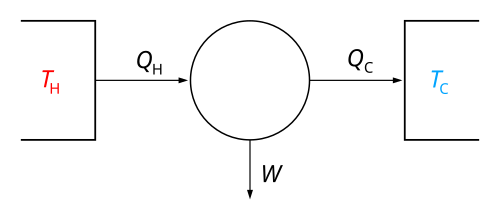
Gibbs publishes 'On the Equilibrium of Heterogeneous Substances'
Gibbs formulates the phase rule, chemical potential, and conditions for equilibrium, founding chemical thermodynamics.
Gibbs publishes 'On the Equilibrium of Heterogeneous Substances' By Eric Gaba (Sting - fr:Sting) - Own workBased upon Image:Carnot-engine.png, Public domain, https://commons.wikimedia.org/w/index.php?curid=1382360
1877 CE
Boltzmann's entropy formula S = k log W
Boltzmann connects entropy to the number of microstates, giving a statistical interpretation of the second law.
Boltzmann's entropy formula S = k log W By User:Daderot http://en.wikipedia.org/wiki/User:Daderot - http://en.wikipedia.org/wiki/Image:Zentralfriedhof_Vienna_-_Boltzmann.JPG, CC BY-SA 3.0, https://commons.wikimedia.org/w/index.php?curid=12009481
1883 CE
Andrews identifies critical point of CO₂
Thomas Andrews experimentally determines the critical temperature and pressure of carbon dioxide. )
Andrews identifies critical point of CO₂ By Peter Guthrie Tait and Alexander Crum Brown - Frontispiece of The Scientific Papers of the Late Thomas Andrews, Public domain, https://commons.wikimedia.org/w/index.php?curid=5736169
1884 CE
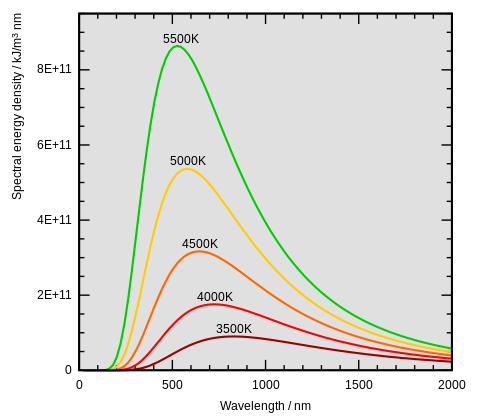
Stefan-Boltzmann law
Josef Stefan empirically and Ludwig Boltzmann theoretically derive the total blackbody radiation law: energy ∝ T⁴.
Stefan-Boltzmann law By Netheril96 - Own work, CC BY-SA 3.0, https://commons.wikimedia.org/w/index.php?curid=15700504
1889 CE
Nernst heat theorem
Walther Nernst proposes that as temperature approaches zero, entropy changes for reactions approach zero, precursor to third law.
1893 CE
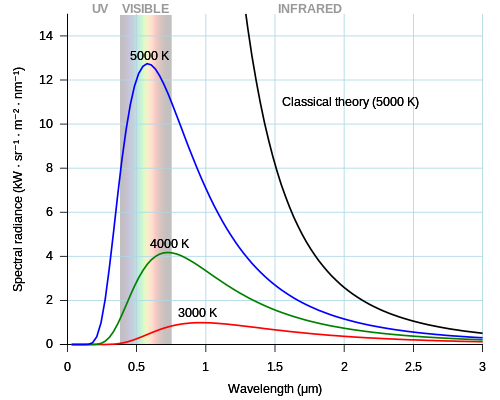
Wien's displacement law
Wilhelm Wien shows that the peak wavelength of blackbody radiation is inversely proportional to temperature.
Wien's displacement law By 4C - Own work based on JPG version Curva Planck TT.jpg, CC BY-SA 3.0, https://commons.wikimedia.org/w/index.php?curid=1017820
Dec 14, 1900 CE
Planck's quantum hypothesis
Max Planck introduces energy quanta to derive the correct blackbody spectrum, initiating quantum theory and linking to entropy.
Planck's quantum hypothesis By Darth Kule - Own work, Public domain, https://commons.wikimedia.org/w/index.php?curid=10555337
1902 CE
Gibbs publishes 'Elementary Principles in Statistical Mechanics'
J. Willard Gibbs develops the ensemble approach, founding modern statistical mechanics.
Gibbs publishes 'Elementary Principles in Statistical Mechanics' By J. Willard Gibbs - Library of the University of California, Public domain, https://commons.wikimedia.org/w/index.php?curid=18570388
1905 CE
Einstein explains Brownian motion
Albert Einstein uses statistical mechanics to derive the diffusion of particles, confirming atomic theory.
Einstein explains Brownian motion By Toshiyouri - Own work, CC BY-SA 4.0, https://commons.wikimedia.org/w/index.php?curid=69356582
1906 CE
Nernst states third law of thermodynamics
Walther Nernst formulates the third law: absolute zero is unattainable in finite steps.
1912 CE
von Laue's proof of third law
Max von Laue shows that the third law implies a zero entropy change at absolute zero.
von Laue's proof of third law By Nobel foundation - http://nobelprize.org/nobel_prizes/physics/laureates/1914/laue-bio.html, Public domain, https://commons.wikimedia.org/w/index.php?curid=6201194
1916 CE
Einstein's quantum theory of radiation
Einstein derives Planck's law using A and B coefficients, introducing stimulated emission.
Einstein's quantum theory of radiation By User:Jhausauer - Author, Public domain, https://commons.wikimedia.org/w/index.php?curid=13358404
1920 CE
Saha ionization equation
Meghnad Saha uses statistical mechanics to relate ionization state to temperature and pressure, crucial for astrophysics.
1924 CE
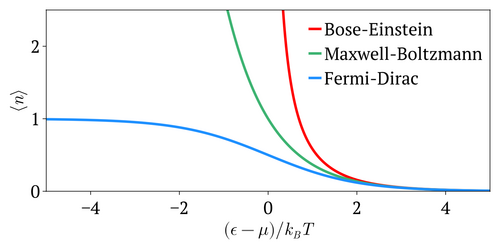
Bose-Einstein statistics
Satyendra Nath Bose and Albert Einstein develop quantum statistics for identical bosons.
Bose-Einstein statistics By Ashton Bradley Aspir8 (talk) - Own work based on: Fermi-Dirac Bose-Einstein Maxwell-Boltzmann statistics.svg, CC0, https://commons.wikimedia.org/w/index.php?curid=149697440
1925 CE
Fermi-Dirac statistics
Enrico Fermi and Paul Dirac derive the statistics for fermions, essential for electron behavior in solids.
1929 CE
Onsager reciprocal relations
Lars Onsager publishes the reciprocal relations for irreversible processes, a cornerstone of non-equilibrium thermodynamics.
1931 CE
Onsager receives Nobel Prize (later)
Onsager proves the reciprocity theorem for coupled flows, expanding thermodynamic theory.
1933 CE
Giauque's paramagnetic cooling
William Giauque uses adiabatic demagnetization to reach temperatures near absolute zero.
Giauque's paramagnetic cooling By The Nobel Foundation - http://www.nobelprize.org/nobel_prizes/chemistry/laureates/1949/, PD-Sweden, https://en.wikipedia.org/w/index.php?curid=34665816
1937 CE
Statistical mechanics of liquids by Kirkwood
John G. Kirkwood develops integral equation theories for liquid structure.
1938 CE
Kapitsa discovers superfluidity
Pyotr Kapitsa observes the frictionless flow of liquid helium-4 below 2.17 K.
Kapitsa discovers superfluidity By Unknown (Mondadori Publishers) - http://www.gettyimages.co.uk/detail/news-photo/portrait-of-the-russian-physicist-pjotr-kapitza-1930s-news-photo/141551184, Public domain, https://commons.wikimedia.org/w/index.php?curid=41222835
1944 CE
Schrödinger's 'What is Life?'
Erwin Schrödinger introduces the concept of negentropy to explain how living organisms maintain order.
1948 CE
Shannon's information entropy
Claude Shannon publishes 'A Mathematical Theory of Communication', linking entropy to information content.