The Standard Model of Particle Physics: Quarks, Leptons & Higgs Boson
Encyclopedia/1. The Cosmos & The Natural World/2. Physics & Chemistry/01. Quantum Physics & Atomic Theory • Curated by Admin Timeline.sg
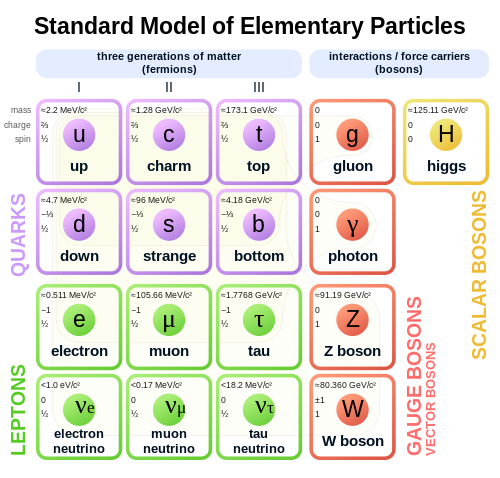
The Standard Model of particle physics describes the fundamental particles (quarks, leptons, bosons) and interactions (electromagnetic, weak, strong) through a gauge theory. Key milestones include the discovery of antimatter, quarks, weak bosons, and the Higgs boson, culminating in the completion of the Standard Model.
Chronological Storyline (37 Milestones)
1930 CE
Pauli Postulates the Neutrino
Wolfgang Pauli proposes the existence of a neutral, light particle (later named 'neutrino') to conserve energy, momentum, and spin in beta decay. This theoretical insight laid the groundwork for the weak interaction and eventually the Standard Model. #physics #history #particlephysics
Pauli Postulates the Neutrino By Argonne National Laboratory - Image courtesy of Argonne National Laboratory, Public domain, https://commons.wikimedia.org/w/index.php?curid=10949136
1932 CE
Chadwick Discovers the Neutron
James Chadwick identifies the neutron, a neutral particle with mass slightly greater than the proton, completing the picture of the atomic nucleus. The neutron became a fundamental constituent of nuclei and a tool for probing matter. #physics #history
Chadwick Discovers the Neutron By No machine-readable author provided. Harp assumed (based on copyright claims). - No machine-readable source provided. Own work assumed (based on copyright claims)., CC BY-SA 2.5, https://commons.wikimedia.org/w/index.php?curid=637381
1932 CE
Anderson Discovers the Positron
Carl D. Anderson observes the positron, the first antimatter particle, in cloud chamber photographs of cosmic rays. This discovery confirmed Dirac's prediction and opened the field of antimatter studies. #physics #antimatter
Anderson Discovers the Positron By Carl D. Anderson (1905–1991) - Anderson, Carl D. (1933). "The Positive Electron". Physical Review 43 (6): 491–494. DOI:10.1103/PhysRev.43.491., Public domain, https://commons.wikimedia.org/w/index.php?curid=93111759
1933 CE
Fermi Formulates Beta Decay Theory
Enrico Fermi develops the first theory of beta decay, introducing the weak interaction and the concept of a neutrino. His work provided a model for how particles can change flavor and emit leptons. #physics #weakinteraction
Fermi Formulates Beta Decay Theory By Inductiveload - Own work, Public domain, https://commons.wikimedia.org/w/index.php?curid=2859203
1935 CE
Yukawa Predicts the Pion
Hideki Yukawa proposes the pion as the carrier of the strong nuclear force, analogous to the photon for electromagnetism. This meson was later discovered in cosmic rays, confirming Yukawa's theory. #physics #nuclearphysics
1936 CE
Muon Discovered
Carl D. Anderson and Seth Neddermeyer discover the muon, a heavy cousin of the electron, in cosmic rays. The muon's unexpected existence led to the 'who ordered that?' remark and later became part of the second generation of leptons. #physics #lepton
1947 CE
Strange Particles Discovered
Cosmic ray experiments reveal kaons and hyperons, particles that are produced strongly but decay weakly, leading to the concept of 'strangeness'. These particles motivated the quark model and flavor symmetry. #physics #strangeness
1947 CE
Pion Discovered by Powell
Cecil Powell's group identifies the pion using photographic plates exposed to cosmic rays, confirming Yukawa's prediction. This discovery established the existence of mesons and the strong force mediator. #physics #cosmicrays
Pion Discovered by Powell By No machine-readable author provided. Harp assumed (based on copyright claims). - No machine-readable source provided. Own work assumed (based on copyright claims)., CC BY-SA 2.5, https://commons.wikimedia.org/w/index.php?curid=637403
1954 CE
Yang–Mills Theory Developed
Chen Ning Yang and Robert Mills generalize gauge invariance to non-Abelian groups, providing the mathematical framework for the strong and weak interactions. This work became the foundation of the Standard Model. #physics #gaugetheory
Yang–Mills Theory Developed By Joel Holdsworth (Joelholdsworth) - Non-Derived SVG of Radiate gluon.png, originally the work of SilverStar at Feynmann-diagram-gluon-radiation.svg, updated by joelholdsworth., Public domain, https://commons.wikimedia.org/w/index.php?curid=1764161
1955 CE
Antiproton Discovered
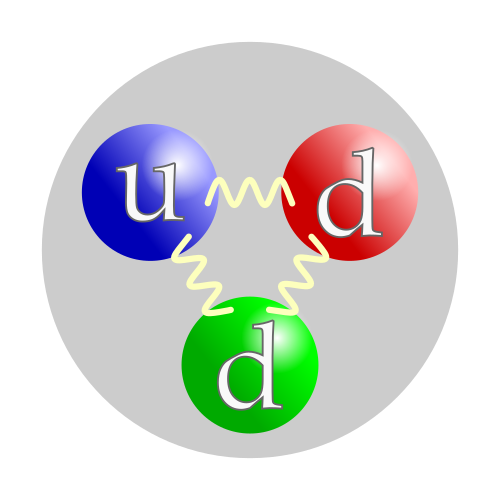
Owen Chamberlain, Emilio Segrè, and colleagues detect the antiproton at the Bevatron accelerator. This discovery confirmed the symmetry between matter and antimatter for baryons. #physics #antimatter
Antiproton Discovered By en real life identity: SHA-1 commitment ba62ca25da3fee2f8f36c101994f571c151abee7 - Self created using Inkscape from File:Quark structure proton.svg as a template., CC BY-SA 3.0, https://commons.wikimedia.org/w/index.php?curid=24105730
1956 CE
Parity Violation in Weak Interactions
Chien-Shiung Wu and her team demonstrate that beta decay violates parity, meaning the weak interaction distinguishes left from right. This groundbreaking result reshaped particle physics and led to the V-A theory. #physics #weakinteraction
Parity Violation in Weak Interactions By Smithsonian Institution - Flickr: Chien-shiung Wu (1912-1997), No restrictions, https://commons.wikimedia.org/w/index.php?curid=18759827
1957 CE
Neutrino Detected
Clyde Cowan and Frederick Reines directly detect the neutrino using a nuclear reactor, confirming its existence. This earned them the Nobel Prize and opened direct neutrino studies. #physics #neutrino
Neutrino Detected By Los Alamos National Laboratory - https://www-nature-com.wikipedialibrary.idm.oclc.org/articles/d41586-021-01318-y, Attribution, https://commons.wikimedia.org/w/index.php?curid=135667733
1961 CE
Gell-Mann and Ne'eman Propose Eightfold Way
Murray Gell-Mann and Yuval Ne'eman independently categorize hadrons into patterns using SU(3) symmetry, the Eightfold Way. This classification predicted new particles and eventually led to the quark model. #physics #hadrons )
Gell-Mann and Ne'eman Propose Eightfold Way By Laurascudder - Own work, CC BY-SA 3.0, https://commons.wikimedia.org/w/index.php?curid=2379550
1964 CE
Quark Model Proposed
Murray Gell-Mann and George Zweig independently propose that hadrons are composed of elementary particles called 'quarks' (Gell-Mann) or 'aces' (Zweig). This revolutionizes particle physics and forms the basis of the Standard Model. #physics #quarks
Quark Model Proposed By Vectorization: Alhadis - Own work based on: 8foldway.png by Bambaiah at English Wikipedia, CC BY-SA 3.0, https://commons.wikimedia.org/w/index.php?curid=125051765
1964 CE
GIM Mechanism Predicts Charm Quark
Sheldon Glashow, John Iliopoulos, and Luciano Maiani introduce the GIM mechanism to suppress flavor-changing neutral currents, predicting the existence of the charm quark. This provided a key test for the Standard Model. #physics #quarks
GIM Mechanism Predicts Charm Quark By Blibla - Own work, CC0, https://commons.wikimedia.org/w/index.php?curid=50058727
1964 CE
Higgs Mechanism Proposed
Peter Higgs, Robert Brout, and François Englert independently develop a mechanism that gives mass to elementary particles via spontaneous symmetry breaking. This predicts the existence of the Higgs boson, later discovered in 2012. #physics #higgs
Higgs Mechanism Proposed By Cush - Own work using: PBS NOVA [1], Fermilab, Office of Science, United States Department of Energy, Particle Data Group, Public domain, https://commons.wikimedia.org/w/index.php?curid=4286964
1967 CE
Electroweak Unification
Steven Weinberg and Abdus Salam independently formulate a unified theory of the electromagnetic and weak interactions based on SU(2)×U(1) gauge symmetry, together with the Higgs mechanism. This theory became a cornerstone of the Standard Model. #physics #electroweak
1968 CE
Partons Revealed at SLAC
Deep inelastic scattering experiments at the Stanford Linear Accelerator Center (SLAC) show that protons contain point-like constituents, later identified as quarks and gluons. This provided direct evidence for the quark model. #physics #partons
Partons Revealed at SLAC By E2m - Own work, Public domain, https://commons.wikimedia.org/w/index.php?curid=1796747
1973 CE
Asymptotic Freedom Discovered
David Gross, Frank Wilczek, and David Politzer discover that the strong force becomes weaker at short distances, explaining why quarks behave as free particles inside hadrons. This breakthrough led to the theory of quantum chromodynamics (QCD). #physics #QCD
Nov 1, 1974 CE
J/ψ Particle Discovered
Two independent groups at SLAC (Burton Richter) and Brookhaven (Samuel Ting) announce the discovery of the J/ψ meson, a bound state of charm and anticharm quarks. The 'November Revolution' confirmed the charm quark and launched the modern era of particle physics. #physics #charm
J/ψ Particle Discovered By https://commons.wikimedia.org/wiki/User:Harp - File:Quark_structure_pion.svg, CC BY-SA 4.0, https://commons.wikimedia.org/w/index.php?curid=46504895
1975 CE
Tau Lepton Discovered
Martin Perl and colleagues at SLAC identify the tau lepton, the third-generation charged lepton, in electron-positron collisions. This discovery established the third family of matter particles. #physics #lepton )
Tau Lepton Discovered By user:MissMJ - File:Standard Model of Elementary Particles.svg, CC BY 3.0, https://commons.wikimedia.org/w/index.php?curid=24692629
1976 CE
Bottom Quark Discovered
The Fermilab E288 experiment, led by Leon Lederman, discovers the upsilon meson, a bound state of bottom and antibottom quarks. This provided the first evidence for the bottom quark. #physics #quarks
Bottom Quark Discovered By user:MissMJ - File:Standard Model of Elementary Particles.svg, CC BY 3.0, https://commons.wikimedia.org/w/index.php?curid=24657344
1979 CE
Gluon Discovered at DESY
Experiments at the PETRA collider at DESY observe three-jet events, interpreted as a quark, antiquark, and a gluon, providing direct evidence of the gluon, the carrier of the strong force. #physics #QCD
Jan 1, 1983 CE
W Boson Discovered
The UA1 experiment at CERN, led by Carlo Rubbia, announces the discovery of the W boson, the carrier of the weak force. This confirmed the electroweak unification and validated the Standard Model. #physics #weakinteraction
May 1, 1983 CE
Z Boson Discovered
The UA1 and UA2 experiments at CERN detect the Z boson, neutral carrier of the weak force. Together with the W boson, this discovery completed the set of gauge bosons predicted by the electroweak theory. #physics #weakinteraction
1989 CE
LEP Starts Operation at CERN
The Large Electron-Positron (LEP) collider begins operations, allowing precise tests of the electroweak theory and measurements of the Z boson mass and width. LEP's data confirmed the Standard Model with high precision. #physics #collider
LEP Starts Operation at CERN By Juhanson - Image taken by Juhanson during CERN 50 Years OpenDay, using Canon EOS 10D camera, CC BY-SA 3.0, https://commons.wikimedia.org/w/index.php?curid=197318
Mar 2, 1995 CE
Top Quark Discovered
The CDF and D∅ experiments at Fermilab announce the discovery of the top quark, the heaviest known elementary particle. Its mass confirmed the Standard Model's predictions and completed the third generation of quarks. #physics #topquark
Top Quark Discovered By user:MissMJ - File:Standard Model of Elementary Particles.svg, CC BY 3.0, https://commons.wikimedia.org/w/index.php?curid=24657343
Jul 21, 2000 CE
Tau Neutrino Detected
The DONUT experiment at Fermilab directly observes the tau neutrino, the final lepton of the Standard Model. This detection confirmed the existence of the third neutrino flavor. #physics #neutrino
Tau Neutrino Detected By user:MissMJ - File:Standard Model of Elementary Particles.svg, CC BY 3.0, https://commons.wikimedia.org/w/index.php?curid=24692631
Sep 10, 2008 CE
Large Hadron Collider Starts Up
The LHC at CERN begins operation, colliding protons at energies up to 13 TeV. Designed to discover the Higgs boson and search for new physics, it became the world's largest and most powerful particle accelerator. #physics #LHC
Large Hadron Collider Starts Up By Arpad Horvath - Drawn by Arpad Horvath with Inkscape., CC BY-SA 2.5, https://commons.wikimedia.org/w/index.php?curid=679693
Jul 4, 2012 CE
Higgs Boson Discovered
The ATLAS and CMS experiments at CERN announce the discovery of a new particle consistent with the Higgs boson. This confirmed the mechanism that gives mass to elementary particles and earned the Nobel Prize for Higgs and Englert. #physics #higgs
Higgs Boson Discovered By CERN for the ATLAS and CMS Collaborations - https://cds.cern.ch/record/1630222, CC BY-SA 3.0, https://commons.wikimedia.org/w/index.php?curid=29737816
Oct 8, 2013 CE
Nobel Prize for Higgs Boson Theory
The Nobel Prize in Physics is awarded to François Englert and Peter Higgs for the theoretical discovery of the Higgs mechanism. The award recognized the completion of the Standard Model. #physics #nobel
Nobel Prize for Higgs Boson Theory By Design of the medal: The Nobel Foundation. Sculptor and engraver: Erik Lindberg (1902). - Source of this work Photographer: David Monniaux (2005, 2006, 2007) Edited by: hidro 21:17, 28 July 2008 (UTC) Design of the medal: The Nobel Foundation. Sculptor and engraver: Erik Lindberg (1902)., Cc-by-sa-3.0, https://en.wikipedia.org/w/index.php?curid=18622921
Jul 14, 2015 CE
Pentaquark Discovered
The LHCb collaboration at CERN reports the observation of pentaquarks, particles composed of five quarks. This finding expands our understanding of exotic hadrons and the strong interaction. #physics #hadrons
Pentaquark Discovered By Headbomb - Own work, CC BY-SA 4.0, https://commons.wikimedia.org/w/index.php?curid=41591193
2016 CE
Exotic Tetraquarks Confirmed
LHCb and other experiments observe several tetraquark states, bound states of four quarks. These exotic hadrons challenge simple quark models and provide insights into QCD. #physics #hadrons
2018 CE
Muon g-2 Experiment Begins at Fermilab
The Muon g-2 experiment at Fermilab starts data collection to measure the muon's anomalous magnetic moment with unprecedented precision. A discrepancy with the Standard Model could hint at new physics. #physics #muon
Muon g-2 Experiment Begins at Fermilab By Reidar Hahn - https://vms.fnal.gov/asset/detail?recid=1950114, CC BY-SA 4.0, https://commons.wikimedia.org/w/index.php?curid=58326280
Apr 7, 2021 CE
Muon g-2 Anomaly Strengthened
The Fermilab Muon g-2 collaboration publishes its first result, confirming a 4.2 sigma deviation from the Standard Model prediction. This strengthens the hint of new physics beyond the Standard Model. #physics #muon
Jul 4, 2022 CE
Higgs Boson Properties Measured
ATLAS and CMS present detailed measurements of the Higgs boson's coupling strengths and spin-parity, all consistent with the Standard Model. These precision tests confirm the Higgs mechanism’s role in mass generation. #physics #higgs
Jul 5, 2023 CE
LHC Run 3 Begins
CERN announces the start of LHC Run 3 with collisions at an energy of 13.6 TeV, aiming to collect more data for precision studies and searches for new physics beyond the Standard Model. #physics #LHC