The Four Great Inventions of China: Paper, Printing, Gunpowder & Compass
Encyclopedia/2. Technology & The Built World/5. Materials & Chemical Engineering/01. Metallurgy & Alloys • Curated by Admin Timeline.sg
The Four Great Inventions of China—paper, printing, gunpowder, and the compass—are ancient Chinese technological innovations that profoundly influenced global civilization, enabling the spread of knowledge, warfare, and navigation.
Chronological Storyline (36 Milestones)
200 BCE
Earliest Chinese Paper Precursors
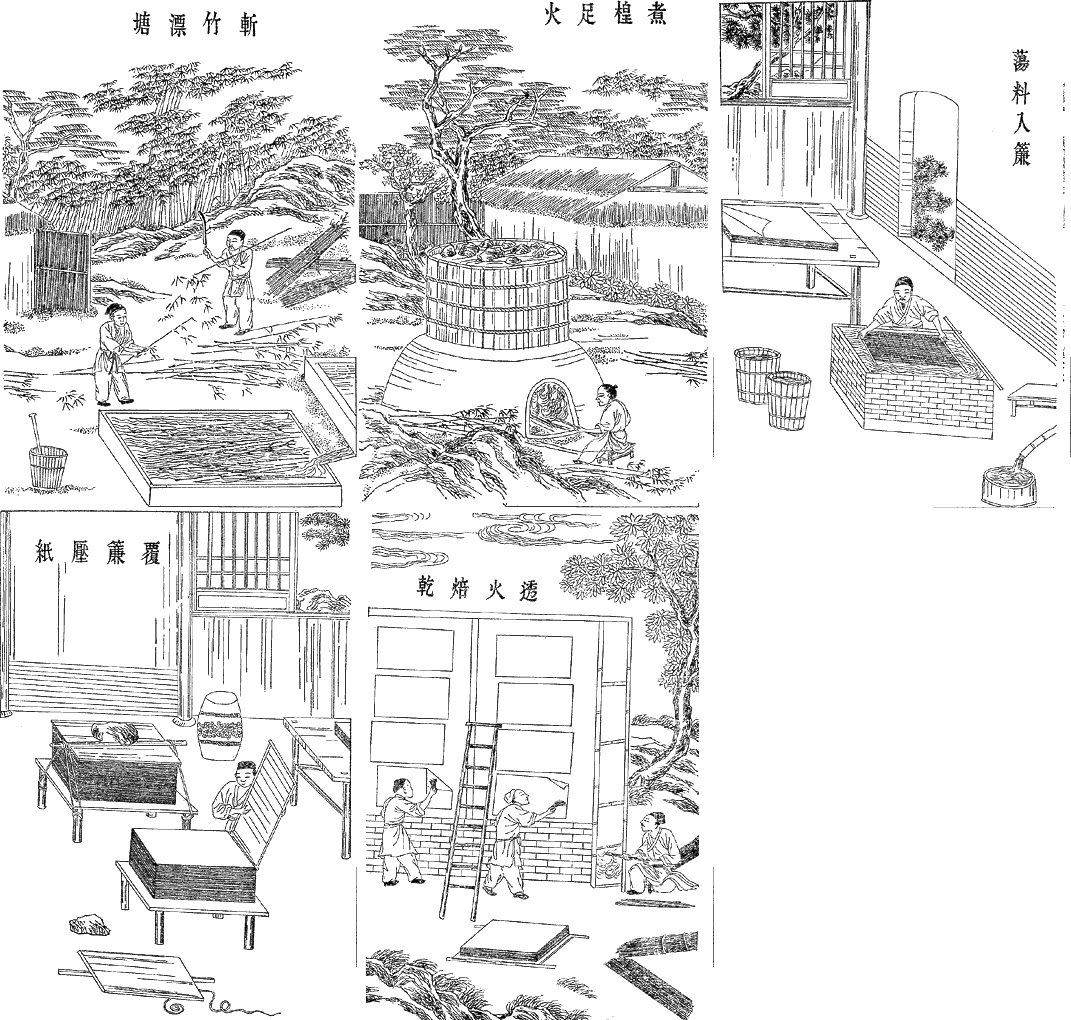
Early Chinese used silk and bamboo for writing, but silk was expensive and bamboo heavy. Hemp paper fragments from this period suggest early experimentation with plant fibers. #inventions #paper
Earliest Chinese Paper Precursors By Unknown pre-modern painter of the 1637 Tiangong Kaiwu of the Ming dynasty. - 香港臨時市政局 [Provisional Urban Council]; 中國歷史博物館聯合主辦 [Hong Kong Museum of History] (1998) "Zàozhǐ" in (in zh, en) Tian gong kai wu: Zhongguo gu dai ke ji wen wu zhan, Hong Kong: 香港歷史博物館 [Hong Kong Museum of History], pp. 54–71 ISBN: 978-962-7039-37-2. OCLC: 41895821. Originally uploaded by 豐 in Chinese Wikipedia.。, Public domain, https://commons.wikimedia.org/w/index.php?curid=776954
105 BCE
Cai Lun Standardizes Papermaking
Cai Lun, a Han court eunuch, improved papermaking using tree bark, hemp, rags, and fishnets. His method became the standard for centuries, earning him recognition as the inventor of paper. #inventions #paper
Cai Lun Standardizes Papermaking By Unknown author - Tsien Tsuen-Hsuin (1985) Needham, Joseph, ed. Science and Civilisation in China: Volume 5, Chemistry and Chemical Technology, Part 1, Paper and Printing, Taipei: Caves Books, pp. 108–109 ISBN: 978-0-521-08690-5. Etnografiska museet, Stockholm: 1935.50.3366.30, Public domain, https://commons.wikimedia.org/w/index.php?curid=3154438
200 CE
Paper Used for Toilet Paper
Paper was used for wrapping and padding, and by the 6th century, for toilet paper. This shows early diversification of paper applications beyond writing. #paper #everyday
Paper Used for Toilet Paper By Brandon Blinkenberg - Own work, CC BY 2.5, https://commons.wikimedia.org/w/index.php?curid=170
593 CE
First Record of Printing in China
Buddhist texts were printed using woodblocks in the Sui dynasty. This marks the earliest known printing, predating movable type by centuries. #printing #Buddhism
First Record of Printing in China By The colophon, at the inner end, reads: Reverently [caused to be] made for universal free distribution by Wang Jie on behalf of his two parents on the 13th of the 4th moon of the 9th year of Xiantong [i.e. 11th May, CE 868 ]. - Zoomable image from the British Library's Online Gallery. Originally uploaded to en:Wikipedia (log) in January 2008 by Fconaway (talk) and in November 2009 by Earthsound (talk)., Public domain, https://commons.wikimedia.org/w/index.php?curid=6925162
700 CE
Diamond Sutra Printed
The Diamond Sutra, a Buddhist scripture, was printed in 868 CE, but earlier fragments exist from around 700 CE. It is the world's oldest dated printed book. #printing #Buddhism
May 11, 868 CE
Diamond Sutra Dated
The Diamond Sutra, a Buddhist text, was printed with a colophon dating it to 868 CE. It is the earliest dated printed book, showcasing advanced woodblock printing. #printing #Buddhism
1040 CE
Bi Sheng Invents Movable Type
Bi Sheng, a Chinese artisan, created movable type using baked clay characters. This innovation allowed faster printing than woodblocks, though it did not become widespread due to the complexity of Chinese script. #printing #movabletype
Bi Sheng Invents Movable Type By Popolon - Own work, CC BY-SA 4.0, https://commons.wikimedia.org/w/index.php?curid=41978610
1044 CE
Gunpowder Formula Published
The Wujing Zongyao, a military compendium, recorded the first known gunpowder formula: saltpeter, sulfur, and charcoal. This marks the transition from alchemy to military use. #gunpowder #military
Gunpowder Formula Published By PericlesofAthens - Own work (My book), Public domain, https://commons.wikimedia.org/w/index.php?curid=2549290
1088 CE
Shen Kuo Describes Movable Type
Shen Kuo's Dream Pool Essays described Bi Sheng's movable type and also mentioned the magnetic compass for navigation, documenting key inventions. #printing #compass
Shen Kuo Describes Movable Type By Unknown 18th century artist - http://www-history.mcs.st-andrews.ac.uk/PictDisplay/Shen_Kua.html, Public domain, https://commons.wikimedia.org/w/index.php?curid=6551589
1100 CE
First Use of Gunpowder in Warfare
Chinese armies used gunpowder in fire arrows and bombs. The Song dynasty employed these weapons against the Jurchens, marking the start of gunpowder warfare. #gunpowder #warfare
1126 CE
Bombard Used in Siege of Kaifeng
The Song used gunpowder bombs and possibly early cannons (bombards) to defend Kaifeng from the Jurchens. This is one of the earliest uses of explosive weapons. #gunpowder #siege
Bombard Used in Siege of Kaifeng By PHGCOM - self-made, photographed at the Musee de l'Armee, CC BY-SA 3.0, https://commons.wikimedia.org/w/index.php?curid=2600099
1132 CE
Fire Lance Invented
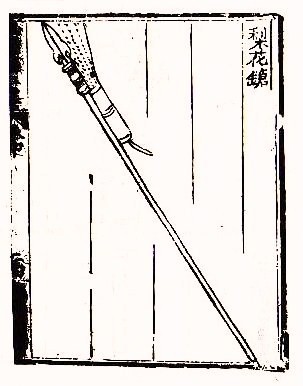
The fire lance, a bamboo tube filled with gunpowder and shrapnel, was used as a flamethrower and early firearm. It evolved into the gun. #gunpowder #firearm
Fire Lance Invented By 焦玉 - 火龍經, Public domain, https://commons.wikimedia.org/w/index.php?curid=53495339
1150 CE
Paper Money Printed in China
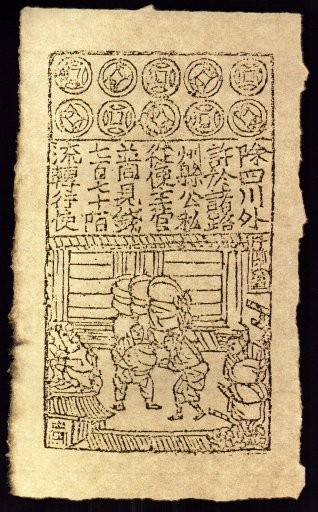
The Song dynasty issued paper money (jiaozi) using woodblock printing. This required high-quality paper and printing techniques, boosting the paper industry. #paper #economy
Paper Money Printed in China By John E. Sandrock - Ancient Chinese Cash Notes - The World's First Paper Money - Part 1 (The Currency Collector)., Public domain, https://commons.wikimedia.org/w/index.php?curid=72426460
1190 CE
Magnetic Compass Used for Navigation
Chinese sailors used a floating magnetic needle for navigation. Shen Kuo had earlier described the magnetic declination, but practical use at sea became common by this time. #compass #navigation
Magnetic Compass Used for Navigation By Jacek Halicki - Own work, CC BY-SA 4.0, https://commons.wikimedia.org/w/index.php?curid=48106443
1232 CE
Gunpowder Bombs at Siege of Kaifeng
The Mongols besieged Kaifeng, and the Jin defenders used gunpowder bombs and fire lances. This demonstrated the destructive power of gunpowder. #gunpowder #siege
Gunpowder Bombs at Siege of Kaifeng By SY - Own work, CC BY-SA 4.0, https://commons.wikimedia.org/w/index.php?curid=67887379
1250 CE
Gunpowder Spreads to Europe
Gunpowder knowledge reached Europe via the Silk Road, likely through Mongol conquests. Roger Bacon described gunpowder in his writings around this time. #gunpowder #SilkRoad
1280 CE
First European Cannon
The earliest European depiction of a cannon appears in a manuscript. Gunpowder weapons began to transform European warfare. #gunpowder #cannon
First European Cannon By Didier Descouens - Own work, Public domain, https://commons.wikimedia.org/w/index.php?curid=141988130
1298 CE
Marco Polo Describes Chinese Inventions
Marco Polo's travelogue mentioned Chinese paper money and coal, but not gunpowder or compass directly. His accounts spread knowledge of Chinese technology. #paper #SilkRoad
Marco Polo Describes Chinese Inventions By Unknown author - The Description of the World, Moule & Pelliot, 1938, dont la source est le frontispice en noir et blanc de la 1e édition allemande du Livre de Marco Polo (Nuremberg, 1477)., Public domain, https://commons.wikimedia.org/w/index.php?curid=194214365
1300 CE
Dry Compass Invented
The dry compass, with a pivoting needle on a card, was developed in Europe, improving upon the Chinese wet compass. This made navigation more reliable. #compass #navigation
1313 CE
Wang Zhen Improves Movable Type
Wang Zhen, a Chinese official, improved movable type using wooden characters and a revolving table for typesetting. His Nong Shu described these methods. #printing #movabletype
Wang Zhen Improves Movable Type By Wang Zhen (simplified Chinese: 王祯; Yuan Dynasty (1271 – 1368 AD) - mybook 唐戈藏书, Public domain, https://commons.wikimedia.org/w/index.php?curid=14987502
1326 CE
First Depiction of a Cannon in Europe
An English manuscript shows a cannon, indicating gunpowder weapons were established in Europe. This marked the beginning of European gunpowder warfare. #gunpowder #cannon
1368 CE
Ming Dynasty Uses Firearms
The Ming dynasty used hand cannons and artillery to defeat the Mongols. They also developed the 'fire lance' and early rockets. #gunpowder #firearm
Ming Dynasty Uses Firearms By Albert Herrmann Creator:Q1509115 & Georg Westermann - Historical and Commercial Atlas of China, Public domain, https://commons.wikimedia.org/w/index.php?curid=158240988
1400 CE
Zheng He's Treasure Ships Use Compass
Zheng He's massive fleet used magnetic compasses for navigation during voyages to Southeast Asia, India, and Africa. This demonstrated the compass's importance in long-distance sea travel. #compass #navigation
Zheng He's Treasure Ships Use Compass By Marcin Konsek - Own work, CC BY-SA 4.0, https://commons.wikimedia.org/w/index.php?curid=51927875
1403 CE
Korean Movable Type (Jikji)
Korea developed metal movable type, printing the Jikji in 1377, but the earliest extant metal type book is from 1403. This advanced printing technology. #printing #movabletype
Korean Movable Type (Jikji) By Unknown author - https://gallica.bnf.fr/ark:/12148/btv1b10527116j, Public domain, https://commons.wikimedia.org/w/index.php?curid=148191571
1440 CE
Gutenberg's Printing Press
Johannes Gutenberg invented the printing press with movable type in Europe, revolutionizing information dissemination. Though inspired by Chinese movable type, his press used a screw mechanism and oil-based ink. #printing #Gutenberg
Gutenberg's Printing Press By Kenneth C. Zirkel - Own work, CC BY-SA 4.0, https://commons.wikimedia.org/w/index.php?curid=163942915
1450 CE
Gunpowder Empires Rise
The Ottoman, Safavid, and Mughal empires used gunpowder weapons to expand. The term 'Gunpowder Empires' was coined by historians to describe their military dominance. #gunpowder #empire
Gunpowder Empires Rise By Pinupbettu - Own work, CC BY-SA 4.0, https://commons.wikimedia.org/w/index.php?curid=81334339
Oct 12, 1492 CE
Columbus Uses Compass
Christopher Columbus used a magnetic compass on his voyage to the Americas. The compass was essential for navigation across the Atlantic. #compass #exploration
Columbus Uses Compass By Sebastiano del Piombo - This file was donated to Wikimedia Commons as part of a project by the Metropolitan Museum of Art. See the Image and Data Resources Open Access Policy, Public domain, https://commons.wikimedia.org/w/index.php?curid=27554267
1498 CE
Vasco da Gama Uses Compass to Reach India
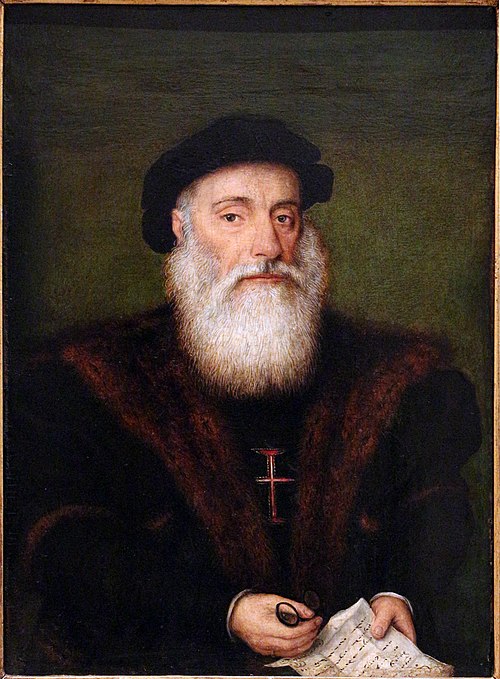
Vasco da Gama used a compass to navigate around Africa to India, opening sea trade routes. The compass enabled European exploration. #compass #exploration
Vasco da Gama Uses Compass to Reach India By Sailko - Own work, CC BY 3.0, https://commons.wikimedia.org/w/index.php?curid=61575307
1500 CE
Paper Mills in Europe
Paper mills spread across Europe, using Chinese papermaking techniques. Paper became cheaper, enabling the printing revolution. #paper #industry
Paper Mills in Europe By Quintin Soloviev - Own work, CC BY 4.0, https://commons.wikimedia.org/w/index.php?curid=177606467
1520 CE
Matchlock Musket in Europe
The matchlock musket, a firearm using a burning match to ignite gunpowder, became common in European armies. It evolved from Chinese fire lances. #gunpowder #firearm
Matchlock Musket in Europe By Rainer Halama - Own work, CC BY 2.5, https://commons.wikimedia.org/w/index.php?curid=4773227
1543 CE
Biringuccio's Pirotechnia
Vannoccio Biringuccio published Pirotechnia, the first printed book on metallurgy and gunpowder. It spread knowledge of gunpowder production. #gunpowder #metallurgy
Biringuccio's Pirotechnia By Vannoccio Biringuccio - Science History Institute, Public domain, https://commons.wikimedia.org/w/index.php?curid=26722702
1556 CE
Agricola's De Re Metallica
Georgius Agricola published De Re Metallica, describing mining and gunpowder use in mining. It became a standard reference. #gunpowder #mining
Agricola's De Re Metallica By Georgius Agricola - http://ihm.nlm.nih.gov/images/A13215, Public domain, https://commons.wikimedia.org/w/index.php?curid=6657599
1571 CE
Battle of Lepanto Uses Cannons
The naval Battle of Lepanto featured extensive use of cannons on galleys. Gunpowder weapons decided the outcome. #gunpowder #naval
Battle of Lepanto Uses Cannons By Laureys a Castro - https://www.bonhams.com/auctions/11468/lot/135/, Public domain, https://commons.wikimedia.org/w/index.php?curid=37718118
1582 CE
Matteo Ricci Brings Western Knowledge to China
Jesuit missionary Matteo Ricci introduced European science, including clocks and maps, to China. He also learned about Chinese inventions and facilitated cultural exchange. #paper #exchange
Matteo Ricci Brings Western Knowledge to China By Chinese brother Emmanuel Pereira (born Yu Wen-hui 游文辉) - Unknown source, Public domain, https://commons.wikimedia.org/w/index.php?curid=85942
1590 CE
First Paper Mill in America
The first paper mill in the Americas was established in Mexico, using Chinese techniques brought by Europeans. Paper production spread globally. #paper #Americas
1600 CE
William Gilbert Publishes De Magnete
William Gilbert's De Magnete described the Earth's magnetism and the compass. This scientific work advanced understanding of magnetism. #compass #science
William Gilbert Publishes De Magnete By Unknown author - Image from Timeline of the First Thirty Years of Radio (image is not eligible for copyright), with small alterations by User:Omegatron, Public domain, https://commons.wikimedia.org/w/index.php?curid=2422400