The Celestial Revolution: Copernicus, Galileo & Kepler's Laws
Encyclopedia/1. The Cosmos & The Natural World/3. Astronomy & Planetary Science/02. Exoplanets & Biosignatures • Curated by Admin Timeline.sg
Historical events timeline.
Chronological Storyline (44 Milestones)
1543 CE
Copernicus Publishes De Revolutionibus
Nicolaus Copernicus's seminal work 'De revolutionibus orbium coelestium' proposed a heliocentric model of the universe, challenging the long-standing geocentric view. This marked the beginning of the Scientific Revolution in astronomy. #astronomy #heliocentrism #Copernicus
Copernicus Publishes De Revolutionibus By derivative work of Johannes Petreius 1543 edition of File:Nicolai_Copernici_torinensis_De_revolutionibus_orbium_coelestium.djvu - File:Nicolai_Copernici_torinensis_De_revolutionibus_orbium_coelestium.djvu, Public domain, https://commons.wikimedia.org/w/index.php?curid=5611684
Nov 11, 1572 CE
Tycho Brahe Observes Supernova
Tycho Brahe observed a new star (supernova) in the constellation Cassiopeia, demonstrating that the heavens were not immutable. His precise observations later aided Kepler's work. #astronomy #supernova #TychoBrahe
Tycho Brahe Observes Supernova By NASA/CXC/Rutgers/J.Warren & J.Hughes et al. - http://chandra.harvard.edu/photo/2005/tycho/; see also https://www.flickr.com/photos/smithsonian/2941525398/, Public domain, https://commons.wikimedia.org/w/index.php?curid=6706920
1577 CE
Tycho Brahe Studies Great Comet
Tycho Brahe's observations of the Great Comet of 1577 showed it was farther than the Moon, contradicting Aristotelian celestial spheres and supporting a more fluid cosmos. #astronomy #comets #TychoBrahe
Tycho Brahe Studies Great Comet By Jiřrí Jakubuv Dačický - Zentralbibliothek Zürich, Public domain, https://commons.wikimedia.org/w/index.php?curid=70591808
1583 CE
Galileo Observes Pendulum Isosynchronism
While in Pisa Cathedral, Galileo noticed a swinging lamp's period was independent of amplitude, leading to his studies of pendulum motion and later timekeeping advances. #physics #pendulum #Galileo
Galileo Observes Pendulum Isosynchronism By Justus Sustermans - http://collections.rmg.co.uk/collections/objects/14174, Public domain, https://commons.wikimedia.org/w/index.php?curid=62614082
1596 CE
Kepler Publishes Mysterium Cosmographicum
Johannes Kepler's first major work proposed a geometric model of the solar system using Platonic solids, an early step toward his laws of planetary motion. #astronomy #Kepler #cosmology
Kepler Publishes Mysterium Cosmographicum By Johannes Kepler - https://archive.org/stream/den-kbd-pil-22002200031E-001#page/n8/mode/2up, Public domain, https://commons.wikimedia.org/w/index.php?curid=66714876
Feb 17, 1600 CE
Giordano Bruno Burned at Stake
Italian philosopher Giordano Bruno was executed for heresy, partly for advocating Copernican heliocentrism and an infinite universe. His martyrdom symbolized the conflict between science and religion. #history #philosophy #Bruno
Giordano Bruno Burned at Stake By Unknown author - https://wellcomeimages.org/indexplus/obf_images/bc/3d/265d1be073eb34224006d0d35b02.jpg Gallery: https://wellcomeimages.org/indexplus/image/L0015152.html Wellcome Collection gallery (2018-04-01): https://wellcomecollection.org/works/qgt4dt8k CC-BY-4.0, CC BY 4.0, https://commons.wikimedia.org/w/index.php?curid=133537203
Oct 9, 1604 CE
Kepler's Supernova Observed
A new star (supernova) appeared in Ophiuchus, observed by Kepler and others. It challenged the immutability of heavens and provided data for later stellar studies. #astronomy #supernova #Kepler
Kepler's Supernova Observed By NASA/ESA/JHU/R.Sankrit & W.Blair - http://www.nasa.gov/multimedia/imagegallery/image_feature_219.html Larger version uploaded from https://chandra.harvard.edu/photo/2012/kepler/ a NASA-sponsored site. Per Bridgeman Art Library v. Corel Corp., no new copyright should apply anyway., Public domain, https://commons.wikimedia.org/w/index.php?curid=14301
Oct 2, 1608 CE
Hans Lippershey Applies for Telescope Patent
Dutch spectacle maker Hans Lippershey attempted to patent the first refracting telescope, though priority is disputed. His invention soon spread across Europe. #telescope #invention #optics
Hans Lippershey Applies for Telescope Patent By Pierre Borel - De vero telescopii inventore (See http://fermi.imss.fi.it/rd/bdv?/bdviewer/bid=000000300919), Public domain, https://commons.wikimedia.org/w/index.php?curid=3990839
Jul 26, 1609 CE
Galileo Demonstrates Telescope in Venice
Galileo Galilei presented an improved telescope to the Venetian Senate, demonstrating its military and astronomical potential. This led to his groundbreaking celestial observations. #telescope #Galileo #astronomy
1609 CE
Kepler Publishes Astronomia Nova
Johannes Kepler's 'Astronomia Nova' introduced the first two laws of planetary motion: elliptical orbits and equal areas in equal times, based on Tycho Brahe's Mars data. #astronomy #Kepler #laws
Kepler Publishes Astronomia Nova By Johannes Kepler - http://www.library.usyd.edu.au/libraries/rare/modernity/kepler4.html, Public domain, https://commons.wikimedia.org/w/index.php?curid=1575517
Jan 7, 1610 CE
Galileo Discovers Jupiter's Moons
Galileo observed four moons orbiting Jupiter, now called the Galilean moons. This supported the Copernican model by showing celestial bodies could orbit a center other than Earth. #astronomy #Galileo #moons
Galileo Discovers Jupiter's Moons By WhatADrag07 - https://photojournal.jpl.nasa.gov/catalog/PIA00600, https://science.nasa.gov/resource/global-image-of-io-true-color/, https://www.flickr.com/photos/kevinmgill/53255790801, https://www.flickr.com/photos/kevinmgill/51238659798/, https://www.flickr.com/photos/kevinmgill/38926064465/, CC BY-SA 4.0, https://commons.wikimedia.org/w/index.php?curid=175775037
Mar 13, 1610 CE
Galileo Publishes Sidereus Nuncius
Galileo's 'Sidereus Nuncius' (Starry Messenger) announced his telescopic discoveries: lunar mountains, Jupiter's moons, and countless stars. It became a bestseller and revolutionized astronomy. #astronomy #Galileo #book
Galileo Publishes Sidereus Nuncius By Galileo Galilei - Houghton Library, Public domain, https://commons.wikimedia.org/w/index.php?curid=35420870
1610 CE
Galileo Observes Phases of Venus
Galileo discovered that Venus exhibits phases like the Moon, which could only be explained if Venus orbited the Sun, providing strong evidence for heliocentrism. #astronomy #Venus #Galileo
Galileo Observes Phases of Venus By Statis Kalyvas - VT-2004 programme - Transferred from fr.wikipedia to Commons by Mu301., Attribution, https://commons.wikimedia.org/w/index.php?curid=5135302
1611 CE
Galileo Observes Sunspots
Galileo and others observed sunspots, showing the Sun was not perfect. He argued they were on the solar surface, contradicting Aristotelian celestial perfection. #astronomy #Sun #Galileo
Galileo Observes Sunspots By NASA - https://www.nasa.gov/mission_pages/sunearth/news/News092511-ar1302.html, Public domain, https://commons.wikimedia.org/w/index.php?curid=16800815
Mar 5, 1616 CE
Copernican Theory Condemned by Catholic Church
The Catholic Church placed Copernicus's 'De Revolutionibus' on the Index of Forbidden Books, declaring heliocentrism 'foolish and absurd' and formally opposing it. #history #religion #censorship
Copernican Theory Condemned by Catholic Church By Unknown author - 1564 edition, printed in Venice, Public domain, https://commons.wikimedia.org/w/index.php?curid=433142
1619 CE
Kepler Publishes Harmonices Mundi
Kepler's 'Harmonices Mundi' (The Harmony of the World) presented his third law of planetary motion: the square of orbital period is proportional to cube of semi-major axis. #astronomy #Kepler #laws
Kepler Publishes Harmonices Mundi By Johannes Kepler - http://posner.library.cmu.edu/Posner/books/CALL1/520_K38PI/vol0/part0/copy0/jpg/lg/0001-lg.jpg linked from http://posner.library.cmu.edu/Posner/books/pages.cgi?call=520_K38PI&layout=vol0/part0/copy0&res=high&file=0001 linked from http://posner.library.cmu.edu/Posner/books/pages.cgi?call=520_K38PI&layout=vol0/part0/copy0, Public domain, https://commons.wikimedia.org/w/index.php?curid=9486143
1627 CE
Kepler Publishes Rudolphine Tables
Kepler's astronomical tables, based on Tycho's data and his own laws, provided accurate planetary positions. They were used by astronomers for decades and supported heliocentrism. #astronomy #tables #Kepler
Kepler Publishes Rudolphine Tables By Johannes Kepler - Google Arts and Culture scan of British Library copy, Google Arts & Culture — HwE971rUl9mthw, Public domain, https://commons.wikimedia.org/w/index.php?curid=84072939
Feb 22, 1632 CE
Galileo Publishes Dialogue Concerning Two Chief World Systems
Galileo's book compared Copernican and Ptolemaic systems, favoring heliocentrism. It led to his trial and house arrest by the Inquisition. #astronomy #Galileo #book
Galileo Publishes Dialogue Concerning Two Chief World Systems By Giovanni Battista Landini - http://moro.imss.fi.it/lettura/LetturaWEB.DLL?AZIONE=IMG&TESTO=E_U&PARAM=07-23-tit.jpg and http://moro.imss.fi.it/lettura/LetturaWEB.DLL?AZIONE=IMG&TESTO=E_U&PARAM=07-25-tit.jpg Transferred from en.wikipedia to Commons by User:Lijealso using CommonsHelper., Public domain, https://commons.wikimedia.org/w/index.php?curid=5289735
Jun 22, 1633 CE
Galileo Forced to Recant
Under threat of torture, Galileo recanted his heliocentric views and was sentenced to house arrest. He remained under confinement until his death in 1642. #history #Galileo #Inquisition
1638 CE
Galileo Publishes Discourses on Two New Sciences
Galileo's final book summarized his work on kinematics and strength of materials, laying foundations for classical mechanics. It was smuggled out of Italy and published in Holland. #physics #Galileo #mechanics
Galileo Publishes Discourses on Two New Sciences By Unknown author, Public domain, https://commons.wikimedia.org/w/index.php?curid=144961
1647 CE
Hevelius Publishes Selenographia
Johannes Hevelius's 'Selenographia' featured detailed lunar maps and introduced many crater names still used today, advancing selenography. #astronomy #Moon #maps
Hevelius Publishes Selenographia By Jan Heweliusz - This file comes from Polona Digital Library and is available under the URL: https://polona2.pl/item/johannis-hevelii-selenographia-sive-lunae-descriptio-atque-accurata-tam-macularum,MTIyNDU4ODAx/10/, Public domain, https://commons.wikimedia.org/w/index.php?curid=165121084
1659 CE
Huygens Discovers Saturn's Rings and Titan
Christiaan Huygens correctly identified Saturn's ring system and discovered its largest moon Titan, using an improved telescope. He also published 'Systema Saturnium'. #astronomy #Saturn #Huygens
Huygens Discovers Saturn's Rings and Titan By Caspar Netscher - http://ressources2.techno.free.fr/informatique/sites/inventions/inventions.html, Public domain, https://commons.wikimedia.org/w/index.php?curid=44047
1665 CE
Newton Begins Work on Calculus and Gravity
During the Great Plague, Isaac Newton at Woolsthorpe developed calculus, the laws of motion, and the concept of universal gravitation, though he published later. #physics #calculus #Newton
Newton Begins Work on Calculus and Gravity By Godfrey Kneller - File:Portrait of Sir Isaac Newton, 1689.jpg from https://exhibitions.lib.cam.ac.uk/linesofthought/artifacts, Public domain, https://commons.wikimedia.org/w/index.php?curid=132521185
1668 CE
Newton Builds First Reflecting Telescope
Isaac Newton constructed the first functional reflecting telescope, using a mirror to avoid chromatic aberration. It was a breakthrough in telescope design. #telescope #Newton #optics
Newton Builds First Reflecting Telescope By The Science Museum UK - [1], CC BY 4.0, https://commons.wikimedia.org/w/index.php?curid=133516675
1671 CE
Cassini Discovers Iapetus and Rhea
Giovanni Domenico Cassini discovered Saturn's moons Iapetus and Rhea, and later Tethys and Dione. He also observed the Cassini Division in Saturn's rings. #astronomy #Saturn #Cassini
Cassini Discovers Iapetus and Rhea By Unknown author - https://x.com/actualites_nrv/status/1931594119240962447, Public domain, https://commons.wikimedia.org/w/index.php?curid=168771473
1676 CE
Rømer Measures Speed of Light
Ole Rømer used observations of Jupiter's moon Io to estimate the speed of light, showing it was finite. His work provided the first quantitative measurement of light speed. #physics #light #Rømer
Rømer Measures Speed of Light By Johann Georg Wolfgang - unknown, but a very similar image appears in Bobis, Laurence; Lequeux, James (2008). "Cassini, Rømer and the velocity of light". J. Astron. Hist. Heritage 11 (2): 97–105. Archived from the original on 2009-07-17. Retrieved on 2009-10-30., Public domain, https://commons.wikimedia.org/w/index.php?curid=302624
Jul 5, 1687 CE
Newton Publishes Principia Mathematica
Isaac Newton's 'Philosophiæ Naturalis Principia Mathematica' formulated the laws of motion and universal gravitation, explaining Kepler's laws and unifying celestial and terrestrial mechanics. #physics #Newton #gravity
Newton Publishes Principia Mathematica By The original uploader was Zhaladshar at English Wikisource. - Transferred from en.wikisource to Commons. (previous image from another copy) Internet Archive (current image from the Bern Dibner copy), Public domain, https://commons.wikimedia.org/w/index.php?curid=2681838
1705 CE
Halley Predicts Comet's Return
Edmond Halley used Newton's laws to predict that a comet observed in 1682 would return in 1758. The comet, later named Halley's Comet, returned as predicted, confirming Newtonian gravity. #astronomy #comets #Halley
Halley Predicts Comet's Return By NASA/W. Liller - NSSDC's Photo Gallery (NASA): http://nssdc.gsfc.nasa.gov/photo_gallery/photogallery-comets.html http://nssdc.gsfc.nasa.gov/image/planetary/comet/lspn_comet_halley1.jpg, Public domain, https://commons.wikimedia.org/w/index.php?curid=544352
1718 CE
Halley Discovers Proper Motion of Stars
Edmond Halley compared ancient star positions with contemporary ones and found that Sirius, Arcturus, and Aldebaran had moved, proving stars are not fixed. #astronomy #stars #Halley
Halley Discovers Proper Motion of Stars By Original: Brews ohare Vectorisation: CheChe - This file was derived from: Proper motion.JPG:, CC BY-SA 3.0, https://commons.wikimedia.org/w/index.php?curid=67165949
1728 CE
Bradley Discovers Aberration of Light
James Bradley observed stellar aberration, the apparent shift in star positions due to Earth's motion. This provided direct evidence of Earth's orbital motion and confirmed the finite speed of light. #astronomy #light #Bradley
Bradley Discovers Aberration of Light By BlankAxolotl - inkscape, CC BY-SA 3.0, https://commons.wikimedia.org/w/index.php?curid=46795372
Dec 25, 1758 CE
Halley's Comet Returns as Predicted
Halley's Comet returned on Christmas Day 1758, confirming Newton's gravitational theory and Halley's prediction. It was a triumph for celestial mechanics. #astronomy #comets #Halley
Jun 6, 1761 CE
Transit of Venus Observed Worldwide
The 1761 transit of Venus was observed by astronomers across the globe to measure the astronomical unit. Despite difficulties, it improved knowledge of the solar system's scale. #astronomy #Venus #transit
Transit of Venus Observed Worldwide By NASA/SDO, HMI - Flickr: NASA's SDO Satellite Captures First Image of the Venus Transit, CC BY 2.0, https://commons.wikimedia.org/w/index.php?curid=19783395
Jun 3, 1769 CE
Transit of Venus and Cook's Voyage
Captain James Cook observed the transit of Venus from Tahiti as part of international efforts to measure the Earth-Sun distance. The data helped refine the astronomical unit. #astronomy #Venus #Cook
Mar 13, 1781 CE
Herschel Discovers Uranus
William Herschel discovered Uranus, the first planet found with a telescope, doubling the size of the known solar system. He initially thought it was a comet. #astronomy #Uranus #Herschel
Herschel Discovers Uranus By Ardenau4 - Own workalso published on Flickr: https://www.flickr.com/photos/197038812@N04/53449450202/, CC0, https://commons.wikimedia.org/w/index.php?curid=143666922
Jan 11, 1787 CE
Herschel Discovers Titania and Oberon
William Herschel discovered Uranus's largest moons, Titania and Oberon, using his 40-foot telescope. He also discovered two more moons later. #astronomy #Uranus #moons
Herschel Discovers Titania and Oberon By NASA's James Webb Telescope and team - https://www.nasa.gov/missions/webb/nasas-webb-rings-in-holidays-with-ringed-planet-uranus/, Public domain, https://commons.wikimedia.org/w/index.php?curid=142471743
Jan 1, 1801 CE
Ceres Discovered by Piazzi
Giuseppe Piazzi discovered Ceres, the first and largest asteroid, initially considered a planet. It was later reclassified as a dwarf planet. #astronomy #asteroid #Ceres
Ceres Discovered by Piazzi By Justin Cowart - Ceres - RC3 - Haulani Crater, Public domain, https://commons.wikimedia.org/w/index.php?curid=49700320
Mar 28, 1802 CE
Pallas Discovered by Olbers
Heinrich Olbers discovered the asteroid Pallas, the second asteroid found. This led to the recognition of the asteroid belt between Mars and Jupiter. #astronomy #asteroid #Pallas
Pallas Discovered by Olbers By Credit: ESO/Vernazza et al. - cropped from File:Potw1749a.tif, which was obtained from https://www.eso.org/public/images/potw1749a/, CC BY 4.0, https://commons.wikimedia.org/w/index.php?curid=77492978
1838 CE
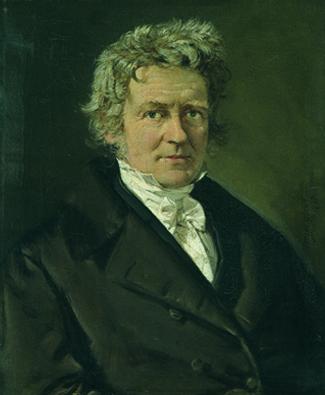
Bessel Measures Stellar Parallax
Friedrich Bessel measured the parallax of 61 Cygni, determining its distance. This was the first reliable measurement of a star's distance, confirming heliocentrism and the vastness of space. #astronomy #parallax #distance
Bessel Measures Stellar Parallax By Christian Albrecht Jensen - Ny Carlsberg Glyptotek, Public domain, https://commons.wikimedia.org/w/index.php?curid=11276529
1843 CE
Doppler Describes Doppler Effect
Christian Doppler proposed the Doppler effect for sound and light. Later applied to astronomy, it enabled measurement of radial velocities of stars and galaxies. #physics #Doppler #waves
1859 CE
Le Verrier Discovers Perihelion Precession of Mercury
Urbain Le Verrier observed that Mercury's orbit precessed more than Newtonian theory predicted, hinting at new physics. This anomaly was later explained by Einstein's general relativity. #astronomy #Mercury #relativity
1868 CE
Helium Discovered in Solar Spectrum
During a solar eclipse, Pierre Janssen observed a new spectral line in the Sun's corona. Norman Lockyer named the element helium, later found on Earth. #astronomy #Sun #helium
Helium Discovered in Solar Spectrum By Alchemist-hp (talk) (www.pse-mendelejew.de) - Own work, GFDL 1.2, https://commons.wikimedia.org/w/index.php?curid=9597822
Aug 12, 1877 CE
Hall Discovers Mars' Moons Phobos and Deimos
Asaph Hall discovered the two small moons of Mars, Phobos and Deimos, using the U.S. Naval Observatory's telescope. Their irregular shapes suggested captured asteroids. #astronomy #Mars #moons
Hall Discovers Mars' Moons Phobos and Deimos By NASA / JPL-Caltech / University of Arizona - http://photojournal.jpl.nasa.gov/catalog/PIA10368, Public domain, https://commons.wikimedia.org/w/index.php?curid=5191977
1887 CE
Michelson-Morley Experiment
Albert Michelson and Edward Morley attempted to detect the luminiferous aether, finding no evidence. This null result paved the way for Einstein's special relativity. #physics #relativity #experiment
Michelson-Morley Experiment By Case Western Reserve University - http://www.cellularuniverse.org/AA2MM_Aether.htm, Public domain, https://commons.wikimedia.org/w/index.php?curid=48697725
1895 CE
Röntgen Discovers X-Rays
Wilhelm Röntgen discovered X-rays, which later became crucial for astronomy (X-ray telescopes). His work opened new windows on the universe. #physics #X-rays #discovery
Röntgen Discovers X-Rays By Erwin Hanfstaengl - https://global.museum-digital.org/singleimage?imagenr=2399678, Public domain, https://commons.wikimedia.org/w/index.php?curid=182243188