Tang Dynasty Poetry: Golden Era of Li Bai, Du Fu & Wang Wei
Encyclopedia/3. History, Societies & Civilizations/01. East Asian Civilizations/01. Chinese Dynasties • Curated by Admin Timeline.sg
The Tang Dynasty (618–907 CE) represents the golden age of classical Chinese poetry, featuring luminaries like Li Bai, Du Fu, Wang Wei, and Bai Juyi. Their works, spanning Daoist lyricism, Confucian realism, Chan Buddhist nature verse, and accessible ballads, have profoundly influenced East Asian literature and culture.
Chronological Storyline (45 Milestones)
618 CE
Tang Dynasty Founded
Li Yuan establishes the Tang Dynasty, ushering in a period of political stability and cultural flourishing that would become the golden age of Chinese poetry. #history #china
Tang Dynasty Founded By Kanguole - Own work Boundaries from Twitchett, Denis and Wechsler, Howard J. (1979), "Kao-tsung (reign 649–83) and the Empress Wu: The Inheritor and the Usurper", in Denis Twitchett and John Fairbank (eds.), The Cambridge History of China, Volume 3: Sui and T'ang China, 589–906, Part I, Cambridge University Press, ISBN 978-0-521-21446-9, (Map 8 p.281) and map 9 (p. 283). Blunden, Caroline and Elvin, Mark (1983), Cultural Atlas of China, Oxford: Phaidon Press, ISBN 0-7148-2309-0, pp. 26, 92–93. Shin, Michael D., ed. (2014) Korean History in Maps, Cambridge University Press, pp. 39, 47 ISBN: 978-1-107-09846-6. (pre-conquest extent of Baekje, approximating the extent of the Ungjin Commandery) Coastline and lakes from Natural Earth 1:50m Physical Vectors Conversion to SVG using svgis, CC BY-SA 4.0, https://commons.wikimedia.org/w/index.php?curid=131635251
618 CE
Early Tang Poets: Four Elites
The 'Four Elites of the Early Tang'—Wang Bo, Yang Jiong, Lu Zhaolin, and Luo Binwang—revitalize poetry, moving away from the ornate Six Dynasties style. #poetry #china
630 CE
Imperial Examination System Expanded
Emperor Taizong expands the civil service examination system, emphasizing Confucian classics and poetry, which elevates the social status of poets and scholars. #education #china
Imperial Examination System Expanded By Qiu Ying (仇英) (attributed) - In the collection of the National Palace Museum, Public domain, https://commons.wikimedia.org/w/index.php?curid=598340
650 CE
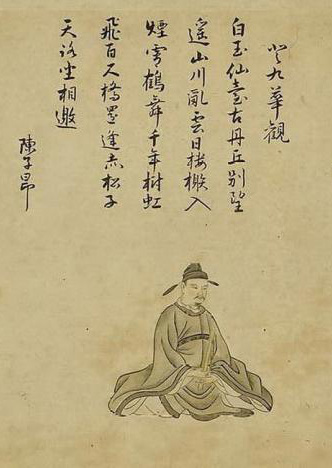
Chen Zi'ang's Poetic Reform
Chen Zi'ang (661–702) advocates for a return to the 'Han-Wei' style, emphasizing substance over ornamentation, influencing High Tang poets. #poetry #china
Chen Zi'ang's Poetic Reform By Kanō Tsunenobu (1636-1713) - http://www.360doc.com/content/15/0302/21/2369606_452072774.shtml, Public domain, https://commons.wikimedia.org/w/index.php?curid=68502305
650 CE
Wang Bo, Early Tang Poet, Born
Wang Bo (c. 650–676), one of the 'Four Elites of the Early Tang,' pioneers the revival of the fu and shi forms, influencing later Tang poetry. #poetry #china )
Wang Bo, Early Tang Poet, Born By No machine-readable author provided. Marchrius~commonswiki assumed (based on copyright claims). - No machine-readable source provided. Own work assumed (based on copyright claims)., CC BY-SA 3.0, https://commons.wikimedia.org/w/index.php?curid=1103561
701 CE
Li Bai and Wang Wei Born
Li Bai (701–762) and Wang Wei (701–761), two of China's greatest poets, are born. Li Bai becomes known for his romantic, Daoist-inspired verse, while Wang Wei excels in Chan Buddhist landscape poetry. #poetry #china
Li Bai and Wang Wei Born By Liang Kai - Cropped from original file located at: E0008311 李白吟行図 - 東京国立博物館 画像検索. Tokyo National Museum., Public domain, https://commons.wikimedia.org/w/index.php?curid=35134
712 CE
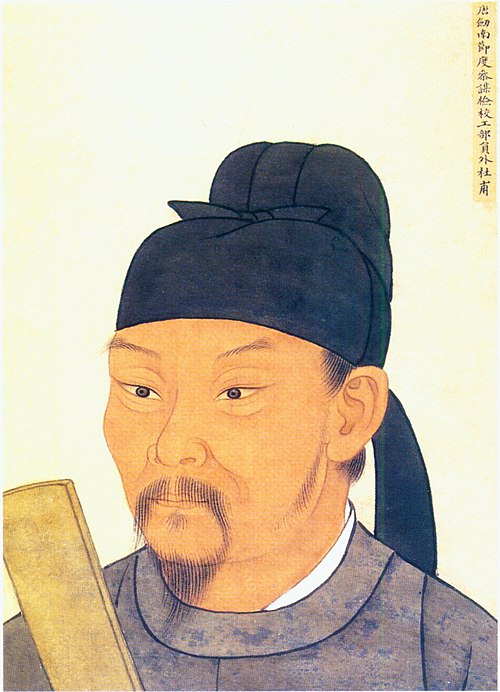
Du Fu Born
Du Fu (712–770), later hailed as the 'Poet Sage,' is born. His work provides a profound historical and moral commentary on the An Lushan Rebellion and Tang society. #poetry #china
Du Fu Born By Unknown author - http://202.121.7.7/person/dzzgx/030124dufu2.jpg, Public domain, https://commons.wikimedia.org/w/index.php?curid=111730
713 CE
Emperor Xuanzong's Reign Begins
Emperor Xuanzong ascends the throne, initiating the 'High Tang' period (713–756), a cultural zenith that fosters the careers of Li Bai, Du Fu, and Wang Wei. #history #china
Emperor Xuanzong's Reign Begins By Unknown author - https://sohanews.sohacdn.com/160588918557773824/2021/9/10/photo-1-1631267454299183080181.jpg, Public domain, https://commons.wikimedia.org/w/index.php?curid=129974569
720 CE
Zhang Jiuling, Poet and Chancellor
Zhang Jiuling (678–740), a poet and chancellor, writes refined poems and mentors younger poets like Wang Wei. #poetry #china
Zhang Jiuling, Poet and Chancellor By Unknown author, Public domain, https://commons.wikimedia.org/w/index.php?curid=1245089
725 CE
Li Bai Travels and Writes 'Quiet Night Thought'
Li Bai composes 'Quiet Night Thought' (静夜思), one of the most famous Chinese poems, reflecting his homesickness during travels. #poetry #china
Li Bai Travels and Writes 'Quiet Night Thought' By Unknown author - Unknown source, Public domain, https://commons.wikimedia.org/w/index.php?curid=151794067
730 CE
Wang Wei's Landscape Poetry Flourishes
Wang Wei, also a painter and musician, creates masterpieces like 'Deer Enclosure' (鹿柴), exemplifying the fusion of poetry, painting, and Chan Buddhism. #poetry #art #china )
Wang Wei's Landscape Poetry Flourishes By Unknown author, Public domain, https://commons.wikimedia.org/w/index.php?curid=1169187
740 CE
Meng Haoran, Landscape Poet, Dies
Meng Haoran (689–740), a pastoral poet known for his nature verse, dies. His work influences Wang Wei and later landscape poetry. #poetry #china
Meng Haoran, Landscape Poet, Dies By Unknown author, Public domain, https://commons.wikimedia.org/w/index.php?curid=1177755
744 CE
Li Bai and Du Fu Meet
Li Bai and Du Fu meet for the first time, forming a legendary friendship that influences both poets' works. Their meeting is a landmark in Chinese literary history. #poetry #china
750 CE
Cen Shen's Frontier Poetry
Cen Shen (715–770) writes vivid frontier poems about the Tang military campaigns in Central Asia, expanding the thematic range of Tang poetry. #poetry #china
Cen Shen's Frontier Poetry By Kanō Tsunenobu (1636-1713) - http://www.360doc.com/content/15/0302/21/2369606_452072774.shtml, Public domain, https://commons.wikimedia.org/w/index.php?curid=68500424
750 CE
Du Fu Writes 'Spring View'
Du Fu composes 'Spring View' (春望), a poignant poem reflecting the devastation of the An Lushan Rebellion, showcasing his historical realism. #poetry #china
755 CE
An Lushan Rebellion Begins
The An Lushan Rebellion (755–763) devastates the Tang Empire, deeply affecting poets like Du Fu, who chronicles the suffering in works like 'The Ballad of the Army Carts.' #history #china
An Lushan Rebellion Begins By SY - Own work, CC BY-SA 4.0, https://commons.wikimedia.org/w/index.php?curid=60785139
756 CE
Emperor Xuanzong Flees Chang'an
During the rebellion, Emperor Xuanzong flees the capital, leading to the death of his beloved consort Yang Guifei, later immortalized in Bai Juyi's 'Song of Everlasting Regret.' #history #china
759 CE
Du Fu Moves to Chengdu
Du Fu settles in Chengdu, where he builds a thatched cottage and writes many of his finest poems, including 'My Thatched Cottage Is Blown Down by the Autumn Wind.' #poetry #china
760 CE
Liu Changqing's Landscape Verse
Liu Changqing (c. 709–785), a poet known for his melancholic landscape poems, gains recognition for works like 'Looking for the Hermit in the Southern Mountain.' #poetry #china
Liu Changqing's Landscape Verse By Unknown author, Public domain, https://commons.wikimedia.org/w/index.php?curid=1169184
761 CE
Wang Wei Dies
Wang Wei dies, leaving a legacy of nature poetry that deeply influences later Chinese landscape verse and Chan Buddhist aesthetics. #poetry #china )
762 CE
Li Bai Dies
Li Bai dies, traditionally said to have drowned while trying to embrace the moon's reflection. His romantic, free-spirited poetry cements his status as the 'Poet Immortal.' #poetry #china
770 CE
Du Fu Dies
Du Fu dies in poverty, but his poetry later gains immense recognition for its moral depth and historical insight, earning him the title 'Poet Sage.' #poetry #china
772 CE
Bai Juyi Born
Bai Juyi (772–846), known for his accessible, socially conscious poetry, is born. He will later write the famous narrative poem 'Song of Everlasting Regret.' #poetry #china
Bai Juyi Born By Unknown author - 清宮殿藏本, Public domain, https://commons.wikimedia.org/w/index.php?curid=151753840
779 CE
Yuan Zhen Born
Yuan Zhen (779–831), a poet and friend of Bai Juyi, co-founds the 'New Yuefu' movement, promoting simple, socially engaged poetry. #poetry #china
Yuan Zhen Born By Unknown author, Public domain, https://commons.wikimedia.org/w/index.php?curid=1177818
780 CE
New Yuefu Movement Emerges
Bai Juyi and Yuan Zhen champion the 'New Yuefu' movement, reviving the folk ballad tradition to address social issues, making poetry accessible to the masses. #poetry #china
800 CE
Han Yu's 'Prose Poetry'
Han Yu writes 'On the Way to Lantian Pass,' a poem blending prose and verse, reflecting his innovative approach to literary form. #poetry #china
806 CE
Bai Juyi Passes Imperial Exam
Bai Juyi passes the jinshi examination, beginning his official career. His poetry often critiques social injustice and advocates for the common people. #education #china
809 CE
Bai Juyi Writes 'Song of Everlasting Regret'
Bai Juyi composes 'Song of Everlasting Regret' (长恨歌), a narrative poem about Emperor Xuanzong and Yang Guifei, becoming one of the most famous poems in Chinese literature. #poetry #china
810 CE
Li He's 'Dream of Heaven'
Li He writes 'Dream of Heaven' (梦天), a surreal poem exploring cosmic themes, showcasing his imaginative style. #poetry #china
816 CE
Bai Juyi Writes 'The Old Charcoal Seller'
Bai Juyi writes 'The Old Charcoal Seller' (卖炭翁), a poignant social critique highlighting the plight of the poor, exemplifying his New Yuefu style. #poetry #china
820 CE
Han Yu's Prose and Poetry Influence
Han Yu (768–824), a leading Confucian scholar and poet, advocates for a return to classical prose and poetry, influencing the literary scene. #literature #china
Han Yu's Prose and Poetry Influence By AnonymousUnknown author - Digitized by National Palace Museum; file is directly from Shuge, Public domain, https://commons.wikimedia.org/w/index.php?curid=126996542
825 CE
Li He, 'Ghost Poet,' Dies
Li He (790–816), known for his fantastical and melancholic poetry, dies young. His unique style influences later poets. #poetry #china
Li He, 'Ghost Poet,' Dies By Unknown author, Public domain, https://commons.wikimedia.org/w/index.php?curid=1165703
830 CE
Du Mu, Late Tang Poet, Active
Du Mu (803–852), a prominent Late Tang poet, writes lyrical poems often reflecting on history and beauty, such as 'Red Cliff.' #poetry #china
Du Mu, Late Tang Poet, Active By Unknown author, Public domain, https://commons.wikimedia.org/w/index.php?curid=1165711
830 CE
Wen Tingyun, Ci Poet, Active
Wen Tingyun (812–870), a pioneer of the 'ci' (lyric) form, writes sensual, musical poems that influence the development of Song dynasty ci poetry. #poetry #china
Wen Tingyun, Ci Poet, Active By Unknown author, Public domain, https://commons.wikimedia.org/w/index.php?curid=1169176
835 CE
Li Shangyin Born
Li Shangyin (c. 813–858), a master of the 'jintishi' (regulated verse), is born. His ambiguous, allusive love poems are highly regarded. #poetry #china
Li Shangyin Born By Kanō Tsunenobu (1636-1713) - http://www.360doc.com/content/15/0302/21/2369606_452072774.shtml, Public domain, https://commons.wikimedia.org/w/index.php?curid=68501473
840 CE
Late Tang Poetic Diversity
The Late Tang period sees diverse poetic voices, including the pastoral poet Meng Jiao (751–814) and the hermit poet Jia Dao (779–843), known for his meticulous craftsmanship. #poetry #china
Late Tang Poetic Diversity By Original uploader was Spencer195 at en.wikipedia - Transferred from en.wikipedia, CC BY-SA 3.0, https://commons.wikimedia.org/w/index.php?curid=7448762
845 CE
Bai Juyi Retires to Xiangshan
Bai Juyi retires to Xiangshan (Fragrant Mountain) and devotes himself to Buddhist practice and poetry, compiling his works. #poetry #china
846 CE
Bai Juyi Dies
Bai Juyi dies, leaving a vast corpus of over 2,800 poems. His accessible style and social themes make him widely popular in East Asia. #poetry #china
850 CE
Compilation of 'Three Hundred Tang Poems' Begins
The anthology 'Three Hundred Tang Poems' (唐诗三百首), later compiled in the 18th century, begins to take shape, preserving the most celebrated Tang poems. #poetry #china
Compilation of 'Three Hundred Tang Poems' Begins By First compiled around 1763 by Sun Zhu (1722-1778), the Qing Dynasty scholar, also known as Hengtang Tuishi Published in 1932 民国二十年上海扫叶山房石印本。 - Three Hundred Tang Poems, with citations., Public domain, https://commons.wikimedia.org/w/index.php?curid=69950120
858 CE
Li Shangyin Dies
Li Shangyin dies, leaving a legacy of intricate, emotionally rich poetry that influences later Chinese and Japanese literature. #poetry #china
860 CE
Tang Poetry Influences Japan
Tang poetry, especially works of Bai Juyi, becomes highly influential in Heian Japan, inspiring Japanese poets like Murasaki Shikibu and the compilation of 'Kokinshu.' #poetry #japan
Tang Poetry Influences Japan By Unknown author - Image: http://collections.lacma.org/sites/default/files/remote_images/piction/ma-31778963-O3.jpg Gallery: http://collections.lacma.org/node/192474 archive copy at the Wayback Machine, Public domain, https://commons.wikimedia.org/w/index.php?curid=27357726
870 CE
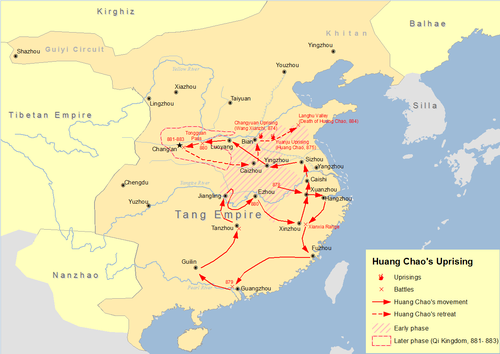
Huang Chao Rebellion Begins
The Huang Chao Rebellion (874–884) further destabilizes the Tang, leading to the destruction of Chang'an and the loss of many literary works. #history #china
Huang Chao Rebellion Begins By SY - Own work, CC BY-SA 4.0, https://commons.wikimedia.org/w/index.php?curid=60790769
880 CE
Wei Zhuang, Poet of the Late Tang, Active
Wei Zhuang (c. 836–910), a poet and lyricist, writes about the fall of the Tang, capturing the era's melancholy in works like 'The Lament of the Lady of Qin.' #poetry #china
904 CE
Zhu Wen Usurps the Throne
Zhu Wen forces Emperor Zhaozong to move the capital, signaling the imminent end of the Tang. Poets like Du Xunhe (846–904) reflect the turmoil. #history #china
Zhu Wen Usurps the Throne By Unknown author - 中国历史博物馆保管部, ed. (2003) 中国历代名人画像谱 1, 福州: 海峡文艺出版社, p. 52 ISBN: 7806407855., Public domain, https://commons.wikimedia.org/w/index.php?curid=155999119
907 CE
Tang Dynasty Falls
The Tang Dynasty officially ends, but its poetic legacy endures. The 'Three Hundred Tang Poems' anthology later becomes a cornerstone of Chinese education and culture. #history #poetry #china