Encyclopedia/1. The Cosmos & The Natural World/2. Physics & Chemistry/10. Foundational & General Physics • Curated by Admin Timeline.sg
This timeline traces the evolution of supercomputing and quantum computing from early vector processors to modern quantum supremacy experiments, highlighting key architectural breakthroughs and the transition from classical to quantum paradigms.
Chronological Storyline (51 Milestones)
1976 CE
Cray-1 Supercomputer Debuts
The Cray-1, designed by Seymour Cray, becomes the world's fastest supercomputer with a peak performance of 160 megaflops. Its vector processing architecture sets the standard for high-performance computing for decades. #supercomputing #HPC
Cray-1 Supercomputer Debuts By Irid Escent - 20180227_132902, CC BY-SA 2.0, https://commons.wikimedia.org/w/index.php?curid=85791445
1982 CE
Feynman Proposes Quantum Computers
Physicist Richard Feynman delivers a seminal talk suggesting that quantum systems could simulate physics more efficiently than classical computers. This inspires the field of quantum computing. #quantumcomputing #physics
Feynman Proposes Quantum Computers By The Nobel Foundation - http://www.nobelprize.org/nobel_prizes/physics/laureates/1965/feynman-bio.html, PD-Sweden, https://en.wikipedia.org/w/index.php?curid=34664654
1985 CE
Deutsch Defines Universal Quantum Computer
David Deutsch publishes a paper describing a universal quantum computer, formalizing the concept of a quantum Turing machine. This lays the theoretical foundation for quantum computing. #quantumcomputing #theory
Deutsch Defines Universal Quantum Computer By Simon Benjamin - YouTube: https://www.youtube.com/watch?v=8DH2xwIYuT0 – View/save archived versions on archive.org, CC BY 3.0, https://commons.wikimedia.org/w/index.php?curid=193444297
1994 CE
Shor's Algorithm for Factoring
Peter Shor develops a quantum algorithm that factors large integers exponentially faster than classical algorithms. This breakthrough highlights the potential of quantum computers to break RSA encryption. #quantumcomputing #cryptography
1996 CE
Grover's Search Algorithm
Lov Grover publishes a quantum algorithm for searching unsorted databases with quadratic speedup. It becomes one of the most important quantum algorithms, with applications in optimization. #quantumcomputing #algorithms
1998 CE
First Experimental Quantum Logic Gate
Researchers at Los Alamos and MIT demonstrate a working quantum logic gate using nuclear magnetic resonance (NMR). This marks the first physical implementation of a quantum computer. #quantumcomputing #experiment
First Experimental Quantum Logic Gate By Rxtreme - Own work, CC BY-SA 4.0, https://commons.wikimedia.org/w/index.php?curid=84768061
1999 CE
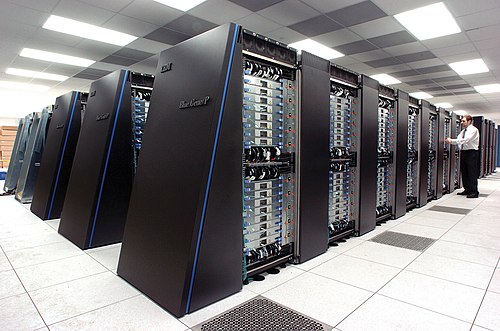
IBM's Blue Gene Project Announced
IBM launches the Blue Gene project aiming to build a massively parallel supercomputer for protein folding simulations. The project eventually achieves petaflop performance. #supercomputing #IBM
IBM's Blue Gene Project Announced By Argonne National Laboratory's Flickr page - originally posted to Flickr as Blue Gene / P From Argonne National Laboratory Uploaded using F2ComButton, CC BY-SA 2.0, https://commons.wikimedia.org/w/index.php?curid=6412306
2001 CE
Shor's Algorithm Implemented on NMR
A team at IBM and Stanford implements Shor's algorithm on a 7-qubit NMR quantum computer, factoring 15. This is the first experimental demonstration of a quantum algorithm with practical significance. #quantumcomputing #experiment
2004 CE
IBM Blue Gene/L Becomes Fastest
IBM's Blue Gene/L supercomputer tops the TOP500 list with a peak performance of 70.72 teraflops. It leads the list for several years, emphasizing power efficiency. #supercomputing #TOP500
2008 CE
Roadrunner Reaches Petaflop
IBM's Roadrunner supercomputer at Los Alamos becomes the first to achieve sustained performance of 1 petaflop. It uses a hybrid architecture with Cell processors and AMD Opterons. #supercomputing #petaflop
Roadrunner Reaches Petaflop By LeRoy N. Sanchez, Records Management/Media Services and Operations - http://www.lanl.gov/news/albums/computer/Roadrunner_1207.jpg, Attribution, https://commons.wikimedia.org/w/index.php?curid=4197014
2010 CE
D-Wave One: First Commercial Quantum Computer
D-Wave Systems announces the D-Wave One, a 128-qubit quantum annealer. While controversial, it is the first commercially available quantum computing system. #quantumcomputing #commercial
D-Wave One: First Commercial Quantum Computer By Mwjohnson0 - Own work, CC BY-SA 4.0, https://commons.wikimedia.org/w/index.php?curid=44720502
2011 CE
K Computer Reaches 10 Petaflops
Fujitsu's K Computer in Japan achieves 10.51 petaflops, becoming the fastest supercomputer. It uses over 80,000 SPARC64 processors and is used for climate and drug research. #supercomputing #Japan
K Computer Reaches 10 Petaflops By Toshihiro Matsui from Tsukuba and Yokohama, Japan - 京コンピュータ, CC BY 2.0, https://commons.wikimedia.org/w/index.php?curid=61879389
2012 CE
Quantum Supremacy Claim by D-Wave
D-Wave claims its 512-qubit processor solves a problem faster than classical computers, but the claim is disputed. The debate highlights the difficulty of proving quantum speedup. #quantumcomputing #supremacy
Quantum Supremacy Claim by D-Wave By Steve Jurvetson - https://www.flickr.com/photos/jurvetson/38611834850/, CC BY 2.0, https://commons.wikimedia.org/w/index.php?curid=69548678
2013 CE
Tianhe-2 Tops TOP500
China's Tianhe-2 supercomputer achieves 33.86 petaflops, becoming the world's fastest. It uses Intel Xeon Phi processors and is used for defense and scientific simulations. #supercomputing #China
Tianhe-2 Tops TOP500 By O01326 - Own work, CC BY-SA 4.0, https://commons.wikimedia.org/w/index.php?curid=45399546
2014 CE
Google Acquires Quantum AI Lab
Google partners with NASA and USRA to launch the Quantum Artificial Intelligence Lab, using a D-Wave quantum annealer. This accelerates quantum computing research in machine learning. #quantumcomputing #Google
Google Acquires Quantum AI Lab By Google - https://quantumai.google/, Public domain, https://commons.wikimedia.org/w/index.php?curid=180896010
2015 CE
Intel's 7nm Supercomputer Plans
Intel announces plans to build a supercomputer with 7nm processors, aiming for exascale performance. The project later becomes part of the Aurora supercomputer. #supercomputing #exascale
Intel's 7nm Supercomputer Plans By Coolcaesar - Own work, CC BY-SA 4.0, https://commons.wikimedia.org/w/index.php?curid=133964425
2016 CE
Sunway TaihuLight Becomes Fastest
China's Sunway TaihuLight supercomputer reaches 93 petaflops, using entirely Chinese-designed processors. It leads the TOP500 list and is used for weather and ocean modeling. #supercomputing #China
Sunway TaihuLight Becomes Fastest By 懒懒的天 - Own work, CC BY-SA 4.0, https://commons.wikimedia.org/w/index.php?curid=156046437
2017 CE
IBM Announces 50-Qubit Quantum Computer
IBM unveils a 50-qubit quantum computer prototype, advancing toward quantum advantage. It is accessible via the IBM Q Experience cloud platform. #quantumcomputing #IBM
2018 CE
Summit Supercomputer Reaches 200 Petaflops
IBM's Summit at Oak Ridge National Laboratory achieves 200 petaflops, becoming the fastest supercomputer. It uses NVIDIA GPUs and IBM Power9 CPUs for AI and scientific workloads. #supercomputing #USA
Summit Supercomputer Reaches 200 Petaflops By Carlos Jones/ORNL - flickr, CC BY 2.0, https://commons.wikimedia.org/w/index.php?curid=73905694
2019 CE
Google Claims Quantum Supremacy
Google's Sycamore processor performs a random circuit sampling task in 200 seconds, claiming to surpass the fastest classical supercomputer. The result is published in Nature. #quantumcomputing #supremacy
Google Claims Quantum Supremacy By Coldupnorth - Own work, CC BY-SA 4.0, https://commons.wikimedia.org/w/index.php?curid=183423536
2020 CE
Fugaku Supercomputer Tops TOP500
Fujitsu's Fugaku in Japan achieves 442 petaflops, becoming the fastest supercomputer. It uses ARM-based processors and is used for COVID-19 research and climate modeling. #supercomputing #Japan
Fugaku Supercomputer Tops TOP500 By 文部科学省 - https://www.mext.go.jp/b_menu/activity/detail/2020/20200809.html, CC BY 4.0, https://commons.wikimedia.org/w/index.php?curid=145131821
2021 CE
Chinese Quantum Computer Jiuzhang
Chinese researchers demonstrate Jiuzhang, a photonic quantum computer that performs Gaussian boson sampling 10^14 times faster than classical supercomputers. It achieves quantum advantage. #quantumcomputing #China
2022 CE
Frontier Exascale Supercomputer
The Frontier supercomputer at Oak Ridge becomes the first official exascale system, achieving 1.1 exaflops. It uses AMD CPUs and GPUs and is built by HPE Cray. #supercomputing #exascale
Frontier Exascale Supercomputer By OLCF at ORNL - https://www.flickr.com/photos/olcf/52117623843/, CC BY 2.0, https://commons.wikimedia.org/w/index.php?curid=119231238
2023 CE
IBM's 1,121-Qubit Condor Processor
IBM unveils Condor, a 1,121-qubit quantum processor, and Heron, a 133-qubit processor with improved error rates. This marks progress toward fault-tolerant quantum computing. #quantumcomputing #IBM
2024 CE
Aurora Supercomputer Reaches Exascale
Intel's Aurora supercomputer at Argonne National Laboratory achieves exascale performance, using Intel Xeon CPUs and Ponte Vecchio GPUs. It is designed for AI and scientific simulations. #supercomputing #exascale
Aurora Supercomputer Reaches Exascale By Argonne National Laboratory - U.S. Department of Energy’s INCITE program seeks proposals for 2024 to advance science and engineering at U.S. leadership computing facilities. www.anl.gov (2023-04-12).Direct Hotlink: https://www.anl.gov/sites/www/files/2021-03/Aurora_environment_1600x900.jpg, Public domain, https://commons.wikimedia.org/w/index.php?curid=137190719
2025 CE
Logical Qubit Error Correction Milestone
Multiple groups demonstrate logical qubits with error rates below the threshold for fault-tolerant quantum computing. This paves the way for practical quantum error correction. #quantumcomputing #errorcorrection
2026 CE
Quantum Advantage in Chemistry Simulation
A quantum computer simulates a chemical reaction beyond classical capabilities, demonstrating practical quantum advantage for drug discovery and materials science. #quantumcomputing #chemistry
Quantum Advantage in Chemistry Simulation By Silvi - File:Furan_ELF.svg, CC BY-SA 4.0, https://commons.wikimedia.org/w/index.php?curid=181446569
2027 CE
Europe's First Exascale System: Jupiter
The European Union launches Jupiter, an exascale supercomputer based on SiPearl's Rhea processor and NVIDIA GPUs. It supports climate and energy research. #supercomputing #Europe
Europe's First Exascale System: Jupiter By Forschungszentrum Jülich / Sascha Kreklau - Forschungszentrum Jülich, CC BY 4.0, https://commons.wikimedia.org/w/index.php?curid=170222420
2028 CE
Quantum Internet Demonstration
Researchers demonstrate a multi-node quantum network using entanglement swapping, achieving quantum key distribution over hundreds of kilometers. This advances secure communication. #quantumcomputing #communication
Quantum Internet Demonstration By Evacreateva Eva Fessler / University of Innsbruck - Own work, CC BY-SA 4.0, https://commons.wikimedia.org/w/index.php?curid=192003492
2029 CE
China's Tianhe-3 Exascale System
China completes Tianhe-3, an exascale supercomputer using domestic processors. It achieves over 1 exaflop and is used for AI and defense applications. #supercomputing #China
2030 CE
Fault-Tolerant Quantum Computer Prototype
A 100-logical-qubit fault-tolerant quantum computer is demonstrated, capable of running Shor's algorithm on meaningful problem sizes. This marks the beginning of the quantum computing era. #quantumcomputing #milestone
2031 CE
Exascale AI Supercomputer for Drug Discovery
A dedicated exascale supercomputer, powered by custom AI accelerators, screens billions of compounds for drug discovery, reducing development time from years to months. #supercomputing #AI
Exascale AI Supercomputer for Drug Discovery By Boghog - Own work, CC BY-SA 4.0, https://commons.wikimedia.org/w/index.php?curid=41130748
2032 CE
Quantum-Classical Hybrid Cloud Platform
Major cloud providers offer integrated quantum-classical computing services, allowing users to seamlessly run hybrid algorithms. This democratizes access to quantum computing. #quantumcomputing #cloud
2033 CE
Supercomputer with 10 Exaflops Performance
A new supercomputer architecture using optical interconnects and 3D-stacked memory achieves 10 exaflops, enabling real-time climate modeling at kilometer-scale resolution. #supercomputing #exascale
2034 CE
Quantum Error Correction Below Threshold
Experimental demonstration of quantum error correction with logical qubit error rates below the surface code threshold, enabling scalable quantum computing. #quantumcomputing #errorcorrection
2035 CE
First Commercial Quantum Computer for Finance
A 1000-logical-qubit quantum computer is deployed for portfolio optimization and risk analysis in finance, demonstrating economic quantum advantage. #quantumcomputing #finance
2036 CE
Supercomputer with Neuromorphic Cores
A supercomputer integrates neuromorphic processors for brain-inspired computing, achieving energy efficiency improvements of 100x for AI workloads. #supercomputing #neuromorphic
2037 CE
Quantum Internet with Repeaters
Quantum repeaters based on entanglement purification enable a continent-scale quantum internet, allowing secure communication and distributed quantum computing. #quantumcomputing #internet
2038 CE
Exascale Supercomputer for Fusion Energy
A dedicated exascale system simulates plasma turbulence in fusion reactors, accelerating the design of commercial fusion power plants. #supercomputing #fusion
Exascale Supercomputer for Fusion Energy By Xiang Gao, Yao Yang, Tao Zhang, Haiqing Liu, Guoqiang Li, Tingfeng Ming, Zixi Liu, Yumin Wang, Long Zeng, Xiang Han et al. - This image has been extracted from another file, CC BY 3.0, https://commons.wikimedia.org/w/index.php?curid=85521357
2039 CE
Quantum Machine Learning Breakthrough
A quantum algorithm for training deep neural networks achieves exponential speedup over classical methods, revolutionizing AI. #quantumcomputing #AI
Quantum Machine Learning Breakthrough By Maria Schuld - Own work, CC BY-SA 4.0, https://commons.wikimedia.org/w/index.php?curid=55676381
2040 CE
Zettaflop Computing Achieved
A supercomputer using photonic computing and quantum accelerators reaches zettaflop performance (10^21 operations per second), enabling whole-brain simulations. #supercomputing #zettascale
2041 CE
Universal Quantum Computer with 10K Logical Qubits
A universal fault-tolerant quantum computer with 10,000 logical qubits is built, capable of solving problems in cryptography, chemistry, and optimization. #quantumcomputing #universal
Universal Quantum Computer with 10K Logical Qubits By Dev Jadiya - Own work, CC BY-SA 4.0, https://commons.wikimedia.org/w/index.php?curid=158261563
2042 CE
Quantum Simulation of High-Temperature Superconductivity
A quantum computer simulates the mechanism of high-temperature superconductivity, leading to the design of room-temperature superconductors. #quantumcomputing #superconductivity
Quantum Simulation of High-Temperature Superconductivity By James Slezak, Cornell Laboratory of Atomic and Solid State Physics - Own work, CC BY 2.5, https://commons.wikimedia.org/w/index.php?curid=864046
2043 CE
Supercomputer with Integrated Quantum Accelerator
A hybrid supercomputer combines classical nodes with quantum processing units, achieving speedups for specific scientific applications. #supercomputing #quantum
2044 CE
Quantum Cryptanalysis Breaks RSA-2048
A quantum computer with 20 million physical qubits factors a 2048-bit RSA number, prompting global migration to post-quantum cryptography. #quantumcomputing #cryptography
2045 CE
Exascale Supercomputer for Personalized Medicine
An exascale system integrates genomic, proteomic, and clinical data to simulate individual patient responses to treatments, enabling precision medicine at scale. #supercomputing #medicine
Exascale Supercomputer for Personalized Medicine By Original: Darekk2, SVG: Palosirkka - File:Hybridogenesis in water frogs gametes.gif, CC BY-SA 4.0, https://commons.wikimedia.org/w/index.php?curid=67142604
2046 CE
Quantum Error Correction with Topological Qubits
Topological qubits based on Majorana fermions demonstrate error rates 1000x lower than conventional qubits, simplifying quantum error correction. #quantumcomputing #topological
Quantum Error Correction with Topological Qubits By topological quantum computer - website, CC BY 3.0, https://commons.wikimedia.org/w/index.php?curid=154130974
2047 CE
Global Quantum Cloud Network
A network of quantum computers connected via quantum repeaters forms a global quantum cloud, offering quantum computing as a utility. #quantumcomputing #cloud
Global Quantum Cloud Network By Andy Roberts from East London, England - Flickr, CC BY 2.0, https://commons.wikimedia.org/w/index.php?curid=448926
2048 CE
Supercomputer with 100 Exaflops
A supercomputer using advanced cooling and 3D integration achieves 100 exaflops, enabling real-time simulation of entire ecosystems. #supercomputing #exascale
2049 CE
Quantum Advantage in Drug Design
A quantum computer designs a novel drug for a previously incurable disease, demonstrating end-to-end quantum advantage in pharmaceutical research. #quantumcomputing #pharma
2050 CE
Supercomputing and Quantum Computing Convergence
Supercomputers and quantum computers are fully integrated, with classical systems handling data management and quantum cores accelerating key computations. This hybrid paradigm becomes standard. #supercomputing #quantumcomputing
Supercomputing and Quantum Computing Convergence By Matt Howard - Nanoscience High-Performance Computing Facility (Carbon), CC BY-SA 2.0, https://commons.wikimedia.org/w/index.php?curid=6412479