Encyclopedia/2. Technology & The Built World/1. Computing, AI & Information Technology • Curated by Admin Timeline.sg
This timeline traces the evolution of supercomputers and high-performance computing from ancient computational devices to modern exascale systems, highlighting key architectural innovations, global contributions, and landmark machines that pushed the boundaries of processing power and parallelism.
Chronological Storyline (40 Milestones)
100 BCE
Antikythera Mechanism Created
Ancient Greek analog computer used to predict astronomical positions and eclipses. Demonstrates early mechanical computation. #computing #history
Antikythera Mechanism Created By Logg Tandy - Own work, CC BY 4.0, https://commons.wikimedia.org/w/index.php?curid=164647291
1623 CE
Schickard's Calculating Clock
Wilhelm Schickard builds the first known mechanical calculator, capable of addition and subtraction. Lays groundwork for automated computation. #computing #invention
Schickard's Calculating Clock By Conrad Melperger - eingescannt aus: Roman Janssen; Oliver Auge (Hg.): Herrenberger Persönlichkeiten aus acht Jahrhunderten, Herrenberg 1999, ISBN 3-926809-09-4, S. 190., Public domain, https://commons.wikimedia.org/w/index.php?curid=6805089
1642 CE
Pascal's Calculator (Pascaline)
Blaise Pascal invents a mechanical calculator for arithmetic operations, influencing future designs. #computing #invention
Pascal's Calculator (Pascaline) By Rama - Own work, CC BY-SA 3.0 fr, https://commons.wikimedia.org/w/index.php?curid=53246694
1837 CE
Babbage's Analytical Engine Conceived
Charles Babbage designs the first general-purpose computer, featuring a stored program concept. Never built, but foundational to computing. #computing #history
Babbage's Analytical Engine Conceived By Charles Babbage - Upload by Mrjohncummings 2013-08-28 15:10, CC BY-SA 2.0, https://commons.wikimedia.org/w/index.php?curid=28024313
1890 CE
Hollerith Tabulating Machine
Herman Hollerith's punched card machine accelerates US Census processing, leading to IBM's formation. #computing #invention
Hollerith Tabulating Machine By Charles Milton Bell - This image is available from the United States Library of Congress's Prints and Photographs division under the digital ID cph.3c15982.This tag does not indicate the copyright status of the attached work. A normal copyright tag is still required. See Commons:Licensing., Public domain, https://commons.wikimedia.org/w/index.php?curid=31281
1936 CE
Turing Machine Formalized
Alan Turing publishes his theoretical model of computation, defining the limits of what computers can do. #computing #theory
Turing Machine Formalized By Rocky Acosta - Own work, CC BY 3.0, https://commons.wikimedia.org/w/index.php?curid=24369879
1941 CE
Zuse Z3 Completed
Konrad Zuse's Z3 is the world's first working programmable, fully automatic digital computer, using electromechanical relays. #computing #history )
Zuse Z3 Completed By File:Z3 Deutsches Museum.JPG: Venusianer at German Wikipedia derivative work: Georgfotoart - This file was derived from: Z3 Deutsches Museum.JPG:, CC BY-SA 3.0, https://commons.wikimedia.org/w/index.php?curid=174765304
1944 CE
Harvard Mark I Operational
IBM's Harvard Mark I is an electromechanical computer used for ballistic calculations. #computing #history
Harvard Mark I Operational By The original uploader was Daderot at English Wikipedia. - Transferred from en.wikipedia to Commons., CC BY-SA 3.0, https://commons.wikimedia.org/w/index.php?curid=1831688
1945 CE
ENIAC Completed
ENIAC, the first general-purpose electronic digital computer, performs calculations for hydrogen bomb development. #computing #history
ENIAC Completed By The original uploader was TexasDex at English Wikipedia. - Transferred from en.wikipedia to Commons by Andrei Stroe using CommonsHelper., CC BY-SA 3.0, https://commons.wikimedia.org/w/index.php?curid=6557095
1949 CE
Manchester Mark 1 and EDSAC
The Manchester Mark 1 uses Williams tube memory, while EDSAC runs the first stored-program computer. #computing #history
1951 CE
UNIVAC I Delivered to US Census
The first commercially available computer, UNIVAC I, processes census data and popularizes computing. #computing #history
UNIVAC I Delivered to US Census By U.S. Census Bureau employees - https://www.census.gov/history/, Public domain, https://commons.wikimedia.org/w/index.php?curid=61118833
1956 CE
IBM 704 and FORTRAN
IBM 704 is the first mass-produced computer with floating-point hardware; FORTRAN is developed for scientific computing. #computing #programming
IBM 704 and FORTRAN By NASA - Great Images in NASA Description, Public domain, https://commons.wikimedia.org/w/index.php?curid=6455009
1960 CE
CDC 1604 Released
Seymour Cray's first supercomputer design, the CDC 1604, uses transistors and sets speed records. #supercomputing #history
CDC 1604 Released By FlyAkwa - Own work, CC BY-SA 4.0, https://commons.wikimedia.org/w/index.php?curid=70701983
1964 CE
CDC 6600 – First Supercomputer
Seymour Cray's CDC 6600 is considered the first true supercomputer, with a performance of 3 megaflops. #supercomputing #history
CDC 6600 – First Supercomputer By FlyAkwa - Own work Data & Pictures : Science Museum Data & Pictures : Computer History Museum Data : CYBER 170 Systems Hardware Handbook Aug 75 Pictures : Histoire de l'Informatique, CC BY-SA 4.0, https://commons.wikimedia.org/w/index.php?curid=70665171
1969 CE
ARPANET Established
The precursor to the internet connects supercomputer centers and researchers, enabling distributed computing. #networking #history
ARPANET Established By ARPANET - The Computer History Museum ([1]), en:File:Arpnet-map-march-1977.png, Public domain, https://commons.wikimedia.org/w/index.php?curid=9990864
1972 CE
Cray Research Founded
Seymour Cray leaves CDC to found Cray Research, designing the world's fastest computers. #supercomputing #history
1976 CE
Cray-1 Released
The Cray-1 achieves 160 megaflops with its vector processing architecture and distinctive C-shaped design. #supercomputing #history
Cray-1 Released By Irid Escent - 20180227_132902, CC BY-SA 2.0, https://commons.wikimedia.org/w/index.php?curid=85791445
1981 CE
ILLIAC IV – Parallel Computing Pioneer
ILLIAC IV, one of the first massively parallel machines, uses 64 processors to achieve high speed. #supercomputing #parallel
ILLIAC IV – Parallel Computing Pioneer By Steve Jurvetson from Menlo Park, USA - Flickr, CC BY 2.0, https://commons.wikimedia.org/w/index.php?curid=755549
1982 CE
Connection Machine CM-1 Announced
Thinking Machines Corporation introduces the Connection Machine, a massively parallel SIMD supercomputer. #supercomputing #parallel
Connection Machine CM-1 Announced By Logg Tandy - Own work, CC BY 4.0, https://commons.wikimedia.org/w/index.php?curid=183178064
1984 CE
Fujitsu VP-200 Vector Supercomputer
Japan enters supercomputing with Fujitsu's VP series, challenging US dominance. #supercomputing #japan
1985 CE
Cray-2 with Liquid Immersion Cooling
Cray-2 packs 4 processors and uses liquid immersion cooling to achieve 1.9 gigaflops. #supercomputing #cooling
Cray-2 with Liquid Immersion Cooling By Rama - Own work, CC BY-SA 3.0 fr, https://commons.wikimedia.org/w/index.php?curid=14305809
1987 CE
Meiko Computing Surface – Transputer-Based
Meiko's Computing Surface uses Inmos Transputers for parallel processing, a stepping stone to clusters. #supercomputing #parallel )
The TOP500 list begins ranking the world's fastest supercomputers biannually, driving competition. #supercomputing #benchmark
TOP500 List Launched By TOP500 - https://top500.org/resources/top500-logo-usage (converted from EPS to SVG by me), Public domain, https://commons.wikimedia.org/w/index.php?curid=109493583
1996 CE
ASCI Red – First Teraflop Computer
Intel's ASCI Red reaches over 1 teraflop for nuclear stockpile simulation, the first to break the teraflop barrier. #supercomputing #teraflop
ASCI Red – First Teraflop Computer By Sandia National Laboratories - https://web.archive.org/web/19990202210213/http://www.sandia.gov/ASCI/images/RedPictures.htm, Public domain, https://commons.wikimedia.org/w/index.php?curid=28171282
2002 CE
Earth Simulator Tops TOP500
NEC's Earth Simulator runs at 35.6 teraflops, leading in climate modeling and highlighting vector architecture. #supercomputing #japan
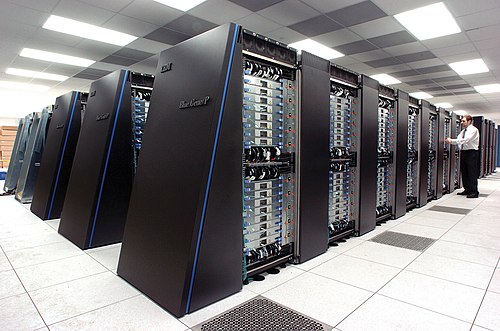
IBM Blue Gene/L Begins Deployment By Argonne National Laboratory's Flickr page - originally posted to Flickr as Blue Gene / P From Argonne National Laboratory Uploaded using F2ComButton, CC BY-SA 2.0, https://commons.wikimedia.org/w/index.php?curid=6412306
Roadrunner – First Petaflop System By LeRoy N. Sanchez, Records Management/Media Services and Operations - http://www.lanl.gov/news/albums/computer/Roadrunner_1207.jpg, Attribution, https://commons.wikimedia.org/w/index.php?curid=4197014
2009 CE
China's Tianhe-1A Tops World
Tianhe-1A becomes China's first world-leading supercomputer, using hybrid architecture. #supercomputing #china
China's Tianhe-1A Tops World By Nakrut - Own work, CC BY-SA 4.0, https://commons.wikimedia.org/w/index.php?curid=61056973
2011 CE
Japan's K Computer Reaches 10 Petaflops
Fujitsu's K computer achieves 10.51 petaflops, using SPARC64 processors and water cooling. #supercomputing #japan
Japan's K Computer Reaches 10 Petaflops By Toshihiro Matsui from Tsukuba and Yokohama, Japan - 京コンピュータ, CC BY 2.0, https://commons.wikimedia.org/w/index.php?curid=61879389
2012 CE
IBM Sequoia – Blue Gene/Q Due to Power
Sequoia reaches 16.32 petaflops for nuclear simulations, using 1.6 million cores. #supercomputing #ibm
IBM Sequoia – Blue Gene/Q Due to Power By Lawrence Livermore National Laboratory - https://computing.llnl.gov/tutorials/bgq/index.html, Public domain, https://commons.wikimedia.org/w/index.php?curid=28281589
2013 CE
Tianhe-2 Tops with 33.86 Petaflops
China's Tianhe-2 remains top for three years, using Intel Xeon Phi accelerators. #supercomputing #china
Tianhe-2 Tops with 33.86 Petaflops By O01326 - Own work, CC BY-SA 4.0, https://commons.wikimedia.org/w/index.php?curid=45399546
2016 CE
Sunway TaihuLight – Pure Chinese Architecture
Sunway TaihuLight peaks at 93 petaflops using native SW26010 processors, avoiding foreign tech. #supercomputing #china
Sunway TaihuLight – Pure Chinese Architecture By 懒懒的天 - Own work, CC BY-SA 4.0, https://commons.wikimedia.org/w/index.php?curid=156046437
2018 CE
Summit – US Returns to Top
IBM's Summit at Oak Ridge reaches 122.3 petaflops, optimized for AI workloads with NVIDIA GPUs. #supercomputing #usa )
Summit – US Returns to Top By Carlos Jones/ORNL - flickr, CC BY 2.0, https://commons.wikimedia.org/w/index.php?curid=73905694
2020 CE
Fugaku Crowned Fastest
Fujitsu's Fugaku tops at 442 petaflops, using ARM-based A64FX processors and winning multiple benchmarks. #supercomputing #japan )
Fugaku Crowned Fastest By 文部科学省 - https://www.mext.go.jp/b_menu/activity/detail/2020/20200809.html, CC BY 4.0, https://commons.wikimedia.org/w/index.php?curid=145131821
2021 CE
Perlmutter and LUMI Lead Exascale Race
Cray-AMD based Perlmutter and the European LUMI system approach exascale, with LUMI at 375 petaflops. #supercomputing #exascale )
2022 CE
Frontier – First Official Exascale Computer
HPE Cray's Frontier at Oak Ridge reaches 1.102 exaflops, marking the exascale era. #supercomputing #exascale )
Frontier – First Official Exascale Computer By OLCF at ORNL - https://www.flickr.com/photos/olcf/52117623843/, CC BY 2.0, https://commons.wikimedia.org/w/index.php?curid=119231238
2023 CE
Aurora Deployed at Argonne
Intel-HPE's Aurora surpasses 1 exaflop, using Intel Xeon Max and Ponte Vecchio GPUs. #supercomputing #exascale )
Aurora Deployed at Argonne By Argonne National Laboratory - U.S. Department of Energy’s INCITE program seeks proposals for 2024 to advance science and engineering at U.S. leadership computing facilities. www.anl.gov (2023-04-12).Direct Hotlink: https://www.anl.gov/sites/www/files/2021-03/Aurora_environment_1600x900.jpg, Public domain, https://commons.wikimedia.org/w/index.php?curid=137190719
2024 CE
Fugaku Next and El Capitan in Progress
Japan's Fugaku Next and US El Capitan (AMD-based) target >2 exaflops for AI and simulation. #supercomputing #future )
2025 CE
JUPITER – European Exascale System
The European JUPITER system in Germany aims for exascale using SiPearl Rhea processors and NVIDIA GPUs. #supercomputing #europe )