Encyclopedia/3. History, Societies & Civilizations/11. Pre-Modern & Modern History • Curated by Admin Timeline.sg
This timeline traces the evolution of legal codes in Sumerian and Babylonian civilizations, from the earliest known laws of Ur-Nammu to the comprehensive Code of Hammurabi and its enduring influence on subsequent legal systems.
Chronological Storyline (52 Milestones)
2400 BCE
Earliest Known Legal Reforms of Urukagina
Urukagina, king of Lagash, enacted reforms to curb corruption and protect the poor, establishing some of the earliest known legal principles. These reforms aimed to restore justice and limit the power of priests and officials. #Sumer #LegalCode #Reforms
2350 BCE
Sargon of Akkad Establishes Centralized Rule
Sargon the Great unified Mesopotamia under the Akkadian Empire, necessitating standardized legal practices across diverse city-states. This centralization laid groundwork for later codified laws. #Akkad #Empire #Law
Sargon of Akkad Establishes Centralized Rule By ALFGRN - This image has been extracted from another file, CC BY-SA 2.0, https://commons.wikimedia.org/w/index.php?curid=90062589
2100 BCE
Code of Ur-Nammu
The Code of Ur-Nammu, attributed to the Sumerian king Ur-Nammu, is the oldest known surviving law code. It established fines and compensation for injuries, reflecting a shift from retributive to compensatory justice. #Sumer #LegalCode #Justice
Code of Ur-Nammu By Istanbul Archaeology Museums - Own work, CC0, https://commons.wikimedia.org/w/index.php?curid=34550484
2050 BCE
Lipit-Ishtar Law Code
The Lipit-Ishtar code, from the king of Isin, expanded on earlier laws, covering property, family, and labor rights. It influenced later Mesopotamian legal traditions. #Sumer #LegalCode #Isin
Lipit-Ishtar Law Code By Unknown author - This file was donated to Wikimedia Commons as part of a project by the Metropolitan Museum of Art. See the Image and Data Resources Open Access Policy, CC0, https://commons.wikimedia.org/w/index.php?curid=60515804
2000 BCE
Sumerian Legal Tablets from Nippur
Numerous clay tablets from Nippur document legal cases, contracts, and court proceedings, providing insight into Sumerian legal practice. These tablets show a sophisticated system of evidence and witness testimony. #Sumer #LegalTablets #Courts
Sumerian Legal Tablets from Nippur By Jasmine N. Walthall, U.S. Army - http://www.defenselink.mil; http://www.defenselink.mil/news/newsarticle.aspx?id=53475; VIRIN: 110309-A-2934W-271, Public domain, https://commons.wikimedia.org/w/index.php?curid=6229908
1930 BCE
Code of Bilalama
The Code of Bilalama, king of Eshnunna, is one of the earliest Akkadian law codes. It regulated prices, wages, and penalties, reflecting economic and social concerns. #Akkad #LegalCode #Eshnunna
1900 BCE
Old Babylonian Legal Practices
During the Old Babylonian period, legal documents became more standardized, with contracts, marriage agreements, and court records written in Akkadian. This period saw the rise of professional judges and scribes. #Babylon #LegalPractice #Scribes
Old Babylonian Legal Practices By Near_East_topographic_map-blank.svg: Sémhur derivative work: Zunkir (talk) - Near_East_topographic_map-blank.svg, CC BY-SA 3.0, https://commons.wikimedia.org/w/index.php?curid=11633183
1850 BCE
Code of Dadusha
The Code of Dadusha, king of Eshnunna, further developed legal provisions, including laws on assault, theft, and family matters. It demonstrates the evolution of legal thought in the region. #Akkad #LegalCode #Eshnunna
Code of Dadusha By Osama Shukir Muhammed Amin FRCP(Glasg) - Own work, CC BY-SA 4.0, https://commons.wikimedia.org/w/index.php?curid=78824254
1792 BCE
Hammurabi Ascends to Throne
Hammurabi became king of Babylon, beginning a reign that would see the unification of Mesopotamia and the creation of his famous law code. His rule marked a high point in Babylonian civilization. #Babylon #King #Hammurabi
Hammurabi Ascends to Throne By Mbzt - Own work, CC BY 3.0, https://commons.wikimedia.org/w/index.php?curid=59794940
1772 BCE
Stele of Hammurabi Erected in Sippar
The stele bearing the Code of Hammurabi was placed in the temple of Shamash, god of justice, in Sippar. It served as a public display of the laws and the king's role as a just ruler. #Babylon #Stele #Justice
1772 BCE
Promulgation of the Code of Hammurabi
Hammurabi's Code, inscribed on a stele, is one of the most complete ancient law codes. It contains 282 laws covering criminal, civil, and family matters, with the principle of lex talionis (eye for an eye). #Babylon #LegalCode #Hammurabi
Promulgation of the Code of Hammurabi By Mbzt - Own work, CC BY 3.0, https://commons.wikimedia.org/w/index.php?curid=16931676
1750 BCE
Hammurabi's Legal Reforms Spread
Hammurabi's code influenced legal practices across his empire, with copies found in various cities. The code standardized penalties and procedures, promoting uniformity in justice. #Babylon #LegalReform #Empire
1700 BCE
Old Babylonian Legal Documents Flourish
Thousands of legal tablets from the Old Babylonian period survive, detailing loans, sales, adoptions, and court cases. These documents show a highly developed legal system with written contracts and witnesses. #Babylon #LegalDocuments #Contracts
1600 BCE
Hittite Laws Emerge
The Hittites, influenced by Mesopotamian traditions, developed their own law codes. These laws show similarities to Hammurabi's Code but with distinct Hittite elements, such as less severe punishments. #Hittite #LegalCode #Influence
Hittite Laws Emerge By Mx. Granger - Own work, CC0, https://commons.wikimedia.org/w/index.php?curid=35705230
1500 BCE
Middle Assyrian Laws
The Middle Assyrian Law code, from the city of Assur, is known for its harsh penalties, especially for women. It provides insight into Assyrian society and its legal priorities. #Assyria #LegalCode #Penalties
1400 BCE
Neo-Sumerian Legal Reforms
During the Third Dynasty of Ur, legal reforms aimed at standardizing weights, measures, and prices. The Ur III period produced many administrative and legal texts. #Sumer #Reforms #UrIII
Neo-Sumerian Legal Reforms By Middle_East_topographic_map-blank.svg: Sémhur (talk) derivative work: Zunkir (talk) - Middle_East_topographic_map-blank.svg, CC BY-SA 3.0, https://commons.wikimedia.org/w/index.php?curid=12665614
1300 BCE
Kassite Legal Traditions
The Kassite dynasty in Babylon continued Mesopotamian legal traditions, with many legal documents from this period. They maintained the use of Akkadian in legal contexts. #Babylon #Kassite #LegalTradition
1200 BCE
Bronze Age Collapse Affects Legal Systems
The collapse of many Bronze Age civilizations disrupted legal institutions. However, some legal traditions survived and were adapted by emerging Iron Age societies. #BronzeAge #Collapse #Legal
Bronze Age Collapse Affects Legal Systems By Alexikoua - Own work, CC BY-SA 3.0, https://commons.wikimedia.org/w/index.php?curid=30160275
1100 BCE
Neo-Assyrian Legal Reforms
The Neo-Assyrian Empire developed a sophisticated legal system with royal decrees and local courts. The empire's expansion required legal integration of diverse peoples. #Assyria #LegalReform #Empire
Neo-Assyrian Legal Reforms By Ningyou - Own work data from Based on a map in 'Atlas of the Bible Lands', C S Hammond & Co (1959), ISBN 9780843709414., Public domain, https://commons.wikimedia.org/w/index.php?curid=600659
1000 BCE
Hebrew Law and the Torah
The Hebrew Bible's legal codes, including the Covenant Code and Deuteronomy, show parallels with Mesopotamian laws. These texts reflect a tradition influenced by earlier Near Eastern legal thought. #Hebrew #Torah #LegalCode
Hebrew Law and the Torah By Unknown author - http://artbelarus.by/cms/pictures_viewer/big/422_photo_1394704064.jpg, Public domain, https://commons.wikimedia.org/w/index.php?curid=31796388
900 BCE
Neo-Babylonian Legal Practices
During the Neo-Babylonian period, legal documents became more detailed, with extensive use of witnesses and seals. The period saw a flourishing of commercial law. #Babylon #LegalPractice #Commerce
Neo-Babylonian Legal Practices By IchthyovenatorSémhur (base map) - Own work, CC BY-SA 4.0, https://commons.wikimedia.org/w/index.php?curid=105149705
800 BCE
Assyrian Legal Texts from Nineveh
The library of Ashurbanipal at Nineveh contained many legal texts, including copies of earlier codes and court records. These texts preserve Mesopotamian legal knowledge. #Assyria #Nineveh #LegalTexts
Assyrian Legal Texts from Nineveh By Gary Todd - https://www.flickr.com/photos/101561334@N08/36562516345/, CC0, https://commons.wikimedia.org/w/index.php?curid=91138912
700 BCE
Sargon II's Legal Reforms
Sargon II of Assyria issued decrees regulating trade and property rights, reflecting the needs of a vast empire. His reforms aimed at economic stability and justice. #Assyria #Reforms #Trade
Sargon II's Legal Reforms By Osama Shukir Muhammed Amin FRCP(Glasg) - Own work, CC BY-SA 4.0, https://commons.wikimedia.org/w/index.php?curid=78780705
600 BCE
Nebuchadnezzar II's Legal Administration
Nebuchadnezzar II of Babylon oversaw a complex legal system with royal judges and local courts. His reign saw the compilation of legal precedents. #Babylon #LegalAdmin #Nebuchadnezzar
Nebuchadnezzar II's Legal Administration By Unknown author, Public domain, https://commons.wikimedia.org/w/index.php?curid=87505819
539 BCE
Cyrus the Great Conquers Babylon
Cyrus the Great of Persia conquered Babylon and issued the Cyrus Cylinder, which proclaimed religious and legal reforms. This marked the end of Babylonian independence but the continuation of legal traditions. #Persia #Cyrus #Conquest
Cyrus the Great Conquers Babylon By Surenae - Own work, CC BY-SA 4.0, https://commons.wikimedia.org/w/index.php?curid=162225973
500 BCE
Persian Legal Administration in Mesopotamia
Under Persian rule, Mesopotamian legal traditions were maintained, with Aramaic becoming a common legal language. The Persians adopted many Babylonian legal practices. #Persia #LegalAdmin #Mesopotamia
Persian Legal Administration in Mesopotamia By Cattette - This image has been extracted from another file, CC BY 4.0, https://commons.wikimedia.org/w/index.php?curid=113179532
400 BCE
Late Babylonian Legal Documents
Legal texts from the late Babylonian period show continuity with earlier traditions, including contracts, marriage agreements, and court proceedings. These documents provide a window into daily life. #Babylon #LegalDocuments #LatePeriod
Late Babylonian Legal Documents By MapMaster - Own work, CC BY-SA 4.0, https://commons.wikimedia.org/w/index.php?curid=3578442
331 BCE
Alexander the Great Conquers Babylon
Alexander's conquest brought Greek influence to Mesopotamia, but local legal traditions persisted. The Hellenistic period saw a blending of Greek and Mesopotamian legal concepts. #Hellenistic #Alexander #Conquest
Alexander the Great Conquers Babylon By Unknown author - This image has been extracted from another file, Public domain, https://commons.wikimedia.org/w/index.php?curid=182741814
300 BCE
Seleucid Legal Reforms
The Seleucid Empire introduced Greek legal practices while allowing local laws to continue. This period saw the use of Greek and Aramaic in legal documents. #Seleucid #LegalReform #Hellenistic
Seleucid Legal Reforms By Hartmann Linge - Own work, CC BY-SA 4.0, https://commons.wikimedia.org/w/index.php?curid=21343017
200 BCE
Parthian Legal Traditions
Under Parthian rule, Mesopotamian legal traditions were preserved, with some influence from Iranian customs. Legal documents from this period show continuity with earlier practices. #Parthia #LegalTradition #Mesopotamia
Parthian Legal Traditions By Original file by Ro4444, edited by me - Own work using: Sources I listed at en:w:Talk:Parthian_Empire/Archive_1#Boundaries_on_the_map, too lazy to write them down here at the moment. The Iranian Expanse by Canepa Olbrycht, Marek Jan 2009. "Mithridates VI Eupator and Iran, pp. 164–166, 170–171 Olbrycht, Marek Jan (2010). "The early reign of Mithradates II the Great in Parthia". pp. 151–153 Shayegan, M. Rahim (2011). Arsacids and Sasanians: Political Ideology in Post-Hellenistic and Late Antique Persia. pp. 116–118, 168 Kia, Mehrdad (2016). The Persian Empire: A Historical Encyclopedia [2 volumes]: A Historical Encyclopedia. pp. 55, 186 (need to find a better source to replace this in the future though)., CC BY-SA 4.0, https://commons.wikimedia.org/w/index.php?curid=94664729
100 BCE
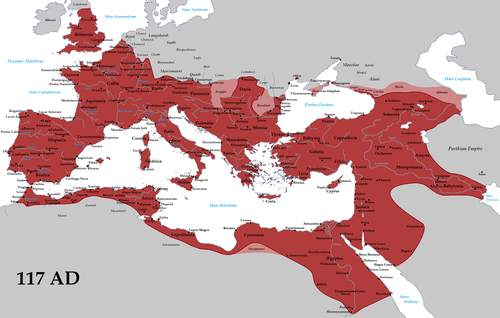
Roman Influence in the Near East
As Rome expanded into the Near East, Roman law began to interact with local legal systems. However, Mesopotamian legal traditions continued in some areas under Roman rule. #Rome #LegalInfluence #NearEast
Roman Influence in the Near East By Tataryn - Own work, CC BY-SA 3.0, https://commons.wikimedia.org/w/index.php?curid=19625326
0 CE
Legacy of Mesopotamian Law
By the Common Era, Mesopotamian legal traditions had influenced many cultures, including Hebrew, Greek, and Roman law. The principles of written codes and justice persisted. #Legacy #LegalCode #Influence
100 CE
Rabbinic Law and the Mishnah
The Mishnah, a Jewish legal code, shows influences from Mesopotamian legal traditions. It systematized oral laws and became a foundation for later Jewish jurisprudence. #Jewish #Mishnah #LegalCode
Rabbinic Law and the Mishnah By Adolf Behrman - Zbiory ŻIH (Żydowski Instytut Historyczny), Public domain, https://commons.wikimedia.org/w/index.php?curid=20753920
200 CE
Sassanian Legal Reforms
The Sassanian Empire developed a comprehensive legal system based on Zoroastrian principles. It incorporated elements of earlier Mesopotamian and Persian laws. #Sassanian #LegalReform #Zoroastrian
Sassanian Legal Reforms By Original file by Ro4444, edited by me - Based on several sources, including the Middle Persian geographical text Šahrestānīhā ī Ērānšahr, CC BY 4.0, https://commons.wikimedia.org/w/index.php?curid=94837349
300 CE
Byzantine Legal Codification
The Byzantine Empire's legal codes, such as the Codex Theodosianus, drew on Roman law but also reflected Near Eastern influences. The tradition of codified law continued. #Byzantine #LegalCode #Codification
Byzantine Legal Codification By Unknown author - https://gallica.bnf.fr/ark:/12148/btv1b10303686s/f136.item.zoom, Public domain, https://commons.wikimedia.org/w/index.php?curid=173370719
400 CE
Syriac Legal Texts
Christian communities in Mesopotamia produced legal texts in Syriac, blending local traditions with biblical law. These texts influenced later Islamic jurisprudence. #Syriac #LegalTexts #Christian
500 CE
Justinian's Corpus Juris Civilis
Emperor Justinian's codification of Roman law became a foundation for European legal systems. It indirectly preserved some principles from ancient Near Eastern law. #Byzantine #Justinian #LegalCode
Justinian's Corpus Juris Civilis By IusRomanum - Own work, CC BY-SA 4.0, https://commons.wikimedia.org/w/index.php?curid=78807015
600 CE
Islamic Conquest of Mesopotamia
The Islamic conquest brought Sharia law to Mesopotamia, which incorporated elements of local legal traditions. The region's legal heritage influenced Islamic jurisprudence. #Islam #Conquest #Sharia
Islamic Conquest of Mesopotamia By Mostafameraji - Own work, CC0, https://commons.wikimedia.org/w/index.php?curid=125734809
700 CE
Development of Islamic Fiqh
Islamic legal scholars developed fiqh (jurisprudence) using the Quran, Hadith, and local customs. Mesopotamian legal concepts were integrated into Islamic law. #Islam #Fiqh #Jurisprudence
Development of Islamic Fiqh By Mdktb - Own work, Public domain, https://commons.wikimedia.org/w/index.php?curid=79788545
800 CE
Abbasid Legal Administration
The Abbasid Caliphate, centered in Baghdad, established a sophisticated legal system with qadis (judges) and courts. The period saw the compilation of legal manuals. #Abbasid #LegalAdmin #Baghdad
Abbasid Legal Administration By Ec.Domnowall - Own work, Public domain, https://commons.wikimedia.org/w/index.php?curid=33988856
900 CE
Rediscovery of Ancient Legal Texts
Medieval Islamic scholars studied ancient Mesopotamian legal texts, preserving knowledge that would later be rediscovered by Western scholars. This contributed to the study of legal history. #IslamicGoldenAge #LegalHistory #Rediscovery
Rediscovery of Ancient Legal Texts By Unknown author, Public domain, https://commons.wikimedia.org/w/index.php?curid=101284
1000 CE
European Reception of Roman Law
The revival of Roman law in Europe, influenced by the Corpus Juris Civilis, indirectly transmitted some Mesopotamian legal principles. This shaped Western legal traditions. #Europe #RomanLaw #LegalTradition
1100 CE
Medieval Islamic Legal Commentaries
Scholars like Al-Ghazali wrote extensive commentaries on Islamic law, which incorporated elements from earlier Near Eastern legal systems. These works influenced legal education. #Islam #LegalCommentary #AlGhazali
1200 CE
Magna Carta and Legal Tradition
The Magna Carta, while English, reflects the ancient principle of written law limiting royal power. This concept has roots in earlier Mesopotamian ideas of justice. #England #MagnaCarta #LegalTradition
Magna Carta and Legal Tradition By Original authors were the barons and King John of England. Uploaded by Earthsound. - This file has been provided by the British Library from its digital collections. Links to the British Library's website may be broken as the library recovers from a October 2023 cyber attack, and will be updated once material becomes accessible online. For more information on the attack see: https://www.bl.uk/about/cyber-attack It is also made available on a British Library website. Catalogue entry: Cotton MS Augustus II 106, Public domain, https://commons.wikimedia.org/w/index.php?curid=78606
1300 CE
Ottoman Legal Reforms
The Ottoman Empire developed a legal system (Kanun) that blended Islamic law with local customs, including those from Mesopotamia. This system lasted for centuries. #Ottoman #LegalReform #Kanun
1400 CE
Humanist Legal Scholarship
Renaissance humanists studied ancient texts, including references to Mesopotamian law. This sparked interest in the origins of legal systems. #Renaissance #Humanism #LegalScholarship
Humanist Legal Scholarship By Leonardo da Vinci - Leonardo Da Vinci - Photo from www.lucnix.be. 2007-09-08 (photograph). Photograpy: This image is the work of Luc Viatour Please credit it with: Luc Viatour / https://Lucnix.be in the immediate vicinity of the image. A link to my website https://lucnix.be is much appreciated but not mandatory. An email to Viatour Luc would be appreciated too. Do not copy this image illegally by ignoring the terms of the license below, as it is not in the public domain. If you would like special permission to use, license, or purchase the image please contact me Viatour Luc to negotiate terms. More free pictures in my personal gallery [Note: this is in the public domain, despite the photographer's contradictory claim. Any use is permissible, and no credit to the photographer is necessary.] Nikon case D80 optical Sigma 17-70mm F2,8/4,5 Macro, Public domain, https://commons.wikimedia.org/w/index.php?curid=2738140
1500 CE
Discovery of Cuneiform Tablets
European travelers and scholars began to encounter cuneiform tablets in Mesopotamia, leading to the eventual decipherment of ancient legal codes. #Cuneiform #Discovery #Tablets
Discovery of Cuneiform Tablets By Bjørn Christian Tørrissen - Own work by uploader, http://bjornfree.com/galleries.html, CC BY-SA 3.0, https://commons.wikimedia.org/w/index.php?curid=8296178
1600 CE
Early Modern Legal Codifications
European states began codifying laws, inspired by Roman and local traditions. The idea of a written code accessible to all echoed ancient Mesopotamian practices. #Europe #Codification #LegalCode
1700 CE
Enlightenment and Natural Law
Enlightenment thinkers like Montesquieu and Rousseau discussed natural law and justice, concepts that had ancient parallels in Mesopotamian legal thought. #Enlightenment #NaturalLaw #Philosophy
Enlightenment and Natural Law By Carlo Crivelli - The Yorck Project (2002) 10.000 Meisterwerke der Malerei (DVD-ROM), distributed by DIRECTMEDIA Publishing GmbH. ISBN: 3936122202., Public domain, https://commons.wikimedia.org/w/index.php?curid=149804
1800 CE
Decipherment of Cuneiform
Scholars like Henry Rawlinson deciphered cuneiform, unlocking the content of ancient legal codes. This revolutionized understanding of Mesopotamian law. #Cuneiform #Decipherment #Scholarship
Decipherment of Cuneiform By Grotefend, in 1815 - Historical researches into the politics, intercourse, and trade of the principal nations of antiquity p.332, Public domain, https://commons.wikimedia.org/w/index.php?curid=90589192
1901 CE
Discovery of the Code of Hammurabi Stele
French archaeologists excavated the stele of Hammurabi at Susa, Iran. The stele, now in the Louvre, became a symbol of ancient justice and legal history. #Archaeology #Hammurabi #Stele
1950 CE
Modern Study of Mesopotamian Law
Scholars like Martha Roth compiled and translated ancient legal codes, making them accessible to modern audiences. This field continues to reveal insights into early legal systems. #Scholarship #LegalHistory #Mesopotamia