Encyclopedia/5. Human Thought & Philosophy/2. Languages, Linguistics & Writing/01. History of Writing Systems • Curated by Admin Timeline.sg
Structural and generative linguistics encompasses the scientific study of language structure, from Ferdinand de Saussure's semiotics and the Prague School's phonology to Noam Chomsky's Universal Grammar. This timeline traces key milestones across diverse linguistic traditions, including ancient Indian grammarians, Arabic philology, and modern theoretical developments.
Chronological Storyline (45 Milestones)
500 BCE
Panini Composes the Ashtadhyayi
Panini's Sanskrit grammar, the Ashtadhyayi, systematically describes the phonology and morphology of Sanskrit with 3,959 rules. It is considered a precursor to modern generative linguistics. #linguistics #grammar
300 BCE
Yaska's Nirukta Analyzes Word Origins
Yaska's Nirukta, a commentary on the Nighantu, is one of the earliest known works on etymology and semantics, classifying words into four categories. It reflects early linguistic analysis in ancient India. #linguistics #etymology
100 CE
Apollonius Dyscolus Writes on Syntax
Apollonius Dyscolus, a Greek grammarian, is credited with the first systematic study of Greek syntax, influencing later Western grammatical theory. #linguistics #syntax
800 CE
Sibawayh's Kitab al-Kitab Defines Arabic Grammar
Sibawayh's 'Al-Kitab' is a foundational work of Arabic grammar, describing phonological and morphological rules. It remains a key reference in Arabic linguistics. #linguistics #Arabic
Sibawayh's Kitab al-Kitab Defines Arabic Grammar By Alipir - Own work, CC BY-SA 3.0, https://commons.wikimedia.org/w/index.php?curid=19110086
1660 CE
Port-Royal Grammaire Générale et Raisonnée
Antoine Arnauld and Claude Lancelot publish the Port-Royal Grammar, exploring universal principles of language structure. It foreshadows generative grammar. #linguistics #philosophy
1786 CE
Sir William Jones Proposes Indo-European Language Family
Sir William Jones's lecture on the relationship between Sanskrit and European languages establishes comparative linguistics and the concept of language families. #linguistics #history )
Sir William Jones Proposes Indo-European Language Family By Joshua Reynolds - https://artuk.org/discover/artworks/sir-william-jones-17461794-fellow-1776-chief-justice-of-calcutta-223878, Public domain, https://commons.wikimedia.org/w/index.php?curid=195894329
1816 CE
Franz Bopp's Comparative Grammar of Sanskrit, Zend, Greek, Latin, Lithuanian, Old Slavonic
Bopp's work systematically compares Indo-European languages, laying the foundation for historical-comparative linguistics. #linguistics #IndoEuropean
Franz Bopp's Comparative Grammar of Sanskrit, Zend, Greek, Latin, Lithuanian, Old Slavonic By Rudolf Strauch - Alfred Gudeman: Imagines philologorum. Berlin/Leipzig: Teubner 1911, S. 23., Public domain, https://commons.wikimedia.org/w/index.php?curid=801103
1876 CE
Karl Verner's Law
Karl Verner discovers a systematic sound change in Germanic languages explaining exceptions to Grimm's Law, a milestone in historical phonology. #linguistics #phonology
Karl Verner's Law By DDG9912 - Own work, CC BY 4.0, https://commons.wikimedia.org/w/index.php?curid=168746212
1916 CE
Ferdinand de Saussure Publishes Course in General Linguistics
Posthumously compiled, Saussure's work introduces key concepts: sign (signifier/signified), langue/parole, and synchronic/diachronic analysis. It founds structural linguistics. #linguistics #semiotics
1926 CE
Prague Linguistic Circle Founded
The Prague Linguistic Circle is established, promoting structuralist phonology and functional linguistics. Key members include Roman Jakobson, Nikolai Trubetzkoy, and Vilém Mathesius. #linguistics #PragueSchool
1928 CE
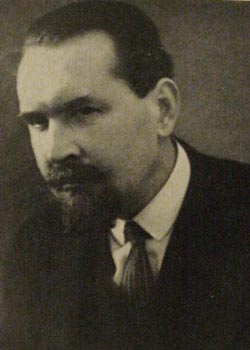
Trubetzkoy's Grundzüge der Phonologie Published
Nikolai Trubetzkoy's posthumous work 'Principles of Phonology' establishes phoneme theory and the concept of phonological opposition. It is a foundational text of Prague School phonology. #linguistics #phonology
Trubetzkoy's Grundzüge der Phonologie Published By Unknown author - ru:Изображение:Trubetzkoy.jpg, Public domain, https://commons.wikimedia.org/w/index.php?curid=3933020
Oct 1, 1939 CE
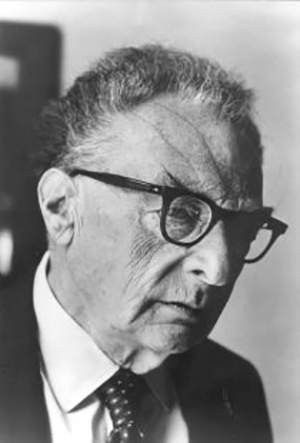
Roman Jakobson Founds the Linguistic Circle of Copenhagen
Jakobson, a key Prague School figure, contributes to the development of distinctive features and functional phonology, influencing structural linguistics worldwide. #linguistics #phonology
Roman Jakobson Founds the Linguistic Circle of Copenhagen By Raulelgreco - Own work, CC BY-SA 4.0, https://commons.wikimedia.org/w/index.php?curid=107397192
1949 CE
Kenneth Pike's Tagmemics Introduced
Kenneth L. Pike proposes tagmemics, a linguistic theory integrating grammar, phonology, and semantics, influencing field linguistics and Bible translation. #linguistics #tagmemics
1951 CE
Zellig Harris's Structural Linguistics Published
Harris's book 'Structural Linguistics' outlines methods for distributional analysis, directly influencing Noam Chomsky's early work. #linguistics #structuralism
Feb 1, 1957 CE
Noam Chomsky Publishes Syntactic Structures
Chomsky's 'Syntactic Structures' revolutionizes linguistics with generative grammar, introducing transformational rules and the concept of deep structure. It launches the Chomskyan revolution. #linguistics #generativeGrammar
Noam Chomsky Publishes Syntactic Structures By Unknown author - Image source (v1): https://onedio.com/haber/gelmis-gecmis-en-etkili-32-bilimsel-kitap-335309 Image source (v2): https://www.le-livre.fr/livres/fiche-ro60079168.html, Public domain, https://commons.wikimedia.org/w/index.php?curid=94512399
1959 CE
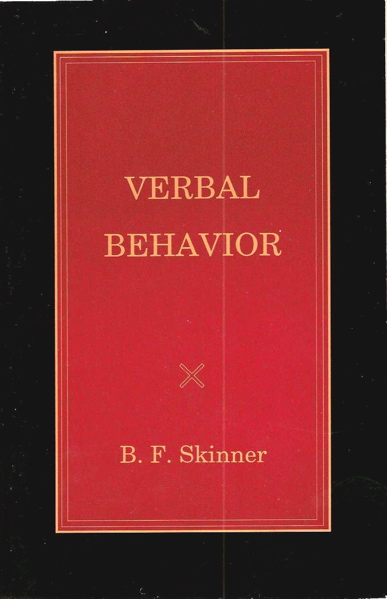
Chomsky Reviews Skinner's Verbal Behavior
Chomsky's critical review of B.F. Skinner's 'Verbal Behavior' argues against behaviorist accounts of language, paving the way for the cognitive revolution in linguistics. #linguistics #cognition
Chomsky Reviews Skinner's Verbal Behavior By B. F. Skinner Foundation - http://www.bfskinner.org/catalog/item/4987428/5083409.htm#image_1, Public domain, https://commons.wikimedia.org/w/index.php?curid=4027879
1965 CE
Aspects of the Theory of Syntax
Chomsky's 'Aspects' elaborates the Standard Theory of generative grammar, introducing the distinction between competence and performance, and recursive rules. #linguistics #generativeGrammar
1968 CE
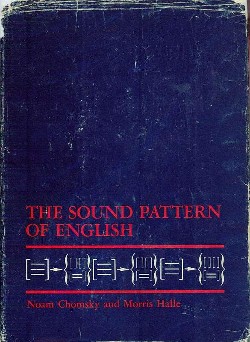
Sound Pattern of English
Chomsky and Morris Halle publish 'The Sound Pattern of English', a generative approach to phonology, introducing distinctive features and phonological rules. #linguistics #phonology
Sound Pattern of English By Unknown author, PD, https://en.wikipedia.org/w/index.php?curid=37837555
1975 CE
Humboldt University Hosts Summer School on Generative Grammar
European linguists gather for intensive study of generative grammar, spreading Chomskyan theory across the continent. #linguistics #generativeGrammar
Humboldt University Hosts Summer School on Generative Grammar By (Automated conversion) at English Wikipedia - Transferred from en.wikipedia to Commons by Jay8g using CommonsHelper., CC BY-SA 3.0, https://commons.wikimedia.org/w/index.php?curid=18083484
1976 CE
Relational Grammar Proposed by David Perlmutter and Paul Postal
Relational grammar emerges as an alternative to Chomsky's framework, emphasizing grammatical relations like subject and object. #linguistics #grammar
1979 CE
Montague Grammar Synthesizes Semantics and Syntax
Richard Montague's work formalizes natural language semantics using intensional logic, influencing computational linguistics. #linguistics #semantics
1981 CE
Chomsky Proposes Government and Binding Theory
Chomsky's 'Lectures on Government and Binding' introduces a modular framework with principles and parameters, replacing the earlier Standard Theory. #linguistics #syntax
1984 CE
Joan Bresnan Develops Lexical-Functional Grammar
Bresnan's Lexical-Functional Grammar (LFG) provides a non-transformational generative framework, emphasizing lexical representation and functional structure. #linguistics #LFG
1985 CE
Head-Driven Phrase Structure Grammar (HPSG) Developed
Carl Pollard and Ivan Sag introduce HPSG, a constraint-based lexicalist theory of syntax, widely used in computational linguistics. #linguistics #HPSG
1986 CE
Functional Grammar by Simon Dik
Simon Dik's functional grammar emphasizes the communicative function of language, influencing typology and discourse analysis. #linguistics #functionalism
1993 CE
Chomsky Introduces the Minimalist Program
Chomsky's minimalist program aims to reduce the theoretical apparatus of generative grammar to only necessary elements, focusing on economy and simplicity. #linguistics #minimalism
1995 CE
The Minimalist Program Published as a Book
Chomsky's book 'The Minimalist Program' consolidates his ideas on economy of derivation and representation, becoming a central framework in generative syntax. #linguistics #syntax
1998 CE
Biolinguistics Emerges as a Field
Growing interest in the biological basis of language leads to the biolinguistic approach, linking generative grammar to evolutionary biology and neuroscience. #linguistics #biolinguistics
Biolinguistics Emerges as a Field By Marco Montanari - Fonte Propria, CC BY-SA 3.0, https://commons.wikimedia.org/w/index.php?curid=18090818
2000 CE
Ray Jackendoff's Parallel Architecture
Jackendoff proposes a parallel architecture for language, with independent levels of phonology, syntax, and semantics, challenging strictly syntactic-centric views. #linguistics #cognition
Ray Jackendoff's Parallel Architecture By The original uploader was Mitchoyoshitaka at English Wikipedia. - Transferred from en.wikipedia to Commons by Muboshgu using CommonsHelper., CC BY 3.0, https://commons.wikimedia.org/w/index.php?curid=18226742
2002 CE
Optimality Theory Applied to Syntax
Optimality Theory (OT), originally in phonology, is extended to syntax, providing a constraint-based approach to cross-linguistic variation. #linguistics #OT
2004 CE
Construction Grammar Gains Traction
Construction grammar, emphasizing form-meaning pairings, becomes a prominent alternative to Chomskyan approaches, particularly in cognitive linguistics. #linguistics #constructionGrammar
2005 CE
Universal Grammar Debates Intensify
Chomsky's Universal Grammar hypothesis faces challenges from usage-based and emergentist theories, sparking long-running debates on innateness. #linguistics #UG
2007 CE
Merge and Phase Theory in Minimalism
Chomsky's phase theory, introducing phases to reduce computational burden, refines the minimalist model and influences subsequent syntactic research. #linguistics #syntax )
2010 CE
Online Corpora Revolutionize Linguistic Research
Large-scale corpora like the Corpus of Contemporary American English (COCA) become widely accessible, enabling usage-based and quantitative studies of grammar. #linguistics #corpus
2011 CE
Neuroimaging Studies of Syntax
Functional MRI and other neuroimaging methods are applied to study syntactic processing, supporting the neural reality of hierarchical structure. #linguistics #neurolinguistics
Neuroimaging Studies of Syntax By Henry Vandyke Carter - Henry Gray (1918) Anatomy of the Human Body (See "Book" section below) Bartleby.com: Gray's Anatomy, Plate 726, Public domain, https://commons.wikimedia.org/w/index.php?curid=620390
2013 CE
Statistical Machine Translation Advances
Statistical and neural machine translation models rely on linguistic structures, bridging computational linguistics and generative theory. #linguistics #NLP
2014 CE
Linguistic Society of America Supports Open Access
The LSA adopts open access policies for its journals, promoting wider dissemination of linguistic research, including generative and structural work. #linguistics #OpenAccess
Linguistic Society of America Supports Open Access By Linguistic Society of America - http://www.linguisticsociety.org, Public domain, https://commons.wikimedia.org/w/index.php?curid=47250469
2015 CE
Chomsky Debuts 'The Language Faculty: From Genes to Grammar'
A major conference discusses Chomsky's latest ideas on the evolution of language and the biological foundations of Universal Grammar. #linguistics #evolution
2016 CE
Google Translate's Neural Machine Translation
Google launches neural machine translation, which better captures syntactic and semantic structures, implicitly building on linguistic theory. #linguistics #AI
2017 CE
Deep Syntax in Computational Linguistics
Deep syntactic parsing using universal dependencies becomes standard, linking surface structure to deeper grammatical relations. #linguistics #NLP
2019 CE
Minimalist Grammars in Natural Language Processing
Formal implementations of minimalist syntax, such as Minimalist Grammars, are applied in parsing and language generation. #linguistics #computational
2020 CE
Black Linguistics Matter Movement
The Black Linguistics Matter movement highlights the importance of diverse perspectives in linguistic theory, challenging Eurocentric biases in generative and structural frameworks. #linguistics #socialjustice
2021 CE
Large Language Models Challenge Linguistic Theory
Models like GPT-3 demonstrate remarkable syntactic abilities, sparking debates about the need for innate linguistic structures versus statistical learning. #linguistics #AI
2022 CE
Universal Grammar and Linguistic Diversity
A major volume revisits the Principles and Parameters framework in light of understudied languages, reaffirming the role of UG in explaining diversity. #linguistics #diversity
2023 CE
Integration of Neurolinguistics and Generative Grammar
Advances in brain imaging, such as MEG, provide finer-grained evidence for hierarchical syntactic processing, supporting key tenets of generative grammar. #linguistics #neurolinguistics
Integration of Neurolinguistics and Generative Grammar By KarinaCor - Poliva O. From where to what: a neuroanatomically based evolutionary model of the emergence of speech in humans. F1000Res. 2017;4:67. Published 2017 Sep 20. doi:10.12688/f1000research.6175.3 https://www.ncbi.nlm.nih.gov/pmc/articles/PMC5600004/, CC BY-SA 4.0, https://commons.wikimedia.org/w/index.php?curid=73554840