Encyclopedia/1. The Cosmos & The Natural World/3. Astronomy & Planetary Science • Curated by Admin Timeline.sg
Stellar Astrophysics and Fusion Nucleosynthesis trace humanity's journey from ancient star-gazing to understanding nuclear fusion as the engine of stars and the origin of elements. This timeline spans early observations by Chinese, Greek, and Islamic astronomers, through the rise of spectroscopy and quantum mechanics, to modern theories of stellar evolution and supernova nucleosynthesis.
Chronological Storyline (46 Milestones)
1000 BCE
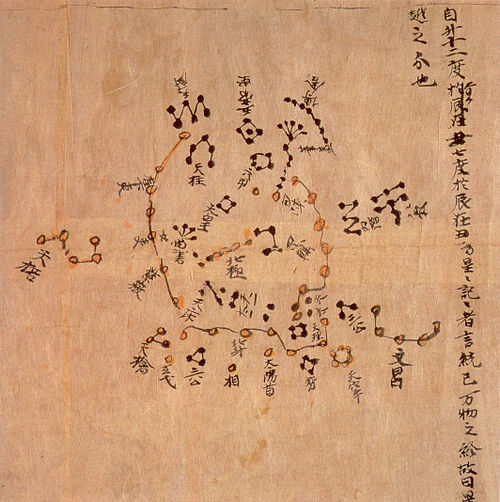
Chinese Record a ‘New Star’ (Supernova)
Ancient Chinese astronomers document a ‘guest star’ in the sky, likely a supernova, one of the earliest recorded celestial events. Chinese records of novas and comets date back over 3,000 years, forming a crucial foundation for historical astronomy. #astronomy #history
Chinese Record a ‘New Star’ (Supernova) By Unknown author, Public domain, https://commons.wikimedia.org/w/index.php?curid=577062
350 BCE
Aristotle’s Celestial Spheres
Aristotle proposes a geocentric model with stars fixed on a crystalline sphere, positing that celestial bodies are unchanging and made of aether. This view dominated Western cosmology for nearly two millennia. #philosophy #astronomy
Aristotle’s Celestial Spheres By After Lysippos - Jastrow (2006), Public domain, https://commons.wikimedia.org/w/index.php?curid=1359807
130 BCE
Hipparchus Catalogs Stars and Discovers Precession
Hipparchus compiles the first known star catalog, listing about 850 stars and their brightnesses. He also discovers the precession of the equinoxes, a key step in understanding stellar positions over long timescales. #astronomy #science
Hipparchus Catalogs Stars and Discovers Precession By William Henry Smyth - George F. Chambers, A Handbook of Descriptive and Practical Astronomy, Vol. 3 (4th ed.) https://archive.org/details/handbookofdescri0003geor/page/n10/mode/1up, Public domain, https://commons.wikimedia.org/w/index.php?curid=134619278
150 CE
Ptolemy’s Almagest Codifies Geocentric Astronomy
Claudius Ptolemy writes the Almagest, synthesizing Greek astronomical knowledge and presenting a geocentric model with epicycles. It remains the authoritative astronomical text for over 1,400 years. #astronomy #history
Ptolemy’s Almagest Codifies Geocentric Astronomy By Ptolemy - http://www.univie.ac.at/hwastro/rare/1515_ptolemae.htm, Public domain, https://commons.wikimedia.org/w/index.php?curid=29985717
964 CE
Al-Sufi Publishes Book of Fixed Stars
Persian astronomer Abd al-Rahman al-Sufi writes the Book of Fixed Stars, updating Ptolemy’s star catalog with precise observations and Arabic names. He also notes the Andromeda Galaxy, the first description of a nebula. #astronomy #islamicgoldenage
Al-Sufi Publishes Book of Fixed Stars By Abd al-Rahman al-Sufi - Google Art Project Museum of Islamic Art, Doha, Public domain, https://commons.wikimedia.org/w/index.php?curid=36270259
1054 CE
Chinese and Japanese Observe SN 1054 Supernova
Chinese and Japanese astronomers record a bright ‘guest star’ that remains visible for 22 months. This event is later identified as the supernova that created the Crab Nebula, a key object in modern astrophysics. #astronomy #supernova
Chinese and Japanese Observe SN 1054 Supernova By NASA, ESA, J. Hester and A. Loll (Arizona State University) - A Giant Hubble Mosaic of the Crab Nebula, Public domain, https://commons.wikimedia.org/w/index.php?curid=516106
1543 CE
Copernicus Publishes Heliocentric Model
Nicolaus Copernicus’s De revolutionibus orbium coelestium proposes a Sun-centered model, challenging the geocentric view. This revolutionizes the understanding of stellar positions and distances. #astronomy #science
Copernicus Publishes Heliocentric Model By derivative work of Johannes Petreius 1543 edition of File:Nicolai_Copernici_torinensis_De_revolutionibus_orbium_coelestium.djvu - File:Nicolai_Copernici_torinensis_De_revolutionibus_orbium_coelestium.djvu, Public domain, https://commons.wikimedia.org/w/index.php?curid=5611684
Nov 11, 1572 CE
Tycho Brahe Observes Supernova SN 1572
Tycho Brahe observes a new star in Cassiopeia, demonstrating that celestial heavens are not immutable. His precise measurements later aid Kepler’s laws and challenge Aristotelian cosmology. #astronomy #supernova
Tycho Brahe Observes Supernova SN 1572 By NASA/CXC/Rutgers/J.Warren & J.Hughes et al. - http://chandra.harvard.edu/photo/2005/tycho/; see also https://www.flickr.com/photos/smithsonian/2941525398/, Public domain, https://commons.wikimedia.org/w/index.php?curid=6706920
1600 CE
William Gilbert Publishes De Magnete
William Gilbert proposes that Earth is a giant magnet, influencing later understanding of stellar magnetism. His work lays groundwork for the study of magnetic fields in stars. #physics #science
William Gilbert Publishes De Magnete By Unknown author - Image from Timeline of the First Thirty Years of Radio (image is not eligible for copyright), with small alterations by User:Omegatron, Public domain, https://commons.wikimedia.org/w/index.php?curid=2422400
Mar 13, 1609 CE
Galileo Turns Telescope to the Stars
Galileo Galilei improves the telescope and observes the Moon, Jupiter’s moons, and stars in the Milky Way, revealing that stars are far more numerous than previously thought. He also notes sunspots, challenging the perfection of celestial bodies. #astronomy #science
Galileo Turns Telescope to the Stars By Justus Sustermans - http://collections.rmg.co.uk/collections/objects/14174, Public domain, https://commons.wikimedia.org/w/index.php?curid=62614082
1619 CE
Kepler Publishes Third Law of Planetary Motion
Johannes Kepler’s Harmonices Mundi presents his third law, relating orbital periods to distances from the Sun. These laws are crucial for later understanding stellar dynamics. #astronomy #physics
Kepler Publishes Third Law of Planetary Motion By Hankwang - Own work, CC BY 2.5, https://commons.wikimedia.org/w/index.php?curid=2102578
Jul 5, 1687 CE
Newton Publishes Principia Mathematica
Isaac Newton’s Principia lays out universal gravitation and laws of motion, explaining planetary orbits and stellar dynamics. His work is foundational for astrophysics, enabling calculations of stellar masses and distances. #physics #astronomy
Newton Publishes Principia Mathematica By The original uploader was Zhaladshar at English Wikisource. - Transferred from en.wikisource to Commons. (previous image from another copy) Internet Archive (current image from the Bern Dibner copy), Public domain, https://commons.wikimedia.org/w/index.php?curid=2681838
1718 CE
Edmond Halley Discovers Proper Motion of Stars
Edmond Halley compares ancient Greek star positions with contemporary ones and detects that stars like Sirius, Arcturus, and Aldebaran have moved, proving that stars are not fixed. This discovery opens the study of stellar kinematics. #astronomy #science
Edmond Halley Discovers Proper Motion of Stars By Original: Brews ohare Vectorisation: CheChe - This file was derived from: Proper motion.JPG:, CC BY-SA 3.0, https://commons.wikimedia.org/w/index.php?curid=67165949
Mar 13, 1781 CE
William Herschel Discovers Uranus
William Herschel discovers Uranus, doubling the known size of the solar system. He also studies binary stars, pioneering the measurement of stellar masses via orbital motion. #astronomy #science
William Herschel Discovers Uranus By Ardenau4 - Own workalso published on Flickr: https://www.flickr.com/photos/197038812@N04/53449450202/, CC0, https://commons.wikimedia.org/w/index.php?curid=143666922
1802 CE
William Herschel Discovers Infrared Radiation from Sun
Herschel discovers infrared radiation by passing sunlight through a prism and measuring temperature beyond the red end. This reveals that stars emit across the electromagnetic spectrum. #physics #astronomy
William Herschel Discovers Infrared Radiation from Sun By Unknown author, CC BY-SA 3.0, https://commons.wikimedia.org/w/index.php?curid=3484188
1814 CE
Fraunhofer Discovers Absorption Lines in Solar Spectrum
Joseph von Fraunhofer examines the solar spectrum with a high-quality prism and identifies hundreds of dark absorption lines (Fraunhofer lines). These lines are later used to determine stellar composition. #physics #astronomy
Fraunhofer Discovers Absorption Lines in Solar Spectrum By This derivative work : Eric Bajart Which is a derivative of: File:Spectrum of blue sky.png by Remember the dot Which is itself a derivative of: File:Spectrum of blue sky.gif by Deglr6328 (14 Oct 2006) - Spectrum of blue sky.png, CC BY-SA 4.0, https://commons.wikimedia.org/w/index.php?curid=10586771
1838 CE
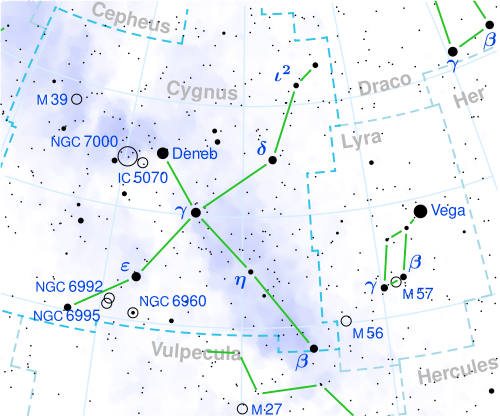
Bessel Measures Stellar Parallax of 61 Cygni
Friedrich Bessel measures the first successful stellar parallax for 61 Cygni, yielding a distance of about 10.4 light-years. This confirms Earth’s orbit and provides a method to gauge stellar distances. #astronomy #science
Bessel Measures Stellar Parallax of 61 Cygni By Cygnus_constellation_map.png: Torsten Bronger derivative work: Kxx (talk) - Cygnus_constellation_map.png, CC BY-SA 3.0, https://commons.wikimedia.org/w/index.php?curid=10828228
1859 CE
Kirchhoff and Bunsen Pioneer Spectroscopy
Gustav Kirchhoff and Robert Bunsen establish that each element emits and absorbs characteristic spectral lines. They apply this to the Sun, identifying elements like hydrogen, iron, and sodium. #physics #chemistry
1864 CE
Huggins Obtains Spectrum of a Nebula
William Huggins uses spectroscopy to analyze the Cat’s Eye Nebula, discovering that it has an emission-line spectrum, indicating it is a cloud of glowing gas, not a cluster of stars. This distinguishes nebulae from galaxies. #astronomy #spectroscopy
Huggins Obtains Spectrum of a Nebula By John Collier - one or more third parties have made copyright claims against Wikimedia Commons in relation to the work from which this is sourced or a purely mechanical reproduction thereof. This may be due to recognition of the "sweat of the brow" doctrine, allowing works to be eligible for protection through skill and labour, and not purely by originality as is the case in the United States (where this website is hosted). These claims may or may not be valid in all jurisdictions. As such, use of this image in the jurisdiction of the claimant or other countries may be regarded as copyright infringement. Please see Commons:When to use the PD-Art tag for more information., Public domain, https://commons.wikimedia.org/w/index.php?curid=6365203
1871 CE
Saha Develops Ionization Equation
Meghnad Saha derives the Saha ionization equation, relating temperature, pressure, and ionization states in stellar atmospheres. This is crucial for interpreting stellar spectra. #physics #astronomy
1885 CE
Balmer Formulates Hydrogen Spectral Series
Johann Balmer discovers an empirical formula for the visible spectral lines of hydrogen, later known as the Balmer series. This provides early clues to atomic structure and is key to stellar classification. #physics #astronomy
Balmer Formulates Hydrogen Spectral Series By OrangeDog - Own work (Original text: Own work by uploader. A logarithmic plot of λ for 1 λ = R ( 1 ( n ′ ) 2 − 1 n 2 ) {\displaystyle {1 \over \lambda }=R\left({1 \over (n^{\prime })^{2}}-{1 \over n^{2}}\right)} , where n′ ranges from 1 to 6, n ranges from n′ + 1 to ∞ {\displaystyle \infty } , and R is the Rydberg constant), CC BY-SA 3.0, https://commons.wikimedia.org/w/index.php?curid=6278485
1905 CE
Hertzsprung-Russell Diagram Conceptualized
Ejnar Hertzsprung and Henry Norris Russell independently plot stellar luminosity against spectral type, revealing main sequence, giants, and white dwarfs. The H-R diagram becomes fundamental to stellar evolution. #astronomy #science
Hertzsprung-Russell Diagram Conceptualized By Richard Powell - The Hertzsprung Russell Diagram, CC BY-SA 2.5, https://commons.wikimedia.org/w/index.php?curid=1736396
Aug 24, 1920 CE
Eddington Proposes Stellar Fusion Energy Source
Arthur Eddington delivers a paper suggesting that stars are powered by nuclear fusion of hydrogen into helium, based on mass-energy equivalence. This paves the way for understanding nucleosynthesis. #astrophysics #fusion
Eddington Proposes Stellar Fusion Energy Source By George Grantham Bain Collection, Library of Congress Prints and Photographs Division Washington, D.C. - This image is available from the United States Library of Congress's Prints and Photographs division under the digital ID ggbain.38064.This tag does not indicate the copyright status of the attached work. A normal copyright tag is still required. See Commons:Licensing., Public domain, https://commons.wikimedia.org/w/index.php?curid=6094619
1925 CE
Payne-Gaposchkin Identifies Stellar Composition
Cecilia Payne-Gaposchkin shows in her PhD thesis that stars are composed mostly of hydrogen and helium, overturning the assumption of Earth-like composition. This is a cornerstone of stellar astrophysics. #astronomy #womeninscience
Payne-Gaposchkin Identifies Stellar Composition By Smithsonian Institution/Science Service, restored by Adam Cuerden - Air and Space Museum online gallery, Public domain, https://commons.wikimedia.org/w/index.php?curid=140704011
1931 CE
Chandrasekhar Describes White Dwarf Mass Limit
Subrahmanyan Chandrasekhar calculates the maximum mass of a white dwarf (Chandrasekhar limit ~1.4 solar masses). This work is critical for understanding stellar endpoints. #astrophysics #science
1938 CE
Bethe and Weizsäcker Propose CNO Cycle
Hans Bethe and Carl Friedrich von Weizsäcker independently propose the CNO cycle, a catalytic fusion process using carbon, nitrogen, and oxygen in more massive stars. #astrophysics #fusion
1938 CE
Bethe and Critchfield Discover pp Chain
Hans Bethe and Charles Critchfield identify the proton-proton chain as the primary fusion process in Sun-like stars. This explains hydrogen burning and energy generation. #fusion #astrophysics
Bethe and Critchfield Discover pp Chain By RJHall translator: Manlleus (ca/es) - Own work. See reference below., CC BY-SA 3.0, https://commons.wikimedia.org/w/index.php?curid=5387273
1951 CE
Fermi and Turkevich Study Stellar Helium Production
Enrico Fermi and Anthony Turkevich consider helium production in stars via the triple-alpha process, later refined by Hoyle. This is a key step in understanding nucleosynthesis beyond hydrogen. #nucleosynthesis #astrophysics
Fermi and Turkevich Study Stellar Helium Production By No machine-readable author provided. Borb assumed (based on copyright claims). - No machine-readable source provided. Own work assumed (based on copyright claims)., CC BY-SA 3.0, https://commons.wikimedia.org/w/index.php?curid=697609
1952 CE
Hoyle Proposes Stellar Nucleosynthesis in Red Giants
Fred Hoyle shows that elements heavier than helium are synthesized inside massive stars via the triple-alpha process in red giants, explaining carbon production. #nucleosynthesis #astrophysics
Hoyle Proposes Stellar Nucleosynthesis in Red Giants By User:Spacepotato - Modified version of Image:HR-diag-no-text.svg, written by Rursus and modified by Bhutajata, CC BY-SA 3.0, https://commons.wikimedia.org/w/index.php?curid=2093830
1954 CE
Baade Identifies Two Populations of Stars
Walter Baade distinguishes Population I (young, metal-rich) and Population II (old, metal-poor) stars in the Milky Way. This refines understanding of stellar evolution and galactic chemical enrichment. #astronomy #galactic
Baade Identifies Two Populations of Stars By NASA/JPL-Caltech/ESO/R. Hurt - http://www.eso.org/public/images/eso1339e/, Public domain, https://commons.wikimedia.org/w/index.php?curid=28274906
1957 CE
B²FH Paper on Synthesis of Elements in Stars
Margaret Burbidge, Geoffrey Burbidge, William Fowler, and Fred Hoyle publish a landmark paper detailing nucleosynthesis processes (p-p, CNO, triple-alpha, s-process, r-process) in stars, becoming the foundation of modern stellar nucleosynthesis. #astrophysics #nucleosynthesis
1960 CE
Maser Emission Discovered from Interstellar Space
The first astrophysical maser (stimulated emission) is detected from the direction of the star-forming region Orion. Masers are used to study high-density regions around stars and supernova remnants. #astrophysics #molecules
Maser Emission Discovered from Interstellar Space By NASA, ESA, and J. Nichols (University of Leicester) - HubbleSite, Public domain, https://commons.wikimedia.org/w/index.php?curid=49826336
1961 CE
First Observation of Solar Neutrinos at Homestake
Raymond Davis Jr. begins the Homestake experiment to detect solar neutrinos, verifying fusion processes in the Sun's core. The solar neutrino problem later leads to neutrino oscillations. #astrophysics #neutrinos
First Observation of Solar Neutrinos at Homestake By U.S. Department of Energy from United States - 390 002 007, Public domain, https://commons.wikimedia.org/w/index.php?curid=64243644
1964 CE
Discovery of Neutron Stars (Pulsars)
Jocelyn Bell Burnell and Antony Hewish discover the first radio pulsar (PSR B1919+21), identified as a rapidly rotating neutron star. This confirms predictions of neutron stars as end products of core-collapse supernovae. #astronomy #pulsars
Discovery of Neutron Stars (Pulsars) By NASA/CXC/SAO (X-Ray); NASA/JPL-Caltech (Infrared) - http://www.nasa.gov/sites/default/files/pia18848-wisefacepalm.jpg, Public domain, https://commons.wikimedia.org/w/index.php?curid=36363158
1967 CE
Paczyński Calculates Mass Transfer in Binary Stars
Bohdan Paczyński develops models for mass transfer in close binary systems, which are crucial for understanding novae, Type Ia supernovae, and X-ray binaries. #astrophysics #binary
Paczyński Calculates Mass Transfer in Binary Stars By Happa - Own work, CC BY 3.0, https://commons.wikimedia.org/w/index.php?curid=17153635
1974 CE
First Direct Image of a Solar-Type Star (Betelgeuse)
Using interferometry, astronomers resolve the disk of Betelgeuse, a red supergiant, for the first time. This image provides direct evidence of stellar surface structure and convection. #astronomy #imaging
First Direct Image of a Solar-Type Star (Betelgeuse) By Orion_constellation_map.png: Torsten Bronger derivative work: Kxx (talk) - Orion_constellation_map.png, CC BY-SA 3.0, https://commons.wikimedia.org/w/index.php?curid=10850823
1982 CE
Discovery of Helium Flash in Globular Cluster Stars
Theoretical predictions of the helium flash (runaway helium fusion in degenerate cores) are observationally confirmed in globular cluster red giants, validating models of stellar evolution. #astrophysics #fusion
Discovery of Helium Flash in Globular Cluster Stars By RicHard-59 - Own work, based on this., CC BY-SA 3.0, https://commons.wikimedia.org/w/index.php?curid=30534795
Feb 23, 1987 CE
Supernova 1987A Observed in the LMC
SN 1987A, the first naked-eye supernova in 400 years, occurs in the Large Magellanic Cloud. Its detection of neutrinos hours before light confirms core-collapse models and neutrino production. #supernova #astrophysics
Supernova 1987A Observed in the LMC By NASA Goddard Space Flight Center from Greenbelt, MD, USA - New Hubble Observations of Supernova 1987A Trace Shock Wave, Public domain, https://commons.wikimedia.org/w/index.php?curid=69021019
1992 CE
First Detection of an Extrasolar Planet Around a Pulsar
Aleksander Wolszczan and Dale Frail announce two planets orbiting the millisecond pulsar PSR B1257+12. This opens the field of exoplanetary systems around evolved stars. #exoplanets #astronomy
Oct 6, 1995 CE
First Exoplanet Around a Sun-Like Star (51 Pegasi b)
Michel Mayor and Didier Queloz discover 51 Pegasi b, a hot Jupiter orbiting a Sun-like star. This revolutionizes stellar astrophysics by revealing planetary companions and their influence on stellar evolution. #exoplanets #astronomy
First Exoplanet Around a Sun-Like Star (51 Pegasi b) By ESO/M. Kornmesser/Nick Risinger (skysurvey.org) - ESO website, CC BY 4.0, https://commons.wikimedia.org/w/index.php?curid=39719418
1999 CE
First Complete Stellar Evolution Models with Rotation
Astrophysicists like André Maeder and Georges Meynet develop comprehensive models incorporating rotational mixing, which significantly affects nucleosynthesis and stellar lifetimes. #stellar #models
First Complete Stellar Evolution Models with Rotation By Fred the Oyster iThe source code of this SVG is valid. This vector image was created with Adobe Illustrator by v., CC BY-SA 4.0, https://commons.wikimedia.org/w/index.php?curid=36218932
2001 CE
Nucleosynthesis of Elements Beyond Iron Explained
Advances in r-process (rapid neutron capture) and s-process (slow neutron capture) calculations solidify the understanding of heavy element production in supernovae and asymptotic giant branch stars. #nucleosynthesis #astrophysics
Nucleosynthesis of Elements Beyond Iron Explained By Kjerish - This image has been extracted from another file, CC BY-SA 4.0, https://commons.wikimedia.org/w/index.php?curid=54378478
2003 CE
WMAP Measures Cosmic Microwave Background
The Wilkinson Microwave Anisotropy Probe (WMAP) provides high-precision data on the CMB, constraining Big Bang nucleosynthesis and the primordial abundance of light elements, which informs stellar nucleosynthesis models. #cosmology #bigbang
WMAP Measures Cosmic Microwave Background By NASA / WMAP Science Team - [1]; converted from the high-resolution TIFF version to a JPEG, Public domain, https://commons.wikimedia.org/w/index.php?curid=3944989
2012 CE
First Direct Detection of Stellar Coronal Mass Ejections
Using the Kepler space telescope, astronomers observe for the first time coronal mass ejections (CMEs) on a Sun-like star (KIC 5520876). This links stellar magnetic activity with exoplanet atmospheres. #astrophysics #sun
First Direct Detection of Stellar Coronal Mass Ejections By NASA/SOHO - https://soho.nascom.nasa.gov/gallery/images/20021202c2cme.html, Public domain, https://commons.wikimedia.org/w/index.php?curid=97256285
Aug 17, 2017 CE
LIGO/Virgo Detect Neutron Star Merger GW170817
Gravitational waves and electromagnetic counterparts from a neutron star merger are observed, confirming that such events are a major site of r-process nucleosynthesis, producing heavy elements like gold and platinum. #gravitationalwaves #nucleosynthesis
LIGO/Virgo Detect Neutron Star Merger GW170817 By LIGO Scientific Collaboration and Virgo Collaboration - https://journals.aps.org/prl/abstract/10.1103/PhysRevLett.119.161101 This W3C-unspecified plot was created with Matplotlib., CC BY-SA 4.0, https://commons.wikimedia.org/w/index.php?curid=63455773
Oct 1, 2022 CE
EHT Images Stellar-Mass Black Hole in Milky Way
The Event Horizon Telescope captures an image of Sgr A*, the supermassive black hole at the Galactic center, but also improves imaging of stellar-mass black holes. This advances understanding of black hole accretion and jets from stellar endpoints. #blackholes #astronomy
EHT Images Stellar-Mass Black Hole in Milky Way By D. Marrone/UofA - Event Horizon Telescope Collaboration, CC BY 4.0, https://commons.wikimedia.org/w/index.php?curid=133002860