1863 CE
Rockefeller Enters Oil Business
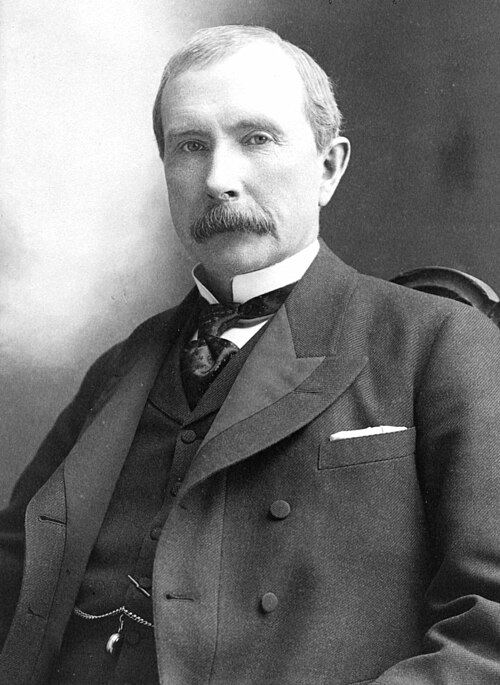
John D. Rockefeller invests in an oil refinery in Cleveland, Ohio, marking his entry into the fledgling petroleum industry. #StandardOil #History
Standard Oil, founded by John D. Rockefeller in 1870, grew into a dominant oil refining and marketing monopoly, ultimately dissolved in 1911 by the U.S. Supreme Court under antitrust law. Its legacy includes modern corporate structure and antitrust regulation.
John D. Rockefeller invests in an oil refinery in Cleveland, Ohio, marking his entry into the fledgling petroleum industry. #StandardOil #History
Rockefeller buys out his partners in the refinery, taking full control and forming Rockefeller & Andrews. #StandardOil #Business
Henry M. Flagler joins the partnership, forming Rockefeller, Andrews & Flagler, which grows into the largest refinery in Cleveland. #StandardOil #Partnership
Standard Oil Company is incorporated in Ohio with John D. Rockefeller as president, consolidating his refining interests. #StandardOil #Founded
Standard Oil negotiates secret preferential rebates from railroads, giving it a competitive advantage over rivals. #Monopoly #Business
Rockefeller acquires 22 of 26 competing refineries in Cleveland in a matter of weeks, consolidating control. #Merger #History
Standard Oil begins acquiring refineries and pipelines outside Ohio, expanding its reach across the United States. #Expansion #Oil
Standard Oil controls about 90% of U.S. oil refining capacity, achieving near-monopoly status. #Monopoly #MarketShare
The Standard Oil Trust is created, a legal structure that allows Rockefeller to control multiple companies through a board of trustees. #Trust #Business
The Standard Oil Trust is officially formalized, centralizing control over 40 companies. #Antitrust #History
Standard Oil moves its headquarters to 26 Broadway in New York City, becoming a major corporate force. #Corporate #History
Standard Oil begins acquiring oil pipelines, integrating transportation into its operations. #Pipeline #Integration
The U.S. Congress passes the Sherman Antitrust Act, aimed at curbing monopolies like Standard Oil. #Antitrust #Law
The trust is reorganized; Standard Oil of New Jersey becomes the holding company for the remaining interests. #Corporate #Restructuring
The Ohio Supreme Court orders the dissolution of the Standard Oil Trust under state law, leading to a restructuring. #Legal #Dissolution
Standard Oil begins exporting kerosene to Europe and Asia, dominating global markets. #Export #Global
John D. Rockefeller retires as president of Standard Oil, remaining chairman until 1911. #Leadership #Retirement
Standard Oil of New Jersey is reincorporated as a holding company, consolidating control over all subsidiaries. #Corporate #Structure
The Spindletop oil strike in Texas creates new competition, challenging Standard Oil's dominance. #Oil #Competition

Ida Tarbell publishes 'The History of the Standard Oil Company,' detailing unethical practices and fueling public outrage. #Journalism #Exposé

The U.S. government files a federal antitrust lawsuit against Standard Oil, citing violations of the Sherman Act. #Antitrust #Lawsuit
John D. Rockefeller's personal wealth is estimated at $900 million (unadjusted), making him the richest person in modern history. #Wealth #History
A federal court finds Standard Oil guilty of violating the Sherman Act, ordering dissolution. #Legal #Verdict
The U.S. Supreme Court upholds the lower court's decision, ordering Standard Oil to break up into 34 independent companies. #Landmark #Antitrust
Standard Oil is officially divided into successor companies including Exxon (Standard Oil of New Jersey), Mobil (Socony), Chevron (Socal), and others. #Breakup #Oil
John D. Rockefeller establishes the Rockefeller Foundation, focusing on philanthropy. #Philanthropy #Foundation
Exxon, the largest successor, continues expanding globally, becoming a major oil company. #Exxon #Oil

Socony (Standard Oil of New York) merges with Vacuum Oil, forming Mobil, a global brand. #Mobil #Oil

Standard Oil of Indiana (later Amoco) expands refining and marketing, becoming a major midwestern oil company. #Amoco #Oil

John D. Rockefeller dies at age 97, having given away most of his fortune to philanthropy. #Obituary #History
Chevron discovers oil in Saudi Arabia, leading to the formation of Aramco. #Chevron #Oil

Standard Oil of New Jersey becomes the world's largest oil company, with revenues exceeding $1 billion. #Exxon #Revenue
The 1973 oil crisis significantly increases profits for Standard Oil successor companies like Exxon and Mobil. #OilCrisis #Profits

Exxon and Mobil, both Standard Oil successors, merge to form ExxonMobil, the world's largest publicly traded oil company. #Merger #ExxonMobil
Chevron (Standard Oil of California) acquires Texaco, consolidating another Standard Oil successor. #Acquisition #Chevron
Conoco and Phillips merge, also incorporating elements from Standard Oil of Indiana (Amoco) and others. #Merger #Oil

ExxonMobil remains a major oil company, though not directly involved in the Deepwater Horizon spill. #Oil #Industry
ExxonMobil faces pressure from climate activists and investors, leading to board changes and strategic shifts. #Climate #Activism
Activist hedge fund Engine No. 1 wins three seats on ExxonMobil's board, pushing for cleaner energy. #Activism #Board