Special & General Relativity: Spacetime, Gravity & Black Holes
Encyclopedia/1. The Cosmos & The Natural World/2. Physics & Chemistry/02. Relativity & Gravitational Physics • Curated by Admin Timeline.sg
Einstein's theories of special and general relativity revolutionized our understanding of space, time, and gravity, leading to predictions such as black holes and gravitational waves, confirmed by experiments from the 1919 solar eclipse to LIGO's 2015 detection.
Chronological Storyline (43 Milestones)
1887 CE
Michelson-Morley Experiment
Albert Michelson and Edward Morley conducted an experiment to detect the luminiferous aether, finding no evidence of it. This null result challenged classical physics and set the stage for Einstein's special relativity. #physics #experiment
Michelson-Morley Experiment By Case Western Reserve University - http://www.cellularuniverse.org/AA2MM_Aether.htm, Public domain, https://commons.wikimedia.org/w/index.php?curid=48697725
1895 CE
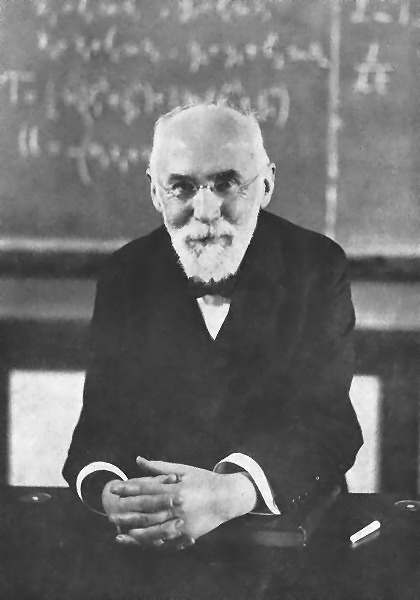
Lorentz Transformations Proposed
Hendrik Lorentz introduced mathematical transformations to explain the null result of the Michelson-Morley experiment. These transformations later became a cornerstone of special relativity. #physics #mathematics
Lorentz Transformations Proposed By The website of the Royal Library shows a picture from the same photosession that is attributed to Museum Boerhaave. The website of the Museum states "vrij beschikbaar voor publicatie" (freely available for publication). - http://th.physik.uni-frankfurt.de/~jr/physpictheo.html (moved from de:Bild:Hendrik Antoon Lorentz.jpg), Public domain, https://commons.wikimedia.org/w/index.php?curid=224998
Sep 26, 1905 CE
Einstein Publishes Special Relativity
Albert Einstein published 'On the Electrodynamics of Moving Bodies', introducing the theory of special relativity. It established that the speed of light is constant and that space and time are relative. #Einstein #relativity
Einstein Publishes Special Relativity By Lucien Chavan [1] (1868 - 1942), a friend of Einstein's when he was living in Berne. - Cropped from original at the The Albert Einstein Archives, The Hebrew University of Jerusalem., Public domain, https://commons.wikimedia.org/w/index.php?curid=16699199
Nov 21, 1905 CE
E=mc² Published
Einstein published a paper deriving the equivalence of mass and energy, E=mc². This equation became one of the most famous in physics, explaining nuclear reactions and stellar energy. #Einstein #energy
E=mc² Published By NASA and The Hubble Heritage Team (STScI/AURA) - HubbleSite: gallery, release., Public domain, https://commons.wikimedia.org/w/index.php?curid=102873
1907 CE
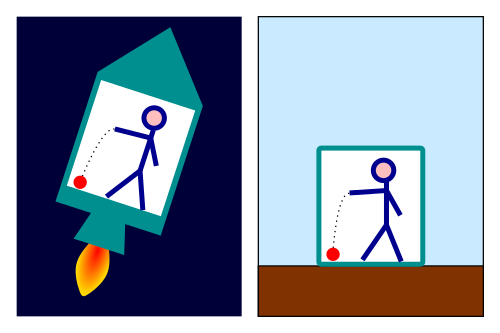
Einstein's Equivalence Principle
Einstein proposed the equivalence principle, stating that gravitational mass and inertial mass are identical. This insight became a foundation for general relativity. #gravity #Einstein
Einstein's Equivalence Principle By derivative work: Pbroks13 (talk) Elevator_gravity2.png: Markus Poessel (Mapos) - Elevator_gravity2.png, CC BY-SA 3.0, https://commons.wikimedia.org/w/index.php?curid=4381205
1908 CE
Minkowski Spacetime Introduced
Hermann Minkowski presented a geometric interpretation of special relativity, unifying space and time into a four-dimensional spacetime. This formalism was crucial for general relativity. #spacetime #geometry
Minkowski Spacetime Introduced By Hermann Minkowski - scan from original book, Public domain, https://commons.wikimedia.org/w/index.php?curid=2956997
1911 CE
Einstein Predicts Light Bending
Einstein calculated that light should bend near massive objects due to gravity, a key prediction of general relativity. This was later confirmed by the 1919 solar eclipse. #gravity #light
Einstein Predicts Light Bending By Lensshoe_hubble.jpg: ESA/Hubble & NASA derivative work: Bulwersator (talk) - Lensshoe_hubble.jpg, Public domain, https://commons.wikimedia.org/w/index.php?curid=17750437
Nov 25, 1915 CE
Einstein Completes General Relativity
Einstein presented the final form of the field equations of general relativity, describing gravity as curvature of spacetime. This theory revolutionized our understanding of gravity. #Einstein #gravity
Einstein Completes General Relativity By Simulating eXtreme Spacetimes Lensing (SXS) - https://www.ligo.caltech.edu/video/ligo20160211v3 (video link); see also http://www.black-holes.org/gw150914, CC BY-SA 4.0, https://commons.wikimedia.org/w/index.php?curid=46994894
1916 CE
Schwarzschild Solution for Black Holes
Karl Schwarzschild found the first exact solution to Einstein's field equations, describing a non-rotating black hole. This solution predicted the existence of black holes and an event horizon. #blackholes #mathematics
1917 CE
Einstein Introduces Cosmological Constant
Einstein added a cosmological constant to his field equations to allow for a static universe. Later, he called it his 'biggest blunder', but it is now used to explain dark energy. #cosmology #Einstein
Einstein Introduces Cosmological Constant By NASA/WMAP Science Team - Original version: NASA; modified by Cherkash, Public domain, https://commons.wikimedia.org/w/index.php?curid=11885244
1918 CE
Lense-Thirring Effect Predicted
Josef Lense and Hans Thirring predicted that a rotating mass would drag spacetime around it, known as frame-dragging. This effect was later confirmed by satellite experiments. #gravity #rotation
May 29, 1919 CE
Solar Eclipse Confirms General Relativity
Arthur Eddington led an expedition to observe the solar eclipse, measuring light bending from stars near the Sun. The results matched Einstein's predictions, making him a global celebrity. #eclipse #confirmation
Solar Eclipse Confirms General Relativity By ESO/Landessternwarte Heidelberg-Königstuhl/F. W. Dyson, A. S. Eddington, & C. Davidson - https://www.eso.org/public/images/potw1926a/, CC BY 4.0, https://commons.wikimedia.org/w/index.php?curid=80091497
1921 CE
Einstein Awarded Nobel Prize
Einstein received the Nobel Prize in Physics for his explanation of the photoelectric effect, not for relativity. However, his work on relativity was widely recognized. #Nobel #Einstein
Einstein Awarded Nobel Prize By Orren Jack Turner - This image is available from the United States Library of Congress's Prints and Photographs division under the digital ID cph.3b46036.This tag does not indicate the copyright status of the attached work. A normal copyright tag is still required. See Commons:Licensing., Public domain, https://commons.wikimedia.org/w/index.php?curid=6372844
1929 CE
Hubble's Law Expands Universe
Edwin Hubble discovered that galaxies are moving away from us, implying the universe is expanding. This supported general relativity's prediction of a dynamic universe. #cosmology #expansion
Hubble's Law Expands Universe By w:en:User:ScienceApologist - This image was copied from wikipedia:en. The original description was: The raisin bread model of the universe explains how each galaxy can perceive every other galaxy in the universe as receding from it. From the WMAP website., Public domain, https://commons.wikimedia.org/w/index.php?curid=2615116
1931 CE
Einstein and de Sitter Universe
Einstein and Willem de Sitter proposed a simple model of an expanding universe with no cosmological constant. This model became a basis for modern cosmology. #cosmology #Einstein
1935 CE
Einstein-Podolsky-Rosen Paradox
Einstein, Boris Podolsky, and Nathan Rosen argued that quantum mechanics is incomplete, using a thought experiment involving entangled particles. This sparked debates on quantum foundations. #quantum #paradox
Einstein-Podolsky-Rosen Paradox By Doris Ulmann - This image is available from the United States Library of Congress's Prints and Photographs division under the digital ID cph.3g04940.This tag does not indicate the copyright status of the attached work. A normal copyright tag is still required. See Commons:Licensing., Public domain, https://commons.wikimedia.org/w/index.php?curid=2468828
1939 CE
Oppenheimer Predicts Black Holes
J. Robert Oppenheimer and Hartland Snyder showed that massive stars could collapse into black holes, objects from which nothing can escape. This was a key theoretical step. #blackholes #collapse
Oppenheimer Predicts Black Holes By Event Horizon Telescope, uploader cropped and converted TIF to JPG - This media was produced by the European Southern Observatory (ESO), under the identifier eso1907a This tag does not indicate the copyright status of the attached work. A normal copyright tag is still required. See Commons:Licensing., CC BY 4.0, https://commons.wikimedia.org/w/index.php?curid=77925953
1948 CE
Hoyle's Steady State Theory
Fred Hoyle proposed the steady state theory as an alternative to the Big Bang, but it required modifications to general relativity. It was later disproven by observational evidence. #cosmology #theory
Hoyle's Steady State Theory By NASA / WMAP Science Team - http://map.gsfc.nasa.gov/media/121238/ilc_9yr_moll4096.png, Public domain, https://commons.wikimedia.org/w/index.php?curid=23285693
1957 CE
Hafele-Keating Experiment Proposed
The Hafele-Keating experiment was proposed to test time dilation by flying atomic clocks around the world. It was later conducted in 1971, confirming special and general relativity. #time #experiment
Hafele-Keating Experiment Proposed By Binarysequence - Own work, CC BY-SA 3.0, https://commons.wikimedia.org/w/index.php?curid=24592511
1960 CE
Pound-Rebka Experiment
Robert Pound and Glen Rebka measured gravitational redshift using gamma rays in a tower at Harvard. This confirmed the predictions of general relativity for gravitational time dilation. #gravity #redshift
Pound-Rebka Experiment By http://en.wikipedia.org/wiki/User:Lumidek - http://en.wikipedia.org/wiki/Image:JeffersonLeft.jpg, Public domain, https://commons.wikimedia.org/w/index.php?curid=3421331
1963 CE
Kerr Solution for Rotating Black Holes
Roy Kerr found an exact solution for rotating black holes, described by the Kerr metric. This was a major advance in understanding realistic black holes. #blackholes #rotation
Kerr Solution for Rotating Black Holes By Yukterez (Simon Tyran, Vienna) - Own work, CC BY-SA 4.0, https://commons.wikimedia.org/w/index.php?curid=50352912
1964 CE
Penrose Proposes Singularity Theorems
Roger Penrose proved that singularities are inevitable in general relativity under certain conditions, leading to the formation of black holes. This work earned him a Nobel Prize in 2020. #singularity #blackholes
1965 CE
Discovery of Cosmic Microwave Background
Arno Penzias and Robert Wilson discovered the cosmic microwave background radiation, providing strong evidence for the Big Bang. This supported the expanding universe model from general relativity. #cosmology #BigBang
Discovery of Cosmic Microwave Background By ESA and the Planck Collaboration - Cosmic Microwave Background, CC BY 4.0, https://commons.wikimedia.org/w/index.php?curid=130789180
1967 CE
Pulsars Discovered
Jocelyn Bell Burnell discovered pulsars, rapidly rotating neutron stars that emit regular pulses. These objects are related to black holes and test general relativity in strong fields. #neutronstars #astronomy
Pulsars Discovered By NASA/CXC/SAO (X-Ray); NASA/JPL-Caltech (Infrared) - http://www.nasa.gov/sites/default/files/pia18848-wisefacepalm.jpg, Public domain, https://commons.wikimedia.org/w/index.php?curid=36363158
1971 CE
Hafele-Keating Experiment Confirms Relativity
Joseph Hafele and Richard Keating flew atomic clocks around the world on commercial airliners. The results confirmed time dilation due to both special and general relativity. #time #experiment
1974 CE
Hulse-Taylor Binary Pulsar Discovered
Russell Hulse and Joseph Taylor discovered a binary pulsar system that allowed precise tests of general relativity. Their observations of orbital decay matched predictions of gravitational wave emission. #pulsar #gravity
1974 CE
Hawking Radiation Proposed
Stephen Hawking proposed that black holes emit radiation due to quantum effects near the event horizon. This combined general relativity with quantum mechanics, leading to black hole thermodynamics. #blackholes #quantum
1979 CE
First Gravitational Lens Discovered
The 'Twin QSO' was discovered as the first gravitational lens, where a galaxy bends light from a distant quasar. This confirmed a key prediction of general relativity. #lensing #galaxies
1986 CE
LIGO Project Initiated
The Laser Interferometer Gravitational-Wave Observatory (LIGO) was proposed to detect gravitational waves. It was designed to measure tiny distortions in spacetime from cosmic events. #gravitationalwaves #detector
LIGO Project Initiated By Amber Stuver - Own work, CC BY-SA 4.0, https://commons.wikimedia.org/w/index.php?curid=46993713
1993 CE
Nobel Prize for Binary Pulsar
Russell Hulse and Joseph Taylor received the Nobel Prize for their discovery of the binary pulsar, which provided indirect evidence for gravitational waves. This spurred efforts to detect them directly. #Nobel #pulsar
1998 CE
Discovery of Dark Energy
Observations of distant supernovae showed that the universe's expansion is accelerating, implying the existence of dark energy. This revived the cosmological constant in general relativity. #cosmology #acceleration
2004 CE
Gravity Probe B Launched
NASA's Gravity Probe B satellite was launched to test frame-dragging and the geodetic effect predicted by general relativity. Results confirmed both effects with high precision. #gravity #satellite
Gravity Probe B Launched By NASA/MSFC - http://www.nasa.gov/mission_pages/gpb/gpb_013.html, Public domain, https://commons.wikimedia.org/w/index.php?curid=5532645
2007 CE
Fermi Gamma-ray Space Telescope Launched
The Fermi telescope was launched to study gamma-ray bursts and other high-energy phenomena. It also tests Lorentz invariance and other aspects of relativity. #gamma #telescope
Fermi Gamma-ray Space Telescope Launched By NASA - https://science.nasa.gov/toolkits/spacecraft-icons (image link), Public domain, https://commons.wikimedia.org/w/index.php?curid=58291732
2010 CE
First Direct Image of an Exoplanet
The first direct image of an exoplanet was taken, but more relevantly, advances in adaptive optics allowed tests of general relativity via gravitational lensing. #exoplanets #imaging
First Direct Image of an Exoplanet By Jason Wang (Caltech)/Christian Marois (NRC Herzberg) - https://jasonwang.space/orbits.html, CC BY 4.0, https://commons.wikimedia.org/w/index.php?curid=90872179
Sep 14, 2015 CE
LIGO Detects Gravitational Waves
LIGO made the first direct detection of gravitational waves from a binary black hole merger, confirming a major prediction of general relativity. This opened a new era of gravitational wave astronomy. #gravitationalwaves #LIGO
LIGO Detects Gravitational Waves By B. P. Abbott et al. (LIGO Scientific Collaboration and Virgo Collaboration) — full list at the end of the article - http://physics.aps.org/featured-article-pdf/10.1103/PhysRevLett.116.061102 . See also the associated Jupyter notebook., CC BY 3.0, https://commons.wikimedia.org/w/index.php?curid=46987868
Aug 17, 2017 CE
GW170817: Neutron Star Merger
LIGO and Virgo detected gravitational waves from a neutron star merger, followed by electromagnetic observations across the spectrum. This multi-messenger event provided insights into heavy element formation and cosmology. #neutronstars #multimessenger
GW170817: Neutron Star Merger By LIGO Scientific Collaboration and Virgo Collaboration - https://journals.aps.org/prl/abstract/10.1103/PhysRevLett.119.161101 This W3C-unspecified plot was created with Matplotlib., CC BY-SA 4.0, https://commons.wikimedia.org/w/index.php?curid=63455773
Oct 3, 2017 CE
Nobel Prize for Gravitational Waves
Rainer Weiss, Barry Barish, and Kip Thorne received the Nobel Prize for their decisive contributions to the LIGO detector and the observation of gravitational waves. #Nobel #gravitationalwaves
Apr 10, 2019 CE
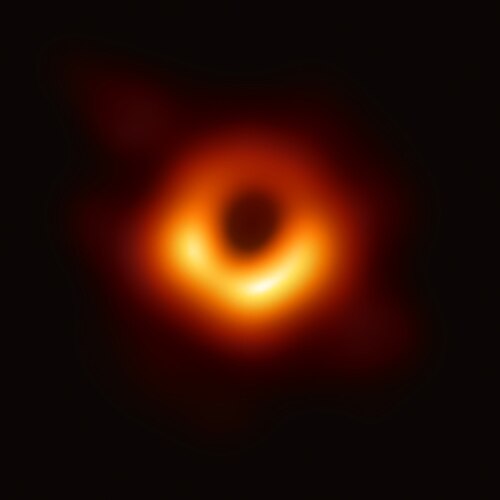
First Image of a Black Hole
The Event Horizon Telescope released the first direct image of a black hole's shadow, at the center of galaxy M87. This image confirmed predictions of general relativity near a black hole. #blackhole #imaging
First Image of a Black Hole By D. Marrone/UofA - Event Horizon Telescope Collaboration, CC BY 4.0, https://commons.wikimedia.org/w/index.php?curid=133002860
Oct 6, 2020 CE
Nobel Prize for Black Hole Physics
Roger Penrose received half the Nobel Prize for proving that black hole formation is a prediction of general relativity, while Andrea Ghez and Reinhard Genzel shared the other half for discovering a supermassive black hole at the Milky Way's center. #Nobel #blackholes
2021 CE
LIGO-Virgo-KAGRA Collaboration
The KAGRA detector in Japan joined the LIGO-Virgo network, enhancing the global gravitational wave observatory. This collaboration improves localization and detection rates. #gravitationalwaves #collaboration
LIGO-Virgo-KAGRA Collaboration By Christopher Berry - http://cplberry.com/2015/07/26/whats-up-doc/, CC BY-SA 4.0, https://commons.wikimedia.org/w/index.php?curid=45370733
2022 CE
JWST Launched
The James Webb Space Telescope launched, capable of observing the early universe and testing general relativity on cosmic scales. It will study dark energy and gravitational lensing. #telescope #cosmology
JWST Launched By NASA - https://www.jwst.nasa.gov/content/webbLaunch/whereIsWebb.html, Public domain, https://commons.wikimedia.org/w/index.php?curid=114125719
2023 CE
Pulsar Timing Array Hints at Gravitational Wave Background
Multiple pulsar timing array collaborations reported evidence for a stochastic gravitational wave background, likely from supermassive black hole binaries. This opens a new window for low-frequency gravitational waves. #gravitationalwaves #pulsars
2024 CE
LISA Pathfinder Success
The LISA Pathfinder mission demonstrated key technologies for the future space-based gravitational wave observatory LISA. It proved that free-falling test masses can be isolated with unprecedented precision. #gravitationalwaves #space
LISA Pathfinder Success By DLR German Aerospace Center - LISA Pathfinder, CC BY 2.0, https://commons.wikimedia.org/w/index.php?curid=32945545