Alternate Universes/7. Classical Mythological Universes • Curated by Admin Timeline.sg
This timeline traces the key events in the development of Shinto mythology, centered on the Kojiki text and the mythic foundation of Japan, from ancient oral traditions to modern cultural adaptations.
Chronological Storyline (34 Milestones)
Feb 11, 660 BCE
Traditional Date of Emperor Jimmu's Accession
According to the Kojiki and Nihon Shoki, Emperor Jimmu, descendant of the sun goddess Amaterasu, ascends the throne, marking the mythical founding of Japan. The date is celebrated as National Foundation Day. #shinto #mythology
Traditional Date of Emperor Jimmu's Accession By Ginko Adachi (active 1874-1897) - artelino - Japanese Prints - Archive 29th May 2009, Public domain, https://commons.wikimedia.org/w/index.php?curid=6894916
712 CE
Completion of the Kojiki
The Kojiki (Records of Ancient Matters) is compiled by Ō no Yasumaro under Empress Genmei, codifying oral myths, including the creation of Japan by Izanagi and Izanami and the lineage of the imperial family. #shinto #literature
720 CE
Completion of the Nihon Shoki
The Nihon Shoki (Chronicles of Japan) is completed, offering a more detailed and sinicized account of Japanese mythology and history, serving as a companion to the Kojiki. #shinto #chronicles
Completion of the Nihon Shoki By Unknown author - http://www.emuseum.jp/cgi/pkihon.cgi?SyoID=4&ID=w012&SubID=s000, Public domain, https://commons.wikimedia.org/w/index.php?curid=6745277
806 CE
Kūkai Establishes Shingon Buddhism with Shinto Syncretism
Kūkai (Kōbō Daishi) introduces Shingon Buddhism, which integrates kami worship, linking Buddhist deities with Shinto kami, fostering the syncretic practice of shinbutsu-shūgō. #buddhism #shinto
Kūkai Establishes Shingon Buddhism with Shinto Syncretism By Urashimataro - Own work, Public domain, https://commons.wikimedia.org/w/index.php?curid=4283200
859 CE
Construction of Iwashimizu Hachiman-gū Shrine
The Hachiman shrine is built, dedicated to the kami of archery and war, later syncretized with the bodhisattva Hachiman, illustrating the merging of Shinto and Buddhist traditions. #shinto #shrines
Construction of Iwashimizu Hachiman-gū Shrine By en:User:Fg2 who I believe is the same as User:Fg2 here. - en:Image:IwashimizuHachimangu.jpg, Public domain, https://commons.wikimedia.org/w/index.php?curid=502031
1086 CE
Compilation of the Konjaku Monogatari-shū
This collection of setsuwa (anecdotes) includes many Shinto-Buddhist tales, reflecting the permeation of mythology into medieval Japanese literature. #literature #mythology
1331 CE
Kitabatake Chikafusa Writes Jinnō Shōtōki
The Jinnō Shōtōki (Chronicle of the Direct Descent of Gods and Sovereigns) reasserts the divine lineage of the imperial family, using Shinto mythology to justify the Southern Court during the Nanboku-chō period. #shinto #history
Kitabatake Chikafusa Writes Jinnō Shōtōki By Washiucho - Own work, based on File:北畠親房.jpg, Public domain, https://commons.wikimedia.org/w/index.php?curid=5930919
Aug 15, 1549 CE
Francis Xavier Arrives in Japan
Christian missionaries arrive, leading to conflicts with Shinto kami worship as the religion is initially misunderstood as a variant of Shinto-Buddhist sects. #christianity #japan
Francis Xavier Arrives in Japan By Unknown author - 『中公バックス 日本の歴史 別巻2 図録 鎌倉から戦国』より。, Public domain, https://commons.wikimedia.org/w/index.php?curid=1262310
1603 CE
Tokugawa Ieyasu Establishes Edo Shogunate
Ieyasu is enshrined as a kami at Nikkō Tōshō-gū, continuing the tradition of deifying powerful rulers, blending Shinto and Confucian elements. #shinto #history
Tokugawa Ieyasu Establishes Edo Shogunate By 663highland - Own work, CC BY-SA 4.0, https://commons.wikimedia.org/w/index.php?curid=134225250
1617 CE
Construction of Tōshō-gū Shrine at Nikkō
The elaborate mausoleum for Tokugawa Ieyasu is built, showcasing the syncretism of Shinto, Buddhism, and Confucianism, and influencing Japanese architecture and religious practice. #shrine #architecture
1650 CE
Yoshida Shintō Revival by Yoshida Kanetomo
The Yoshida Shintō school systematizes shrine ritual and theology, asserting Shinto's independence from Buddhism and influencing state Shinto later. #shinto #philosophy
1685 CE
Matsuo Bashō Writes The Narrow Road to the Deep North
Bashō's haiku travelogue includes references to Shinto kami and sacred sites, embedding mythology in Japanese literary aesthetics. #literature #poetry
Matsuo Bashō Writes The Narrow Road to the Deep North By Hokusai - http://visipix.dynalias.com/search/search.php?q=hokusai&u=&l=en, Public domain, https://commons.wikimedia.org/w/index.php?curid=13896592
1790 CE
Motoori Norinaga Writes Kojiki-den
Motoori Norinaga completes his 44-volume commentary on the Kojiki, reviving interest in pure Shinto and laying foundations for kokugaku (National Learning). #shinto #scholarship
Motoori Norinaga Writes Kojiki-den By Motoori Norinaga - https://www.tfm.co.jp/yes/?id=128, Public domain, https://commons.wikimedia.org/w/index.php?curid=2711824
Oct 14, 1868 CE
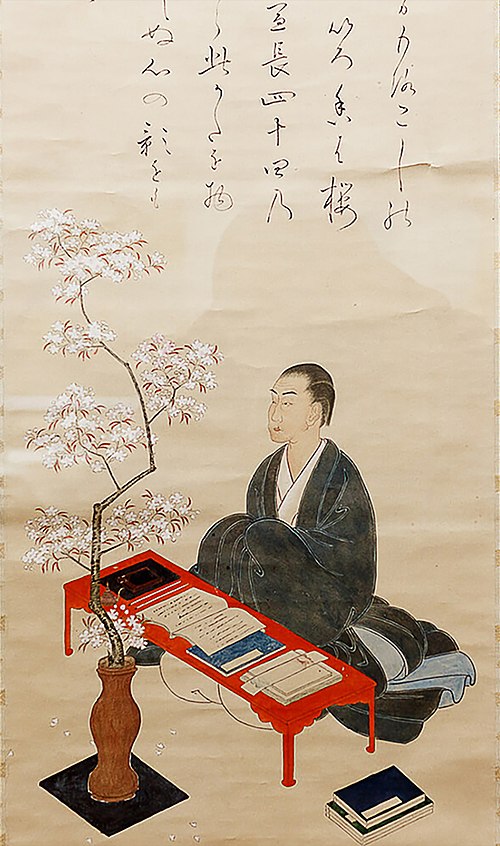
Meiji Restoration and Separation of Shinto and Buddhism
The Meiji government orders shinbutsu bunri, separating Shinto from Buddhism, elevating Shinto as state religion, and suppressing Buddhist institutions. #meiji #shinto
Meiji Restoration and Separation of Shinto and Buddhism By Unknown author - http://www.d1.dion.ne.jp/~s_minaga/sos_turugaoka.htm, Public domain, https://commons.wikimedia.org/w/index.php?curid=5529420
1871 CE
Establishment of State Shinto
The Meiji government designates Shinto shrines as state institutions, creating the bureaucratic administration of Shinto and promoting emperor worship based on mythic lineage. #state_shinto #politics
Establishment of State Shinto By Bank of the Empire of Japan - Own work, uploaded by Eclipse2009, Public domain, https://commons.wikimedia.org/w/index.php?curid=15754031
Feb 11, 1889 CE
Promulgation of the Meiji Constitution
The constitution declares the emperor sacred and inviolable, reinforcing the myth of his divine descent as stated in the Kojiki. #emperor #mythology
Promulgation of the Meiji Constitution By Kantei - Kantei.go.jp https://www.kantei.go.jp/jp/seido/index.html , https://web.archive.org/web/20211007101451/https://www.kantei.go.jp/jp/seido/index.html, CC BY 4.0, https://commons.wikimedia.org/w/index.php?curid=96920661
1900 CE
Publication of Basil Hall Chamberlain's Translation of Kojiki
The first complete English translation of the Kojiki introduces Japanese mythology to the Western world, influencing global understanding of Shinto. #kojiki #translation
1912 CE
Death of Emperor Meiji and Kigensetsu Celebrations
Emperor Meiji's funeral rites incorporate Shinto elements, and the holiday Kigensetsu (Empire Day) celebrates the mythic founding of Japan by Emperor Jimmu. #emperor #holiday
Death of Emperor Meiji and Kigensetsu Celebrations By Artanisen - Own work, CC BY-SA 4.0, https://commons.wikimedia.org/w/index.php?curid=110892707
1928 CE
Lafcadio Hearn Publishes Kwaidan
Hearn's collection of Japanese ghost stories and legends draws on Shinto and folk mythology, popularizing yokai and kami in the West. #literature #yokai
1937 CE
Kokutai no Hongi Published
The government-issued text Kokutai no Hongi (Cardinal Principles of the National Entity) uses Shinto mythology to justify ultra-nationalism and the emperor's divine status. #nationalism #propaganda
Kokutai no Hongi Published By Kawamura Kiyoo - https://www.musee-orsay.fr/fr/oeuvres/le-coq-blanc-75986 [1], Public domain, https://commons.wikimedia.org/w/index.php?curid=46842379
Dec 15, 1945 CE
Shinto Directive Issued by SCAP
The Allied occupation forces order the disestablishment of State Shinto, ending government support and removing mythological references from education. #postwar #shinto
Jan 1, 1946 CE
Emperor Shōwa Issues the Humanity Declaration
Emperor Hirohito renounces his divinity, effectively ending the myth of the emperor's direct descent from Amaterasu as a political reality. #emperor #shinto
1952 CE
Establishment of Jinja Honchō
The Association of Shinto Shrines is founded as a private religious organization to unite shrines after State Shinto's dissolution, preserving traditions. #shinto #organization
Establishment of Jinja Honchō By Wiiii - Own work, CC BY-SA 3.0, https://commons.wikimedia.org/w/index.php?curid=10807026
Feb 11, 1967 CE
National Foundation Day (Kenkoku Kinen no Hi) Established
The post-war Japanese government reinstates February 11 as National Foundation Day, based on the mythical accession of Emperor Jimmu, though now as a secular holiday. #holiday #mythology )
1970 CE
Expo '70 in Osaka Features Shinto Mythological Themes
The world exposition includes pavilions highlighting Japanese mythology, including the Mythical Age section, showcasing Shinto creation myths to an international audience. #expo #culture
Expo '70 in Osaka Features Shinto Mythological Themes By 大高猛 - File:EXPO'70 SYMBOL MARK.png, Public domain, https://commons.wikimedia.org/w/index.php?curid=122303913
1982 CE
Miyazaki's Anime "My Neighbor Totoro" Features Shinto Spirits
Hayao Miyazaki's film introduces the totoro as forest spirits, reflecting Shinto kami concepts of nature, influencing global pop culture. #anime #shinto
1992 CE
UNESCO Lists Sacred Sites and Pilgrimage Routes in the Kii Mountain Range
UNESCO recognizes the sacred sites including Kumano Sanzan and Yoshino, which are deeply tied to Shinto mythology of kami and afterlife. #unesco #pilgrimage
UNESCO Lists Sacred Sites and Pilgrimage Routes in the Kii Mountain Range By 663highland - Own work, CC BY 2.5, https://commons.wikimedia.org/w/index.php?curid=8349450
2001 CE
Video Game "Okami" Released with Shinto Mythology
The game "Okami" features the sun goddess Amaterasu as a wolf, reviving interest in Shinto myths through interactive media. #gaming #shinto
2010 CE
Ise Jingu Shrine Pilgrimage Revival
Modern pilgrimage to Ise Grand Shrine, dedicated to Amaterasu, increases as a cultural and spiritual practice, highlighting the living tradition of Shinto mythology. #pilgrimage #shinto
Ise Jingu Shrine Pilgrimage Revival By N yotarou - Own work, CC BY-SA 4.0, https://commons.wikimedia.org/w/index.php?curid=39352102
Jun 22, 2013 CE
Mt. Fuji Listed as UNESCO World Heritage Site
Mount Fuji, a sacred mountain in Shinto mythology associated with kami and the goddess Konohanasakuya-hime, gains recognition for its cultural significance. #unesco #shinto
Mt. Fuji Listed as UNESCO World Heritage Site By Suicasmo - Own work, CC BY-SA 4.0, https://commons.wikimedia.org/w/index.php?curid=156462791
2016 CE
Shinto-Inspired Anime "Your Name." Achieves Global Success
Makoto Shinkai's film incorporates Shinto themes of kami, musubi (connection), and sacred places, reaching international audiences. #anime #shinto
Nov 10, 2019 CE
Enthronement of Emperor Naruhito with Shinto Rituals
Emperor Naruhito's enthronement includes ancient Shinto rites like the Daijosai, reaffirming the mythic and ceremonial continuity of the imperial line. #emperor #ritual
Enthronement of Emperor Naruhito with Shinto Rituals By Prime Minister's official residence (首相官邸) - Kantei (the office of the Prime Minister of Japan) https://www.kantei.go.jp/jp/singi/gishikitou_iinkai/dai5/siryou6.pdf, CC BY 4.0, https://commons.wikimedia.org/w/index.php?curid=79160145
2021 CE
Japanese Government Recognizes Ainu Religion with Shinto Syncretism
Legal changes promote Ainu culture, including their own kami concepts, acknowledging the diversity of indigenous spiritual traditions in Japan. #ainu #shinto
Japanese Government Recognizes Ainu Religion with Shinto Syncretism By Unknown author - Online Collection of Brooklyn Museum; Photo: Brooklyn Museum, 38.648_detail1_IMLS_SL2.jpg, Public domain, https://commons.wikimedia.org/w/index.php?curid=10959904
Apr 29, 2023 CE
Grand Shrine of Ise Undergoes Periodic Reconstruction (Shikinen Sengū)
The 62nd rebuilding of the inner sanctuary of Ise Jingu takes place, a centuries-old tradition symbolizing renewal in Shinto cosmology. #shinto #tradition