4000 BCE
Discovery of Semiconducting Materials
Ancient civilizations use naturally occurring semiconducting materials like galena in early electrical experiments. #materials #history
Semiconductor fabrication traces the evolution from early transistor invention to modern extreme ultraviolet lithography and TSMC's foundry model, enabling the global microchip industry.
Ancient civilizations use naturally occurring semiconducting materials like galena in early electrical experiments. #materials #history
Volta's pile provides a stable electrical source, enabling later semiconductor research. #physics #invention

Faraday observes that silver sulfide's conductivity increases with temperature, noting the first semiconductor effect. #physics #discovery
Braun discovers rectification at metal-semiconductor junctions, leading to early radio detectors. #electronics #invention

Silicon is used in early crystal radio detectors, marking the first practical semiconductor application. #electronics #history
John Bardeen, Walter Brattain, and William Shockley at Bell Labs demonstrate the first working transistor, revolutionizing electronics. #transistor #invention

William Shockley invents the more practical bipolar junction transistor, enabling mass production. #transistor #technology

Texas Instruments produces the first commercial silicon transistor, replacing germanium for better performance. #silicon #electronics
Jack Kilby at Texas Instruments demonstrates the first integrated circuit, combining multiple components on a single germanium slab. #IC #invention

Robert Noyce at Fairchild Semiconductor patents a planar integrated circuit using silicon, enabling practical mass production. #IC #semiconductor

Fairchild and Texas Instruments release the first commercial integrated circuits, used in military and aerospace applications. #IC #commercial
Frank Wanlass at Fairchild invents CMOS (complementary metal-oxide-semiconductor) logic, which becomes dominant due to low power consumption. #CMOS #invention

Gordon Moore predicts that transistor density on ICs will double every two years, guiding the semiconductor industry for decades. #MooresLaw #prediction
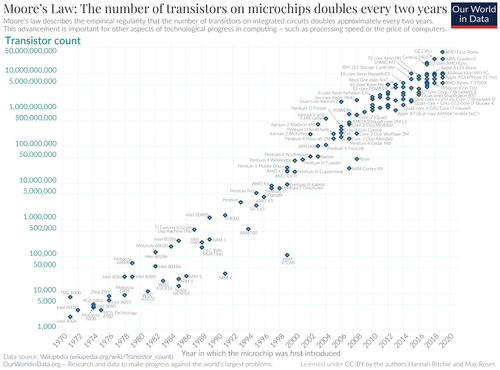
Intel introduces the 1103 DRAM chip, replacing magnetic core memory and enabling affordable computer memory. #memory #semiconductor

Intel launches the first commercial microprocessor, the 4004, integrating a CPU on a single chip and sparking the microcomputer revolution. #microprocessor #Intel

Intel's 8080 becomes the first truly general-purpose microprocessor, used in early personal computers like the Altair 8800. #microprocessor #computing

Intel introduces the 8086 processor, establishing the x86 architecture that dominates PCs for decades. #x86 #Intel

GCA Corporation introduces the first wafer stepper, improving precision in IC fabrication. #lithography #manufacturing
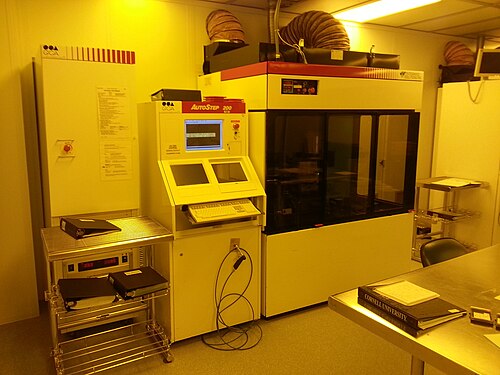
Intel's 386 introduces 32-bit computing and memory management, enabling advanced operating systems like Windows. #microprocessor #Intel

Morris Chang founds Taiwan Semiconductor Manufacturing Company (TSMC), pioneering the pure-play foundry model that separates chip design from fabrication. #TSMC #foundry

TSMC begins offering dedicated foundry services for application-specific integrated circuits (ASICs), revolutionizing the semiconductor industry. #ASIC #foundry

TSMC introduces a 0.8-micron CMOS process, enabling higher density and performance for logic chips. #CMOS #process
Intel's Pentium features superscalar architecture and 60 MHz clock speed, becoming a household name in PCs. #microprocessor #Intel

TSMC ramps up 0.5-micron technology, serving major fabless companies like NVIDIA and Qualcomm. #TSMC #semiconductor
IBM and Motorola introduce copper interconnects to replace aluminum, reducing resistance and improving performance. #interconnect #technology
TSMC's 0.18-micron process becomes a workhorse for system-on-chip (SoC) designs, powering early mobile phones. #SoC #TSMC
TSMC opens the first 300mm wafer fabrication facility, increasing production efficiency and reducing costs. #wafer #manufacturing )

Intel introduces strained silicon to enhance transistor performance, boosting carrier mobility. #transistor #technology

TSMC adopts low-k dielectric materials to reduce parasitic capacitance, enabling faster switching. #TSMC #process
Intel introduces high-k/metal gate technology in its 45nm process, reducing leakage and improving performance. #Intel #technology
Toshiba announces 3D NAND flash, stacking memory cells vertically to increase density. #memory #NAND

TSMC's 40nm node enables high-performance graphics processors and mobile chips. #TSMC #process
Intel introduces FinFET (tri-gate) transistors at 22nm, improving control and reducing leakage. #transistor #FinFET

TSMC's 28nm node becomes a long-lived process for mobile and networking chips, widely adopted. #TSMC #process
TSMC adopts FinFET at 16nm, competing with Intel and enabling high-performance mobile processors. #FinFET #TSMC
ASML delivers the first extreme ultraviolet (EUV) lithography system, NXE:3300B, for advanced node development. #EUV #lithography

TSMC begins volume production of 7nm chips, used in Apple A12 and AMD Ryzen processors. #TSMC #7nm
TSMC and Samsung start using EUV lithography for 7nm+ and 5nm nodes, enabling finer patterning. #EUV #manufacturing
TSMC announces 5nm process with EUV, offering 15% speed gain and 30% power reduction over 7nm. #TSMC #5nm
Apple's M1 processor, built on TSMC's 5nm process, delivers breakthrough performance and efficiency for Macs. #Apple #M1

TSMC begins risk production of 3nm chips, using FinFlex technology for optimized performance and power. #TSMC #3nm
ASML delivers the first high-NA (0.55) EUV lithography system, enabling sub-3nm nodes. #EUV #ASML
TSMC announces 2nm process with nanosheet transistors, targeting production in 2025. #TSMC #2nm
TSMC, Intel, and Samsung announce massive investments in new fabs worldwide to address semiconductor supply chain resilience. #semiconductor #supplychain