Safavid Persia: Shah Ismail, Isfahan Architecture & Shi'a Cultural Renaissance
Encyclopedia/3. History, Societies & Civilizations/03. Middle Eastern & Islamic Civilizations/04. Persian Empires • Curated by Admin Timeline.sg
The Safavid Empire (1501-1736) established Twelver Shi'ism as the state religion of Persia, fostering a cultural renaissance under Shah Abbas I with the construction of Isfahan's Naqsh-e Jahan Square and a thriving silk trade. This timeline covers the dynasty's founding, military conflicts, architectural achievements, and eventual decline.
Chronological Storyline (46 Milestones)
1501 CE
Shah Ismail I Founds the Safavid Dynasty
Shah Ismail I, a teenager, conquers Tabriz and proclaims himself Shah, establishing the Safavid dynasty and declaring Twelver Shi'ism the state religion. This marks the beginning of a distinct Persian identity and Shi'a dominance in Iran. #history #shia
Shah Ismail I Founds the Safavid Dynasty By Kamāl ud-Dīn Behzād - https://islamansiklopedisi.org.tr/sah-ismail https://www.millisaraylar.gov.tr/en/saray-kosk-ve-kasirlar/topkapi-sarayi, Public domain, https://commons.wikimedia.org/w/index.php?curid=129352303
1503 CE
Conquest of Baghdad
Ismail I captures Baghdad from the Aq Qoyunlu, extending Safavid control into Iraq and securing Shi'a holy sites like Najaf and Karbala. #war #history
1505 CE
Safavid Conquest of Gilan
Ismail I conquers the Caspian province of Gilan, adding its silk-producing regions to the burgeoning Safavid economy. #economy
Safavid Conquest of Gilan By Salehyar - Own work, CC BY-SA 4.0, https://commons.wikimedia.org/w/index.php?curid=44056726
1510 CE
Battle of Merv: Safavids Defeat Uzbeks
Shah Ismail I defeats the Uzbek Khanate near Merv, securing Khorasan and the eastern borders of the empire. #battle
1511 CE
Suppression of the Nur Ali Khalifa Rebellion
Ismail crushes a revolt led by Qizilbash commander Nur Ali Khalifa, centralizing his authority. #politics
Aug 23, 1514 CE
Battle of Chaldiran
The Safavid army under Ismail I suffers a decisive defeat by the Ottoman Sultan Selim I due to superior Ottoman artillery and gunpowder tactics. This battle halts Safavid westward expansion and cements Ottoman control over eastern Anatolia. #war #history
Battle of Chaldiran By Amir Pashaei - Own work, CC BY-SA 4.0, https://commons.wikimedia.org/w/index.php?curid=83213370
1524 CE
Death of Shah Ismail I
Shah Ismail I dies at age 37, possibly from grief or illness, leaving a weakened empire to his son Tahmasp I. #history
1538 CE
Tahmasp I Annexes Shirvan
Shah Tahmasp I conquers the Shirvan region (modern Azerbaijan), eliminating a rebellious local dynasty and consolidating Safavid control over the Caspian coast. #history
Tahmasp I Annexes Shirvan By Artist circa 1575 - This image has been extracted from another file, Public domain, https://commons.wikimedia.org/w/index.php?curid=168366505
1544 CE
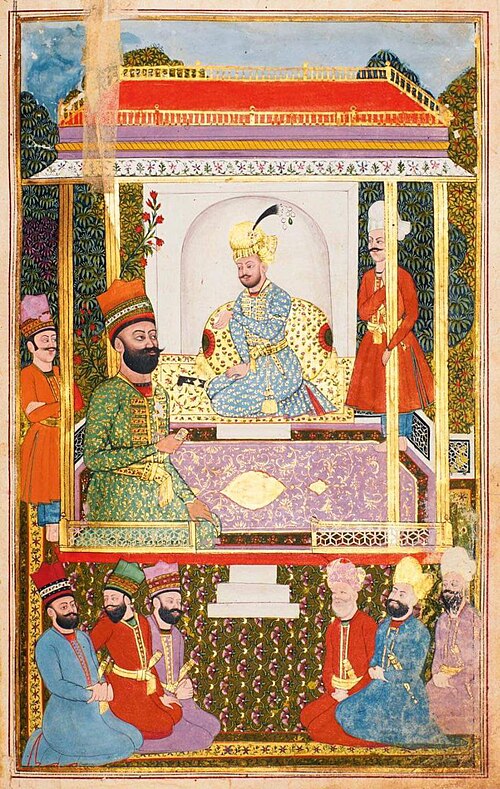
Humayun Takes Refuge in Safavid Court
The exiled Mughal Emperor Humayun seeks refuge at the Safavid court of Tahmasp I, who provides military aid to reclaim his throne. This strengthens Safavid-Mughal ties and introduces Persian art to India. #diplomacy #art
Humayun Takes Refuge in Safavid Court By Circa 1550-55 artist - This image has been extracted from another file, Public domain, https://commons.wikimedia.org/w/index.php?curid=156992221
1555 CE
Treaty of Amasya with the Ottoman Empire
The Treaty of Amasya ends decades of conflict between the Safavids and Ottomans, establishing a peace that lasts nearly 30 years and recognizing Safavid control over eastern Transcaucasia. #peace
Treaty of Amasya with the Ottoman Empire By Chamboz (talk · contribs) - Wikipédia, CC BY-SA 4.0, https://commons.wikimedia.org/w/index.php?curid=64294534
1576 CE
Death of Tahmasp I and Succession Crisis
Shah Tahmasp I dies, leading to a period of instability as rival Qizilbash factions struggle for power. His son Ismail II briefly reigns until his mysterious death in 1577. #history
Oct 1, 1587 CE
Shah Abbas I Comes to Power
At age 16, Shah Abbas I ascends the throne, initiating a golden age for Safavid Persia through military, administrative, and economic reforms. #history #goldenage
Shah Abbas I Comes to Power By Bishandas (attribution) - This image has been extracted from another file, Public domain, https://commons.wikimedia.org/w/index.php?curid=169268853
1588 CE
Abbas I's Early Reforms: Ghulam System
Shah Abbas I begins creating a corps of ghulams (slave soldiers) from Circassian, Georgian, and Armenian captives, reducing Qizilbash influence. #military
1590 CE
Treaty of Constantinople with Ottomans
Abbas I signs a disadvantageous peace with the Ottoman Empire, ceding lands to focus on internal consolidation and reforming the army (especially the introduction of ghulam slave soldiers). #diplomacy )
Treaty of Constantinople with Ottomans By Chamboz - Own work References: Dávid, Géza, ed. (2000) Ottomans, Hungarians, and Habsburgs in Central Europe: The Military Confines in the Era of Ottoman Conquest, Brill Finkel, Caroline (2005) Osman's Dream: The Story of the Ottoman Empire, 1300-1923, Basic Books ISBN: 978-0-465-02396-7. Hathaway, Jane (2008) The Arab Lands under Ottoman Rule, 1516-1800, Pearson Education Ltd. ISBN: 978-0-582-41899-8. Peirce, Leslie (1993) The Imperial Harem: Women and Sovereignty in the Ottoman Empire, Oxford University Press ISBN: 0-19-508677-5. Pop, Ioan-Aurel, ed. (2006) History of Romania Compendium, Romanian Cultural Institute Luft, P. (1993) "Mushaʿshaʿ" in Encyclopaedia of Islam, 7, pp. 672−675 Magocsi, Paul Robert (2010) A History of Ukraine: The Land and Its Peoples (2nd ed.), University of Toronto Press Rhoads, Murphey (1999) Ottoman Warfare, 1500-1700, Rutgers University Press ISBN: 1-85728-389-9., CC BY-SA 4.0, https://commons.wikimedia.org/w/index.php?curid=64318203
1598 CE
Relocation of Capital to Isfahan
Shah Abbas I moves the Safavid capital from Qazvin to Isfahan, transforming it into a magnificent city with grand boulevards, gardens, and monumental architecture. #architecture #urbanism
Relocation of Capital to Isfahan By Pedram forouzanfar - Own work, CC BY-SA 4.0, https://commons.wikimedia.org/w/index.php?curid=93928569
1603 CE
Reconquest of Tabriz from Ottomans
Abbas I launches a successful campaign against the Ottoman Empire, recapturing Tabriz, Nakhchivan, and other territories lost in previous treaties. #war
1606 CE
Completion of the Musalla and Chaharbagh Avenue
Isfahan's Chaharbagh, a 1.6 km avenue lined with gardens and palaces, is completed, connecting the new city center with the Zayandeh River. It becomes a model of royal urban planning. #architecture
1610 CE
Construction of Naqsh-e Jahan Square Begins
Shah Abbas I orders the construction of Naqsh-e Jahan Square (now Imam Square) in Isfahan, a massive rectangular plaza surrounded by the Shah Mosque, Sheikh Lotfollah Mosque, Ali Qapu Palace, and the Grand Bazaar. It becomes a UNESCO World Heritage site. #architecture #heritage
Construction of Naqsh-e Jahan Square Begins By احمد جمالی مقدم - Own work, CC BY-SA 4.0, https://commons.wikimedia.org/w/index.php?curid=72749848
1611 CE
Forced Relocation of Armenians to New Julfa
Abbas I relocates thousands of Armenian Christians from Julfa to a suburb of Isfahan called New Julfa, boosting the silk trade with Armenian merchants and fostering cultural exchange. #trade #diaspora
Forced Relocation of Armenians to New Julfa By Thomas - originally posted to Flickr as the courtyard, CC BY 2.0, https://commons.wikimedia.org/w/index.php?curid=6773288
1613 CE
Abbas I's Embassy to Europe
Shah Abbas I sends an embassy to the courts of Spain, France, and England seeking an anti-Ottoman alliance, opening diplomatic channels that increase European knowledge of Persia. #diplomacy
1616 CE
Shah Mosque of Isfahan Completed
The grand Shah Mosque (Imam Mosque) in Naqsh-e Jahan Square is completed, showcasing exquisite Persian tilework, muqarnas, and a stunning iwan. It remains a masterpiece of Islamic architecture. #architecture #islamicart
1618 CE
Sheikh Lotfollah Mosque Completed
The private royal mosque of Sheikh Lotfollah, built adjacent to Naqsh-e Jahan Square, is finished. It features a unique dome with intricate arabesque designs and no minarets. #architecture
Sheikh Lotfollah Mosque Completed By Nicolas Hadjisavvas - University of The Aegean, CC BY 2.5, https://commons.wikimedia.org/w/index.php?curid=1663523
1622 CE
Capture of Hormuz from the Portuguese
With the help of the English East India Company, Abbas I's forces expel the Portuguese from Hormuz Island, gaining control of the Persian Gulf trade route and boosting Safavid commerce. #trade #colonialism )
Capture of Hormuz from the Portuguese By British Library - https://arth.sas.upenn.edu/events/jill-and-john-avery-lecture-history-art-kishwar-rizvi, Public domain, https://commons.wikimedia.org/w/index.php?curid=123340873
Jan 19, 1629 CE
Death of Shah Abbas I
Shah Abbas I dies at age 58, leaving a powerful, centralized empire with a flourishing economy and culture. His successors fail to maintain his legacy. #history
1630 CE
Construction of Khaju Bridge Begins
Under Shah Abbas II, the Khaju Bridge over the Zayandeh River in Isfahan is built, serving as both a bridge and a dam, with a central pavilion for royal gatherings. #architecture #engineering
Construction of Khaju Bridge Begins By Gire 3pich2005 with special thanks to Hossein Majidi - Own work, Public domain, https://commons.wikimedia.org/w/index.php?curid=7278551
1639 CE
Treaty of Zuhab with Ottoman Empire
The Treaty of Zuhab (or Qasr-e Shirin) ends the Ottoman-Safavid War of 1623–1639, demarcating the border between the two empires, which largely remains the modern Iran-Iraq border. #peace
Treaty of Zuhab with Ottoman Empire By Flag of Ottoman Empire (1517-1793) - https://turkicflags.wordpress.com/historical-flags-of-the-turkic-states/ https://www.flickr.com/photos/ateshahmedovic/3109940303 https://www.worldstatesmen.org/Hungary.htm https://www.facebook.com/212424193545148/photos/a.212429313544636/402195657901333/?type=3 http://www.vexilla-mundi.com/cyprus_history.html, CC BY-SA 4.0, https://commons.wikimedia.org/w/index.php?curid=113247273
May 12, 1642 CE
Shah Abbas II Ascends the Throne
At age 10, Shah Abbas II becomes ruler, later strengthening the economy and patronizing the arts, especially in Isfahan. #history
Shah Abbas II Ascends the Throne By Circa 1647 - Feng Wei (Flickr), Public domain, https://commons.wikimedia.org/w/index.php?curid=168746995
1647 CE
Foundation of the Madrasa-ye Shah in Isfahan
Shah Abbas II establishes the Shah Theological School, a major center for Shi'a learning and education. #education
1654 CE
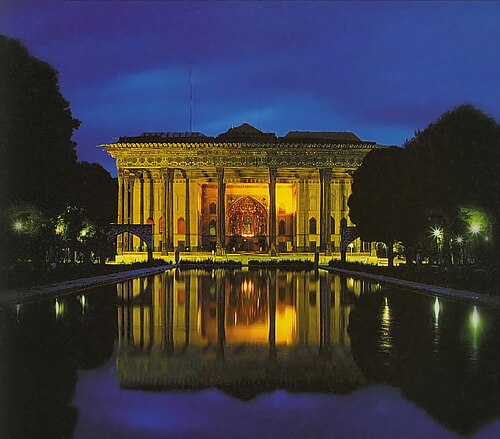
Chehel Sotoun Palace Completed
The Chehel Sotoun (Forty Columns) pavilion in Isfahan is finished, used for royal receptions and banquets. Its name derives from reflections of 20 wooden columns in a pool. #architecture
Chehel Sotoun Palace Completed By Arad - Personal picture - en.wikipedia, CC BY-SA 3.0, https://commons.wikimedia.org/w/index.php?curid=1239096
1660 CE
Mulla Sadra's Philosophical Works Gain Recognition
The influential Islamic philosopher Mulla Sadra, who died in 1635, gains posthumous fame as his school of Transcendent Theosophy influences Shi'a thought and Persian philosophy. #philosophy #shia
Mulla Sadra's Philosophical Works Gain Recognition By Hooman Mallahzadeh - Own work, CC BY-SA 4.0, https://commons.wikimedia.org/w/index.php?curid=146847289
Sep 26, 1666 CE
Death of Shah Abbas II
Shah Abbas II dies, possibly poisoned, leading to a period of decline under his successor Shah Suleiman I. #history
1676 CE
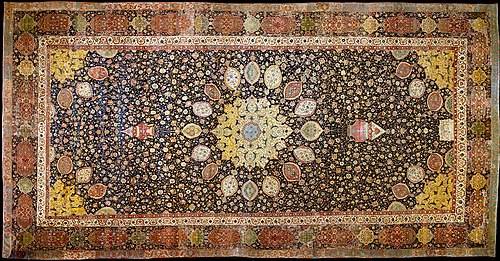
Safavid Carpet Weaving Flourishes
The Safavid period reaches its peak in carpet production, with masterpieces like the 'Ardabil Carpet' (now in V&A Museum) woven in Isfahan or Kashan. Persian carpets become globally prized trade goods. #art #trade
Safavid Carpet Weaving Flourishes By Unknown – production - AAG4cbGKXbWxeA at Google Cultural Institute maximum zoom level, Public domain, https://commons.wikimedia.org/w/index.php?curid=22621440
Jun 29, 1694 CE
Shah Sultan Husayn Becomes Shah
The weak and ineffectual Shah Sultan Husayn ascends the throne, leading to religious intolerance, economic decline, and the eventual fall of the dynasty. #history
Shah Sultan Husayn Becomes Shah By Original: Muhammad Ali (painter)Cropped: TRAJAN 117 - Cropped from File:Muhammad Ali 001.jpg, Public domain, https://commons.wikimedia.org/w/index.php?curid=25264179
1704 CE
Revolts in Kandahar and the Hotak Rising
The Ghilzai Pashtuns in Kandahar revolt against Safavid rule under Mirwais Hotak, beginning the Hotak dynasty's challenge to Safavid authority. #war
1709 CE
Mirwais Hotak Captures Kandahar
Mirwais Hotak seizes Kandahar from the Safavid governor, effectively establishing an independent state. #history
1715 CE
Death of Mirwais Hotak; Mahmud Hotak Takes Over
Mirwais Hotak dies, and his son Mahmud Hotak continues the rebellion, eventually invading Iran. #history
Mar 8, 1722 CE
Battle of Gulnabad: Hotaks Defeat Safavids
The Afghan army under Mahmud Hotak decisively defeats the Safavid forces near Isfahan, leading to the siege and capture of the capital. #battle
Battle of Gulnabad: Hotaks Defeat Safavids By Kailanmapper - Own work, CC BY-SA 4.0, https://commons.wikimedia.org/w/index.php?curid=107130380
Oct 23, 1722 CE
Fall of Isfahan and Surrender of Shah Sultan Husayn
After a long siege, Isfahan falls to the Hotak Afghans. Shah Sultan Husayn abdicates, ending effective Safavid rule temporarily. Mahmud Hotak proclaims himself Shah of Iran. #history
Apr 25, 1725 CE
Death of Mahmud Hotak and Ashraf Hotak's Reign
Mahmud Hotak dies (possibly insane or assassinated), and his cousin Ashraf Hotak takes power, facing Ottoman and Russian encroachments. #history
Death of Mahmud Hotak and Ashraf Hotak's Reign By M.samei - Own work, CC BY-SA 4.0, https://commons.wikimedia.org/w/index.php?curid=85465968
Sep 29, 1729 CE
Nader Shah Defeats Ashraf Hotak at Battle of Damghan
Nader Qoli Beg (later Nader Shah) defeats the Hotak Afghans at Damghan, beginning the restoration of Safavid power under the puppet Shah Tahmasp II. #war )
Nader Shah Defeats Ashraf Hotak at Battle of Damghan By نامشخص. احتمالاً محمد علی بیک نقاشباشی یا علی بن محمد زمان یا علی اشرف. - نسخهٔ خطی جهانگشای نادری از مجموعهٔ ادیب برومند (اندازهٔ کتاب: ۳۵×۲۲ سانتیمتر). این اثر در کتابی به مشخصات زیر منتشر شده است:استرآبادی، محمدمهدی. تاریخ جهانگشای نادری: نسخه خطی مصور متعلق به ۱۱۷۱ ه. ق. با مقدمهٔ عبدالعلی ادیب برومند. خوشنویسی نستعلیق عباس اخوین. تهران: سروش (انتشارات صدا و سیما)؛ نگار، ۱۳۷۰., Public domain, https://commons.wikimedia.org/w/index.php?curid=97289209
1730 CE
Nader Recaptures Isfahan and Ends Hotak Rule
Nader enters Isfahan, expelling the Afghans and restoring Tahmasp II to the throne as a figurehead. #history
Nader Recaptures Isfahan and Ends Hotak Rule By Ashrafi coin of Ashraf Hotak - https://www.numisbids.com/n.php?p=lot&sid=3374&lot=1331, CC BY-SA 4.0, https://commons.wikimedia.org/w/index.php?curid=112252911
1732 CE
Deposition of Tahmasp II and Infant Abbas III
Nader deposes the weak Tahmasp II and crowns his infant son Abbas III, ruling as regent. #history
Deposition of Tahmasp II and Infant Abbas III By Mirza Mahdi Khan Astarabadi - https://www.sothebys.com/en/auctions/ecatalogue/2016/arts-islamic-world-l16220/lot.57.html, Public domain, https://commons.wikimedia.org/w/index.php?curid=134974246
1732 CE
Treaty of Resht with Russia
Nader negotiates the Treaty of Resht, recovering Safavid territories in the Caucasus from Russia. #diplomacy
Treaty of Resht with Russia By William Robert Shepherd - Perry-Castañeda Library Map Collection, University of Texas at Austin Historical Atlas by William R. Shepherd Shepherd, William. Historical Atlas. New York: Henry Holt and Company, 1911 http://legacy.lib.utexas.edu/maps/historical/history_shepherd_1911.html, Public domain, https://commons.wikimedia.org/w/index.php?curid=79698793
1735 CE
Battle of Yeghevard: Nader Defeats Ottomans
Nader defeats an Ottoman army near Yeghevard, leading to the Treaty of Ganja that restores Safavid borders. #war
Battle of Yeghevard: Nader Defeats Ottomans By نامشخص. احتمالاً محمد علی بیک نقاشباشی یا علی بن محمد زمان یا علی اشرف. - نسخهٔ خطی جهانگشای نادری از مجموعهٔ ادیب برومند (اندازهٔ کتاب: ۳۵×۲۲ سانتیمتر). این اثر در کتابی به مشخصات زیر منتشر شده است:استرآبادی، محمدمهدی. تاریخ جهانگشای نادری: نسخه خطی مصور متعلق به ۱۱۷۱ ه. ق. با مقدمهٔ عبدالعلی ادیب برومند. خوشنویسی نستعلیق عباس اخوین. تهران: سروش (انتشارات صدا و سیما)؛ نگار، ۱۳۷۰., Public domain, https://commons.wikimedia.org/w/index.php?curid=97278649
Mar 8, 1736 CE
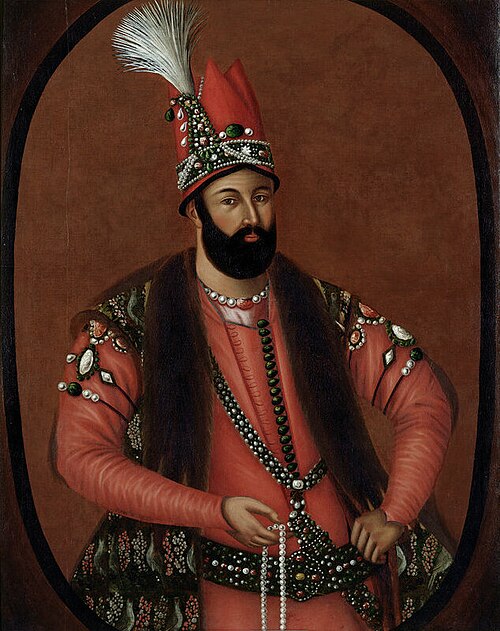
Nader Shah Crowns Himself Shahanshah
At a grand assembly in the Mughan plain, Nader is crowned Shah of Iran, ending the Safavid dynasty and beginning the Afsharid era. #history
Nader Shah Crowns Himself Shahanshah By Unknown author - https://imagesonline.bl.uk/asset/143693. Per page x of the The Contest for Rule in Eighteenth-Century Iran: Idea of Iran Vol. 11, the artist is unknown, and the work was created in circa 1740. British Library:[1] Source: Foster 44 Caption: Nadir Shah of Persia (1732-1747). Three-quarter length, in an oval cartouche. The Shah wears a scarlet tunic with a sleeveless outer garment trimmed with fur. On his head is a high cap (a ‘tahmazi’) ornamented with a jewelled aigrette. The face is turned a little to the right. The left hand rests on the hip, the right holds a string of pearls. Jewelled bracelets on his upper arms., Public domain, https://commons.wikimedia.org/w/index.php?curid=138912707
1736 CE
End of the Safavid Dynasty
With Nader Shah's coronation, the Safavid dynasty officially ends after 235 years, having profoundly shaped Persian and Shi'a identity. #history #shia
End of the Safavid Dynasty By Safavid_Flag.png: Orange Tuesday (talk) The original uploader was Orange Tuesday at English Wikipedia. derivative work: Himasaram (talk) - Safavid_Flag.png, Public domain, https://commons.wikimedia.org/w/index.php?curid=11856267