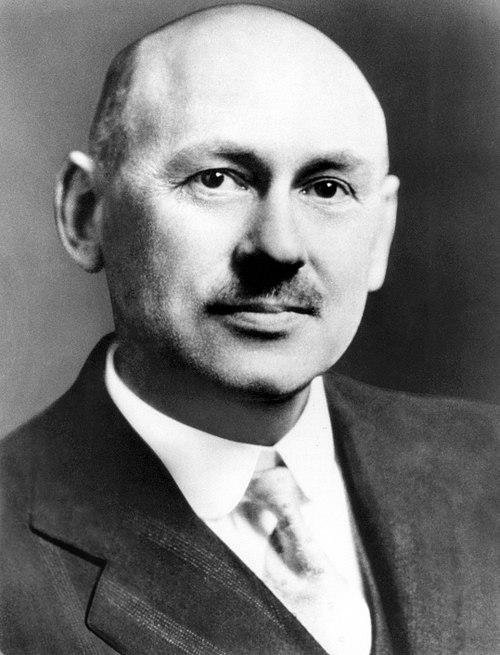
Robert Goddard: Liquid-Fueled Rocketry & Father of American Spaceflight
Encyclopedia/2. Technology & The Built World/4. Energy & Transportation/06. Energy & Transportation Biographies • Curated by Admin Timeline.sg
Timeline of American engineer Robert H. Goddard, who pioneered liquid-fueled rocketry and is considered the father of modern spaceflight.
Chronological Storyline (40 Milestones)
Oct 5, 1882 CE
Robert Goddard Born in Worcester, MA
Robert Hutchings Goddard is born in Worcester, Massachusetts, to Nahum Danford Goddard and Fannie Louise Hoyt. #rocketry #history
Robert Goddard Born in Worcester, MA By NASA - Great Images in NASA Description, Public domain, https://commons.wikimedia.org/w/index.php?curid=6462082
Oct 19, 1899 CE
Cherry Tree Vision of Space Travel
At age 17, Goddard climbs a cherry tree and has a vision of a device that could travel to space, marking the start of his lifelong interest in rocketry. #rocketry #space
1904 CE
Enters Worcester Polytechnic Institute
Goddard enrolls at Worcester Polytechnic Institute to study engineering. #education #rocketry
1908 CE
Receives B.S. from WPI
Goddard earns his Bachelor of Science degree from Worcester Polytechnic Institute. #education #rocketry
1908 CE
Begins Graduate Studies at Clark University
Goddard starts graduate work at Clark University in Worcester. #education #rocketry
1910 CE
Receives M.A. from Clark University
Goddard earns his Master of Arts degree. #education #rocketry
1911 CE
Receives Ph.D. from Clark University
Goddard earns his Ph.D. in physics. #education #science
1912 CE
Research Fellow at Princeton University
Goddard becomes a research fellow at Princeton, where he conducts early experiments with rocket propulsion. #research #rocketry
1913 CE
First Rocket Patents
Goddard receives his first patents for rocket technology, including a design for a multistage rocket. #patents #rocketry
1914 CE
Returns to Clark University as Instructor
Goddard becomes an instructor at Clark University, where he continues his rocket research. #education #rocketry
1915 CE
Begins Solid-Fuel Rocket Experiments
Goddard starts experimenting with solid-fuel rockets, testing various propellants. #experiment #rocketry
1916 CE
Publishes Paper on Rocket Efficiency
Goddard publishes a paper on the efficiency of rocket engines, laying theoretical groundwork. #publication #science
Jan 1, 1919 CE
Publishes 'A Method of Reaching Extreme Altitudes'
Goddard's seminal paper is published by the Smithsonian Institution, detailing the use of liquid-fueled rockets for high-altitude research. #publication #space
Jan 13, 1920 CE
New York Times Ridicules Goddard's Moon Rocket Claim
The New York Times editorial criticizes Goddard's suggestion that rockets could reach the Moon, later retracting in 1969. #media #controversy
1921 CE
Begins Liquid-Fueled Rocket Work
Goddard starts development of liquid-fueled rocket engines, initially using liquid oxygen and gasoline. #innovation #rocketry
1923 CE
Static Test of Liquid-Oxygen/Gasoline Engine
Goddard conducts a static test of a liquid-fueled rocket engine, proving the concept works. #experiment #engineering
Jun 21, 1924 CE
Marries Esther Kisk
Goddard marries Esther Kisk, who becomes his lifelong partner and assistant. #personal #family
1925 CE
Successful Static Test of Liquid Rocket Engine
Goddard achieves a successful static test of a liquid-fueled rocket engine, producing significant thrust. #experiment #breakthrough
Mar 16, 1926 CE
First Liquid-Fueled Rocket Launch (Nell)
Goddard launches the first liquid-fueled rocket, named 'Nell', from a farm in Auburn, Massachusetts. It reaches an altitude of 41 feet. #rocketry #milestone
Apr 3, 1926 CE
Second Liquid-Fueled Rocket Flight
Goddard launches a second liquid-fueled rocket, achieving a higher altitude. #experiment #rocketry
1927 CE
Demonstrates Gyroscopic Control
Goddard begins experimenting with gyroscopic stabilization for rocket guidance. #innovation #guidance
Jul 1, 1929 CE
Launches Larger Rocket with Scientific Payload
Goddard launches a larger rocket carrying a barometer and camera, drawing public attention and funding. #experiment #payload
Dec 30, 1930 CE
First Roswell Launch
Goddard conducts the first rocket launch from his Roswell test range. #experiment #rocketry
1930 CE
Moves to Roswell, New Mexico
With support from the Guggenheim Foundation, Goddard moves to Roswell, New Mexico for more isolated testing. #research #relocation
1931 CE
Gyroscopic Steering Tests
Goddard tests gyroscopic systems for active rocket steering. #innovation #guidance
1932 CE
First Launch with Gyroscopic Steering
Goddard launches a rocket with gyroscopic control, demonstrating stable flight. #success #technology
1933 CE
Rocket Test Flights Continue
Goddard conducts a series of test flights, refining rocket design and propulsion. #experiment #progress
1934 CE
Develops Parachute Recovery System
Goddard designs and tests parachute recovery for rockets to enable reuse. #innovation #recovery
May 31, 1935 CE
Record Altitude Flight: 7,500 Feet
A rocket reaches an altitude of 7,500 feet (2,300 m), a new record. #milestone #performance
Oct 29, 1935 CE
Rocket Exceeds 4,000 mph
A rocket achieves speeds over 4,000 mph (6,400 km/h), demonstrating supersonic capability. #speed #breakthrough
1936 CE
Publishes Fluid Dynamics Research
Goddard publishes work on fluid dynamics relevant to rocket nozzles and combustion. #publication #science
1937 CE
Tests Turbopump for Rocket Engines
Goddard develops and tests a turbopump to feed propellants under high pressure. #innovation #engineering
1938 CE
Demonstrates Rocket to U.S. Army
Goddard presents his rocket technology to the U.S. Army Air Corps, seeking military interest. #military #presentation
1939 CE
Patents Multistage Rocket
Goddard receives a patent for a multistage rocket design, crucial for reaching orbit. #patents #innovation
1940 CE
Develops JATO (Jet-Assisted Takeoff) for Aircraft
Goddard works on JATO units to boost aircraft takeoff performance, initially tested with a Navy plane. #military #aviation
1941 CE
First JATO Test Flight
Goddard's JATO system is tested on an aircraft, proving its effectiveness. #test #aviation
1942 CE
JATO Development Continues
Goddard continues refining JATO units for the U.S. Navy during World War II. #war #technology
1943 CE
Further JATO Demonstrations
Goddard conducts more JATO demonstrations, solidifying the technology's utility. #military #success
1944 CE
Diagnosed with Throat Cancer
Goddard is diagnosed with cancer of the throat, which would eventually claim his life. #personal #health
Aug 10, 1945 CE
Robert Goddard Dies in Baltimore
Goddard dies in Baltimore, Maryland, at the age of 62, after a battle with throat cancer. #obituary #legacy