Encyclopedia/1. The Cosmos & The Natural World/1. Mathematics & Formal Systems/02. Algebra & Symbolic Systems • Curated by Admin Timeline.sg
Ring theory and field theory are branches of abstract algebra that study algebraic structures with two operations (addition and multiplication), evolving from ancient number systems to modern axiomatic frameworks. Key milestones include the development of modular arithmetic, ideal theory, and the advent of Noetherian rings.
Chronological Storyline (43 Milestones)
300 CE
Chinese Remainder Theorem in Sunzi Suan Jing
The Chinese mathematical text Sunzi Suan Jing (Master Sun's Mathematical Manual) contains the earliest known statement of the Chinese remainder theorem, a foundational result in modular arithmetic. #math #history
628 CE
Brahmagupta's Brāhmasphuṭasiddhānta
Brahmagupta's work on arithmetic involving zero and negative numbers lays early groundwork for ring properties. #math #history
820 CE
Al-Khwarizmi's The Compendious Book on Calculation by Completion and Balancing
Al-Khwarizmi's algebra treatise introduces systematic solutions of linear and quadratic equations, influencing later algebraic structures. #math #history
Al-Khwarizmi's The Compendious Book on Calculation by Completion and Balancing By Zarateman - Own work, CC0, https://commons.wikimedia.org/w/index.php?curid=162213187
1202 CE
Fibonacci's Liber Abaci
Fibonacci introduces Hindu-Arabic numerals and modular arithmetic concepts to Europe, including the Fibonacci sequence. #math #history
Fibonacci's Liber Abaci By Unknown author, Public domain, https://commons.wikimedia.org/w/index.php?curid=720501
1545 CE
Cardano's Ars Magna
Gerolamo Cardano publishes solutions to cubic and quartic equations, advancing the study of polynomial rings. #math #algebra )
1801 CE
Gauss's Disquisitiones Arithmeticae
Carl Friedrich Gauss systematizes modular arithmetic and number theory, establishing the ring of integers modulo n. #math #numbertheory
Gauss's Disquisitiones Arithmeticae By Unknown author, Public domain, https://commons.wikimedia.org/w/index.php?curid=641724
1832 CE
Galois Theory Founded by Évariste Galois
Évariste Galois develops the connection between field theory and group theory, revolutionizing the solvability of polynomial equations. #math #algebra
Galois Theory Founded by Évariste Galois By Unknown author - Iyanaga, Shokichi, "ガロアの時代 ガロアの数学 第一部 時代篇" , Springer-Verlag Tokyo, 1999 http://www.win.tue.nl/~aeb/at/GaloisCorrespondence.html, Public domain, https://commons.wikimedia.org/w/index.php?curid=103351
Oct 16, 1843 CE
Hamilton Discovers Quaternions
William Rowan Hamilton discovers quaternions, a non-commutative division algebra, expanding the concept of fields. #math #algebra
Hamilton Discovers Quaternions By Cmglee - Own work, CC BY-SA 4.0, https://commons.wikimedia.org/w/index.php?curid=145997978
1854 CE
Cayley Defines Abstract Groups
Arthur Cayley introduces the concept of an abstract group, influencing ring theory through the study of group rings. #math #algebra
Cayley Defines Abstract Groups By Herbert Beraud (1845–1896) - http://www-groups.dcs.st-and.ac.uk/~history/PictDisplay/Cayley.html, Public domain, https://commons.wikimedia.org/w/index.php?curid=904674
1871 CE
Dedekint Introduces Ideals
Richard Dedekind introduces the concept of ideals in algebraic number theory, a cornerstone of ring theory. #math #algebra )
1882 CE
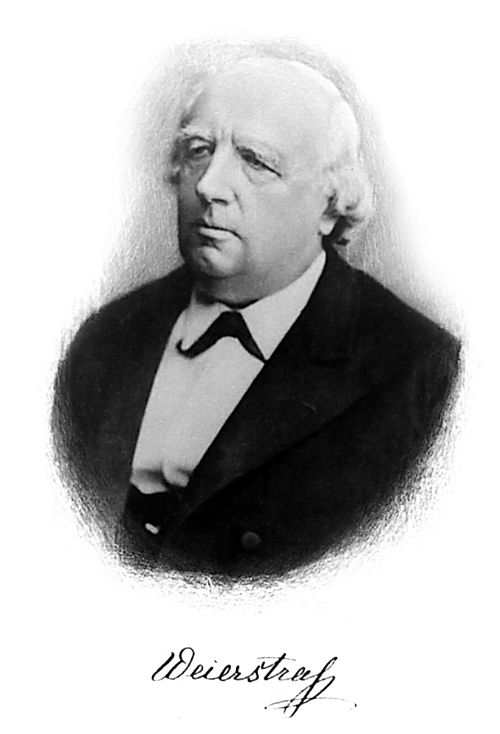
Weierstrass on Polynomial Rings
Karl Weierstrass studies polynomial rings over fields, contributing to the foundations of commutative algebra. #math #algebra
Weierstrass on Polynomial Rings By Unknown author, Public domain, https://commons.wikimedia.org/w/index.php?curid=324146
1893 CE
Hilbert's Basis Theorem
David Hilbert proves that every ideal in a polynomial ring over a field is finitely generated, a key result in ring theory. #math #algebra
1900 CE
Hilbert's Nullstellensatz
David Hilbert proves the Nullstellensatz, linking algebraic geometry and commutative algebra. #math #algebra
1905 CE
Wedderburn's Little Theorem
Joseph Wedderburn proves that every finite division ring is a field, a classic result in ring theory. #math #algebra
1908 CE
Steinitz's Classification of Fields
Ernst Steinitz publishes a paper classifying fields by characteristic and transcendence degree, founding field theory. #math #algebra
Steinitz's Classification of Fields By Ar2r4alll - Own work, CC BY 3.0, https://commons.wikimedia.org/w/index.php?curid=8545862
1921 CE
Emmy Noether and Ideal Theory
Emmy Noether publishes her seminal paper on ideal theory, establishing the ascending chain condition and Noetherian rings. #math #algebra
Emmy Noether and Ideal Theory By Unknown authorUnknown author Publisher: Mathematical Association of America [3], Brooklyn Museum [4], Agnes Scott College [5], [6] - Emmy Noether (1882-1935), Archived, Public domain, https://commons.wikimedia.org/w/index.php?curid=158126186
1927 CE
Artin's Theory of Braids and Rings
Emil Artin develops the Artin–Wedderburn theorem for semisimple rings, advancing ring structure theory. #math #algebra
1930 CE
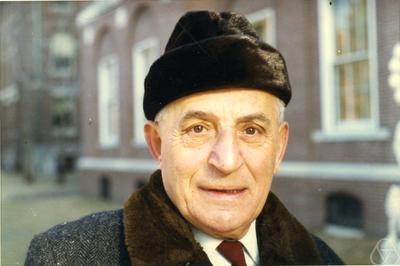
Jacobson Radical Introduced
Nathan Jacobson introduces the Jacobson radical, a fundamental concept in ring theory. #math #algebra
Jacobson Radical Introduced By Konrad Jacobs, Erlangen - https://opc.mfo.de/detail?photo_id=1941, CC BY-SA 2.0 de, https://commons.wikimedia.org/w/index.php?curid=11192158
1935 CE
Zariski's Work on Algebraic Geometry
Oscar Zariski applies commutative algebra to algebraic geometry, leading to the Zariski topology. #math #algebra
Zariski's Work on Algebraic Geometry By George Bergman - https://opc.mfo.de/detail?photo_id=6262, GFDL 1.2, https://commons.wikimedia.org/w/index.php?curid=6090840
1941 CE
Cohen's Work on Local Rings
Irvin Cohen's thesis on the structure of complete local rings marks a milestone in ring theory. #math #algebra
1945 CE
Cartan and Eilenbergs' Homological Algebra
Henri Cartan and Samuel Eilenberg publish 'Homological Algebra', applying ring theory to homology. #math #algebra
Cartan and Eilenbergs' Homological Algebra By IkamusumeFan - Own work, CC BY-SA 4.0, https://commons.wikimedia.org/w/index.php?curid=36817104
1950 CE
Kaplansky's Theorems on Rings
Irving Kaplansky proves major results on von Neumann regular rings and Hilbert's problems. #math #algebra
Kaplansky's Theorems on Rings By George Bergman - https://commons.wikimedia.org/wiki/File:Irving_Kaplansky_1988_(re-scanned).jpg, CC BY-SA 4.0, https://commons.wikimedia.org/w/index.php?curid=180274965
1955 CE
Bourbaki's 'Algebra' Published
Nicolas Bourbaki publishes a structured treatise on algebra, solidifying ring and field theory as core. #math #algebra
1958 CE
Serre's Algebraic Geometry and Commutative Algebra
Jean-Pierre Serre uses sheaf theory and rings to reformulate algebraic geometry. #math #algebra
Serre's Algebraic Geometry and Commutative Algebra By Mediterranean Institute for the Mathematical Sciences - Extracted from https://www.youtube.com/watch?v=wXCo54RuP1s&t=1502s, CC BY 3.0, https://commons.wikimedia.org/w/index.php?curid=110894720
1960 CE
Grothendieck's Scheme Theory
Alexander Grothendieck revolutionizes algebraic geometry by basing it on commutative rings and schemes. #math #algebra
Grothendieck's Scheme Theory By Konrad Jacobs, Erlangen, Copyright by MFO / Original uploader was AEDP at it.wikipedia - Cutted from File:Alexander_Grothendieck.jpg, CC BY-SA 4.0, https://commons.wikimedia.org/w/index.php?curid=154118951
1964 CE
Auslander-Buchsbaum Theorem
Maurice Auslander and David Buchsbaum prove the Auslander-Buchsbaum theorem on the depth of modules over rings. #math #algebra
1965 CE
Quillen's Work on Projective Modules
Daniel Quillen proves the Quillen–Suslin theorem (Serre's conjecture) that projective modules over polynomial rings are free. #math #algebra
1967 CE
Finite Field Theory Applications
Finite fields become essential in coding theory and cryptography, with Berlekamp's algorithm for polynomial factorization. #math #crypto
1970 CE
Ring Theory in Representation Theory
Maurice Auslander's representation theory of Artin algebras connects rings and modules. #math #algebra
1972 CE
Jacobson's 'Basic Algebra I'
Nathan Jacobson publishes a comprehensive textbook 'Basic Algebra I', widely used for ring and field theory. #math #education
1975 CE
Hochschild's Cohomology for Rings
Gerhard Hochschild develops Hochschild cohomology, now a key tool in ring theory. #math #algebra
1980 CE
McConnell and Robson's Noncommutative Noetherian Rings
The book by J. C. McConnell and J. C. Robson systematizes the theory of noncommutative Noetherian rings. #math #algebra
McConnell and Robson's Noncommutative Noetherian Rings By The original uploader was Ecphora at English Wikipedia. - Transferred from en.wikipedia to Commons by Ecphora., Public domain, https://commons.wikimedia.org/w/index.php?curid=7338477
1983 CE
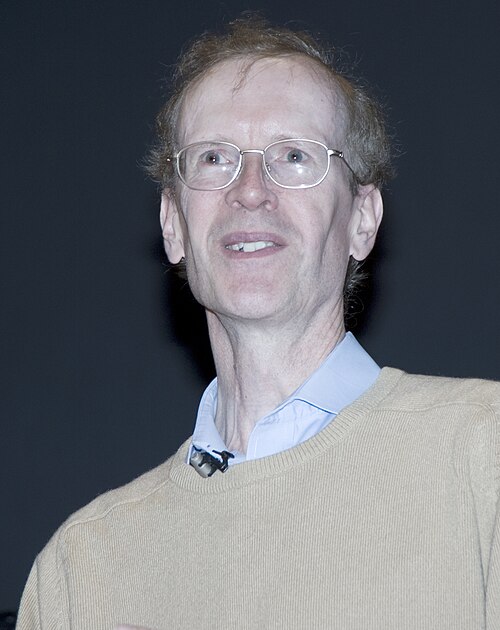
Wiles' Work on Iwasawa Theory
Andrew Wiles uses ring theory and modular forms in his approach to Fermat's Last Theorem. #math #numbertheory
Wiles' Work on Iwasawa Theory By "copyright C. J. Mozzochi, Princeton N.J" - http://www.mozzochi.org/deligne60/Deligne1/_DSC0024.jpg, Attribution, https://commons.wikimedia.org/w/index.php?curid=2635913
1988 CE
Cohn's 'Free Rings and Their Relations'
Paul Cohn publishes a foundational text on free rings and skew fields. #math #algebra
Cohn's 'Free Rings and Their Relations' By George Bergman - https://opc.mfo.de/detail?photoID=10621, GFDL 1.2, https://commons.wikimedia.org/w/index.php?curid=4341956
1994 CE
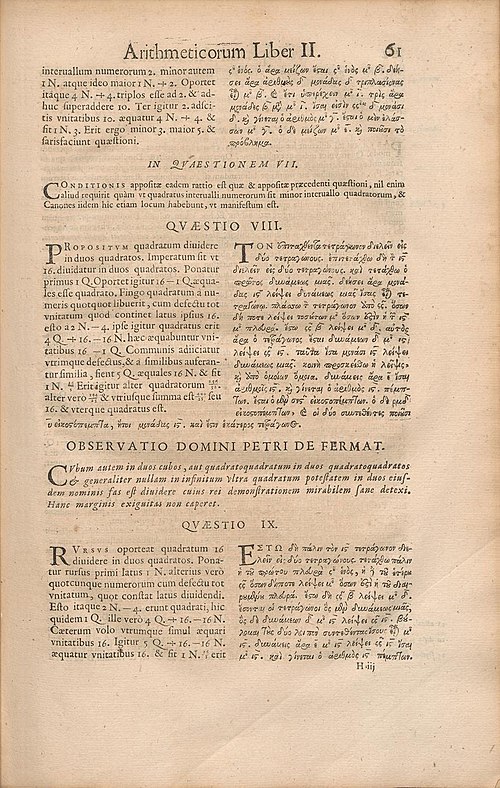
Wiiles Proves Fermat's Last Theorem
Andrew Wiles completes the proof of Fermat's Last Theorem, relying heavily on ring theory and modular forms. #math #numbertheory
Wiiles Proves Fermat's Last Theorem By Unknown author, Public domain, https://commons.wikimedia.org/w/index.php?curid=533640
1996 CE
Lafforgue's Proof of the Langlands Correspondence for Function Fields
Laurent Lafforgue proves the Langlands correspondence for function fields, using ring theory of adeles. #math #algebra
Lafforgue's Proof of the Langlands Correspondence for Function Fields By Institut des Hautes Études Scientifiques (IHÉS) - Issu de https://www.youtube.com/watch?v=YQthqp5gplc, CC BY 3.0, https://commons.wikimedia.org/w/index.php?curid=50468182
2000 CE
Hesselink's Work on Quivers and Rings
Advances in quiver representations connect to ring theory and derived categories. #math #algebra )
2002 CE
Agrawal–Kayal–Saxena Primality Test
The AKS primality test uses properties of polynomial rings over finite fields. #math #algorithms
2006 CE
Gratzer's Lattice Theory and Ring Connections
George Grätzer publishes 'Lattice Theory: Foundation', highlighting links between lattices and rings. #math #algebra
2010 CE
Homological Conjectures in Commutative Algebra
Advances in homological algebra, including the direct summand conjecture, are resolved. #math #algebra
2012 CE
Perfectoid Spaces in Algebraic Geometry
Peter Scholze introduces perfectoid spaces, using non-archimedean fields and ring theory. #math #algebra
2016 CE
Categorification of Rings via Khovanov Homology
Categorification techniques, such as Khovanov homology, link ring theory to knot theory. #math #topology
2018 CE
Stacks Project and Commutative Algebra
The Stacks Project provides a comprehensive online resource for commutative algebra and ring theory. #math #algebra
Stacks Project and Commutative Algebra By Aise Johan de Jong - https://stacks.math.columbia.edu/download/book.pdf, Public domain, https://commons.wikimedia.org/w/index.php?curid=183804623