Ring Theory & Fields: Pioneer Biographies & Lasting Legacies
Encyclopedia/1. The Cosmos & The Natural World/1. Mathematics & Formal Systems/02. Algebra & Symbolic Systems • Curated by Admin Timeline.sg
This timeline traces the development of ring theory and fields from ancient number systems to modern abstract algebra, highlighting the lives and contributions of key mathematicians across civilizations.
Chronological Storyline (40 Milestones)
250 BCE
Sunzi's Chinese Remainder Problem
The Chinese mathematician Sunzi poses a problem in the Sunzi Suanjing that later inspires the Chinese Remainder Theorem, a foundational result in modular arithmetic and ring theory. #math #history
Sunzi's Chinese Remainder Problem By AnonymousUnknown author - Own work (my book), Public domain, https://commons.wikimedia.org/w/index.php?curid=12568381
628 CE
Brahmagupta Defines Zero and Negative Numbers
Indian mathematician Brahmagupta's Brahmasphutasiddhanta establishes rules for arithmetic with zero and negative numbers, laying groundwork for modern ring theory. #math #india
820 CE
Al-Khwarizmi's Al-Jabr
Persian mathematician Al-Khwarizmi publishes Al-Kitab al-Mukhtasar fi Hisab al-Jabr wal-Muqabala, systematizing linear and quadratic equations and giving algebra its name. #math #islamicgoldenage
Al-Khwarizmi's Al-Jabr By Zarateman - Own work, CC0, https://commons.wikimedia.org/w/index.php?curid=162213187
1545 CE
Cardano's Ars Magna
Gerolamo Cardano publishes solutions to cubic and quartic equations, advancing algebra and field theory. #math #renaissance )
1637 CE
Descartes Links Algebra and Geometry
René Descartes' La Géométrie introduces coordinate geometry, connecting algebraic equations to geometric curves and influencing the concept of polynomial rings. #math #analyticgeometry
Descartes Links Algebra and Geometry By Original uploader was User:Caton at [1] - Originally from fr.wikipedia; description page is/was here., Public domain, https://commons.wikimedia.org/w/index.php?curid=1379032
1770 CE
Euler's Elements of Algebra
Leonhard Euler publishes his comprehensive algebra textbook, systematizing the field and influencing later work in ring theory. #math #algebra
Euler's Elements of Algebra By Euler, Leonhard, 1707-1783 Hewlett, John, 1762-1844 Horner, Francis, 1778-1817 Bernoulli, Jean, 1744-1807 Lagrange, J. L. (Joseph Louis), 1736-1813 - Internet Archive identifier: elementsofalgebr00eule https://archive.org/download/elementsofalgebr00eule/elementsofalgebr00eule.pdf, Public domain, https://commons.wikimedia.org/w/index.php?curid=95114769
1801 CE
Gauss's Disquisitiones Arithmeticae
Carl Friedrich Gauss formalizes modular arithmetic and introduces congruences, essential for later ring theory. #math #numbertheory
Gauss's Disquisitiones Arithmeticae By Unknown author, Public domain, https://commons.wikimedia.org/w/index.php?curid=641724
1824 CE
Abel Proves Quintic Unsolvability
Niels Henrik Abel proves that the general quintic equation is unsolvable by radicals, a key result in field theory. #math #algebra
May 31, 1832 CE
Galois Dies, Field Theory Birth
Évariste Galois dies after developing group and field theory, linking polynomial equations to symmetry and founding modern algebra. #math #galoistheory
Galois Dies, Field Theory Birth By Unknown author - Iyanaga, Shokichi, "ガロアの時代 ガロアの数学 第一部 時代篇" , Springer-Verlag Tokyo, 1999 http://www.win.tue.nl/~aeb/at/GaloisCorrespondence.html, Public domain, https://commons.wikimedia.org/w/index.php?curid=103351
Oct 16, 1843 CE
Hamilton Discovers Quaternions
William Rowan Hamilton invents quaternions, the first non-commutative division algebra, sparking ring theory. #math #quaternions
Hamilton Discovers Quaternions By Cmglee - Own work, CC BY-SA 4.0, https://commons.wikimedia.org/w/index.php?curid=145997978
1847 CE
Boole's Algebraic Logic
George Boole publishes The Mathematical Analysis of Logic, applying algebraic methods to logic, later influencing Boolean rings. #math #logic
1858 CE
Cayley Defines Matrix Multiplication
Arthur Cayley introduces matrix multiplication, providing a key example of non-commutative rings. #math #matrices
Cayley Defines Matrix Multiplication By Quartl - Own work, CC BY-SA 3.0, https://commons.wikimedia.org/w/index.php?curid=27634996
1870 CE
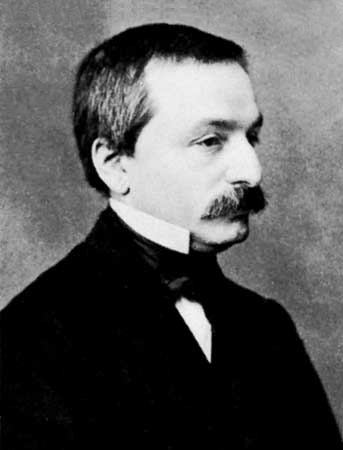
Kronecker Defines Abstract Fields
Leopold Kronecker gives the first abstract definition of a field in his work on algebraic numbers. #math #fieldtheory
Kronecker Defines Abstract Fields By Unknown author - http://www.britannica.com/EBchecked/media/28346/Kronecker-1865, Public domain, https://commons.wikimedia.org/w/index.php?curid=33753789
1871 CE
Dedekind Introduces Ideals
Richard Dedekind introduces the concept of ideals in rings of algebraic integers, a cornerstone of ring theory. #math #ideals )
1882 CE
Hurwitz Studies Quaternion Algebras
Adolf Hurwitz investigates quaternion algebras over the rationals, advancing non-commutative ring theory. #math #algebra
Hurwitz Studies Quaternion Algebras By Unknown author - MacTutor biography, http://www-gap.dcs.st-and.ac.uk/~history/Biographies/Hurwitz.html, Public domain, https://commons.wikimedia.org/w/index.php?curid=1518800
1893 CE
Frobenius Classifies Division Algebras
Ferdinand Georg Frobenius proves that the only finite-dimensional division algebras over the real numbers are the reals, complexes, and quaternions. #math #divisionalgebra )
1893 CE
Weber Defines Rings Abstractly
Heinrich Weber provides the first abstract definition of a ring in his algebra textbook, formalizing the concept. #math #ringtheory
Weber Defines Rings Abstractly By Ludwig Zipfel - This image is from the collection of the ETH-Bibliothek and has been published on Wikimedia Commons as part of a cooperation with Wikimedia CH. Corrections and additional information are welcome., Public domain, https://commons.wikimedia.org/w/index.php?curid=59448786
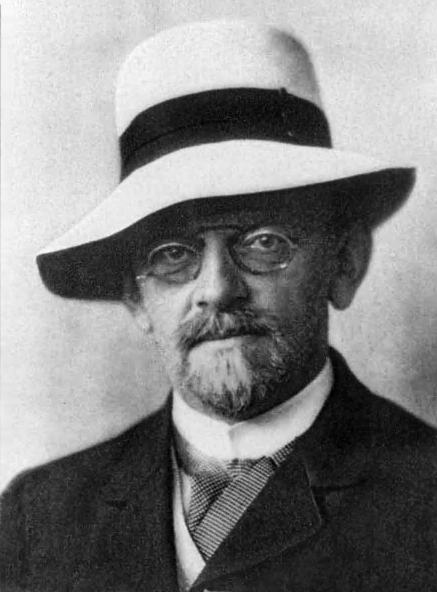
Aug 8, 1900 CE
Hilbert's Problems Include Basis Theorem
David Hilbert presents his famous problems, including the basis theorem that proves finite generation of ideals in polynomial rings. #math #hilbert
Hilbert's Problems Include Basis Theorem By Unknown author - Possibly Reid, Constance (1970) Hilbert, Berlin, Heidelberg: Springer Berlin Heidelberg Imprint Springer, p. 230 ISBN: 978-3-662-27132-2., Public domain, https://commons.wikimedia.org/w/index.php?curid=36302
1905 CE
Wedderburn's Little Theorem
Joseph Wedderburn proves that every finite division ring is a field, a fundamental result in ring theory. #math #finitefields
1914 CE
Noether Begins Work on Ideals
Emmy Noether starts her groundbreaking research on ideals in commutative rings, laying the foundation for Noetherian rings. #math #emmyNoether
Noether Begins Work on Ideals By Unknown authorUnknown author Publisher: Mathematical Association of America [3], Brooklyn Museum [4], Agnes Scott College [5], [6] - Emmy Noether (1882-1935), Archived, Public domain, https://commons.wikimedia.org/w/index.php?curid=158126186
1921 CE
Noether's Idealtheorie in Ringbereichen
Emmy Noether publishes her seminal paper giving the modern theory of ideals in commutative rings, defining Noetherian rings. #math #ringtheory
1926 CE
Artin Generalizes to Noncommutative Rings
Emil Artin introduces Artinian rings and develops the structure theory of noncommutative rings. #math #artin
Artin Generalizes to Noncommutative Rings By Konrad Jacobs, Erlangen - Mathematisches Forschungsinstitut Oberwolfach, https://opc.mfo.de/detail?photoID=116, CC BY-SA 2.0 de, https://commons.wikimedia.org/w/index.php?curid=3898471
1927 CE
Artin's Theorem on Simple Algebras
Emil Artin proves the structure theorem for simple algebras, a key result in ring theory. #math #algebras
1936 CE
Wedderburn's Structure Theorem
Joseph Wedderburn publishes the Wedderburn-Artin theorem classifying semisimple rings and algebras. #math #ringtheory
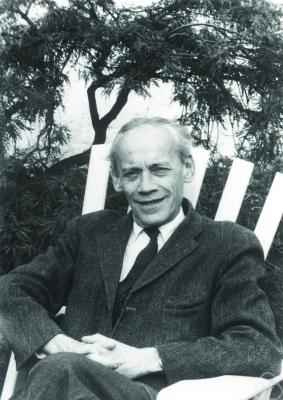
1945 CE
Jacobson Introduces Radical
Nathan Jacobson defines the Jacobson radical of a ring, a crucial tool in ring structure theory. #math #jacobson
Jacobson Introduces Radical By Konrad Jacobs, Erlangen - https://opc.mfo.de/detail?photo_id=1941, CC BY-SA 2.0 de, https://commons.wikimedia.org/w/index.php?curid=11192158
1950 CE
Chevalley on Valuation Rings
Claude Chevalley develops the concept of valuation rings, important for algebraic geometry and number theory. #math #algebraicgeometry
1956 CE
von Neumann's Continuous Geometry
John von Neumann explores continuous geometry using rings of operators, influencing noncommutative ring theory. #math #ornstein
1960 CE
Auslander-Reiten Theory Emerges
Maurice Auslander and Idun Reiten develop Auslander-Reiten theory for Artin algebras, a key tool in representation theory. #math #representationtheory
1962 CE
Bass on K-Theory of Rings
Hyman Bass develops algebraic K-theory for rings, linking ring theory to topology and number theory. #math #ktheory
1964 CE
Atiyah's Commutative Algebra Book
Michael Atiyah and I. G. Macdonald publish a classic textbook on commutative algebra, widely used for ring theory. #math #commutativealgebra
1968 CE
Kaplansky's Conjectures
Irving Kaplansky formulates influential conjectures on group rings and their properties. #math #grouprings
1970 CE
Drinfeld's Quantum Groups
Vladimir Drinfeld introduces quantum groups, noncommutative algebras leading to new ring theory applications in physics. #math #quantumgroups
Drinfeld's Quantum Groups By Original: Jakob.scholbach Vector: Pbroks13 - Own work based on: Cyclic group.png, CC BY-SA 3.0, https://commons.wikimedia.org/w/index.php?curid=4370108
1975 CE
Gilmer on Commutative Ring Theory
Robert Gilmer publishes a comprehensive treatise on commutative ring theory, advancing the field. #math #commutativealgebra
1980 CE
Deligne Proves Weil Conjectures
Pierre Deligne proves the Weil conjectures, using advanced ring theory and algebraic geometry. #math #weilconjectures
1990 CE
Quillen's Algebraic K-Theory
Daniel Quillen wins the Fields Medal for his work on algebraic K-theory, deepening connections between ring theory and topology. #math #fieldsmedal
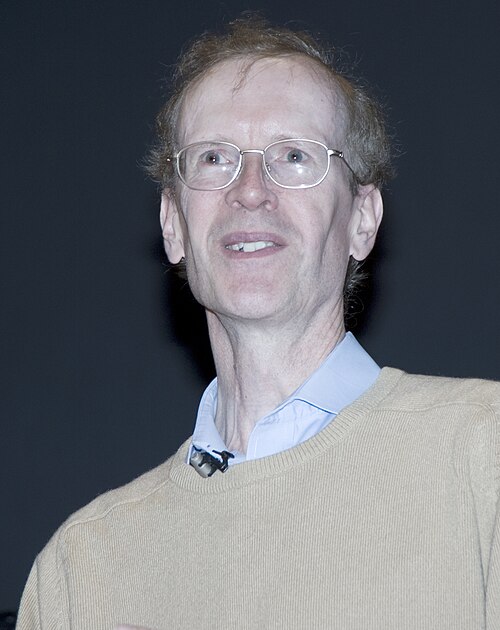
Sep 19, 1995 CE
Wiles Proves Fermat's Last Theorem
Andrew Wiles proves Fermat's Last Theorem using algebraic number theory and ring theory, particularly modular forms. #math #fermat
Wiles Proves Fermat's Last Theorem By "copyright C. J. Mozzochi, Princeton N.J" - http://www.mozzochi.org/deligne60/Deligne1/_DSC0024.jpg, Attribution, https://commons.wikimedia.org/w/index.php?curid=2635913
2002 CE
Bhargava on Rings of Small Rank
Manjul Bhargava develops new results on rings of small rank, earning the Fields Medal in 2014. #math #fieldsmedal
Bhargava on Rings of Small Rank By IMU - http://www.mathunion.org/general/prizes/2014, FAL, https://commons.wikimedia.org/w/index.php?curid=35855138
2005 CE
Lafforgue's Fields Medal Work
Laurent Lafforgue wins the Fields Medal for his contributions to the Langlands program using ring theory and algebraic geometry. #math #langlands
Lafforgue's Fields Medal Work By Institut des Hautes Études Scientifiques (IHÉS) - Issu de https://www.youtube.com/watch?v=YQthqp5gplc, CC BY 3.0, https://commons.wikimedia.org/w/index.php?curid=50468182
2010 CE
Ngô Bảo Châu Proves Fundamental Lemma
Ngô Bảo Châu proves the Fundamental Lemma in the Langlands program, using geometric ring theory and valued fields. #math #langlands
Ngô Bảo Châu Proves Fundamental Lemma By Nguyentrongphu - Own work, CC BY-SA 4.0, https://commons.wikimedia.org/w/index.php?curid=169783860
2018 CE
Scholze's Perfectoid Spaces
Peter Scholze introduces perfectoid spaces, a new ring-theoretic framework in arithmetic geometry, winning the Fields Medal. #math #perfectoid