Ring Theory & Fields: Modern Frontiers & Breakthrough Innovations
Encyclopedia/1. The Cosmos & The Natural World/1. Mathematics & Formal Systems/02. Algebra & Symbolic Systems • Curated by Admin Timeline.sg
This timeline traces the evolution of ring theory and field theory from ancient number systems to modern frontiers, highlighting key discoveries and pioneers across global mathematical traditions.
Chronological Storyline (42 Milestones)
300 BCE
Euclid's Elements (Number Theory)
Euclid's 'Elements' lays foundations for number theory, including the Euclidean algorithm and properties of integers, which later underpin ring theory. #mathematics #history
Euclid's Elements (Number Theory) By University of Pennsylvania Museum of Archaeology and Anthropology - https://openn.library.upenn.edu/Data/0016/html/e2748.html, CC BY-SA 4.0, https://commons.wikimedia.org/w/index.php?curid=169166171
250 CE
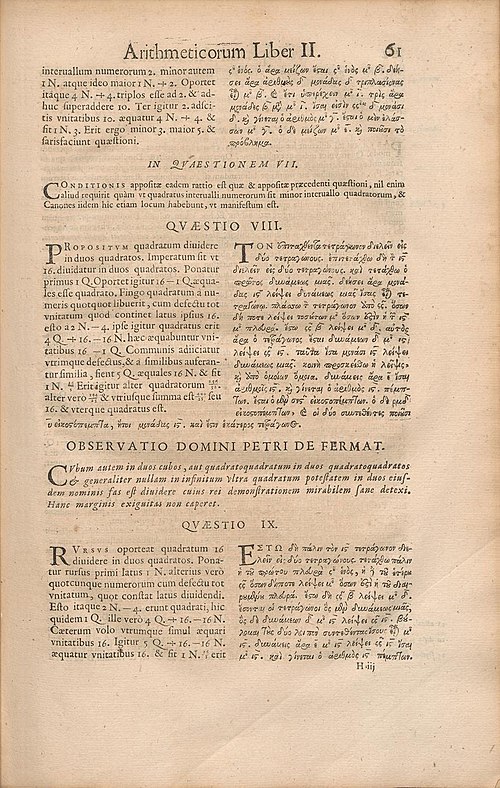
Diophantus' Arithmetica
Diophantus writes 'Arithmetica', studying polynomial equations and algebraic structures, foreshadowing ring theory. #mathematics #algebra
628 CE
Brahmagupta's Brahmasphutasiddhanta
Brahmagupta formalizes arithmetic of zero and negative numbers, and solves quadratic equations, contributing to field concepts. #mathematics #india
830 CE
Al-Khwarizmi's Al-Jabr
Al-Khwarizmi's 'The Compendious Book on Calculation by Completion and Balancing' gives systematic solutions to linear and quadratic equations, coining 'algebra' and influencing ring theory. #mathematics #islamicgoldenage
Al-Khwarizmi's Al-Jabr By Zarateman - Own work, CC0, https://commons.wikimedia.org/w/index.php?curid=162213187
1070 CE
Omar Khayyam's Cubic Equations
Omar Khayyam classifies cubic equations and provides geometric solutions, advancing polynomial theory and field extensions. #mathematics #persia
Omar Khayyam's Cubic Equations By Alireza Javaheri - https://web.archive.org/web/20161024154356/http://www.panoramio.com/photo/85093358, CC BY 3.0, https://commons.wikimedia.org/w/index.php?curid=55909539
1202 CE
Fibonacci's Liber Abaci
Fibonacci introduces Hindu-Arabic numerals to Europe, and studies arithmetic and algebra, laying groundwork for number theory and rings. #mathematics #medieval
Fibonacci's Liber Abaci By Unknown author, Public domain, https://commons.wikimedia.org/w/index.php?curid=720501
1545 CE
Cardano's Ars Magna
Gerolamo Cardano publishes solutions to cubic and quartic equations, dealing with complex numbers and field extensions. #mathematics #renaissance )
1637 CE
Descartes' La Géométrie
René Descartes introduces analytic geometry and notation for exponents, influencing polynomial rings. #mathematics #algebra
Descartes' La Géométrie By Original uploader was User:Caton at [1] - Originally from fr.wikipedia; description page is/was here., Public domain, https://commons.wikimedia.org/w/index.php?curid=1379032
1685 CE
Wallis' Treatise of Algebra
John Wallis writes 'A Treatise of Algebra', consolidating algebraic methods and complex numbers, precursor to ring concepts. #mathematics #algebra
Wallis' Treatise of Algebra By After Godfrey Kneller - one or more third parties have made copyright claims against Wikimedia Commons in relation to the work from which this is sourced or a purely mechanical reproduction thereof. This may be due to recognition of the "sweat of the brow" doctrine, allowing works to be eligible for protection through skill and labour, and not purely by originality as is the case in the United States (where this website is hosted). These claims may or may not be valid in all jurisdictions. As such, use of this image in the jurisdiction of the claimant or other countries may be regarded as copyright infringement. Please see Commons:When to use the PD-Art tag for more information., Public domain, https://commons.wikimedia.org/w/index.php?curid=6365975
1742 CE
Goldbach's Conjecture
Christian Goldbach proposes that every even integer >2 is sum of two primes, stimulating number theory and ring of integers. #mathematics #numbertheory
Goldbach's Conjecture By Christian Goldbach - http://www.mscs.dal.ca/~joerg/pic/g-letter.jpg, Public domain, https://commons.wikimedia.org/w/index.php?curid=1721422
1770 CE
Lagrange's Memoir on Equations
Joseph-Louis Lagrange analyzes permutations of roots, foreshadowing group theory and Galois theory which connect to fields. #mathematics #algebra
Lagrange's Memoir on Equations By Unknown author - File:Joseph_Louis_Lagrange.jpg, CC0, https://commons.wikimedia.org/w/index.php?curid=155608232
1799 CE
Gauss's Disquisitiones Arithmeticae
Carl Friedrich Gauss publishes foundational number theory treatise, introducing modular arithmetic and unique factorization, central to ring theory. #mathematics #numbertheory
Gauss's Disquisitiones Arithmeticae By Unknown author, Public domain, https://commons.wikimedia.org/w/index.php?curid=641724
1832 CE
Galois' Theory of Equations
Évariste Galois develops Galois theory linking field extensions to groups, solving the solvability of polynomials. #mathematics #algebra
Galois' Theory of Equations By Unknown author - Iyanaga, Shokichi, "ガロアの時代 ガロアの数学 第一部 時代篇" , Springer-Verlag Tokyo, 1999 http://www.win.tue.nl/~aeb/at/GaloisCorrespondence.html, Public domain, https://commons.wikimedia.org/w/index.php?curid=103351
1843 CE
Hamilton's Quaternions
William Rowan Hamilton discovers quaternions, a non-commutative division algebra, expanding field and ring concepts. #mathematics #algebra
Hamilton's Quaternions By Cmglee - Own work, CC BY-SA 4.0, https://commons.wikimedia.org/w/index.php?curid=145997978
1854 CE
Boole's Laws of Thought
George Boole introduces Boolean algebra, a ring with idempotent multiplication, influencing algebra and logic. #mathematics #logic
1870 CE
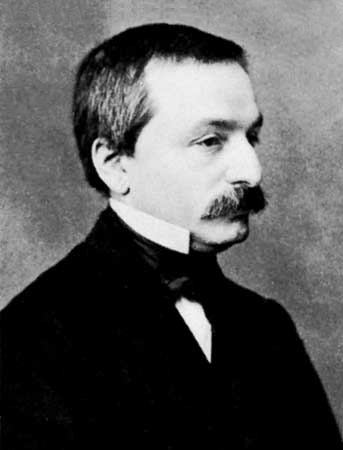
Kronecker's Integritätsbereiche
Leopold Kronecker introduces 'Integritätsbereiche' (integral domains) and algebraic number theory, formalizing ring concepts. #mathematics #algebra
Kronecker's Integritätsbereiche By Unknown author - http://www.britannica.com/EBchecked/media/28346/Kronecker-1865, Public domain, https://commons.wikimedia.org/w/index.php?curid=33753789
1882 CE
Dedekind's Ideals
Richard Dedekind defines ideals in rings of algebraic integers, laying foundation for ring theory and algebraic number theory. #mathematics #algebra
Dedekind's Ideals By Unknown (Mondadori Publishers) - https://www.gettyimages.co.uk/detail/news-photo/portrait-of-the-german-mathematician-richard-dedekind-1900s-news-photo/141551154, Public domain, https://commons.wikimedia.org/w/index.php?curid=41284791
1893 CE
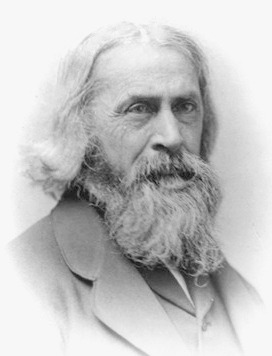
Peirce's Associative Algebras
Benjamin Peirce classifies associative algebras, contributing to structure theory of rings. #mathematics #algebra
Peirce's Associative Algebras By Unknown author - http://www.pragmaticism.net/faq.htm, Public domain, https://commons.wikimedia.org/w/index.php?curid=16249087
1894 CE
Weber's Lehrbuch der Algebra
Heinrich Weber publishes 'Lehrbuch der Algebra', systematically presenting field theory and algebraic structures. #mathematics #algebra
Weber's Lehrbuch der Algebra By Ludwig Zipfel - This image is from the collection of the ETH-Bibliothek and has been published on Wikimedia Commons as part of a cooperation with Wikimedia CH. Corrections and additional information are welcome., Public domain, https://commons.wikimedia.org/w/index.php?curid=59448786
1900 CE
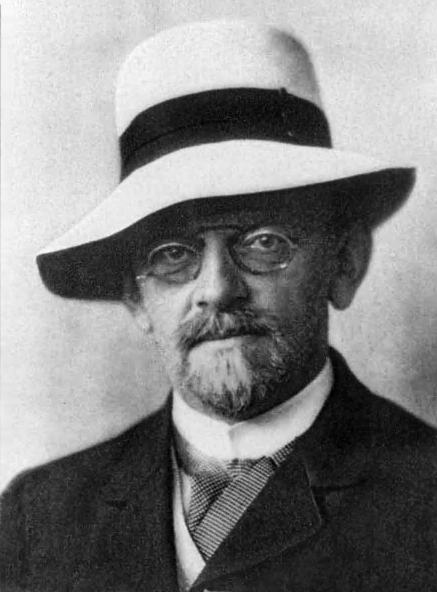
Hilbert's Paris Problems
David Hilbert presents 23 unsolved problems, including the theory of fields and rings, shaping 20th-century algebra. #mathematics #history
Hilbert's Paris Problems By Unknown author - Possibly Reid, Constance (1970) Hilbert, Berlin, Heidelberg: Springer Berlin Heidelberg Imprint Springer, p. 230 ISBN: 978-3-662-27132-2., Public domain, https://commons.wikimedia.org/w/index.php?curid=36302
1905 CE
Wedderburn's Little Theorem
Joseph Wedderburn proves that every finite division ring is a field, a fundamental result in ring theory. #mathematics #algebra
1910 CE
Steinitz's Field Theory
Ernst Steinitz publishes 'Algebraische Theorie der Körper', axiomatizing field theory and classifying fields by characteristic. #mathematics #algebra
Steinitz's Field Theory By Ar2r4alll - Own work, CC BY 3.0, https://commons.wikimedia.org/w/index.php?curid=8545862
1921 CE
Noether's Ideal Theory in Rings
Emmy Noether publishes 'Idealtheorie in Ringbereichen', founding modern ring theory with ascending chain conditions. #mathematics #algebra #womeninmath
Noether's Ideal Theory in Rings By Unknown authorUnknown author Publisher: Mathematical Association of America [3], Brooklyn Museum [4], Agnes Scott College [5], [6] - Emmy Noether (1882-1935), Archived, Public domain, https://commons.wikimedia.org/w/index.php?curid=158126186
1924 CE
Artin's Reciprocity Law
Emil Artin formulates the reciprocity law for abelian extensions, a major milestone in class field theory and field theory. #mathematics #numbertheory
1926 CE
Artin-Wedderburn Theorem
Emil Artin and Joseph Wedderburn develop structure theorem for semisimple rings, central to ring theory. #mathematics #algebra
1930 CE
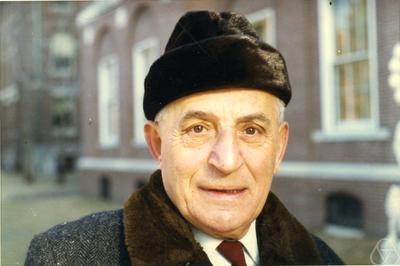
van der Waerden's Moderne Algebra
Bartel Leendert van der Waerden publishes 'Moderne Algebra', systematizing ring and field theory based on Noether and Artin. #mathematics #algebra
van der Waerden's Moderne Algebra By Böhm, W. Ernst - This image is from the collection of the ETH-Bibliothek and has been published on Wikimedia Commons as part of a cooperation with Wikimedia CH. Corrections and additional information are welcome., CC BY-SA 4.0, https://commons.wikimedia.org/w/index.php?curid=103244960
1936 CE
Chevalley's Theory of Local Fields
Claude Chevalley develops local class field theory, formalizing p-adic fields and extensions. #mathematics #numbertheory
Chevalley's Theory of Local Fields By Konrad Jacobs - MFO, CC BY-SA 2.0 de, https://commons.wikimedia.org/w/index.php?curid=8046334
1945 CE
Zariski's Algebraic Geometry
Oscar Zariski introduces Zariski topology and develops algebraic geometry using commutative ring theory. #mathematics #algebraicgeometry
Zariski's Algebraic Geometry By George Bergman - https://opc.mfo.de/detail?photo_id=6262, GFDL 1.2, https://commons.wikimedia.org/w/index.php?curid=6090840
1950 CE
Cartan-Eilenberg Homological Algebra
Henri Cartan and Samuel Eilenberg publish 'Homological Algebra', extending ring theory through derived functors. #mathematics #algebra
Cartan-Eilenberg Homological Algebra By IkamusumeFan - Own work, CC BY-SA 4.0, https://commons.wikimedia.org/w/index.php?curid=36817104
1958 CE
Auslander-Buchsbaum Theorem
Maurice Auslander and David Buchsbaum prove the Auslander-Buchsbaum theorem on regular local rings. #mathematics #commutativealgebra
1963 CE
Feit-Thompson Theorem
Walter Feit and John Thompson prove that finite groups of odd order are solvable, using character theory and field theory. #mathematics #grouptheory
1964 CE
Serre's GAGA
Jean-Pierre Serre proves the GAGA principle linking algebraic geometry over complex numbers with analytic geometry, via ringed spaces. #mathematics #algebraicgeometry
1968 CE
Hilbert's Tenth Problem (Negative)
Yuri Matiyasevich proves that there is no algorithm to solve Diophantine equations, linking rings to computability. #mathematics #logic
1972 CE
K-theory of Rings
Daniel Quillen defines higher algebraic K-theory for rings, revolutionizing algebraic topology and ring theory. #mathematics #algebraictopology
1976 CE
Deligne's Proof of Weil Conjectures
Pierre Deligne proves the Weil conjectures using l-adic cohomology and étale cohomology of schemes, profoundly impacting algebraic geometry and number theory. #mathematics #algebraicgeometry
1983 CE
Faltings' Theorem (Mordell Conjecture)
Gerd Faltings proves the Mordell conjecture, showing that curves of genus >1 have finitely many rational points, using arithmetic geometry. #mathematics #numbertheory
Faltings' Theorem (Mordell Conjecture) By Renate Schmid - https://opc.mfo.de/detail?photoID=7513, CC BY-SA 2.0 de, https://commons.wikimedia.org/w/index.php?curid=5427105
1994 CE
Wiles' Proof of Fermat's Last Theorem
Andrew Wiles proves Fermat's Last Theorem, using modular forms, elliptic curves, and Galois representations, a landmark in ring and field theory applications. #mathematics #numbertheory
Wiles' Proof of Fermat's Last Theorem By Unknown author, Public domain, https://commons.wikimedia.org/w/index.php?curid=533640
2002 CE
AKS Primality Test
Manindra Agrawal, Neeraj Kayal, and Nitin Saxena develop deterministic polynomial-time primality test, using finite field theory. #mathematics #computerscience
2005 CE
Lafforgue's Chtoucas
Laurent Lafforgue proves the Langlands correspondence for function fields, using moduli of shtukas and étale cohomology. #mathematics #numbertheory
Lafforgue's Chtoucas By Institut des Hautes Études Scientifiques (IHÉS) - Issu de https://www.youtube.com/watch?v=YQthqp5gplc, CC BY 3.0, https://commons.wikimedia.org/w/index.php?curid=50468182
2013 CE
Zhang's Bounded Gaps Between Primes
Yitang Zhang proves that there are infinitely many pairs of primes with bounded gaps, using sieve methods and algebraic number theory. #mathematics #numbertheory
Zhang's Bounded Gaps Between Primes By VOA - http://www.voachinese.com/media/video/i-america-math-zhang-yitang-20131204/1803128.html, Public domain, https://commons.wikimedia.org/w/index.php?curid=33336006
2018 CE
Perfectoid Spaces (Scholze)
Peter Scholze develops perfectoid spaces, bridging p-adic fields and number theory, earning the Fields Medal. #mathematics #numbertheory
2020 CE
Geometric Langlands (Gaitsgory et al.)
Dennis Gaitsgory and collaborators prove the geometric Langlands conjecture for reductive groups, deep connection between algebraic geometry and representation theory. #mathematics #algebraicgeometry