Ring Theory & Fields: Foundational Epochs & Key Milestones
Encyclopedia/1. The Cosmos & The Natural World/1. Mathematics & Formal Systems/02. Algebra & Symbolic Systems • Curated by Admin Timeline.sg
This timeline traces the foundational epochs and key milestones in ring theory and fields, from ancient modular arithmetic to modern noncommutative geometry, highlighting global contributions.
Chronological Storyline (34 Milestones)
400 CE
Chinese Remainder Theorem
Sunzi Suanjing states the Chinese remainder theorem for simultaneous congruences, a foundational concept in modular arithmetic and ring theory. #mathematics #history
Chinese Remainder Theorem By Cmglee - Own work, CC BY-SA 4.0, https://commons.wikimedia.org/w/index.php?curid=50938525
628 CE
Brahmagupta's Quadratic Equations
Indian mathematician Brahmagupta writes Brāhmasphuṭasiddhānta, providing solutions to quadratic equations and arithmetic with zero, influencing later algebra. #mathematics #history
825 CE
Al-Khwarizmi's Algebra
Persian scholar Al-Khwarizmi publishes The Compendious Book on Calculation by Completion and Balancing, systematically solving linear and quadratic equations and introducing algebraic methods. #mathematics #history
Al-Khwarizmi's Algebra By Zarateman - Own work, CC0, https://commons.wikimedia.org/w/index.php?curid=162213187
1202 CE
Fibonacci's Liber Abaci
Fibonacci introduces Arabic numerals and algebraic methods to Europe, advocating for modular arithmetic and influencing later ring theoretic concepts. #mathematics #history
Fibonacci's Liber Abaci By Unknown author, Public domain, https://commons.wikimedia.org/w/index.php?curid=720501
1545 CE
Cardano's Ars Magna
Gerolamo Cardano publishes solutions to cubic and quartic equations, advancing polynomial algebra and the concept of complex numbers. #mathematics #history )
Cardano's Ars Magna By JCSantos - Own work, Public domain, https://commons.wikimedia.org/w/index.php?curid=3810175
1799 CE
Gauss Proves Fundamental Theorem of Algebra
Carl Friedrich Gauss gives the first rigorous proof that every non-constant polynomial over complex numbers has a root, linking field theory and algebra. #mathematics #history
1801 CE
Gauss's Disquisitiones Arithmeticae
Gauss publishes his monumental work on number theory, formalizing modular arithmetic and quadratic forms, paving the way for ring theory. #mathematics #history
Gauss's Disquisitiones Arithmeticae By Unknown author, Public domain, https://commons.wikimedia.org/w/index.php?curid=641724
1824 CE
Abel Proves Insolubility of Quintic
Niels Henrik Abel proves that the general quintic equation cannot be solved by radicals, motivating Galois theory and field extensions. #mathematics #history
1832 CE
Galois Lays Foundation for Field Theory
Évariste Galois develops the theory of groups and fields, linking polynomial solvability to field automorphisms, now known as Galois theory. #mathematics #history
Galois Lays Foundation for Field Theory By Unknown author - Iyanaga, Shokichi, "ガロアの時代 ガロアの数学 第一部 時代篇" , Springer-Verlag Tokyo, 1999 http://www.win.tue.nl/~aeb/at/GaloisCorrespondence.html, Public domain, https://commons.wikimedia.org/w/index.php?curid=103351
1843 CE
Hamilton Discovers Quaternions
William Rowan Hamilton invents quaternions, the first non-commutative division algebra, expanding ring theory beyond fields. #mathematics #history
Hamilton Discovers Quaternions By Cmglee - Own work, CC BY-SA 4.0, https://commons.wikimedia.org/w/index.php?curid=145997978
1847 CE
Kummer Introduces Ideal Numbers
Ernst Kummer introduces ideal numbers to restore unique factorization in cyclotomic fields, a precursor to Dedekind ideals. #mathematics #history
1858 CE
Cayley Defines Matrix Multiplication
Arthur Cayley formalizes matrix algebra, providing a non-commutative ring structure now central to ring theory. #mathematics #history )
Cayley Defines Matrix Multiplication By Mavaddat - Own work, CC BY-SA 4.0, https://commons.wikimedia.org/w/index.php?curid=126575964
1870 CE
Dedekint Defines Ideals in Algebraic Number Theory
Richard Dedekind develops the modern notion of ideals to extend unique factorization to algebraic integers, founding ideal theory. #mathematics #history )
1882 CE
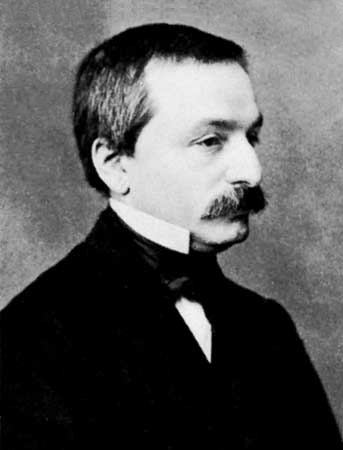
Kronecker Introduces Divisors
Leopold Kronecker develops a theory of divisors for polynomial rings, contributing to the foundations of commutative ring theory. #mathematics #history
Kronecker Introduces Divisors By Unknown author - http://www.britannica.com/EBchecked/media/28346/Kronecker-1865, Public domain, https://commons.wikimedia.org/w/index.php?curid=33753789
1888 CE
Hilbert's Basis Theorem
David Hilbert proves that polynomial rings over a Noetherian ring are Noetherian, a cornerstone of commutative algebra. #mathematics #history
1890 CE
Hilbert's Syzygy Theorem
Hilbert proves the syzygy theorem for polynomial rings, initiating homological algebra and deep insights into ring theory. #mathematics #history
1893 CE
Weber's Definition of a Field
Heinrich Weber gives the first modern definition of a field, unifying algebraic structures and formalizing field theory. #mathematics #history )
Weber's Definition of a Field By Phlsph7 - Own work, CC BY 4.0, https://commons.wikimedia.org/w/index.php?curid=141382296
1899 CE
Hensel Introduces p-adic Numbers
Kurt Hensel develops p-adic numbers, creating a complete field that enriches number theory and ring completions. #mathematics #history
Hensel Introduces p-adic Numbers By Melchoir - Own work, CC BY-SA 4.0, https://commons.wikimedia.org/w/index.php?curid=186745843
1908 CE
Wedderburn's Little Theorem
Joseph Wedderburn proves that every finite division ring is a field, a fundamental result in ring theory. #mathematics #history
1910 CE
Steinitz Classifies Fields
Ernst Steinitz publishes a comprehensive classification of fields, including the concept of algebraic closure and characteristic. #mathematics #history
Steinitz Classifies Fields By Ar2r4alll - Own work, CC BY 3.0, https://commons.wikimedia.org/w/index.php?curid=8545862
1916 CE
Dickson's Theory of Algebras
Leonard Eugene Dickson publishes a systematic treatment of linear associative algebras, furthering non-commutative ring theory. #mathematics #history
1921 CE
Noether's Idealtheorie in Ringbereichen
Emmy Noether publishes her seminal paper introducing ascending chain conditions and prime ideals, founding modern ring theory. #mathematics #history
Noether's Idealtheorie in Ringbereichen By Unknown authorUnknown author Publisher: Mathematical Association of America [3], Brooklyn Museum [4], Agnes Scott College [5], [6] - Emmy Noether (1882-1935), Archived, Public domain, https://commons.wikimedia.org/w/index.php?curid=158126186
1927 CE
Artin's Theory of Orders and Algebras
Emil Artin develops the theory of Artin rings and orders, advancing non-commutative ring theory and representation theory. #mathematics #history
Artin's Theory of Orders and Algebras By Konrad Jacobs, Erlangen - Mathematisches Forschungsinstitut Oberwolfach, https://opc.mfo.de/detail?photoID=116, CC BY-SA 2.0 de, https://commons.wikimedia.org/w/index.php?curid=3898471
1933 CE
von Neumann's Regular Rings
John von Neumann introduces regular rings in functional analysis, connecting ring theory to operator algebras. #mathematics #history
1936 CE
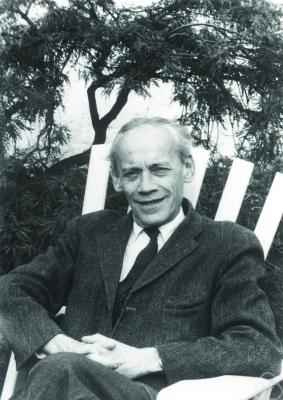
Jacobson Radical Defined
Nathan Jacobson defines the Jacobson radical, a fundamental concept in ring theory characterizing the intersection of maximal left ideals. #mathematics #history
Jacobson Radical Defined By Konrad Jacobs, Erlangen - https://opc.mfo.de/detail?photo_id=1941, CC BY-SA 2.0 de, https://commons.wikimedia.org/w/index.php?curid=11192158
1945 CE
Bourbaki's Éléments de Mathématique – Algèbre
Bourbaki publishes its influential algebra volume, standardizing ring and field theories with an axiomatic approach. #mathematics #history
1955 CE
Grothendieck's Scheme Theory
Alexander Grothendieck revolutionizes algebraic geometry using the language of commutative rings and schemes, deeply linking ring theory and geometry. #mathematics #history )
1960 CE
Serre Highlights Algebraic Geometry and Commutative Algebra
Jean-Pierre Serre's FAC and GAGA papers bridge sheaf theory and commutative rings, inspiring modern algebraic geometry. #mathematics #history
1964 CE
Cohen's Theorem on Prime Ideals
Irvin Cohen proves that in a Noetherian ring, prime ideals are generated by finitely many elements, influencing polynomial ring theory. #mathematics #history
1970 CE
Quillen–Suslin Theorem Proved
Daniel Quillen and Andrei Suslin independently prove that every projective module over a polynomial ring is free, solving Serre's conjecture. #mathematics #history
1975 CE
Ring Theory in Representation Theory Flourishes
Work by Auslander, Reiten, and others links ring theory with representation theory through Auslander–Reiten theory and quiver algebras. #mathematics #history
1980 CE
PI-Algebras Become Central
Polynomial identity (PI) algebras are systematically studied, leading to structure theorems for rings satisfying polynomial identities. #mathematics #history
1990 CE
Noncommutative Algebraic Geometry Emerges
Vladimir Drinfeld, Yuri Manin, and others develop noncommutative algebraic geometry, extending geometric methods to noncommutative rings. #mathematics #history
2000 CE
Advancements in Module Theory and Homological Algebra
Modern developments in ring theory continue, including the study of tilting theory, cluster algebras, and applications to combinatorics. #mathematics #history