Renaissance & Enlightenment: Humanism, Gutenberg Press, Scientific Revolution & Rights of Man
Encyclopedia/3. History, Societies & Civilizations/04. European Civilizations & Empires/02. Renaissance & Enlightenment • Curated by Admin Timeline.sg
The Renaissance and Enlightenment periods from 1350 to 1789 marked Europe's intellectual rebirth through humanism, the printing press, scientific discoveries, and political philosophy, leading to revolutions and modern thought.
Chronological Storyline (43 Milestones)
1353 CE
Boccaccio completes the Decameron
Giovanni Boccaccio finishes writing the Decameron, a collection of novellas that exemplifies early Renaissance humanism, blending classical influences with vernacular storytelling. The work had a profound impact on European literature and culture. #renaissance #literature
Boccaccio completes the Decameron By Boccaccio, Giovanni - Available in the BEIC digital library and uploaded in partnership with BEIC Foundation., Public domain, https://commons.wikimedia.org/w/index.php?curid=39723021
1382 CE
Wycliffe's Bible translation
Theologian John Wycliffe oversaw the first complete translation of the Bible into English, challenging the authority of the Catholic Church and prefiguring the Protestant Reformation. This vernacular Bible made scripture accessible to laypeople. #reformation #religion
Wycliffe's Bible translation By Unknown author, Public domain, https://commons.wikimedia.org/w/index.php?curid=441291
1397 CE
Manuel Chrysoloras teaches Greek in Florence
The Byzantine scholar Manuel Chrysoloras began teaching Greek at the University of Florence, sparking a revival of Classical Greek studies in Renaissance Italy. His work introduced important Greek texts to Western Europe. #renaissance #education
Manuel Chrysoloras teaches Greek in Florence By Paolo Uccello. - https://kphil.ned.univie.ac.at/sites/default/files/Wulfram_Chrysoloras.pdf, Public domain, https://commons.wikimedia.org/w/index.php?curid=23828037
1440 CE
Gutenberg invents movable type printing press
Johannes Gutenberg developed the mechanical movable-type printing press in Mainz, revolutionizing the production of books and enabling mass communication. This invention accelerated the spread of knowledge and was a key driver of the Renaissance and Reformation. #technology #renaissance
Gutenberg invents movable type printing press By vlasta2 - Flickr: PrintMus 038, CC BY 2.0, https://commons.wikimedia.org/w/index.php?curid=16412858
1453 CE
Fall of Constantinople
The Ottoman conquest of Constantinople ended the Byzantine Empire and prompted a wave of Greek scholars and texts to migrate to Italy, fueling Renaissance humanism. The event also marked a shift in trade routes and power dynamics. #history #renaissance
Fall of Constantinople By DimiTalen - Own work, CC0, https://commons.wikimedia.org/w/index.php?curid=140075738
1469 CE
Ficino completes translation of Plato
Marsilio Ficino finished his Latin translation of all known works of Plato, reviving Neoplatonism and influencing Renaissance philosophy, art, and theology. His work at the Florentine Platonic Academy shaped humanist thought. #philosophy #renaissance
Ficino completes translation of Plato By 1521-1552 - The collection of the portraits of Paolo Giovio. Pinacoteca Civica Di Como, Public domain, https://commons.wikimedia.org/w/index.php?curid=195166970
1492 CE
Columbus reaches the Americas
Christopher Columbus's first voyage to the Americas opened a new era of European exploration and colonization, initiating the Columbian Exchange of crops, animals, and diseases. The event transformed global history and expanded European horizons. #exploration #history
Columbus reaches the Americas By Sebastiano del Piombo - This file was donated to Wikimedia Commons as part of a project by the Metropolitan Museum of Art. See the Image and Data Resources Open Access Policy, Public domain, https://commons.wikimedia.org/w/index.php?curid=27554267
1503 CE
Leonardo da Vinci paints the Mona Lisa
Leonardo da Vinci began painting the Mona Lisa, a masterpiece of Renaissance portraiture known for its enigmatic expression and sfumato technique. The painting exemplifies Renaissance ideals of proportion and naturalism. #art #renaissance
Leonardo da Vinci paints the Mona Lisa By Leonardo da Vinci - Natural colors from 17:19, 18 August 2011 (UTC) version by Cybershot800i of File:Mona Lisa, by Leonardo da Vinci, from C2RMF retouched.jpg per this discussion. Cropped and relevelled from File:Mona Lisa, by Leonardo da Vinci, from C2RMF.jpg. Originally C2RMF: Galerie de tableaux en très haute définition: image page., Public domain, https://commons.wikimedia.org/w/index.php?curid=22963578
1508 CE
Michelangelo begins the Sistine Chapel ceiling
Michelangelo started painting the ceiling of the Sistine Chapel in Vatican City, creating a monumental fresco cycle that is a cornerstone of High Renaissance art. The work showcases his mastery of human anatomy and narrative composition. #art #renaissance
Michelangelo begins the Sistine Chapel ceiling By Antoine Taveneaux - File:Sistine_Chapel_ceiling_02.jpg, CC BY-SA 3.0, https://commons.wikimedia.org/w/index.php?curid=117824241
1513 CE
Machiavelli writes The Prince
Niccolò Machiavelli completed The Prince, a political treatise that analyzed power and statecraft, often associated with the phrase 'the ends justify the means.' The work marked a departure from medieval political thought and laid foundations for modern political science. #philosophy #politics
Machiavelli writes The Prince By Niccolò Machiavelli - BNCF, Public domain, https://commons.wikimedia.org/w/index.php?curid=11844670
Oct 31, 1517 CE
Luther posts the 95 Theses
Martin Luther is said to have nailed his Ninety-five Theses to the door of the Wittenberg Castle Church, challenging the sale of indulgences and sparking the Protestant Reformation. This act led to the creation of Protestant denominations and reshaped European religion and politics. #reformation #history
Luther posts the 95 Theses By Martin Luther - http://digital.staatsbibliothek-berlin.de/werkansicht/?PPN=PPN644115580&PHYSID=PHYS_0001, Public domain, https://commons.wikimedia.org/w/index.php?curid=47482515
1521 CE
Diet of Worms condemns Luther
The Holy Roman Emperor Charles V issued the Edict of Worms declaring Martin Luther a heretic after he refused to recant his writings. This event intensified the Reformation and led to the spread of Lutheranism. #reformation #religion
Diet of Worms condemns Luther By Anton von Werner - Скан картины., Public domain, https://commons.wikimedia.org/w/index.php?curid=11727916
1534 CE
Act of Supremacy establishes Church of England
The English Parliament passed the Act of Supremacy, declaring Henry VIII the Supreme Head of the Church of England, severing ties with the Roman Catholic Church. This marked the beginning of the English Reformation and increased royal power. #history #religion
May 24, 1543 CE
Copernicus publishes De revolutionibus
Nicolaus Copernicus published 'De revolutionibus orbium coelestium,' proposing a heliocentric model with the Sun at the center of the universe. This sparked the Scientific Revolution and challenged the geocentric Ptolemaic system. #science #astronomy
Copernicus publishes De revolutionibus By derivative work of Johannes Petreius 1543 edition of File:Nicolai_Copernici_torinensis_De_revolutionibus_orbium_coelestium.djvu - File:Nicolai_Copernici_torinensis_De_revolutionibus_orbium_coelestium.djvu, Public domain, https://commons.wikimedia.org/w/index.php?curid=5611684
Sep 25, 1555 CE
Peace of Augsburg
The Peace of Augsburg ended the religious war between Catholic and Lutheran states in the Holy Roman Empire, establishing the principle 'cuius regio, eius religio' (whose realm, his religion). It temporarily settled the Reformation conflicts. #history #religion
Peace of Augsburg By User:Michail - [1], Public domain, https://commons.wikimedia.org/w/index.php?curid=533576
Feb 15, 1564 CE
Galileo Galilei born
Galileo Galilei, a pioneering astronomer, physicist, and engineer, was born in Pisa. His scientific contributions, including telescopic discoveries and support for heliocentrism, became central to the Scientific Revolution. #science #history
Galileo Galilei born By Justus Sustermans - http://collections.rmg.co.uk/collections/objects/14174, Public domain, https://commons.wikimedia.org/w/index.php?curid=62614082
1570 CE
Ortelius publishes first modern atlas
Abraham Ortelius published 'Theatrum Orbis Terrarum,' the first modern atlas, containing unified maps of the world. This work advanced cartography and geographical knowledge during the Renaissance. #geography #science
Ortelius publishes first modern atlas By Abraham Ortelius - https://www.raremaps.com/gallery/detail/99250/world-continents-typus-orbis-terrarum-americae-s-ortelius, Public domain, https://commons.wikimedia.org/w/index.php?curid=153530215
Oct 4, 1582 CE
Gregorian calendar introduced
Pope Gregory XIII introduced the Gregorian calendar to correct inaccuracies in the Julian calendar, reforming the date of Easter and adjusting the leap year rule. It was gradually adopted by Catholic countries and later worldwide. #history #science
Feb 17, 1600 CE
Giordano Bruno burned at stake
Philosopher Giordano Bruno was executed by the Roman Inquisition for heresy, including his support for heliocentrism and infinite universe theories. His death symbolized the conflict between science and religious orthodoxy. #history #philosophy
Giordano Bruno burned at stake By Unknown author - https://wellcomeimages.org/indexplus/obf_images/bc/3d/265d1be073eb34224006d0d35b02.jpg Gallery: https://wellcomeimages.org/indexplus/image/L0015152.html Wellcome Collection gallery (2018-04-01): https://wellcomecollection.org/works/qgt4dt8k CC-BY-4.0, CC BY 4.0, https://commons.wikimedia.org/w/index.php?curid=133537203
1609 CE
Galileo improves the telescope
Galileo Galilei heard of the Dutch telescope and built his own improved version, which he used to observe the Moon, Jupiter's moons, and the phases of Venus. These discoveries provided strong evidence for the Copernican heliocentric model. #science #astronomy
1618 CE
Thirty Years' War begins
The Thirty Years' War started as a religious conflict between Protestant and Catholic states in the Holy Roman Empire, but escalated into a broader European war. It caused immense devastation and reshaped the political order. #history #war
Thirty Years' War begins By Karl Friedrich Lessing - 1wEqeIJ6E-zN8w at Google Cultural Institute maximum zoom level, Public domain, https://commons.wikimedia.org/w/index.php?curid=22006837
1620 CE
Bacon publishes Novum Organum
Francis Bacon published 'Novum Organum,' outlining a new scientific method based on empirical observation and inductive reasoning. This work encouraged systematic experimentation and influenced the development of modern science. #science #philosophy
Bacon publishes Novum Organum By Francis Bacon - Houghton Library, Public domain, https://commons.wikimedia.org/w/index.php?curid=34947014
1628 CE
Harvey publishes on blood circulation
William Harvey published 'Exercitatio Anatomica de Motu Cordis et Sanguinis in Animalibus,' describing the systemic circulation of blood and the function of the heart. This discovery revolutionized physiology and medicine. #science #medicine
Harvey publishes on blood circulation By After Daniël Mijtens - National Portrait Gallery: NPG 5115, Public domain, https://commons.wikimedia.org/w/index.php?curid=5975113
1632 CE
Galileo publishes Dialogue Concerning the Two Chief World Systems
Galileo's 'Dialogue' compared Copernican and Ptolemaic systems, advocating heliocentrism and leading to his trial by the Inquisition. The book became a landmark in the history of science. #science #astronomy
Galileo publishes Dialogue Concerning the Two Chief World Systems By Giovanni Battista Landini - http://moro.imss.fi.it/lettura/LetturaWEB.DLL?AZIONE=IMG&TESTO=E_U&PARAM=07-23-tit.jpg and http://moro.imss.fi.it/lettura/LetturaWEB.DLL?AZIONE=IMG&TESTO=E_U&PARAM=07-25-tit.jpg Transferred from en.wikipedia to Commons by User:Lijealso using CommonsHelper., Public domain, https://commons.wikimedia.org/w/index.php?curid=5289735
1633 CE
Galileo's trial by Inquisition
The Catholic Inquisition tried Galileo for heresy, forcing him to recant his support for heliocentrism. He was placed under house arrest for life, a key event in the conflict between science and religion. #science #history
1637 CE
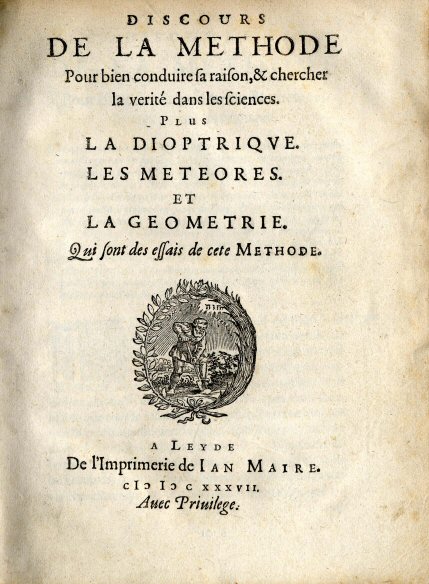
Descartes publishes Discourse on Method
René Descartes published 'Discours de la méthode,' introducing Cartesian doubt and the famous statement 'Cogito, ergo sum' (I think, therefore I am). This work laid the foundation for modern rationalist philosophy. #philosophy #science
Descartes publishes Discourse on Method By Ian Maire - Leeds University Library, Public domain, https://commons.wikimedia.org/w/index.php?curid=1472528
May 15, 1648 CE
Treaty of Westphalia
The Peace of Westphalia ended the Thirty Years' War and established the principle of national sovereignty, recognizing the independence of states. It laid the groundwork for modern international relations and the nation-state system. #history #politics
Treaty of Westphalia By Dietmar Rabich - Own work, CC BY-SA 4.0, https://commons.wikimedia.org/w/index.php?curid=35093032
1651 CE
Hobbes publishes Leviathan
Thomas Hobbes published 'Leviathan,' a foundational work of political philosophy that argued for a social contract and absolute sovereignty to avoid the state of nature. The book influenced the development of liberal and authoritarian thought. #philosophy #politics )
Nov 28, 1660 CE
Royal Society founded
The Royal Society of London for Improving Natural Knowledge was founded, becoming a leading institution for the promotion of scientific research. Its members included key figures like Robert Hooke and Isaac Newton. #science #history
Royal Society founded By Royal Society - https://royalsociety.org/, PD, https://en.wikipedia.org/w/index.php?curid=81747653
1665 CE
Hooke publishes Micrographia
Robert Hooke published 'Micrographia,' featuring detailed engravings of microscopic observations, including the discovery of cells in cork. The book popularized microscopy and contributed to the Scientific Revolution. #science #microscopy
Hooke publishes Micrographia By Robert Hooke (1635-1703) - This image is available from the National Library of Wales, Public domain, https://commons.wikimedia.org/w/index.php?curid=7442137
Jul 5, 1687 CE
Newton publishes Principia Mathematica
Isaac Newton published 'Philosophiæ Naturalis Principia Mathematica,' formulating the laws of motion and universal gravitation. This work unified celestial and terrestrial mechanics and became the cornerstone of classical physics. #science #physics
Newton publishes Principia Mathematica By The original uploader was Zhaladshar at English Wikisource. - Transferred from en.wikisource to Commons. (previous image from another copy) Internet Archive (current image from the Bern Dibner copy), Public domain, https://commons.wikimedia.org/w/index.php?curid=2681838
Nov 5, 1688 CE
Glorious Revolution
William of Orange invaded England, overthrowing King James II in a relatively bloodless coup. The revolution established parliamentary supremacy and the Bill of Rights, limiting royal power and promoting Protestantism. #history #politics
Glorious Revolution By Johan Herman Isings - https://nl.pinterest.com/pin/305822630933297117/, Public domain, https://commons.wikimedia.org/w/index.php?curid=114211023
1690 CE
Locke publishes Two Treatises of Government
John Locke published his 'Two Treatises of Government,' arguing for natural rights (life, liberty, property) and the consent of the governed. His ideas profoundly influenced Enlightenment thought and later democratic revolutions. #philosophy #politics
Locke publishes Two Treatises of Government By Unknown author, Public domain, https://commons.wikimedia.org/w/index.php?curid=399928
1733 CE
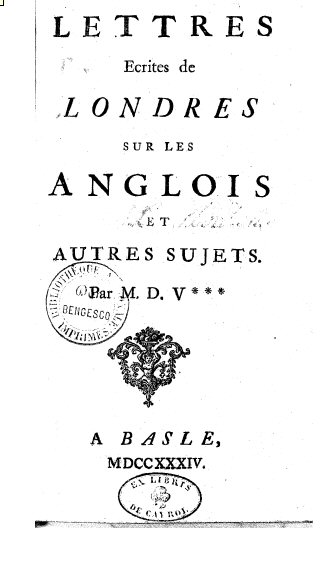
Voltaire publishes Letters on the English
Voltaire published his 'Letters on the English Nation' praising English liberties, religious tolerance, and scientific progress, while criticizing French absolutism. The work helped spread Enlightenment ideas across Europe. #philosophy #enlightenment
Voltaire publishes Letters on the English By Voltaire - Gallica, BNF, Public domain, https://commons.wikimedia.org/w/index.php?curid=3247508
1748 CE
Montesquieu publishes The Spirit of the Laws
Montesquieu published 'De l'esprit des lois,' advocating for the separation of powers into executive, legislative, and judicial branches. This work greatly influenced the U.S. Constitution and modern political theory. #philosophy #politics
Montesquieu publishes The Spirit of the Laws By Smuconlaw. - Own work; photographed from an original copy., Public domain, https://commons.wikimedia.org/w/index.php?curid=39705801
1751 CE
Publication of Diderot's Encyclopédie
The first volume of Denis Diderot and Jean le Rond d'Alembert's 'Encyclopédie, ou dictionnaire raisonné des sciences, des arts et des métiers' was published. This monumental work aimed to compile all human knowledge and promote Enlightenment values. #enlightenment #knowledge
Publication of Diderot's Encyclopédie By Long List of Contributors to the Encyclopédie - File:ENC 1-NA5 600px.jpeg http://ets.lib.uchicago.edu/ARTFL/OLDENCYC/images, Public domain, https://commons.wikimedia.org/w/index.php?curid=28864546
1762 CE
Rousseau publishes The Social Contract
Jean-Jacques Rousseau published 'Du contrat social,' arguing for popular sovereignty and the general will. The book influenced the French Revolution and modern democratic theory. #philosophy #politics
Rousseau publishes The Social Contract By Unknown author, Public domain, https://commons.wikimedia.org/w/index.php?curid=399924
1769 CE
Watt patents the steam engine with separate condenser
James Watt patented his improved steam engine featuring a separate condenser, which dramatically increased efficiency. This innovation became a key driver of the Industrial Revolution. #technology #industry
Watt patents the steam engine with separate condenser By Carl Frederik von Breda - one or more third parties have made copyright claims against Wikimedia Commons in relation to the work from which this is sourced or a purely mechanical reproduction thereof. This may be due to recognition of the "sweat of the brow" doctrine, allowing works to be eligible for protection through skill and labour, and not purely by originality as is the case in the United States (where this website is hosted). These claims may or may not be valid in all jurisdictions. As such, use of this image in the jurisdiction of the claimant or other countries may be regarded as copyright infringement. Please see Commons:When to use the PD-Art tag for more information., Public domain, https://commons.wikimedia.org/w/index.php?curid=3942134
Jul 4, 1776 CE
American Declaration of Independence
The Continental Congress adopted the Declaration of Independence, proclaiming the thirteen American colonies' separation from Britain. The document, heavily influenced by Enlightenment philosophy, articulated rights to life, liberty, and the pursuit of happiness. #history #politics
American Declaration of Independence By original: w:Second Continental Congress; reproduction: William Stone - numerous, Public domain, https://commons.wikimedia.org/w/index.php?curid=621811
1781 CE
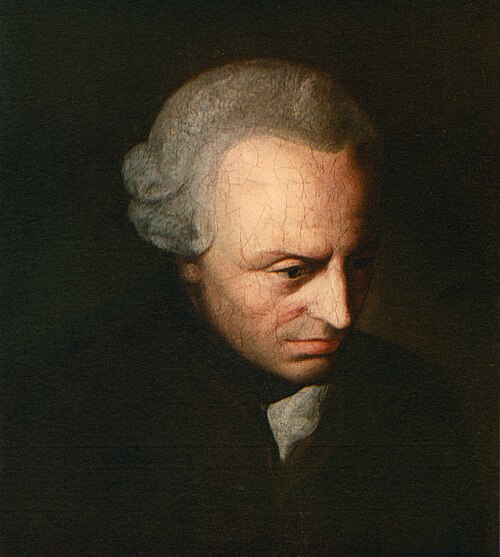
Kant publishes Critique of Pure Reason
Immanuel Kant published his 'Critique of Pure Reason,' a landmark work in Western philosophy that synthesized rationalism and empiricism. He argued that space and time are forms of our sensibility, shaping how we experience reality. #philosophy #enlightenment
Kant publishes Critique of Pure Reason By Unknown, possibly Elisabeth von Stägemann (Anton Graff school) - original from the Norwegian Digital Learning Arena (NDLA) https://ndla.no/image/43900, Public domain, https://commons.wikimedia.org/w/index.php?curid=139262788
Sep 17, 1787 CE
U.S. Constitution signed
The United States Constitution was signed at the Constitutional Convention in Philadelphia, creating a federal government with a separation of powers and a system of checks and balances. It reflected Enlightenment ideals and became a model for modern democracies. #history #politics
U.S. Constitution signed By Constitutional Convention, Public domain, https://commons.wikimedia.org/w/index.php?curid=15795309
Jul 14, 1789 CE
Storming of the Bastille
Parisian revolutionaries stormed the Bastille prison, a symbol of royal tyranny, marking the beginning of the French Revolution. The event sparked a decade of political upheaval that transformed France and inspired movements worldwide. #history #revolution
Storming of the Bastille By Unidentified painter - Current version: Palace of Versailles; direct link to the image: [1] Original version: L’Histoire par l’image, Public domain, https://commons.wikimedia.org/w/index.php?curid=6882732
Aug 26, 1789 CE
Declaration of the Rights of Man and of the Citizen
The French National Constituent Assembly adopted the Declaration of the Rights of Man and of the Citizen, proclaiming universal human rights based on Enlightenment principles of liberty, equality, and fraternity. This document influenced future human rights declarations. #history #politics
Declaration of the Rights of Man and of the Citizen By Unknown author - https://www.parismuseescollections.paris.fr/fr/musee-carnavalet/oeuvres/declaration-des-droits-de-l-homme-et-du-citoyen-4#infos-principales, Public domain, https://commons.wikimedia.org/w/index.php?curid=65758