Radio Astronomy & Cosmic Waves: Jansky, Reber, Pulsars & Fast Radio Bursts
Encyclopedia/1. The Cosmos & The Natural World/3. Astronomy & Planetary Science/01. Stellar Astrophysics • Curated by Admin Timeline.sg
Radio astronomy explores celestial objects through their radio emissions, from Karl Jansky's discovery of galactic radio noise to modern fast radio bursts and the Five-hundred-meter Aperture Spherical Telescope (FAST) in China.
Chronological Storyline (39 Milestones)
2024 BCE
Future: MeerKAT+ Extension
MeerKAT in South Africa continues expansion, serving as a precursor for the SKA with deep surveys of the sky. #radioastronomy #SKA
Future: MeerKAT+ Extension By Morganoshell - Own work, CC BY-SA 4.0, https://commons.wikimedia.org/w/index.php?curid=47588577
1932 CE
Jansky Discovers Galactic Radio Noise
Karl Jansky, an engineer at Bell Labs, detects radio waves from the Milky Way's center, founding radio astronomy. #radioastronomy #history
Jansky Discovers Galactic Radio Noise By NRAO/AUI/NSF - https://public.nrao.edu/gallery/karl-guthe-jansky/, CC BY 4.0, https://commons.wikimedia.org/w/index.php?curid=169680767
1937 CE
Reber Builds First Parabolic Radio Telescope
Grote Reber constructs a 9.6-meter radio dish in his backyard, producing the first radio maps of the sky. #radioastronomy #engineering
Reber Builds First Parabolic Radio Telescope By NRAO/AUI/NSF - https://public.nrao.edu/gallery/grote-reber-in-1975/, CC BY 4.0, https://commons.wikimedia.org/w/index.php?curid=169680655
1946 CE
First Radio Interferometry Experiment
Joseph Pawsey and Ruby Payne-Scott use sea-cliff interferometry to locate solar radio bursts, pioneering interferometry. #radioastronomy #solarscience
First Radio Interferometry Experiment By Peter Gavin Hall (Ruby Payne-Scott's son) - Peter Hall (Ruby Payne-Scott's son), CC BY-SA 3.0, https://commons.wikimedia.org/w/index.php?curid=8185566
1951 CE
First Detection of the Hydrogen 21-cm Line
Harold Ewen and Edward Purcell detect the 21-cm hyperfine line of neutral hydrogen, revolutionizing understanding of the Milky Way. #radioastronomy #cosmology
First Detection of the Hydrogen 21-cm Line By Tiltec - Own work, Public domain, https://commons.wikimedia.org/w/index.php?curid=5739956
1955 CE
Construction of the Mullard Radio Astronomy Observatory
The Mullard Radio Astronomy Observatory in Cambridge, UK, is established, housing the Cambridge Interferometer and leading to key discoveries. #radioastronomy #observatory
Construction of the Mullard Radio Astronomy Observatory By Rror - Own work, CC BY-SA 3.0, https://commons.wikimedia.org/w/index.php?curid=6651783
1957 CE
Jodrell Bank Marks Telescope Operation
The 76-meter Lovell Telescope at Jodrell Bank, UK, becomes operational, tracking Sputnik and conducting radio astronomy. #radioastronomy #engineering
Jodrell Bank Marks Telescope Operation By Mike Peel; Jodrell Bank Centre for Astrophysics, University of Manchester - Own work. Also available at http://www.jodrellbank.manchester.ac.uk/multimedia/images/LovellTelescope2.html, CC BY-SA 4.0, https://commons.wikimedia.org/w/index.php?curid=2520502
1960 CE
First Quasar Discovery: 3C 273
Radio source 3C 273 is identified as a quasi-stellar object (quasar) by Allan Sandage and Thomas Matthews, showing immense luminosity. #radioastronomy #quasars
First Quasar Discovery: 3C 273 By Hubble ESA - Best image of bright quasar 3C 273, CC BY 2.0, https://commons.wikimedia.org/w/index.php?curid=97380612
1963 CE
Arecibo Telescope Opens in Puerto Rico
The 305-meter Arecibo dish begins operations, used for radar astronomy, radio astronomy, and SETI until its collapse in 2020. #radioastronomy #telescope
Arecibo Telescope Opens in Puerto Rico By Mariordo (Mario Roberto Durán Ortiz) - Own work, CC BY-SA 4.0, https://commons.wikimedia.org/w/index.php?curid=81590797
1964 CE
Discovery of Cosmic Microwave Background Radiation
Arno Penzias and Robert Wilson accidentally detect the 3K cosmic microwave background radiation, confirming the Big Bang. #radioastronomy #cosmology
Discovery of Cosmic Microwave Background Radiation By ESA and the Planck Collaboration - Cosmic Microwave Background, CC BY 4.0, https://commons.wikimedia.org/w/index.php?curid=130789180
1965 CE
First Interstellar Molecule Detected: OH
Hydroxyl (OH) maser emission is discovered in the interstellar medium, opening the field of astrochemistry. #radioastronomy #astrochemistry
First Interstellar Molecule Detected: OH By Pillsmarch - Own work, CC BY-SA 4.0, https://commons.wikimedia.org/w/index.php?curid=136545168
1967 CE
Bell Discovers Pulsars
Jocelyn Bell Burnell detects regular radio pulses from a neutron star, the first pulsar (CP 1919), a major breakthrough. #radioastronomy #pulsars
Bell Discovers Pulsars By Launch_of_IYA_2009,_Paris_-_Grygar,_Bell_Burnell.jpg: Astronomical Institute, Academy of Sciences of the Czech Republic derivative work: Anrie (talk) - Launch_of_IYA_2009,_Paris_-_Grygar,_Bell_Burnell.jpg, CC BY-SA 3.0, https://commons.wikimedia.org/w/index.php?curid=9988968
1968 CE
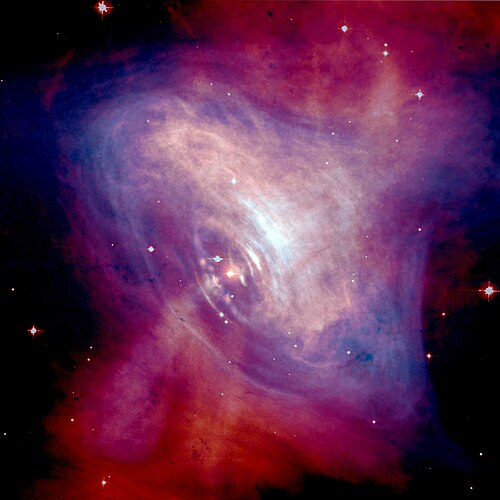
Crab Nebula Pulsar Discovery
The pulsar in the Crab Nebula is detected at radio wavelengths, linking to the 1054 AD supernova. #radioastronomy #supernova
Crab Nebula Pulsar Discovery By Optical: NASA/HST/ASU/J. Hester et al. X-Ray: NASA/CXC/ASU/J. Hester et al. - https://hubblesite.org/contents/media/images/2002/24/1248-Image.html, Public domain, https://commons.wikimedia.org/w/index.php?curid=238064
1971 CE
First Black Hole Candidate: Cygnus X-1
Cygnus X-1, a strong X-ray source, is identified via radio observations as a black hole in a binary system. #radioastronomy #blackholes
First Black Hole Candidate: Cygnus X-1 By IAU and Sky & Telescope magazine (Roger Sinnott & Rick Fienberg) - [1], CC BY 4.0, https://commons.wikimedia.org/w/index.php?curid=15406373
1974 CE
Hewish and Ryle Win Nobel Prize for Pulsars
Antony Hewish and Martin Ryle share the Nobel Prize for their role in pulsar discovery, though Jocelyn Bell is controversially omitted. #radioastronomy #nobel
Hewish and Ryle Win Nobel Prize for Pulsars By AIP Emilio Segrè Visual Archives, John Irwin Slide Collection - https://repository.aip.org/antony-hewish-3, Attribution, https://commons.wikimedia.org/w/index.php?curid=174963284
1974 CE
Arecibo Message Sent to Space
The Arecibo radio telescope transmits a binary message toward globular cluster M13, humanity's first intentional interstellar message. #radioastronomy #SETI
1977 CE
Very Large Array (VLA) Dedicated
The VLA in New Mexico, a 27-antenna interferometer, begins full operations, transforming radio imaging. #radioastronomy #VLBI
Very Large Array (VLA) Dedicated By user:Hajor - Own work, CC BY-SA 3.0, https://commons.wikimedia.org/w/index.php?curid=138997
1980 CE
First Millisecond Pulsar Discovered
Don Backer et al. discover PSR B1937+21, a pulsar spinning 642 times per second, opening study of neutron star interiors. #radioastronomy #pulsars
First Millisecond Pulsar Discovered By B. Saxton, NRAO/AUI/NSF - https://public.nrao.edu/gallery/how-to-make-a-millisecond-pulsar (direct link), CC BY 4.0, https://commons.wikimedia.org/w/index.php?curid=108485033
1982 CE
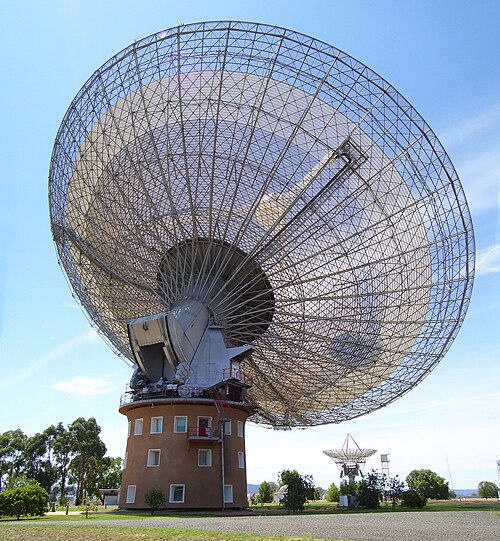
Parkes Radio Telescope Operations
The 64-meter Parkes dish in Australia begins its long service, contributing to pulsar surveys and the Apollo missions. #radioastronomy #australia
Parkes Radio Telescope Operations By Diceman Stephen West - Own work, CC BY-SA 3.0, https://commons.wikimedia.org/w/index.php?curid=6174237
1987 CE
Supernova 1987A Radio Observations
Radio telescopes track the supernova SN 1987A in the Large Magellanic Cloud, providing insights into stellar death. #radioastronomy #supernova
Supernova 1987A Radio Observations By NASA Goddard Space Flight Center from Greenbelt, MD, USA - New Hubble Observations of Supernova 1987A Trace Shock Wave, Public domain, https://commons.wikimedia.org/w/index.php?curid=69021019
1990 CE
First Pulsar Planet Discovered
Aleksander Wolszczan discovers planets around millisecond pulsar PSR B1257+12, the first exoplanets ever found. #radioastronomy #exoplanets
1993 CE
Hubble Constant Measurement via HST Key Project
Radio observations of Cepheid variables and Type Ia supernovae help refine the Hubble constant to 73 km/s/Mpc. #radioastronomy #cosmology
Hubble Constant Measurement via HST Key Project By w:en:User:ScienceApologist - This image was copied from wikipedia:en. The original description was: The raisin bread model of the universe explains how each galaxy can perceive every other galaxy in the universe as receding from it. From the WMAP website., Public domain, https://commons.wikimedia.org/w/index.php?curid=2615116
1995 CE
First Brown Dwarf Detected via Radio
Radio emission from brown dwarfs is detected, revealing magnetic activity in substellar objects. #radioastronomy #browndwarfs
First Brown Dwarf Detected via Radio By NASA/JPL-Caltech - http://planetquest.jpl.nasa.gov/image/114, Public domain, https://commons.wikimedia.org/w/index.php?curid=24187352
1998 CE
Discovery of Gamma-Ray Burst Afterglows in Radio
Radio telescopes detect afterglows of gamma-ray bursts, linking them to supernovae and neutron star mergers. #radioastronomy #GRB
Discovery of Gamma-Ray Burst Afterglows in Radio By Nicolle Rager Fuller of the NSF - National Science Foundation Press Release 05-156: Gamma-Ray Burst Smashes a Record, Attribution, https://commons.wikimedia.org/w/index.php?curid=2768651
2001 CE
SKA Project Initiated
The Square Kilometre Array (SKA) concept is proposed, aiming to be the world's largest radio telescope with sites in South Africa and Australia. #radioastronomy #SKA
SKA Project Initiated By SKA Project Development Office and Swinburne Astronomy Productions - Square Kilometre ArrayImage: https://cdn.britannica.com/10/167010-050-121F3DF4.jpg, CC BY 3.0, https://commons.wikimedia.org/w/index.php?curid=11315190
2002 CE
First Exoplanet Directly Imaged (Radio Context)
While optical direct imaging of exoplanets begins, radio observations contribute to characterizing exoplanet magnetospheres. #radioastronomy #exoplanets
First Exoplanet Directly Imaged (Radio Context) By Jason Wang (Caltech)/Christian Marois (NRC Herzberg) - https://jasonwang.space/orbits.html, CC BY 4.0, https://commons.wikimedia.org/w/index.php?curid=90872179
2007 CE
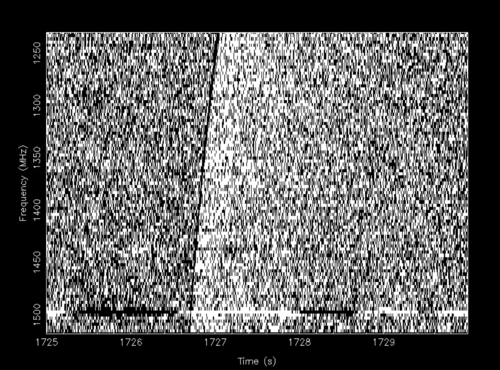
First Fast Radio Burst Discovered
Duncan Lorimer and student David Narkevic find a bright, millisecond-duration radio burst in archived Parkes data, now known as the Lorimer Burst. #radioastronomy #FRB
First Fast Radio Burst Discovered By Psr1909 - Own work, CC BY-SA 4.0, https://commons.wikimedia.org/w/index.php?curid=44102265
2010 CE
ALMA Array Inaugurated
The Atacama Large Millimeter/submillimeter Array (ALMA) in Chile begins operations, revolutionizing high-resolution radio astronomy at millimeter wavelengths. #radioastronomy #ALMA
ALMA Array Inaugurated By Iztok Bončina/ESO - http://www.eso.org/public/images/potw1040a/, CC BY 4.0, https://commons.wikimedia.org/w/index.php?curid=11686363
2012 CE
Repeating Fast Radio Burst Detected
FRB 121102 is discovered to repeat, ruling out catastrophic origins and linking to a dwarf galaxy. #radioastronomy #FRB
2014 CE
Murchison Widefield Array Commences
The MWA in Western Australia begins observations, focusing on the Epoch of Reionization and solar imaging. #radioastronomy #EoR
Murchison Widefield Array Commences By Natasha Hurley-Walker - Own work, CC BY-SA 3.0, https://commons.wikimedia.org/w/index.php?curid=18366320
FAST, the world's largest filled-aperture radio telescope, begins science operations in Guizhou, China, excelling in pulsar and HI surveys. #radioastronomy #China
Five-hundred-meter Aperture Spherical Telescope (FAST) Completed By SCJiang - Own work, CC BY-SA 4.0, https://commons.wikimedia.org/w/index.php?curid=172271062
2017 CE
Event Horizon Telescope Images a Black Hole
The EHT, a global VLBI network, captures the first image of a black hole (M87*) using radio observations at 1.3 mm. #radioastronomy #blackholes
Event Horizon Telescope Images a Black Hole By D. Marrone/UofA - Event Horizon Telescope Collaboration, CC BY 4.0, https://commons.wikimedia.org/w/index.php?curid=133002860
2019 CE
CHIME Detects Hundreds of FRBs
The Canadian Hydrogen Intensity Mapping Experiment (CHIME) rapidly discovers numerous fast radio bursts, advancing FRB science. #radioastronomy #FRB
2020 CE
Arecibo Telescope Collapses
The iconic Arecibo dish suffers catastrophic structural failure, ending 57 years of groundbreaking observations. #radioastronomy #telescope
2020 CE
Jocelyn Bell Burnell Wins Breakthrough Prize
Jocelyn Bell Burnell receives the Special Breakthrough Prize for her discovery of pulsars, donating the prize money. #radioastronomy #pulsars
2021 CE
SKA Construction Officially Begins
The Square Kilometre Array enters the construction phase with telescopes in South Africa and Australia, aiming for first light in 2029. #radioastronomy #SKA
2022 CE
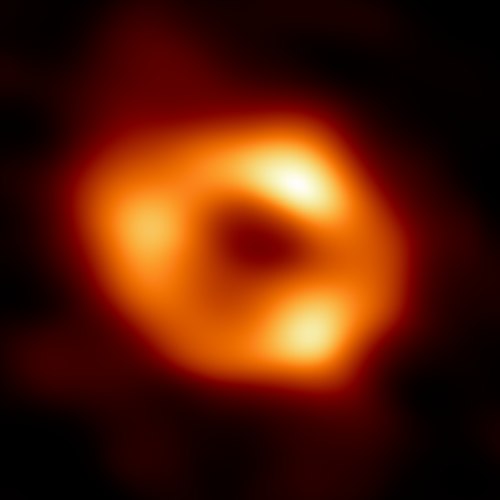
Milky Way's Supermassive Black Hole Imaged
The Event Horizon Telescope reveals the shadow of Sagittarius A*, the black hole at the center of the Milky Way, using radio interferometry. #radioastronomy #blackholes
Milky Way's Supermassive Black Hole Imaged By EHT Collaboration - https://www.eso.org/public/images/eso2208-eht-mwa/ (image link), CC BY 4.0, https://commons.wikimedia.org/w/index.php?curid=117933557
2023 CE
FAST Discovers Repeating FRB M81 Source
China's FAST telescope localizes a repeating fast radio burst to the nearby galaxy M81, enabling multi-wavelength studies. #radioastronomy #FRB
2024 CE
Nançay Radio Telescope Upgrade
The Nançay Radio Telescope in France undergoes upgrades for better sensitivity to cosmic waves and exoplanet radio emission. #radioastronomy #exoplanets
Nançay Radio Telescope Upgrade By Wouter Hagens - Own work, CC BY-SA 4.0, https://commons.wikimedia.org/w/index.php?curid=41708398