Encyclopedia/1. The Cosmos & The Natural World/3. Astronomy & Planetary Science • Curated by Admin Timeline.sg
This timeline chronicles the lives and achievements of the pioneers of radio astronomy and cosmic microwave background research, from James Clerk Maxwell's theoretical predictions to the modern era of satellite observatories and global telescope arrays.
Chronological Storyline (42 Milestones)
1865 CE
James Clerk Maxwell Predicts Electromagnetic Waves
James Clerk Maxwell publishes his theory of electromagnetism, predicting the existence of electromagnetic waves that travel at the speed of light. This theoretical foundation later enables radio astronomy. #radioastronomy #theoreticalphysics
James Clerk Maxwell Predicts Electromagnetic Waves By Unknown author - https://www.researchgate.net/figure/James-Clerk-Maxwell-1831-1879_fig1_360164096, Public domain, https://commons.wikimedia.org/w/index.php?curid=129476608
1887 CE
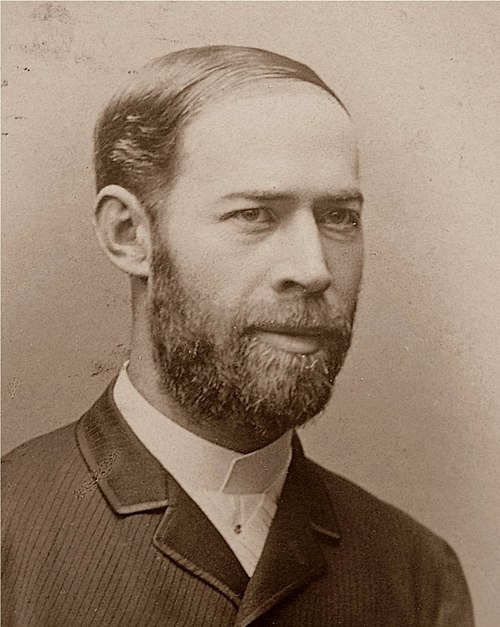
Heinrich Hertz Demonstrates Radio Waves
Heinrich Hertz experimentally generates and detects radio waves, confirming Maxwell's theory. His work is pivotal for the development of radio technology and eventual radio astronomy. #radioastronomy #experiment
Heinrich Hertz Demonstrates Radio Waves By Robert Krewaldt, Kaiserplatz 16, Bonn - Cabinetphotograph, Kabinettfotografie, Public domain, https://commons.wikimedia.org/w/index.php?curid=26781773
1931 CE
Karl Jansky Discovers Galactic Radio Waves
Karl Jansky, an engineer at Bell Labs, detects radio waves from the Milky Way while investigating static interference. This marks the birth of radio astronomy. #radioastronomy #pioneers
Karl Jansky Discovers Galactic Radio Waves By NRAO/AUI/NSF - https://public.nrao.edu/gallery/karl-guthe-jansky/, CC BY 4.0, https://commons.wikimedia.org/w/index.php?curid=169680767
1937 CE
Grote Reber Builds First Parabolic Radio Telescope
Amateur astronomer Grote Reber builds the first parabolic radio telescope in his backyard in Wheaton, Illinois, and produces the first radio map of the sky. #radioastronomy #pioneers
Grote Reber Builds First Parabolic Radio Telescope By NRAO/AUI/NSF - https://public.nrao.edu/gallery/grote-reber-in-1975/, CC BY 4.0, https://commons.wikimedia.org/w/index.php?curid=169680655
1942 CE
J.S. Hey Discovers Solar Radio Emission
British physicist J.S. Hey detects radio emission from the Sun during wartime radar experiments, marking the first detection of solar radio waves. #radioastronomy #sun
1944 CE
Grote Reber Publishes First Radio Map of the Milky Way
Grote Reber publishes a detailed radio map of the Milky Way at 160 MHz, revealing a galactic center and radio sources, establishing radio astronomy as a new field. #radioastronomy #galaxy
1945 CE
Ruby Payne-Scott Pioneers Radio Interferometry
Australian physicist Ruby Payne-Scott conducted early work in radio interferometry, including the first observation of solar radio bursts. She was a pioneer for women in science. #radioastronomy #womeninscience
Ruby Payne-Scott Pioneers Radio Interferometry By Peter Gavin Hall (Ruby Payne-Scott's son) - Peter Hall (Ruby Payne-Scott's son), CC BY-SA 3.0, https://commons.wikimedia.org/w/index.php?curid=8185566
1946 CE
Martin Ryle Invents the Radio Interferometer
Martin Ryle develops the radio interferometer, using two antennas to improve angular resolution. This technique leads to aperture synthesis later. #radioastronomy #interferometry
Martin Ryle Invents the Radio Interferometer By AIP Emilio Segrè Visual Archives, John Irwin Slide Collection - https://repository.aip.org/martin-ryle-international-astronomical-union-iau-conference, Attribution, https://commons.wikimedia.org/w/index.php?curid=172959665
1948 CE
Alpher, Herman and Gamow Predict the Cosmic Microwave Background
Ralph Alpher and Robert Herman, with George Gamow, predict the existence of cosmic microwave background radiation as a relic of the Big Bang. #cosmicmicrowavebackground #cosmology
Alpher, Herman and Gamow Predict the Cosmic Microwave Background By Credit: Alpher Papers. - https://link.springer.com/article/10.1007/s00016-012-0088-7, CC BY-SA 4.0, https://commons.wikimedia.org/w/index.php?curid=102121476
1951 CE
Discovery of the 21 cm Hydrogen Line
Harold Ewen and Edward Purcell detect the 21 cm hydrogen line, predicted by Hendrik van de Hulst, enabling radio astronomy to study neutral hydrogen in galaxies. #radioastronomy #hydrogen
Discovery of the 21 cm Hydrogen Line By Tiltec - Own work, Public domain, https://commons.wikimedia.org/w/index.php?curid=5739956
1953 CE
Hanbury Brown and Twiss Intensity Interferometer
Robert Hanbury Brown and Richard Twiss develop the intensity interferometer, using correlation of light intensity to measure stellar diameters, influencing radio astronomy. #radioastronomy #interferometry
1955 CE
Lovell Telescope Completed at Jodrell Bank
Bernard Lovell completes the 76-meter Lovell Telescope, then the world's largest steerable radio telescope, used for tracking satellites and cosmic radio sources. #radioastronomy #telescope
Lovell Telescope Completed at Jodrell Bank By Mike Peel; Jodrell Bank Centre for Astrophysics, University of Manchester - Own work. Also available at http://www.jodrellbank.manchester.ac.uk/multimedia/images/LovellTelescope2.html, CC BY-SA 4.0, https://commons.wikimedia.org/w/index.php?curid=2520502
1957 CE
Sputnik Tracked by Radio Telescopes
The Lovell Telescope and other radio observatories track Sputnik 1, demonstrating the utility of radio telescopes for satellite tracking and space science. #radioastronomy #spacerace
1960 CE
Jan Oort and Hendrik van de Hulst Found Leiden Radio Observatory
Dutch astronomers Jan Oort and Hendrik van de Hulst establish the Leiden Observatory's radio astronomy group, leading to major contributions in galactic and extragalactic astronomy. #radioastronomy #netherlands
Jan Oort and Hendrik van de Hulst Found Leiden Radio Observatory By User:AWossink - Own work, CC BY-SA 4.0, https://commons.wikimedia.org/w/index.php?curid=54241860
1961 CE
Hartebeesthoek Radio Observatory Established in South Africa
The Hartebeesthoek Radio Astronomy Observatory (HartRAO) is founded near Johannesburg, becoming the first major radio telescope in Africa, later part of VLBI networks. #radioastronomy #africa
Hartebeesthoek Radio Observatory Established in South Africa By Martinvl - Own work, CC BY-SA 4.0, https://commons.wikimedia.org/w/index.php?curid=53722122
1963 CE
Arecibo Observatory Opened
The Arecibo Observatory in Puerto Rico, with a 305-meter fixed dish, becomes the world's largest radio telescope, used for radar astronomy, planetary science, and SETI. #radioastronomy #telescope
Arecibo Observatory Opened By Mariordo (Mario Roberto Durán Ortiz) - Own work, CC BY-SA 4.0, https://commons.wikimedia.org/w/index.php?curid=81590797
1964 CE
Penzias and Wilson Discover the Cosmic Microwave Background
Arno Penzias and Robert Wilson at Bell Labs detect an unexplained noise in their horn antenna, later identified as the cosmic microwave background, confirming the Big Bang. #cosmicmicrowavebackground #cosmology
Penzias and Wilson Discover the Cosmic Microwave Background By ESA and the Planck Collaboration - Cosmic Microwave Background, CC BY 4.0, https://commons.wikimedia.org/w/index.php?curid=130789180
1965 CE
Penzias and Wilson Publish CMB Discovery
Penzias and Wilson publish their discovery, and Robert Dicke's team provides the theoretical interpretation, solidifying the CMB as evidence for the Big Bang. #cosmicmicrowavebackground #bigbang
Aug 1, 1967 CE
Jocelyn Bell Burnell Discovers Pulsars
Graduate student Jocelyn Bell Burnell detects the first pulsar (CP 1919) using the Interplanetary Scintillation Array, leading to a Nobel Prize for her supervisor Antony Hewish. #radioastronomy #pulsars #womeninscience
Jocelyn Bell Burnell Discovers Pulsars By Launch_of_IYA_2009,_Paris_-_Grygar,_Bell_Burnell.jpg: Astronomical Institute, Academy of Sciences of the Czech Republic derivative work: Anrie (talk) - Launch_of_IYA_2009,_Paris_-_Grygar,_Bell_Burnell.jpg, CC BY-SA 3.0, https://commons.wikimedia.org/w/index.php?curid=9988968
1970 CE
Govind Swarup Establishes Ooty Radio Telescope
Indian astronomer Govind Swarup leads the construction of the Ooty Radio Telescope, a 530-meter-long cylindrical parabola, used for lunar occultation and other studies. #radioastronomy #india
Govind Swarup Establishes Ooty Radio Telescope By Own work - Ooty Radio Telescope, CC BY 3.0, https://commons.wikimedia.org/w/index.php?curid=7463023
1970 CE
First Very Long Baseline Interferometry Experiments
The first VLBI experiments are conducted, linking radio telescopes thousands of kilometers apart to achieve milliarcsecond resolution, revolutionizing astrometry and imaging. #radioastronomy #vlbi
First Very Long Baseline Interferometry Experiments By ESO/B. Tafreshi/TWAN (twanight.org) - http://www.eso.org/public/images/potw1222a/, CC BY 4.0, https://commons.wikimedia.org/w/index.php?curid=19646814
1971 CE
Measurement of CMB Spectrum Confirms Blackbody Nature
Robert Wilson and others measure the cosmic microwave background spectrum in the mm/sub-mm, confirming it is a nearly perfect blackbody, consistent with the Big Bang. #cosmicmicrowavebackground #cosmology
1978 CE
COBE Satellite Proposed
The Cosmic Background Explorer (COBE) satellite is proposed to precisely measure the CMB spectrum and search for anisotropies, leading to major cosmological insights. #cosmicmicrowavebackground #satellite
COBE Satellite Proposed By NASA - https://science.nasa.gov/toolkits/spacecraft-icons (image link), Public domain, https://commons.wikimedia.org/w/index.php?curid=58072784
1980 CE
Very Large Array (VLA) Dedicated
The Karl G. Jansky Very Large Array in New Mexico is dedicated, consisting of 27 radio dishes in Y-shaped configuration, becoming a premier radio telescope for high-resolution imaging. #radioastronomy #telescope
Very Large Array (VLA) Dedicated By user:Hajor - Own work, CC BY-SA 3.0, https://commons.wikimedia.org/w/index.php?curid=138997
1982 CE
Nobeyama Radio Observatory Opens in Japan
The Nobeyama Radio Observatory becomes operational with a 45-meter telescope, advancing Japanese radio astronomy and enabling studies of interstellar molecules and star formation. #radioastronomy #japan
Nobeyama Radio Observatory Opens in Japan By Wiiii - Own work, CC BY-SA 3.0, https://commons.wikimedia.org/w/index.php?curid=7676783
Nov 1, 1989 CE
COBE Satellite Launched
NASA's Cosmic Background Explorer (COBE) satellite is launched, designed to measure the diffuse infrared and microwave background radiation from the early universe. #cosmicmicrowavebackground #satellite
1990 CE
COBE FIRAS Shows Perfect Blackbody Spectrum
The FIRAS instrument on COBE measures the CMB spectrum with high precision, showing it matches a blackbody at 2.725 K, confirming the Big Bang model. #cosmicmicrowavebackground #nobelprize
Apr 1, 1992 CE
COBE DMR Detects CMB Anisotropies
The COBE DMR instrument detects temperature fluctuations in the CMB at a level of one part in 100,000, providing the seeds for structure formation in the universe. #cosmicmicrowavebackground #cosmology
1995 CE
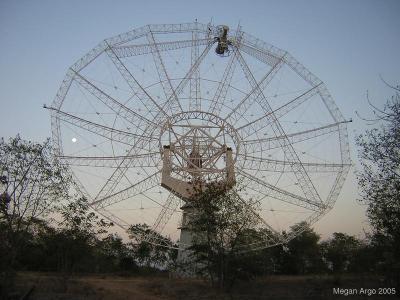
Giant Metrewave Radio Telescope (GMRT) Operational in India
Govind Swarup's vision, the GMRT, a low-frequency radio telescope array near Pune, begins operations, enabling studies of neutral hydrogen and radio transients. #radioastronomy #india
Giant Metrewave Radio Telescope (GMRT) Operational in India By The original uploader was MeganKA at English Wikipedia. - Transferred from en.wikipedia to Commons., CC BY 2.0, https://commons.wikimedia.org/w/index.php?curid=2985519
The BOOMERANG balloon-borne experiment maps 1% of the sky, showing the CMB angular power spectrum consistent with a flat universe. #cosmicmicrowavebackground #balloon
2000 CE
MAXIMA Balloon Experiment Confirms CMB Power Spectrum
The MAXIMA balloon experiment independently measures the CMB power spectrum, reinforcing results from BOOMERANG and providing strong evidence for inflation. #cosmicmicrowavebackground #balloon )
Jun 30, 2001 CE
WMAP Satellite Launched
NASA's Wilkinson Microwave Anisotropy Probe (WMAP) is launched to map CMB temperature fluctuations with higher resolution and sensitivity than COBE. #cosmicmicrowavebackground #satellite
WMAP Satellite Launched By NASA / WMAP Science Team - [1]; converted from the high-resolution TIFF version to a JPEG, Public domain, https://commons.wikimedia.org/w/index.php?curid=3944989
Feb 1, 2003 CE
WMAP First Year Results Released
WMAP's first year data produces a detailed CMB map, determining cosmological parameters with unprecedented precision, supporting the Lambda-CDM model. #cosmicmicrowavebackground #cosmology
Oct 1, 2006 CE
Nobel Prize Awarded to Mather and Smoot for CMB Research
George Smoot and John Mather receive the Nobel Prize in Physics for their work on the Cosmic Background Explorer, confirming the blackbody form and anisotropy of the CMB. #cosmicmicrowavebackground #nobelprize
Nobel Prize Awarded to Mather and Smoot for CMB Research By Christopher Michel - John Mather, CC BY 2.0, https://commons.wikimedia.org/w/index.php?curid=39209520
2006 CE
Large Millimeter Telescope (LMT) Inaugurated in Mexico
The LMT, a 50-meter millimeter-wave telescope, is inaugurated at Sierra Negra, Mexico, becoming the largest single-dish telescope of its kind, aiding studies of star formation and galaxy evolution. #radioastronomy #mexico
Large Millimeter Telescope (LMT) Inaugurated in Mexico By Luyten - Own work, CC BY-SA 3.0, https://commons.wikimedia.org/w/index.php?curid=3809571
May 14, 2009 CE
Planck Satellite Launched
ESA's Planck satellite is launched to map the CMB with even higher resolution than WMAP, measuring temperature and polarization to test cosmic inflation and refine cosmology. #cosmicmicrowavebackground #satellite )
Planck Satellite Launched By Photograph by Mike Peel (www.mikepeel.net). - Own work, CC BY-SA 4.0, https://commons.wikimedia.org/w/index.php?curid=14045307
Mar 13, 2011 CE
ALMA Dedicated in Chile
The Atacama Large Millimeter/submillimeter Array (ALMA) is inaugurated in Chile, consisting of 66 antennas, enabling high-resolution observations of cold gas and dust in the universe. #radioastronomy #interferometry
ALMA Dedicated in Chile By Iztok Bončina/ESO - http://www.eso.org/public/images/potw1040a/, CC BY 4.0, https://commons.wikimedia.org/w/index.php?curid=11686363
Mar 21, 2013 CE
Planck Releases First Full-Sky CMB Map
Planck's data reveals the most precise map of the CMB, showing anomalies and confirming the standard cosmological model with high precision. #cosmicmicrowavebackground #cosmology )
Sep 25, 2016 CE
FAST Radio Telescope Begins Operations in China
The Five-hundred-meter Aperture Spherical Telescope (FAST) begins operations in China, becoming the world's largest single-dish radio telescope, used for pulsar discovery and HI surveys. #radioastronomy #china
FAST Radio Telescope Begins Operations in China By SCJiang - Own work, CC BY-SA 4.0, https://commons.wikimedia.org/w/index.php?curid=172271062
2018 CE
Square Kilometre Array (SKA) Construction Begins
Construction of the Square Kilometre Array, a next-generation radio telescope spanning South Africa and Australia, begins, promising unprecedented sensitivity and survey speed. #radioastronomy #international
Square Kilometre Array (SKA) Construction Begins By SKAO - https://skao.canto.global/v/SKAOMediaKit/landing?viewIndex=0, CC BY 3.0, https://commons.wikimedia.org/w/index.php?curid=196367403
Apr 10, 2019 CE
Event Horizon Telescope Images Supermassive Black Hole
The Event Horizon Telescope, a global VLBI network, produces the first image of a black hole (M87*), revealing its shadow and advancing radio interferometry to new heights. #radioastronomy #blackhole
Event Horizon Telescope Images Supermassive Black Hole By D. Marrone/UofA - Event Horizon Telescope Collaboration, CC BY 4.0, https://commons.wikimedia.org/w/index.php?curid=133002860
2021 CE
MeerKAT in South Africa Releases Deep Radio Images
The MeerKAT telescope, a precursor to SKA, releases stunning deep radio images of the Galactic Center and other fields, showcasing its capabilities. #radioastronomy #southafrica
MeerKAT in South Africa Releases Deep Radio Images By Morganoshell - Own work, CC BY-SA 4.0, https://commons.wikimedia.org/w/index.php?curid=47588577