Quantum Optics & Laser Coherence: Global Cross-Cultural Perspectives
Encyclopedia/1. The Cosmos & The Natural World/2. Physics & Chemistry/01. Quantum Physics & Atomic Theory • Curated by Admin Timeline.sg
This timeline traces the global history of quantum optics and laser coherence, from ancient optical theories to modern quantum technologies, highlighting contributions across civilizations, including Chinese, Islamic, Indian, and Western scientists.
Chronological Storyline (43 Milestones)
470 BCE
Mohist optics in China
Chinese philosopher Mozi and his followers document camera obscura, reflection, and pinhole imaging, establishing early geometrical optics. #optics #history
Mohist optics in China By Vjacheslav Rublevskiy - https://www.flickr.com/photos/193162016@N04/51221161306/, CC0, https://commons.wikimedia.org/w/index.php?curid=106219380
300 BCE
Euclid's Optics
Euclid writes 'Optics', a foundational work describing geometric principles of vision and light rays. #optics #ancient
Euclid's Optics By Euclid - Available in the BEIC digital library and uploaded in partnership with BEIC Foundation., Public domain, https://commons.wikimedia.org/w/index.php?curid=37857016
1021 CE
Ibn al-Haytham's Book of Optics
Ibn al-Haytham (Alhazen) publishes 'Book of Optics', explaining vision, reflection, refraction, and the camera obscura, laying foundations for experimental optics. #optics #IslamicScience
Ibn al-Haytham's Book of Optics By Ibn al-Haytham, Vitello, Friedrich Risner - University of Oklahoma History of Science Collections et BnF Gallica : http://gallica.bnf.fr/ark:/12148/bpt6k312873d.r=Haytham?rk=407727;2, Public domain, https://commons.wikimedia.org/w/index.php?curid=48189707
1088 CE
Shen Kuo's Dream Pool Essays
Chinese polymath Shen Kuo describes camera obscura and pinhole imaging in his 'Dream Pool Essays', contributing to early understanding of light. #optics #China
Shen Kuo's Dream Pool Essays By Unknown 18th century artist - http://www-history.mcs.st-andrews.ac.uk/PictDisplay/Shen_Kua.html, Public domain, https://commons.wikimedia.org/w/index.php?curid=6551589
1309 CE
Kamal al-Din al-Farisi on optics
Persian physicist Kamal al-Din al-Farisi extends Ibn al-Haytham's work, providing correct explanation of the rainbow and studying refraction. #optics #IslamicScience
Kamal al-Din al-Farisi on optics By Kamal al-Din al-Hasan ibn Ali ibn al-Hasan al-Farisi (1267-1318) Photo: Kamal al-Din al-Hasan ibn Ali ibn al-Hasan al-Farisi (1267-1318). - Adilnor Collection., CC BY-SA 3.0, https://commons.wikimedia.org/w/index.php?curid=124678039
1604 CE
Kepler's Astronomiae Pars Optica
Johannes Kepler publishes 'Astronomiae Pars Optica', correctly explaining inverted image formation on the retina and introducing the term 'optical axis'. #optics #astronomy
1621 CE
Snell's law of refraction
Willebrord Snellius discovers the law of refraction, relating angles of incidence and refraction for light passing between media. #optics #physics
Snell's law of refraction By Oleg Alexandrov — I just tweaked the original - Rotated and tweaked version of en:Image:Snells law.svg, same license, Public domain, https://commons.wikimedia.org/w/index.php?curid=3273668
1665 CE
Grimaldi discovers diffraction
Francesco Maria Grimaldi first observes and describes the diffraction of light, coining the term and noting deviations from geometric propagation. #optics #physics
Grimaldi discovers diffraction By Unknown author, Public domain, https://commons.wikimedia.org/w/index.php?curid=6581653
1672 CE
Newton's prism experiments
Isaac Newton demonstrates that white light is composed of colors by passing it through a prism, laying groundwork for color theory. #optics #physics
Newton's prism experiments By Unknown author, Public domain, https://commons.wikimedia.org/w/index.php?curid=510265
1801 CE
Young's double-slit experiment
Thomas Young performs the double-slit experiment, demonstrating the wave nature of light through interference patterns. #optics #physics
Young's double-slit experiment By Original: NekoJaNekoJa Vector: Johannes Kalliauer - Own work based on: Double-slit.PNG:, CC BY-SA 4.0, https://commons.wikimedia.org/w/index.php?curid=61496401
1817 CE
Fresnel's wave theory of light
Augustin-Jean Fresnel develops a comprehensive wave theory of light, explaining diffraction and interference, and gaining acceptance over the particle theory. #optics #physics
Fresnel's wave theory of light By L3erdnik - Own work, CC0, https://commons.wikimedia.org/w/index.php?curid=166076517
1865 CE
Maxwell's electromagnetic theory
James Clerk Maxwell's equations unify electricity and magnetism, predicting that light is an electromagnetic wave. #physics #optics
Maxwell's electromagnetic theory By FF-UK - Own work, CC BY-SA 4.0, https://commons.wikimedia.org/w/index.php?curid=59542523
1887 CE
Hertz discovers photoelectric effect
Heinrich Hertz experimentally discovers the photoelectric effect, where light ejects electrons from a metal surface, later explained by Einstein. #physics #quantum
Hertz discovers photoelectric effect By Ponor - Own work, CC BY-SA 4.0, https://commons.wikimedia.org/w/index.php?curid=92684859
Dec 14, 1900 CE
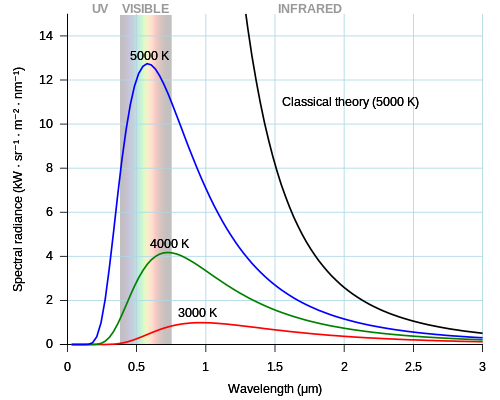
Planck introduces quantum theory
Max Planck presents his law of blackbody radiation, introducing the concept of energy quanta, marking the birth of quantum physics. #quantum #physics
Planck introduces quantum theory By Darth Kule - Own work, Public domain, https://commons.wikimedia.org/w/index.php?curid=10555337
1905 CE
Einstein explains photoelectric effect
Albert Einstein proposes that light consists of particles (photons), explaining the photoelectric effect and establishing the quantum nature of light. #quantum #physics
1917 CE
Einstein's stimulated emission
Albert Einstein derives the concept of stimulated emission of radiation, the theoretical basis for the laser and maser. #physics #quantum
Einstein's stimulated emission By 彭嘉傑 - Own work, CC BY 2.5, https://commons.wikimedia.org/w/index.php?curid=60733412
1924 CE
Bose's photon statistics
Satyendra Nath Bose sends a paper to Einstein on the statistics of photons, leading to Bose-Einstein statistics and the concept of bosons. #physics #quantum
Bose's photon statistics By Unknown author - Picture in Siliconeer, Public domain, https://commons.wikimedia.org/w/index.php?curid=2201891
1928 CE
Raman effect discovered
C. V. Raman and K. S. Krishnan discover inelastic scattering of light, known as the Raman effect, which reveals molecular vibrational information. #physics #optics
Raman effect discovered By KCVelaga - File:Electron-scattering.png by JabberWok, CC BY-SA 4.0, https://commons.wikimedia.org/w/index.php?curid=79274364
1940 CE
Fabrikant proposes laser principle
Soviet physicist V. A. Fabrikant suggests using stimulated emission for amplifying light, an early precursor to the laser. #physics #optics
1947 CE
Lamb shift discovered
Willis Lamb and Robert Retherford measure the Lamb shift, a small energy difference in hydrogen that confirms quantum electrodynamics. #quantum #physics
Lamb shift discovered By Joel Holdsworth (Joelholdsworth) - Non-Derived SVG of Radiate gluon.png, originally the work of SilverStar at Feynmann-diagram-gluon-radiation.svg, updated by joelholdsworth., Public domain, https://commons.wikimedia.org/w/index.php?curid=1764161
1950 CE
Kastler proposes optical pumping
Alfred Kastler develops the concept of optical pumping, a method to create population inversion for lasers. #physics #optics
Kastler proposes optical pumping By Arnero - Own work, Public domain, https://commons.wikimedia.org/w/index.php?curid=3426192
1953 CE
First maser built
Charles Townes and colleagues build the first maser (microwave amplification by stimulated emission of radiation), a precursor to the laser. #physics #optics
First maser built By Dan Rubin - Retrieved February 18, 2015 from Shunaman, Fred "Revolutionary new oscillator-amplifier" in Radio-Electronic Engineering magazine, Ziff-Davis Publishing Co., New York, Vol. 26, No. 6, June 1955, cover on http://www.americanradiohistory.com, Public domain, https://commons.wikimedia.org/w/index.php?curid=38461589
1956 CE
Hanbury Brown–Twiss effect
Robert Hanbury Brown and Richard Q. Twiss demonstrate intensity correlation of light, measuring stellar diameters and laying groundwork for quantum optics. #optics #astronomy
1958 CE
Schawlow and Townes propose laser
Arthur Schawlow and Charles Townes publish a paper proposing the construction of a laser, and Gordon Gould independently develops similar ideas. #physics #optics
Schawlow and Townes propose laser By ESO/A. Ghizzi Panizza (www.albertoghizzipanizza.com) - This media was produced by the European Southern Observatory (ESO), under the identifier potw2222a This tag does not indicate the copyright status of the attached work. A normal copyright tag is still required. See Commons:Licensing., CC BY 4.0, https://commons.wikimedia.org/w/index.php?curid=135742267
May 16, 1960 CE
First laser demonstrated
Theodore Maiman operates the first working laser, a pulsed ruby laser at Hughes Research Laboratories. #physics #optics
First laser demonstrated By US Gov - https://en.wikipedia.org/wiki/File:Ruby_laser.jpg A modified version of this Wikipedia photo. Originally drawn by the US Gov. Dept. of Energy, from here: https://www.osti.gov/biblio/16710, Public domain, https://commons.wikimedia.org/w/index.php?curid=140068448
1960 CE
Helium-neon laser invented
Ali Javan and colleagues build the first continuous-wave gas laser using helium and neon. #physics #optics
Helium-neon laser invented By Tommy Markstein - Own work (Original text: Tommy Markstein), CC BY-SA 3.0, https://commons.wikimedia.org/w/index.php?curid=24295060
1962 CE
Semiconductor laser diode
Robert Hall and others invent the first semiconductor laser diode, enabling compact laser sources. #physics #optics
Semiconductor laser diode By Unknown author - Jet Propulsion Laboratory website: http://technology.jpl.nasa.gov/gallery/index.cfm?page=imageDetail&ItemID=120&catId=8 (archive), Public domain, https://commons.wikimedia.org/w/index.php?curid=2359148
1963 CE
Glauber's quantum theory of coherence
Roy J. Glauber publishes the quantum theory of optical coherence, earning a Nobel Prize and founding modern quantum optics. #quantum #optics
1971 CE
Nobel for holography to Gabor
Dennis Gabor receives the Nobel Prize in Physics for his invention of holography, a technique using laser light to record 3D images. #optics #physics
Nobel for holography to Gabor By Holo-Mouse.jpg: Georg-Johann Lay derivative work: Epzcaw (talk) - Holo-Mouse.jpg, Public domain, https://commons.wikimedia.org/w/index.php?curid=16456745
1972 CE
First Bell test with photons
Stuart Freedman and John Clauser perform the first experimental test of Bell's inequalities using entangled photons, supporting quantum mechanics. #quantum #physics
1982 CE
Aspect's Bell test experiments
Alain Aspect conducts precise tests of Bell inequalities with photon pairs, closing loopholes and confirming quantum entanglement. #quantum #physics
Aspect's Bell test experiments By Ecole polytechnique Université Paris-Saclay - Mooc optique quantique, CC BY-SA 2.0, https://commons.wikimedia.org/w/index.php?curid=123730100
1985 CE
Squeezed light generated
Richard Slusher and others generate squeezed light states, reducing quantum noise in one quadrature for precision measurements. #quantum #optics
Squeezed light generated By Geek3 - Own work, CC BY-SA 4.0, https://commons.wikimedia.org/w/index.php?curid=79089581
1986 CE
Optical tweezers invented
Arthur Ashkin invents optical tweezers, using a tightly focused laser beam to trap and manipulate microscopic particles. #optics #physics
Optical tweezers invented By Bjschellenberg - https://stevenhoekstra.owlstown.net/projects/426-levitated-nanospheres (see doi:10.1063/5.0166136 that is CC-BY and has this image as issue-cover, with first-author matching uploader's username), CC BY-SA 4.0, https://commons.wikimedia.org/w/index.php?curid=137390829
1993 CE
Electromagnetically induced transparency
Stephen Harris and colleagues demonstrate electromagnetically induced transparency, making an opaque medium transparent to a probe laser. #quantum #optics
Electromagnetically induced transparency By F G Sedgwick - Own work by the original uploader, Public domain, https://commons.wikimedia.org/w/index.php?curid=54909870
1995 CE
Bose-Einstein condensate achieved
Eric Cornell, Carl Wieman, and Wolfgang Ketterle create the first Bose-Einstein condensate using laser cooling and trapping. #physics #quantum
Bose-Einstein condensate achieved By Vectorized version by AG Caesar, original by DG85 - Inspired by a work from Wikipedia User DG85 https://commons.wikimedia.org/wiki/File:QuantumPhaseTransition.png, Public domain, https://commons.wikimedia.org/w/index.php?curid=67110336
1997 CE
Nobel for laser cooling
Steven Chu, Claude Cohen-Tannoudji, and William D. Phillips receive the Nobel Prize for laser cooling and trapping of atoms. #physics #optics
Nobel for laser cooling By Darth luigi - Own work, CC BY-SA 4.0, https://commons.wikimedia.org/w/index.php?curid=153687990
2001 CE
Nobel for Bose-Einstein condensation
Cornell, Wieman, and Ketterle are awarded the Nobel Prize for achieving Bose-Einstein condensation in dilute gases. #physics #quantum
2005 CE
Nobel for optical frequency comb
John L. Hall and Theodor W. Hänsch share the Nobel Prize for laser-based precision spectroscopy, including the optical frequency comb technique. #physics #optics
Nobel for optical frequency comb By Rubber Duck (☮ • ✍) - Own work, Public domain, https://commons.wikimedia.org/w/index.php?curid=39652854
2011 CE
First heralded quantum memory
Researchers demonstrate a heralded quantum memory for light, storing and retrieving single photons on demand for quantum networks. #quantum #optics
2015 CE
LIGO detects gravitational waves
LIGO uses laser interferometry to detect gravitational waves from merging black holes, opening new astronomy windows. #physics #optics
LIGO detects gravitational waves By Amber Stuver - Own work, CC BY-SA 4.0, https://commons.wikimedia.org/w/index.php?curid=46993713
2016 CE
Chinese quantum satellite Micius
China launches the Micius satellite for quantum key distribution and entanglement experiments, enabling secure communication tests. #quantum #China
2018 CE
Attosecond light pulses
Researchers generate attosecond laser pulses, capturing electron dynamics in real time and advancing ultrafast optics. #physics #optics
Attosecond light pulses By FedericoVis - Own work, CC BY-SA 4.0, https://commons.wikimedia.org/w/index.php?curid=106611728
2022 CE
Nobel for quantum entanglement
Alain Aspect, John Clauser, and Anton Zeilinger win the Nobel Prize for experiments with entangled photons and quantum information science. #quantum #physics