Encyclopedia/1. The Cosmos & The Natural World/2. Physics & Chemistry/01. Quantum Physics & Atomic Theory • Curated by Admin Timeline.sg
A biographical timeline tracking the seminal contributions, inventions, and lasting legacies of leading figures in Quantum Mechanics & Wave Functions, from ancient atomic theories to modern quantum technologies.
Chronological Storyline (40 Milestones)
600 BCE
Kanada Proposes Atomic Theory in Vaisheshika
Indian sage Kanada systematically presents an atomic theory in the Vaisheshika school, suggesting all matter is composed of indivisible particles called paramanu. #history #physics )
Kanada Proposes Atomic Theory in Vaisheshika By Xaetherion - Own work, CC BY-SA 4.0, https://commons.wikimedia.org/w/index.php?curid=185658968
460 BCE
Democritus Advocates Atomism
Greek philosopher Democritus proposes that all matter consists of small, indestructible particles called atoms, laying the groundwork for atomic theory. #history #philosophy
Democritus Advocates Atomism By user:shakko - Own work, CC BY-SA 3.0, https://commons.wikimedia.org/w/index.php?curid=5535206
1803 CE
Dalton Introduces Atomic Theory
John Dalton publishes his atomic theory based on quantitative chemical experiments, proposing that elements are composed of atoms of fixed weights. #chemistry #physics
Dalton Introduces Atomic Theory By Thomas Phillips - National Portrait Gallery, London, Public domain, https://commons.wikimedia.org/w/index.php?curid=11727058
1827 CE
Brown Discovers Brownian Motion
Botanist Robert Brown observes the random jitter of pollen grains in water, later explained as evidence of atomic collisions. #physics #history )
Brown Discovers Brownian Motion By Unknown author, Public domain, https://commons.wikimedia.org/w/index.php?curid=401417
1869 CE
Mendeleev Creates Periodic Table
Dmitri Mendeleev organizes elements into a periodic table based on atomic weights and chemical properties, predicting undiscovered elements. #chemistry #science
Mendeleev Creates Periodic Table By Original: Unknown authorUnknown author Upload: Germansociety2014 - Unknown source, Public domain, https://commons.wikimedia.org/w/index.php?curid=32692107
1887 CE
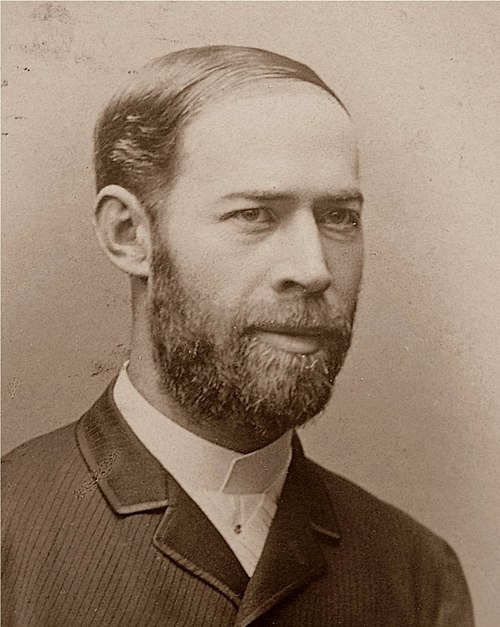
Hertz Observes Photoelectric Effect
Heinrich Hertz discovers the photoelectric effect, where light causes emission of electrons from a metal surface, later explained quantum mechanically. #physics #discovery
Hertz Observes Photoelectric Effect By Robert Krewaldt, Kaiserplatz 16, Bonn - Cabinetphotograph, Kabinettfotografie, Public domain, https://commons.wikimedia.org/w/index.php?curid=26781773
1895 CE
Röntgen Discovers X-Rays
Wilhelm Röntgen discovers X-rays, a form of high-energy electromagnetic radiation, leading to new imaging technologies and studies of atomic structure. #physics #medicine
Röntgen Discovers X-Rays By Erwin Hanfstaengl - https://global.museum-digital.org/singleimage?imagenr=2399678, Public domain, https://commons.wikimedia.org/w/index.php?curid=182243188
1896 CE
Becquerel Discovers Radioactivity
Henri Becquerel accidentally discovers radioactivity when uranium salts fog a photographic plate, revealing atomic instability. #physics #history
Becquerel Discovers Radioactivity By Paul Nadar / Adam Cuerden - This file comes from Gallica Digital Library and is available under the digital ID btv1b532297273/f1, Public domain, https://commons.wikimedia.org/w/index.php?curid=120421283
1897 CE
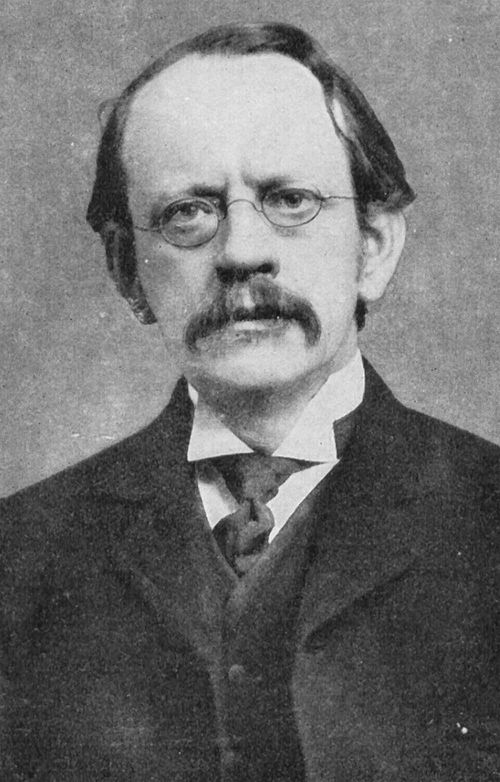
Thomson Identifies the Electron
J.J. Thomson's cathode ray experiments reveal the electron, a negatively charged particle much smaller than the atom. #physics #discovery
Thomson Identifies the Electron By Not Mentioned - First World War.com, Public domain, https://commons.wikimedia.org/w/index.php?curid=2969861
1900 CE
Planck Introduces Quantum of Action
Max Planck proposes that energy is quantized in discrete packets (quanta) to explain blackbody radiation, founding quantum theory. #physics #quantum
Planck Introduces Quantum of Action By Hugo Erfurth - This file was derived from: Max Planck by Hugo Erfurth 1938cr.jpg Original source: https://www.dhm.de/lemo/bestand/objekt/max-planck, Public domain, https://commons.wikimedia.org/w/index.php?curid=153625300
1905 CE
Einstein Explains Photoelectric Effect
Albert Einstein uses light quanta (photons) to explain the photoelectric effect, providing strong evidence for quantum theory. #physics #nobel
Einstein Explains Photoelectric Effect By Oren Jack Turner - This image is available from the United States Library of Congress's Prints and Photographs division under the digital ID cph.3b46036.This tag does not indicate the copyright status of the attached work. A normal copyright tag is still required. See Commons:Licensing., Public domain, https://commons.wikimedia.org/w/index.php?curid=6372844
1911 CE
Rutherford Discovers Atomic Nucleus
Ernest Rutherford's gold foil experiment reveals the atom's small, dense nucleus, leading to the nuclear model of the atom. #physics #discovery
Rutherford Discovers Atomic Nucleus By Bain News Service, publisher Restored by: Bammesk - Library of Congress Catalog: https://lccn.loc.gov/2014716719 Image download: https://cdn.loc.gov/service/pnp/ggbain/36500/36570v.jpg Original url: https://www.loc.gov/pictures/item/2014716719/, Public domain, https://commons.wikimedia.org/w/index.php?curid=112190894
1913 CE
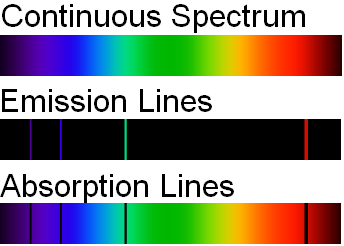
Bohr Proposes Quantum Model of Hydrogen
Niels Bohr introduces a model with quantized electron orbits that successfully explains the hydrogen spectrum and atomic stability. #physics #quantum
Bohr Proposes Quantum Model of Hydrogen By The American Institute of Physics credits the photo [1] to AB Lagrelius & Westphal, which is the Swedish company used by the Nobel Foundation for most photos of its book series Les Prix Nobel. - Niels Bohr's Nobel Prize biography, from 1922, Public domain, https://commons.wikimedia.org/w/index.php?curid=288274
1916 CE
Einstein Derives A and B Coefficients
Albert Einstein formulates the A and B coefficients for spontaneous and stimulated emission, laying the foundation for lasers. #physics #quantum
Einstein Derives A and B Coefficients By User:Jhausauer - Author, Public domain, https://commons.wikimedia.org/w/index.php?curid=13358404
1923 CE
Compton Discovers the Compton Effect
Arthur Compton demonstrates the particle nature of light by observing the wavelength shift of X-rays scattered by electrons. #physics #quantum
Compton Discovers the Compton Effect By Ponor - Own work, CC BY-SA 4.0, https://commons.wikimedia.org/w/index.php?curid=91353714
1924 CE
Bose Sends Paper on Photon Statistics
Satyendra Nath Bose derives Planck's law by treating photons as indistinguishable particles, leading to Bose-Einstein statistics. #physics #quantum
Bose Sends Paper on Photon Statistics By Unknown author - Picture in Siliconeer, Public domain, https://commons.wikimedia.org/w/index.php?curid=2201891
1924 CE
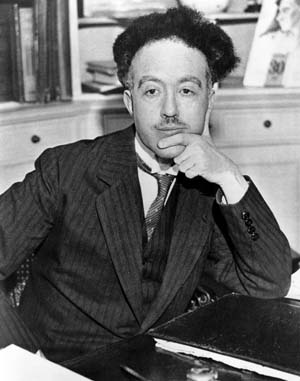
de Broglie Proposes Matter Waves
Louis de Broglie suggests that particles like electrons have wave-like properties, laying the groundwork for wave mechanics. #physics #quantum
de Broglie Proposes Matter Waves By Unknown author - https://www.physics.umd.edu/courses/Phys420/Spring2002/Parra_Spring2002/HTMPages/whoswho.htm, Public domain, https://commons.wikimedia.org/w/index.php?curid=622169
1925 CE
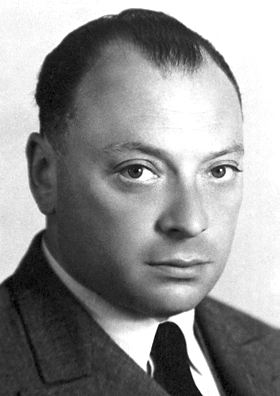
Pauli States the Exclusion Principle
Wolfgang Pauli postulates that no two electrons can occupy the same quantum state, explaining atomic structure and the periodic table. #physics #quantum
Pauli States the Exclusion Principle By Nobel foundation - http://nobelprize.org/nobel_prizes/physics/laureates/1945/pauli-bio.html, Public domain, https://commons.wikimedia.org/w/index.php?curid=6183525
1925 CE
Heisenberg Develops Matrix Mechanics
Werner Heisenberg creates the first complete formulation of quantum theory using matrices, avoiding unobservable quantities. #physics #quantum
Heisenberg Develops Matrix Mechanics By Unknown author - This image was provided to Wikimedia Commons by the German Federal Archive (Deutsches Bundesarchiv) as part of a cooperation project. The German Federal Archive guarantees an authentic representation only using the originals (negative and/or positive), resp. the digitalization of the originals as provided by the Digital Image Archive., CC BY-SA 3.0 de, https://commons.wikimedia.org/w/index.php?curid=187307971
1926 CE
Schrödinger Formulates Wave Equation
Erwin Schrödinger derives his wave equation, describing quantum behavior with wave functions and energy levels. #physics #quantum
Schrödinger Formulates Wave Equation By Unknown author - Narodowe Archiwum Cyfrowe - Sygnatura 1-E-939 (Original picture), Public domain, https://commons.wikimedia.org/w/index.php?curid=113379275
1926 CE
Born Interprets Wave Function Probabilistically
Max Born proposes that the square of the wave function gives the probability density of finding a particle, a core tenet of quantum mechanics. #physics #quantum
Born Interprets Wave Function Probabilistically By Unknown author, Public domain, https://commons.wikimedia.org/w/index.php?curid=137838
1927 CE
Heisenberg Formulates Uncertainty Principle
Werner Heisenberg states that the position and momentum of a particle cannot be simultaneously known with arbitrary precision. #physics #quantum
Heisenberg Formulates Uncertainty Principle By Unknown author - This image was provided to Wikimedia Commons by the German Federal Archive (Deutsches Bundesarchiv) as part of a cooperation project. The German Federal Archive guarantees an authentic representation only using the originals (negative and/or positive), resp. the digitalization of the originals as provided by the Digital Image Archive., CC BY-SA 3.0 de, https://commons.wikimedia.org/w/index.php?curid=5436254
1927 CE
Copenhagen Interpretation Emerges
Niels Bohr and others develop the Copenhagen interpretation, asserting that quantum systems exist as superpositions until measured. #physics #quantum
1928 CE
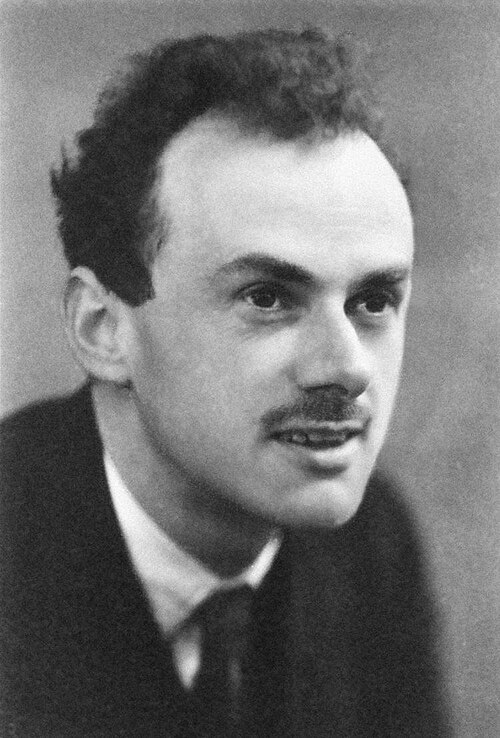
Dirac Derives Relativistic Electron Equation
Paul Dirac formulates the Dirac equation, describing relativistic electrons and predicting antimatter. #physics #quantum
Dirac Derives Relativistic Electron Equation By Nobel Foundation - http://nobelprize.org/nobel_prizes/physics/laureates/1933/dirac.html, Public domain, https://commons.wikimedia.org/w/index.php?curid=624401
1930 CE
Dirac Lays Foundations of Quantum Electrodynamics
Paul Dirac develops the theory of quantum electrodynamics, describing interactions between electrons and photons. #physics #quantum
Dirac Lays Foundations of Quantum Electrodynamics By Joel Holdsworth (Joelholdsworth) - Non-Derived SVG of Radiate gluon.png, originally the work of SilverStar at Feynmann-diagram-gluon-radiation.svg, updated by joelholdsworth., Public domain, https://commons.wikimedia.org/w/index.php?curid=1764161
1932 CE
Chadwick Discovers the Neutron
James Chadwick identifies the neutron, an uncharged nuclear particle, completing the picture of the atomic nucleus. #physics #discovery
Chadwick Discovers the Neutron By Los Alamos National Laboratory, Attribution, https://commons.wikimedia.org/w/index.php?curid=36283260
1933 CE
Fermi Develops Theory of Beta Decay
Enrico Fermi proposes the theory of beta decay, introducing the weak nuclear force and the neutrino. #physics #quantum
Fermi Develops Theory of Beta Decay By Department of Energy-Office of Public Affairs, restored by Yann - This tag does not indicate the copyright status of the attached work. A normal copyright tag is still required. See Commons:Licensing., Public domain, https://commons.wikimedia.org/w/index.php?curid=156854
1935 CE
Einstein, Podolsky, Rosen Propose EPR Paradox
The EPR paper argues that quantum mechanics is incomplete, highlighting issues of entanglement and nonlocality. #physics #quantum
Einstein, Podolsky, Rosen Propose EPR Paradox By Doris Ulmann - This image is available from the United States Library of Congress's Prints and Photographs division under the digital ID cph.3g04940.This tag does not indicate the copyright status of the attached work. A normal copyright tag is still required. See Commons:Licensing., Public domain, https://commons.wikimedia.org/w/index.php?curid=2468828
1935 CE
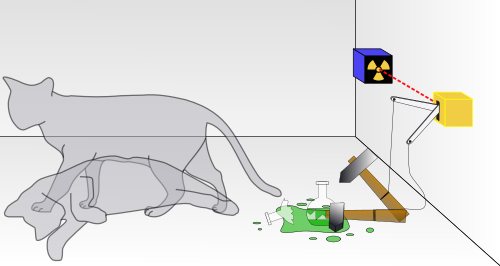
Schrödinger's Cat Gedankenexperiment
Erwin Schrödinger proposes a thought experiment illustrating quantum superposition and measurement paradoxes using a cat. #physics #quantum
Schrödinger's Cat Gedankenexperiment By Dhatfield - Own work, CC BY-SA 3.0, https://commons.wikimedia.org/w/index.php?curid=4279886
1935 CE
Yukawa Predicts the Meson
Hideki Yukawa theorizes the existence of mesons as carriers of the strong nuclear force binding protons and neutrons. #physics #quantum
Yukawa Predicts the Meson By Nobel Foundation archive - nobelprize.org [1], Public domain, https://commons.wikimedia.org/w/index.php?curid=6182205
1936 CE
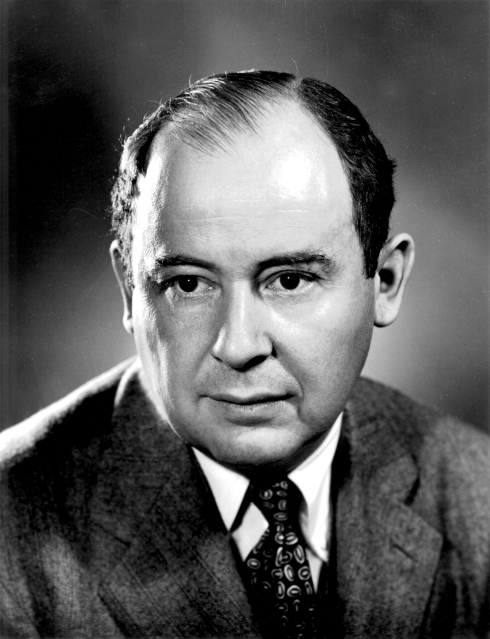
von Neumann Publishes Mathematical Foundations
John von Neumann provides a rigorous mathematical framework for quantum mechanics in his book 'Mathematical Foundations of Quantum Mechanics'. #physics #mathematics
von Neumann Publishes Mathematical Foundations By LANL - http://www.lanl.gov/history/atomicbomb/images/NeumannL.GIF (archive copy at the Wayback Machine), Attribution, https://commons.wikimedia.org/w/index.php?curid=3429594
1938 CE
Hahn and Strassmann Discover Nuclear Fission
Otto Hahn and Fritz Strassmann, with crucial contributions from Lise Meitner, demonstrate the splitting of uranium nuclei. #physics #discovery
Hahn and Strassmann Discover Nuclear Fission By Created by Fastfission in Illustrator. The SVG code is valid. This vector image was created with a text editor. Please do not replace the simplified code of this file with a version created with Inkscape or any other graphical vector graphics editor - Own work, Public domain, https://commons.wikimedia.org/w/index.php?curid=486924
1943 CE
Tomonaga Develops QED Renormalization
Sin-Itiro Tomonaga independently formulates a renormalization method for quantum electrodynamics, later awarded a Nobel Prize. #physics #quantum
Tomonaga Develops QED Renormalization By Nobel foundation - https://www.nobelprize.org/prizes/physics/1965/tomonaga/facts/, Public domain, https://commons.wikimedia.org/w/index.php?curid=6138962
1948 CE
Feynman Introduces Feynman Diagrams
Richard Feynman develops intuitive diagrams and a path-integral formulation for quantum electrodynamics, simplifying calculations. #physics #quantum
Feynman Introduces Feynman Diagrams By The Nobel Foundation - http://www.nobelprize.org/nobel_prizes/physics/laureates/1965/feynman-bio.html, PD-Sweden, https://en.wikipedia.org/w/index.php?curid=34664654
1949 CE
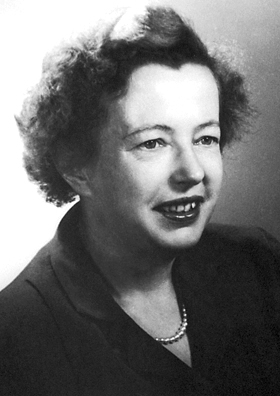
Goeppert-Mayer Proposes Nuclear Shell Model
Maria Goeppert-Mayer develops the nuclear shell model, explaining magic numbers and nuclear stability. #physics #nuclear
Goeppert-Mayer Proposes Nuclear Shell Model By Nobel foundation - http://nobelprize.org/nobel_prizes/physics/laureates/1963/mayer-autobio.html, Public domain, https://commons.wikimedia.org/w/index.php?curid=6140956
1957 CE
Everett Formulates Many-Worlds Interpretation
Hugh Everett III proposes the many-worlds interpretation, where quantum superpositions lead to branching parallel universes. #physics #quantum
Everett Formulates Many-Worlds Interpretation By Christian Schirm - Own work, based on File:ISO_7010_W003.svg and File:Skull_and_Crossbones.svg, inspired by File:MWI_Schrodingers_cat.png, CC0, https://commons.wikimedia.org/w/index.php?curid=17512691
1964 CE
Bell Derives Inequality for Local Hidden Variables
John Stewart Bell formulates Bell's inequality, providing a testable criterion distinguishing quantum mechanics from local realism. #physics #quantum
1982 CE
Aspect Performs Crucial Bell Test Experiments
Alain Aspect and colleagues conduct experiments confirming violation of Bell's inequality, supporting quantum entanglement. #physics #quantum
Aspect Performs Crucial Bell Test Experiments By Ecole polytechnique from Paris - PHYSIQUE QUANTIQUE : LES TRAVAUX D'ALAIN ASPECT, PROFESSEUR À L’X, COURONNÉS DU PRIX NOBEL 2022, CC BY-SA 2.0, https://commons.wikimedia.org/w/index.php?curid=126015843
1995 CE
First Bose-Einstein Condensate Created
Eric Cornell and Carl Wieman achieve the first Bose-Einstein condensate in a dilute gas of rubidium atoms, a new state of matter. #physics #quantum
First Bose-Einstein Condensate Created By Vectorized version by AG Caesar, original by DG85 - Inspired by a work from Wikipedia User DG85 https://commons.wikimedia.org/wiki/File:QuantumPhaseTransition.png, Public domain, https://commons.wikimedia.org/w/index.php?curid=67110336
2021 CE
Nobel Prize in Physics for Quantum Entanglement Experiments
The Nobel Prize in Physics jointly awarded to Alain Aspect, John F. Clauser, and Anton Zeilinger for experiments with entangled photons. #physics #nobel