Encyclopedia/1. The Cosmos & The Natural World/2. Physics & Chemistry/01. Quantum Physics & Atomic Theory • Curated by Admin Timeline.sg
From ancient atomic speculations to modern quantum computing, the history of quantum mechanics traces the development of wave functions, wave-particle duality, and quantum theory. Key milestones include Planck's quantization, the Schrödinger equation, and the discovery of entanglement.
Chronological Storyline (41 Milestones)
600 BCE
Indian Philosopher Kanada Proposes Atomism
Kanada, an ancient Indian philosopher, founded the Vaisheshika school which posited that all objects are composed of indivisible particles called paramanu (atoms). This atomic theory anticipated later concepts of quantized matter. #quantummechanics #history #indianphilosophy )
Indian Philosopher Kanada Proposes Atomism By Xaetherion - Own work, CC BY-SA 4.0, https://commons.wikimedia.org/w/index.php?curid=185658968
400 BCE
Democritus Develops Atomic Theory
The Greek philosopher Democritus proposed that all matter consists of tiny, indivisible particles called atoms, moving in the void. This foundational concept influenced later atomic and quantum theories. #quantummechanics #history
Democritus Develops Atomic Theory By user:shakko - Own work, CC BY-SA 3.0, https://commons.wikimedia.org/w/index.php?curid=5535206
1000 CE
Alhazen Publishes Book of Optics
The Islamic scientist Alhazen (Ibn al-Haytham) wrote the Book of Optics, which correctly theorized that light travels in straight lines and performed experiments with pinhole cameras. His work laid groundwork for wave optics. #optics #quantummechanics #islamicgoldenage
Alhazen Publishes Book of Optics By Ibn al-Haytham, Vitello, Friedrich Risner - University of Oklahoma History of Science Collections et BnF Gallica : http://gallica.bnf.fr/ark:/12148/bpt6k312873d.r=Haytham?rk=407727;2, Public domain, https://commons.wikimedia.org/w/index.php?curid=48189707
1704 CE
Isaac Newton Publishes Opticks
Newton's Opticks proposed that light consists of particles (corpuscles). This corpuscular theory was later challenged by wave theory, contributing to the wave-particle duality concept central to quantum mechanics. #physics #quantummechanics
Isaac Newton Publishes Opticks By Unknown author, Public domain, https://commons.wikimedia.org/w/index.php?curid=510265
1801 CE
Thomas Young Demonstrates Double-Slit Interference
In his double-slit experiment, Young showed that light exhibits interference patterns, supporting the wave theory of light. This experiment became a classic demonstration of wave-particle duality in quantum mechanics. #physics #quantummechanics
Thomas Young Demonstrates Double-Slit Interference By Original: NekoJaNekoJa Vector: Johannes Kalliauer - Own work based on: Double-slit.PNG:, CC BY-SA 4.0, https://commons.wikimedia.org/w/index.php?curid=61496401
1865 CE
James Clerk Maxwell Publishes Electromagnetic Theory
Maxwell formulated the classical theory of electromagnetic radiation, describing light as an electromagnetic wave. His equations set the stage for Einstein's later work on photons. #physics #quantummechanics
James Clerk Maxwell Publishes Electromagnetic Theory By Unknown author - https://www.researchgate.net/figure/James-Clerk-Maxwell-1831-1879_fig1_360164096, Public domain, https://commons.wikimedia.org/w/index.php?curid=129476608
1887 CE
Heinrich Hertz Discovers Photoelectric Effect
Hertz discovered the photoelectric effect, where light shining on a metal surface ejects electrons. This phenomenon could not be explained by classical wave theory, leading Einstein to propose light quanta. #physics #quantummechanics
Heinrich Hertz Discovers Photoelectric Effect By Ponor - Own work, CC BY-SA 4.0, https://commons.wikimedia.org/w/index.php?curid=92684859
Dec 14, 1900 CE
Max Planck Introduces Quantum of Action
To resolve the ultraviolet catastrophe in blackbody radiation, Planck proposed that energy is emitted in discrete packets (quanta) proportional to frequency. This marks the birth of quantum theory. #quantummechanics #physics
Max Planck Introduces Quantum of Action By Hugo Erfurth - This file was derived from: Max Planck by Hugo Erfurth 1938cr.jpg Original source: https://www.dhm.de/lemo/bestand/objekt/max-planck, Public domain, https://commons.wikimedia.org/w/index.php?curid=153625300
Mar 17, 1905 CE
Einstein Explains Photoelectric Effect with Light Quanta
Einstein's paper proposed that light consists of discrete energy packets (photons), explaining the photoelectric effect. This established the quantum nature of light and earned him a Nobel Prize. #quantummechanics #physics
Einstein Explains Photoelectric Effect with Light Quanta By Oren Jack Turner - This image is available from the United States Library of Congress's Prints and Photographs division under the digital ID cph.3b46036.This tag does not indicate the copyright status of the attached work. A normal copyright tag is still required. See Commons:Licensing., Public domain, https://commons.wikimedia.org/w/index.php?curid=6372844
1913 CE
Niels Bohr Proposes Quantized Atomic Model
Bohr introduced a model of the hydrogen atom with electron orbits corresponding to discrete energy levels. It successfully explained spectral lines and introduced quantum principles to atomic structure. #quantummechanics #physics
Niels Bohr Proposes Quantized Atomic Model By JabberWok at English Wikipedia - Transferred from en.wikipedia to Commons., CC BY-SA 3.0, https://commons.wikimedia.org/w/index.php?curid=2639910
1916 CE
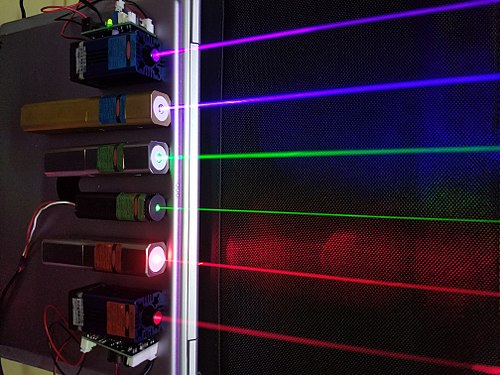
Einstein Predicts Stimulated Emission
Einstein theorized that electrons could be stimulated to emit photons of a specific frequency, laying the foundation for the laser. This concept is grounded in quantum theory. #quantummechanics #physics
Einstein Predicts Stimulated Emission By 彭嘉傑 - Own work, CC BY 2.5, https://commons.wikimedia.org/w/index.php?curid=60733412
1922 CE
Stern and Gerlach Perform Stern-Gerlach Experiment
The experiment demonstrated spatial quantization of angular momentum by passing silver atoms through a nonuniform magnetic field, confirming quantum properties of spin. #quantummechanics #physics
Stern and Gerlach Perform Stern-Gerlach Experiment By Tatoute - Own work, CC BY-SA 4.0, https://commons.wikimedia.org/w/index.php?curid=34095239
1924 CE
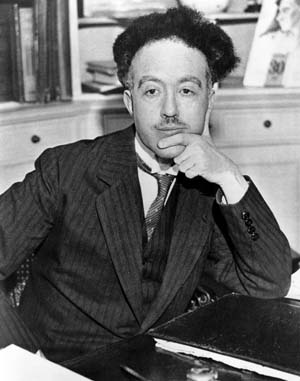
Louis de Broglie Proposes Matter Waves
In his PhD thesis, de Broglie suggested that particles like electrons have wave-like properties, with wavelength inversely proportional to momentum. This wave-particle duality became a cornerstone of quantum mechanics. #quantummechanics #physics
Louis de Broglie Proposes Matter Waves By Unknown author - https://www.physics.umd.edu/courses/Phys420/Spring2002/Parra_Spring2002/HTMPages/whoswho.htm, Public domain, https://commons.wikimedia.org/w/index.php?curid=622169
1924 CE
Satyendra Nath Bose Derives Planck's Law for Photons
Bose sent a paper to Einstein deriving Planck's law by treating photons as identical particles with specific statistical properties, leading to Bose-Einstein statistics. This work was crucial for quantum statistical mechanics. #quantummechanics #physics #indianscience
Satyendra Nath Bose Derives Planck's Law for Photons By Unknown author - Picture in Siliconeer, Public domain, https://commons.wikimedia.org/w/index.php?curid=2201891
Jul 29, 1925 CE
Heisenberg Develops Matrix Mechanics
Heisenberg formulated a new quantum theory based on matrices, avoiding unobservable orbital paths. This was the first complete formulation of quantum mechanics. #quantummechanics #physics
Oct 17, 1925 CE
Goudsmit and Uhlenbeck Discover Electron Spin
Goudsmit and Uhlenbeck proposed that electrons possess an intrinsic angular momentum called spin. This quantum property is essential for understanding atomic structure and magnetic behavior. #quantummechanics #physics
Jan 27, 1926 CE
Erwin Schrödinger Formulates Wave Equation
Schrödinger derived his famous wave equation, describing the quantum state of a particle as a wavefunction. It became the fundamental equation of non-relativistic quantum mechanics. #quantummechanics #physics
Jan 15, 1927 CE
Davisson and Germer Confirm Electron Diffraction
Davisson and Germer experimentally confirmed de Broglie's matter wave hypothesis by observing diffraction of electrons off a nickel crystal. This directly demonstrated wave-particle duality for electrons. #quantummechanics #physics
1927 CE
Bohr Introduces Complementarity Principle
Niels Bohr proposed that quantum systems exhibit complementary properties, such as wave and particle, which cannot be observed simultaneously. This idea resolved the wave-particle duality paradox. #quantummechanics #physics )
1927 CE
Heisenberg States Uncertainty Principle
Heisenberg's uncertainty principle states that the more precisely a particle's position is known, the less precisely its momentum can be known. This limit is inherent to quantum systems. #quantummechanics #physics
Heisenberg States Uncertainty Principle By Unknown author - This image was provided to Wikimedia Commons by the German Federal Archive (Deutsches Bundesarchiv) as part of a cooperation project. The German Federal Archive guarantees an authentic representation only using the originals (negative and/or positive), resp. the digitalization of the originals as provided by the Digital Image Archive., CC BY-SA 3.0 de, https://commons.wikimedia.org/w/index.php?curid=5436254
1928 CE
Paul Dirac Combines Quantum Mechanics and Relativity
Dirac derived a relativistic equation for the electron, which predicted the existence of antimatter (positron). The Dirac equation also explained electron spin naturally. #quantummechanics #physics
Nov 29, 1935 CE
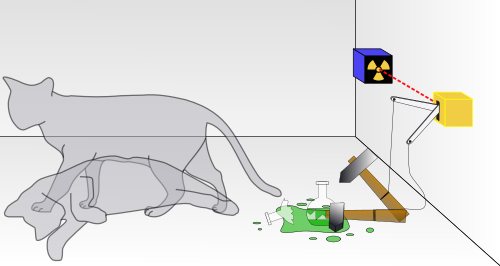
Schrödinger Proposes Cat-in-the-Box Thought Experiment
Schrödinger devised a scenario where a cat is both alive and dead until observed, illustrating the absurdity of quantum superposition applied to macroscopic objects. It became a landmark in quantum interpretation. #quantummechanics #physics
Schrödinger Proposes Cat-in-the-Box Thought Experiment By Dhatfield - Own work, CC BY-SA 3.0, https://commons.wikimedia.org/w/index.php?curid=4279886
1935 CE
Einstein, Podolsky, and Rosen Publish EPR Paradox
The EPR paper argued that quantum mechanics is incomplete because it allows 'spooky action at a distance'. This sparked debates on entanglement and local realism. #quantummechanics #physics
Einstein, Podolsky, and Rosen Publish EPR Paradox By Doris Ulmann - This image is available from the United States Library of Congress's Prints and Photographs division under the digital ID cph.3g04940.This tag does not indicate the copyright status of the attached work. A normal copyright tag is still required. See Commons:Licensing., Public domain, https://commons.wikimedia.org/w/index.php?curid=2468828
1935 CE
Hideki Yukawa Proposes Meson Theory of Nuclear Forces
Yukawa postulated a new particle (meson) as the carrier of the strong nuclear force, using quantum field theory. This was a major step toward understanding the strong interaction. #quantummechanics #physics #japan
Hideki Yukawa Proposes Meson Theory of Nuclear Forces By Nobel Foundation archive - nobelprize.org [1], Public domain, https://commons.wikimedia.org/w/index.php?curid=6182205
1947 CE
Lamb and Retherford Measure Lamb Shift
The Lamb shift is a small difference in energy levels of hydrogen explained by quantum electrodynamics (QED). This measurement spurred the development of QED. #quantummechanics #physics
Lamb and Retherford Measure Lamb Shift By Joel Holdsworth (Joelholdsworth) - Non-Derived SVG of Radiate gluon.png, originally the work of SilverStar at Feynmann-diagram-gluon-radiation.svg, updated by joelholdsworth., Public domain, https://commons.wikimedia.org/w/index.php?curid=1764161
1948 CE
Feynman, Schwinger, and Tomonaga Develop QED
Independently, Feynman, Schwinger, and Tomonaga formulated quantum electrodynamics, a relativistic quantum field theory of light and electrons. Feynman's path integral approach became widely used. #quantummechanics #physics
1949 CE
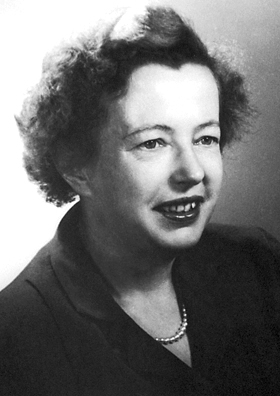
Maria Goeppert-Mayer Proposes Nuclear Shell Model
Goeppert-Mayer developed the nuclear shell model, describing the quantum structure of atomic nuclei with magic numbers. Her work earned her a Nobel Prize in 1963. #quantummechanics #physics #womeninscience
Maria Goeppert-Mayer Proposes Nuclear Shell Model By Nobel foundation - http://nobelprize.org/nobel_prizes/physics/laureates/1963/mayer-autobio.html, Public domain, https://commons.wikimedia.org/w/index.php?curid=6140956
1952 CE
David Bohm Develops Pilot-Wave Theory
Bohm proposed a deterministic interpretation of quantum mechanics with hidden variables, known as the de Broglie–Bohm theory. It is a nonlocal realistic alternative to Copenhagen interpretation. #quantummechanics #physics
1957 CE
Hugh Everett Proposes Many-Worlds Interpretation
Everett's relative state formulation (later many-worlds) suggests that all quantum possibilities are realized in distinct branching universes. This interpretation avoids wavefunction collapse. #quantummechanics #physics
Hugh Everett Proposes Many-Worlds Interpretation By Christian Schirm - Own work, based on File:ISO_7010_W003.svg and File:Skull_and_Crossbones.svg, inspired by File:MWI_Schrodingers_cat.png, CC0, https://commons.wikimedia.org/w/index.php?curid=17512691
Nov 4, 1964 CE
John Bell Publishes Bell's Theorem
Bell's theorem proves that any local hidden variable theory cannot reproduce all quantum mechanical predictions. It opened the door to experimental tests of quantum nonlocality. #quantummechanics #physics
1972 CE
First Experimental Bell Test by Clauser et al.
Clauser, Horne, Shimony, and Holt performed one of the first experiments testing Bell's inequalities, showing results consistent with quantum mechanics and ruling out local realism. #quantummechanics #physics
Aug 1, 1982 CE
Alain Aspect Performs Groundbreaking Bell Test
Aspect's experiment used time-varying analyzers to close the locality loophole, strongly confirming quantum mechanics and violating Bell inequalities. It solidified entanglement as a real phenomenon. #quantummechanics #physics
Alain Aspect Performs Groundbreaking Bell Test By Ecole polytechnique from Paris - PHYSIQUE QUANTIQUE : LES TRAVAUX D'ALAIN ASPECT, PROFESSEUR À L’X, COURONNÉS DU PRIX NOBEL 2022, CC BY-SA 2.0, https://commons.wikimedia.org/w/index.php?curid=126015843
1985 CE
David Deutsch Proposes Universal Quantum Computer
Deutsch described a quantum Turing machine, laying the theoretical foundation for quantum computing. He showed that quantum computers could solve certain problems faster than classical computers. #quantumcomputing #quantummechanics #physics
David Deutsch Proposes Universal Quantum Computer By Dev Jadiya - Own work, CC BY-SA 4.0, https://commons.wikimedia.org/w/index.php?curid=158261563
1993 CE
Bennett et al. Propose Quantum Teleportation
Bennett, Brassard, Crépeau, Jozsa, Peres, and Wootters described a protocol for teleporting a quantum state using entanglement. This theoretical breakthrough led to experimental realizations soon after. #quantummechanics #physics
Bennett et al. Propose Quantum Teleportation By JozumBjada - Own work, CC BY-SA 4.0, https://commons.wikimedia.org/w/index.php?curid=128460435
1995 CE
First Bose-Einstein Condensate Created
Using laser cooling and magnetic traps, Cornell, Wieman, and Ketterle achieved a new state of matter predicted by Bose and Einstein, where a dilute gas of atoms behaves as a single quantum entity. #quantummechanics #physics
First Bose-Einstein Condensate Created By Vectorized version by AG Caesar, original by DG85 - Inspired by a work from Wikipedia User DG85 https://commons.wikimedia.org/wiki/File:QuantumPhaseTransition.png, Public domain, https://commons.wikimedia.org/w/index.php?curid=67110336
1997 CE
Zeilinger and Colleagues Demonstrate Photon Teleportation
Using entangled photons, Zeilinger's group successfully teleported the quantum state of a photon over a short distance. This was a landmark experiment in quantum information. #quantummechanics #physics
2000 CE
Peter Shor Develops Factoring Algorithm for Quantum Computers
Shor's algorithm demonstrated that a quantum computer could factor large numbers exponentially faster than classical computers, posing a threat to RSA encryption. It spurred investment in quantum computing. #quantumcomputing #quantummechanics
2004 CE
First Quantum Cryptography Network Setup
A quantum key distribution network was demonstrated using entangled photons, enabling secure communication based on quantum principles. This advanced the field of quantum information. #quantummechanics #cryptography
2012 CE
Higgs Boson Discovered at CERN
The ATLAS and CMS experiments at the Large Hadron Collider observed the Higgs boson, confirming the mechanism that gives mass to elementary particles in the Standard Model of quantum field theory. #particlephysics #quantummechanics
Higgs Boson Discovered at CERN By CERN for the ATLAS and CMS Collaborations - https://cds.cern.ch/record/1630222, CC BY-SA 3.0, https://commons.wikimedia.org/w/index.php?curid=29737816
2019 CE
Google Claims Quantum Supremacy
Google's Sycamore processor performed a computation in 200 seconds that would take a classical supercomputer thousands of years, claiming the first demonstration of quantum supremacy. #quantumcomputing #quantummechanics
Oct 4, 2022 CE
Nobel Prize Awarded for Quantum Entanglement Experiments
The Nobel Prize in Physics was awarded to Alain Aspect, John Clauser, and Anton Zeilinger for their groundbreaking experiments with entangled photons, establishing quantum information science. #quantummechanics #physics