Quantum Field Theory & Electrodynamics: Major Case Studies & Paradigm Shifts
Encyclopedia/1. The Cosmos & The Natural World/2. Physics & Chemistry/01. Quantum Physics & Atomic Theory • Curated by Admin Timeline.sg
This timeline covers major case studies and paradigm shifts in Quantum Field Theory (QFT) and Quantum Electrodynamics (QED), from ancient observations of electricity to the modern Standard Model of particle physics. It includes contributions from scientists across the globe, highlighting key theoretical breakthroughs and experimental confirmations.
Chronological Storyline (42 Milestones)
600 BCE
Thales of Miletus notes amber static electricity
Thales records that rubbing amber attracts light objects, one of the earliest recorded studies of electricity. #physics #ancient
Thales of Miletus notes amber static electricity By Wilhelm Meyer - own scan, Public domain, https://commons.wikimedia.org/w/index.php?curid=11037570
1088 CE
Shen Kuo describes magnetic compass
Chinese polymath Shen Kuo writes about the magnetic needle compass, contributing to the understanding of magnetism. #chinesescience #magnetism
Shen Kuo describes magnetic compass By Hans A. Rosbach - Own work, CC BY-SA 3.0, https://commons.wikimedia.org/w/index.php?curid=89508454
1600 CE
William Gilbert publishes De Magnete
Gilbert coins the term 'electric' and systematically studies magnetism and static electricity. #physics #renaissance
1745 CE
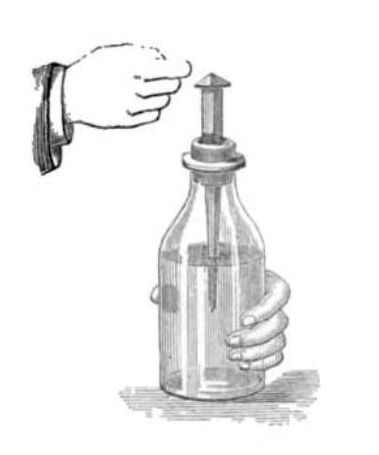
Invention of the Leyden jar
Pieter van Musschenbroek and Ewald Georg von Kleist independently create the Leyden jar, the first capacitor. #electricity #invention
Invention of the Leyden jar By W. Jerome Harrison - Downloaded 2010-07-18 from W. Jerome Harrison and Charles A. White (1898) Magnetism and Electricity, 5th Ed., Blackie and Son, UK, p. 107, fig. 64 on Google Books, Public domain, https://commons.wikimedia.org/w/index.php?curid=10942385
Jun 15, 1752 CE
Franklin's kite experiment
Benjamin Franklin proves lightning is electrical, demonstrating the link between static electricity and atmospheric phenomena. #electricity #experiment
Franklin's kite experiment By Joseph-Siffred Duplessis - ZgEyj5EEKdux-g at Google Cultural Institute maximum zoom level, Public domain, https://commons.wikimedia.org/w/index.php?curid=21880454
Apr 1, 1820 CE
Ørsted discovers electromagnetism
Hans Christian Ørsted observes that a current-carrying wire deflects a compass needle, establishing the link between electricity and magnetism. #electromagnetism #discovery
Ørsted discovers electromagnetism By Christian Albrecht Jensen - http://collection.smk.dk/#/en/detail/KMS8176, Public domain, https://commons.wikimedia.org/w/index.php?curid=66359596
1831 CE
Faraday discovers electromagnetic induction
Michael Faraday demonstrates that a changing magnetic field induces an electric current, laying the foundation for dynamos and transformers. #physics #induction
Faraday discovers electromagnetic induction By Unknown author - [1], Public domain, https://commons.wikimedia.org/w/index.php?curid=141504840
1865 CE
Maxwell publishes electromagnetic theory
James Clerk Maxwell presents a unified theory of electricity and magnetism, predicting electromagnetic waves. #maxwell #electromagnetism
1887 CE
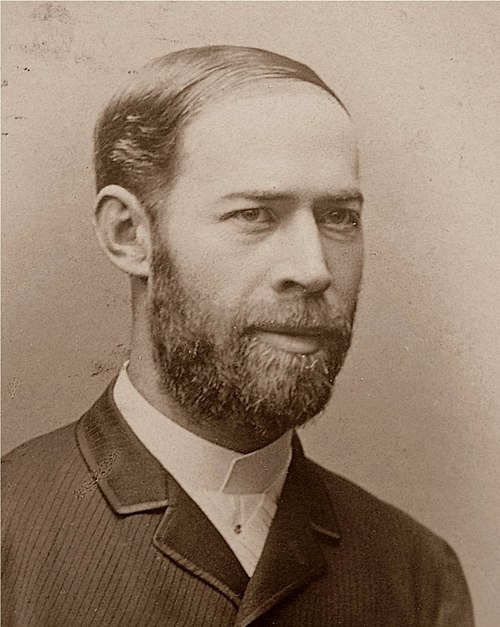
Hertz confirms electromagnetic waves
Heinrich Hertz experimentally generates and detects radio waves, confirming Maxwell's theory. #experiment #radiowaves
Hertz confirms electromagnetic waves By Robert Krewaldt, Kaiserplatz 16, Bonn - Cabinetphotograph, Kabinettfotografie, Public domain, https://commons.wikimedia.org/w/index.php?curid=26781773
Dec 14, 1900 CE
Planck introduces the quantum
Max Planck proposes the quantization of energy to explain blackbody radiation, marking the birth of quantum theory. #quantum #planck
Planck introduces the quantum By Hugo Erfurth - This file was derived from: Max Planck by Hugo Erfurth 1938cr.jpg Original source: https://www.dhm.de/lemo/bestand/objekt/max-planck, Public domain, https://commons.wikimedia.org/w/index.php?curid=153625300
1905 CE
Einstein explains photoelectric effect
Albert Einstein proposes that light consists of quanta (photons), explaining the photoelectric effect and establishing the particle nature of light. #photons #einstein
Einstein explains photoelectric effect By Ponor - Own work, CC BY-SA 4.0, https://commons.wikimedia.org/w/index.php?curid=92684859
1911 CE
Rutherford proposes nuclear atom
Ernest Rutherford deduces the existence of a small, dense atomic nucleus from gold foil experiments. #atomicphysics #rutherford
1913 CE
Bohr model of the atom
Niels Bohr introduces quantized electron orbits, explaining hydrogen spectral lines and advancing quantum theory. #atomicmodel #bohr
Bohr model of the atom By JabberWok at English Wikipedia - Transferred from en.wikipedia to Commons., CC BY-SA 3.0, https://commons.wikimedia.org/w/index.php?curid=2639910
1924 CE
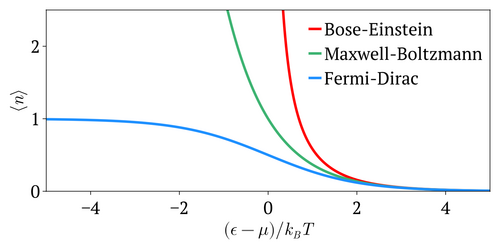
Bose sends paper on photon statistics
Satyendra Nath Bose derives Planck's law by treating photons as indistinguishable particles, leading to Bose-Einstein statistics. #quantum #statistics
Bose sends paper on photon statistics By Ashton Bradley Aspir8 (talk) - Own work based on: Fermi-Dirac Bose-Einstein Maxwell-Boltzmann statistics.svg, CC0, https://commons.wikimedia.org/w/index.php?curid=149697440
1925 CE
Heisenberg develops matrix mechanics
Werner Heisenberg, Max Born, and Pascual Jordan formulate matrix mechanics, the first complete quantum theory. #quantummechanics #heisenberg
1926 CE
Schrödinger equation published
Erwin Schrödinger introduces wave mechanics with his wave equation, providing a powerful tool for quantum physics. #waveequation #schrodinger
1927 CE
Heisenberg's uncertainty principle
Werner Heisenberg formulates the uncertainty principle, a fundamental concept in quantum mechanics. #uncertainty #quantum
Heisenberg's uncertainty principle By Unknown author - This image was provided to Wikimedia Commons by the German Federal Archive (Deutsches Bundesarchiv) as part of a cooperation project. The German Federal Archive guarantees an authentic representation only using the originals (negative and/or positive), resp. the digitalization of the originals as provided by the Digital Image Archive., CC BY-SA 3.0 de, https://commons.wikimedia.org/w/index.php?curid=5436254
1927 CE
Dirac attempts quantization of EM field
Paul Dirac publishes first attempt to quantize the electromagnetic field, laying groundwork for QED. #qed #dirac
Dirac attempts quantization of EM field By Joel Holdsworth (Joelholdsworth) - Non-Derived SVG of Radiate gluon.png, originally the work of SilverStar at Feynmann-diagram-gluon-radiation.svg, updated by joelholdsworth., Public domain, https://commons.wikimedia.org/w/index.php?curid=1764161
1928 CE
Dirac equation for the electron
Paul Dirac formulates a relativistic equation for the electron, predicting antimatter. #dirac #relativisticquantummechanics
1932 CE
Anderson discovers positron
Carl D. Anderson discovers the positron, confirming Dirac's prediction of antimatter. #antimatter #positron
Anderson discovers positron By Carl D. Anderson (1905–1991) - Anderson, Carl D. (1933). "The Positive Electron". Physical Review 43 (6): 491–494. DOI:10.1103/PhysRev.43.491., Public domain, https://commons.wikimedia.org/w/index.php?curid=93111759
1934 CE
Yukawa proposes meson theory
Hideki Yukawa postulates the existence of mesons to explain the strong nuclear force, a key step toward quantum field theory of strong interactions. #yukawa #meson
Yukawa proposes meson theory By Nobel Foundation archive - nobelprize.org [1], Public domain, https://commons.wikimedia.org/w/index.php?curid=6182205
1943 CE
Tomonaga begins relativistic QED work
Sin-Itiro Tomonaga starts developing a relativistic formulation of QED, independent of Western researchers. #japanese #qed
Tomonaga begins relativistic QED work By Nobel foundation - https://www.nobelprize.org/prizes/physics/1965/tomonaga/facts/, Public domain, https://commons.wikimedia.org/w/index.php?curid=6138962
1947 CE
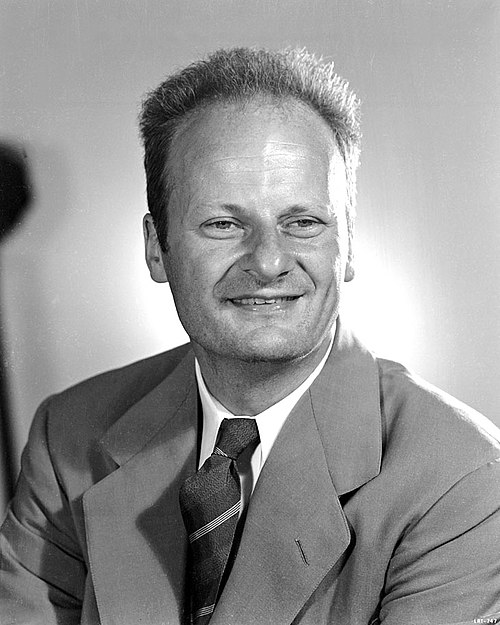
Bethe calculates Lamb shift non-relativistically
Hans Bethe provides a non-relativistic calculation of the Lamb shift, glimpsing the effects of quantum electrodynamics. #bethe #qed
Bethe calculates Lamb shift non-relativistically By Los Alamos National Laboratory, Attribution, https://commons.wikimedia.org/w/index.php?curid=71763
1947 CE
Lamb shift discovered
Willis Lamb and Robert Retherford measure a small energy shift in hydrogen, prompting the need for accurate QED calculations. #lambshift #qed
1948 CE
Casimir effect predicted
Hendrik Casimir predicts an attractive force between conducting plates due to vacuum fluctuations, a key QED phenomenon. #casimir #qed
Casimir effect predicted By Emok - Own work, CC BY-SA 3.0, https://commons.wikimedia.org/w/index.php?curid=4275811
1948 CE
Feynman introduces Feynman diagrams
Richard Feynman devises a graphical method to visualize and calculate interactions in QED, revolutionizing particle physics. #feynman #diagrams
1949 CE
Dyson unifies QED approaches
Freeman Dyson proves the equivalence of Feynman, Schwinger, and Tomonaga's formulations of QED. #qed #dyson
Dyson unifies QED approaches By ioerror - Flickr, CC BY-SA 2.0, https://commons.wikimedia.org/w/index.php?curid=71877726
1954 CE
Yang-Mills theory introduced
Chen Ning Yang and Robert Mills generalize gauge theory to non-Abelian groups, essential for the Standard Model. #yangmills #gaugetheory
1956 CE
Sakata model proposed
Shoichi Sakata proposes a composite model for hadrons, an early step toward the quark model. #sakata #hadrons
Sakata model proposed By 朝日新聞社 - 『アサヒグラフ』 1949年5月4日号, Public domain, https://commons.wikimedia.org/w/index.php?curid=34767661
1961 CE
Glashow-Weinberg-Salam electroweak unification
Sheldon Glashow, Steven Weinberg, and Abdus Salam independently develop a unified theory of electromagnetic and weak forces. #electroweak #standardmodel
Glashow-Weinberg-Salam electroweak unification By Cush - Own work using: PBS NOVA [1], Fermilab, Office of Science, United States Department of Energy, Particle Data Group, Public domain, https://commons.wikimedia.org/w/index.php?curid=4286964
1964 CE
Quark model introduced
Murray Gell-Mann and George Zweig independently propose quarks as fundamental constituents of hadrons. #quarks #hadrons
Quark model introduced By Vectorization: Alhadis - Own work based on: 8foldway.png by Bambaiah at English Wikipedia, CC BY-SA 3.0, https://commons.wikimedia.org/w/index.php?curid=125051765
1964 CE
Higgs mechanism proposed
Robert Brout, François Englert, and Peter Higgs propose a mechanism for mass generation via spontaneous symmetry breaking. #higgs #boson
1971 CE
't Hooft proves renormalizability of Yang-Mills
Gerard 't Hooft demonstrates that non-Abelian gauge theories are renormalizable, legitimizing electroweak theory. #renormalization #gaugetheory
't Hooft proves renormalizability of Yang-Mills By Wammes Waggel - Own work, CC BY-SA 3.0, https://commons.wikimedia.org/w/index.php?curid=5175482
1973 CE
Neutral currents discovered
The Gargamelle bubble chamber experiment at CERN detects neutral currents, confirming electroweak theory. #neutralcurrents #cern
1973 CE
Asymptotic freedom explained
David Gross, Frank Wilczek, and David Politzer discover asymptotic freedom in QCD, predicting that quarks interact more weakly at high energies. #qcd #asymptoticfreedom
Nov 11, 1974 CE
J/ψ particle discovered
The J/ψ meson, containing charm quarks, is simultaneously discovered at SLAC and Brookhaven, confirming the charm quark. #charm #qcd
J/ψ particle discovered By https://commons.wikimedia.org/wiki/User:Harp - File:Quark_structure_pion.svg, CC BY-SA 4.0, https://commons.wikimedia.org/w/index.php?curid=46504895
Aug 1, 1979 CE
Gluon observed at DESY
The TASSO experiment at DESY finds evidence of gluons in three-jet events, confirming gluons as carriers of strong force. #gluon #qcd
1980 CE
Formulation of superstring theory
Michael Green and John Schwarz develop superstring theory, proposing that fundamental particles are one-dimensional strings. #stringtheory #qft
Mar 2, 1995 CE
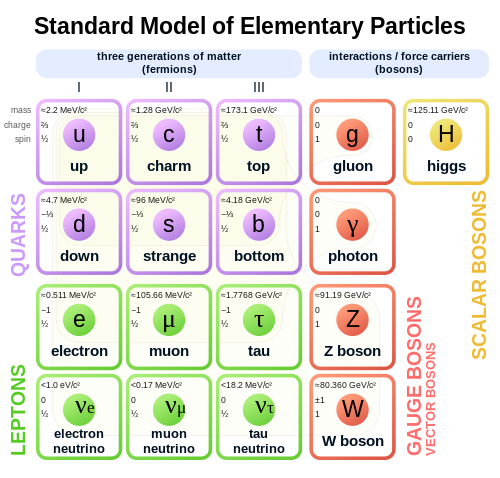
Top quark discovered at Fermilab
The CDF and DØ experiments at Fermilab announce the discovery of the top quark, completing the quark family. #topquark #standardmodel
Top quark discovered at Fermilab By user:MissMJ - File:Standard Model of Elementary Particles.svg, CC BY 3.0, https://commons.wikimedia.org/w/index.php?curid=24657343
Jul 21, 2000 CE
Tau neutrino detected
The DONUT experiment at Fermilab announces direct detection of the tau neutrino, completing the lepton family. #neutrino #standardmodel
Tau neutrino detected By user:MissMJ - File:Standard Model of Elementary Particles.svg, CC BY 3.0, https://commons.wikimedia.org/w/index.php?curid=24692631
Jul 4, 2012 CE
Higgs boson discovered at CERN
ATLAS and CMS experiments at the LHC announce a new particle consistent with the Higgs boson, validating the Standard Model's mass generation mechanism. #higgs #cern
Higgs boson discovered at CERN By CERN for the ATLAS and CMS Collaborations - https://cds.cern.ch/record/1630222, CC BY-SA 3.0, https://commons.wikimedia.org/w/index.php?curid=29737816
Oct 8, 2013 CE
Nobel Prize for Higgs and Englert
The Nobel Prize in Physics is awarded to François Englert and Peter Higgs for the theoretical discovery of the Higgs mechanism. #nobel #higgs
Nobel Prize for Higgs and Englert By Design of the medal: The Nobel Foundation. Sculptor and engraver: Erik Lindberg (1902). - Source of this work Photographer: David Monniaux (2005, 2006, 2007) Edited by: hidro 21:17, 28 July 2008 (UTC) Design of the medal: The Nobel Foundation. Sculptor and engraver: Erik Lindberg (1902)., Cc-by-sa-3.0, https://en.wikipedia.org/w/index.php?curid=18622921