Encyclopedia/1. The Cosmos & The Natural World/2. Physics & Chemistry/01. Quantum Physics & Atomic Theory • Curated by Admin Timeline.sg
This timeline traces the seminal contributions, inventions, and lasting legacies of leading figures in Quantum Entanglement & Information, from early philosophical underpinnings to modern quantum technologies and Nobel-recognized experiments.
Chronological Storyline (35 Milestones)
1900 CE
Planck Introduces the Quantum Hypothesis
Max Planck proposes that energy is quantized, laying the foundation for quantum theory. This revolutionary idea later enables the development of quantum information science. #physics #quantum
Planck Introduces the Quantum Hypothesis By Hugo Erfurth - This file was derived from: Max Planck by Hugo Erfurth 1938cr.jpg Original source: https://www.dhm.de/lemo/bestand/objekt/max-planck, Public domain, https://commons.wikimedia.org/w/index.php?curid=153625300
1905 CE
Einstein's Photoelectric Effect
Albert Einstein explains the photoelectric effect by proposing light quanta (photons), confirming the quantum nature of light. This work earns him the Nobel Prize and influences later concepts of quantum entanglement. #physics #quantum
Einstein's Photoelectric Effect By Ponor - Own work, CC BY-SA 4.0, https://commons.wikimedia.org/w/index.php?curid=92684859
1925 CE
Heisenberg Formulates Matrix Mechanics
Werner Heisenberg develops matrix mechanics, the first complete formulation of quantum mechanics. This mathematical framework introduces the non-commutative nature of observables, crucial for quantum information theory. #physics #quantum
1926 CE
Schrödinger's Wave Equation
Erwin Schrödinger publishes his wave equation, providing a differential equation for quantum state evolution. This formalism becomes a cornerstone of quantum mechanics and quantum information processing. #physics #quantum
1927 CE
Bohr's Complementarity Principle
Niels Bohr introduces complementarity, asserting that quantum systems exhibit dual wave-particle nature. This philosophical concept shapes interpretations of entanglement and measurement. #physics #quantum
1927 CE
Heisenberg's Uncertainty Principle
Heisenberg proposes the uncertainty principle, stating that certain pairs of complementary variables cannot both be measured precisely. This principle underpins limitations and possibilities in quantum cryptography. #physics #quantum
Heisenberg's Uncertainty Principle By Unknown author - This image was provided to Wikimedia Commons by the German Federal Archive (Deutsches Bundesarchiv) as part of a cooperation project. The German Federal Archive guarantees an authentic representation only using the originals (negative and/or positive), resp. the digitalization of the originals as provided by the Digital Image Archive., CC BY-SA 3.0 de, https://commons.wikimedia.org/w/index.php?curid=5436254
1935 CE
Einstein-Podolsky-Rosen (EPR) Paradox
Einstein, Podolsky, and Rosen argue that quantum mechanics is incomplete, describing what later becomes known as entanglement. The EPR paradox challenges locality and sparks decades of foundational research. #physics #quantum
Einstein-Podolsky-Rosen (EPR) Paradox By Doris Ulmann - This image is available from the United States Library of Congress's Prints and Photographs division under the digital ID cph.3g04940.This tag does not indicate the copyright status of the attached work. A normal copyright tag is still required. See Commons:Licensing., Public domain, https://commons.wikimedia.org/w/index.php?curid=2468828
1935 CE
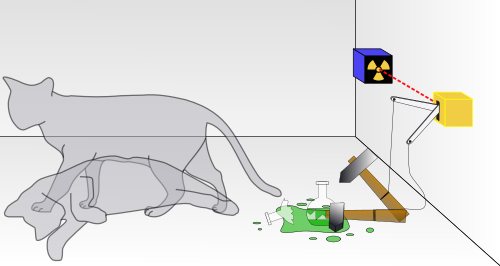
Schrödinger's Cat and Entanglement Term
Erwin Schrödinger coins the term 'entanglement' and illustrates quantum weirdness with the cat paradox. His thought experiment highlights the counterintuitive nature of superposition and correlation. #physics #quantum
Schrödinger's Cat and Entanglement Term By Dhatfield - Own work, CC BY-SA 3.0, https://commons.wikimedia.org/w/index.php?curid=4279886
1952 CE
Bohm's Hidden Variables Theory
David Bohm develops a deterministic hidden-variables interpretation of quantum mechanics. His work revives interest in the foundations of quantum theory and influences later tests of local realism. #physics #quantum
1964 CE
Bell's Theorem
John Bell proves that no local hidden-variable theory can reproduce all quantum predictions. Bell's inequality provides an experimental test for entanglement, revolutionizing quantum foundations. #physics #quantum
1969 CE
CHSH Inequality Formulation
Clauser, Horne, Shimony, and Holt develop a simplified Bell-type inequality (CHSH) amenable to laboratory testing. This breakthrough enables experimental verification of quantum nonlocality. #physics #quantum
1972 CE
First Bell Test: Clauser-Freedman Experiment
John Clauser and Stuart Freedman perform the first experimental test of Bell's inequalities, showing agreement with quantum mechanics. This pioneer work provides early evidence against local realism. #physics #experiment
First Bell Test: Clauser-Freedman Experiment By Christopher Michel - Own work, CC BY 4.0, https://commons.wikimedia.org/w/index.php?curid=150810012
1981 CE
Aspect's Bell Tests
Alain Aspect leads experiments closing loopholes in Bell tests, providing strong confirmation of quantum entanglement. His work cements the reality of nonlocality and influences quantum information science. #physics #quantum
Aspect's Bell Tests By Ecole polytechnique Université Paris-Saclay - Mooc optique quantique, CC BY-SA 2.0, https://commons.wikimedia.org/w/index.php?curid=123730100
1982 CE
Feynman Proposes Quantum Computing
Richard Feynman suggests that quantum systems could simulate physics more efficiently than classical computers. This foundational idea inspires the field of quantum computing and information. #physics #computing
Feynman Proposes Quantum Computing By The Nobel Foundation - http://www.nobelprize.org/nobel_prizes/physics/laureates/1965/feynman-bio.html, PD-Sweden, https://en.wikipedia.org/w/index.php?curid=34664654
1984 CE
BB84 Quantum Key Distribution Protocol
Charles Bennett and Gilles Brassard devise the first quantum cryptography protocol, BB84, using single photons to securely distribute encryption keys. This is a landmark in quantum communication. #cryptography #quantum
1985 CE
Deutsch's Quantum Turing Machine
David Deutsch formulates the quantum Turing machine, establishing the theoretical foundation for universal quantum computation. His work formalizes the idea of a quantum computer. #computing #quantum
1989 CE
GHZ State Discovery
Greenberger, Horne, and Zeilinger introduce the GHZ state, a multipartite entangled state that reveals nonlocality without statistical inequalities. This concept advances understanding of multiparty entanglement. #physics #quantum
GHZ State Discovery By Omnissiahs hierophant - LaTeX qcircuit script, CC-BY-SA-4.0, https://en.wikipedia.org/w/index.php?curid=62700834
1991 CE
Ekert's E91 QKD Protocol
Artur Ekert proposes a quantum key distribution protocol (E91) based on entangled pairs and Bell's theorem. This protocol links security directly to quantum nonlocality. #cryptography #quantum
1993 CE
Quantum Teleportation Proposed
Charles Bennett, Gilles Brassard, and others publish the theoretical proposal for quantum teleportation, using entanglement to transfer quantum states. This becomes a core technique in quantum information. #physics #quantum
Quantum Teleportation Proposed By JozumBjada - Own work, CC BY-SA 4.0, https://commons.wikimedia.org/w/index.php?curid=128460435
1994 CE
Shor's Algorithm for Factoring
Peter Shor develops an efficient quantum algorithm for integer factorization, threatening RSA cryptography. This breakthrough spurs intense interest in quantum computing. #computation #quantum
1995 CE
Quantum Error Correction Codes
Shor and Steane independently discover quantum error correction, enabling fault-tolerant quantum computing. This development overcomes the decoherence barrier for practical quantum computers. #computing #physics
1996 CE
Grover's Search Algorithm
Lov Grover invents a quantum algorithm for unstructured search with quadratic speedup. This algorithm demonstrates quantum advantage for a wide class of problems. #computation #quantum
1997 CE
First Experimental Quantum Teleportation
Anton Zeilinger's group in Innsbruck achieves the first experimental quantum teleportation of a photon. This milestone proves the feasibility of entanglement-based information transfer. #experiment #quantum
First Experimental Quantum Teleportation By CEU / Daniel Vegel; Central European University from Budapest, Hungary - Anton Zeilinger, President of the Austrian Academy of Sciences making a speech at the Inauguration of the Central European University Vienna Campus on November 15, 2019 in Expedithalle, Vienna., CC BY 2.0, https://commons.wikimedia.org/w/index.php?curid=162422091
1998 CE
First Quantum Cryptography Demonstration
The Zeilinger group performs the first experimental demonstration of quantum cryptography over a short distance. This work paves the way for commercial quantum key distribution. #cryptography #experiment
1999 CE
Cirac-Zoller Proposal for Ion Trap Quantum Computing
Ignacio Cirac and Peter Zoller propose a scheme for quantum computing using trapped ions. This blueprint leads to the first implementations of small-scale quantum processors. #computing #physics
2004 CE
First Quantum Entanglement in Quantum Dots
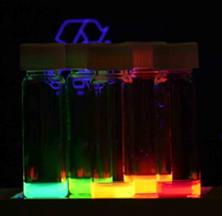
Researchers demonstrate entanglement in semiconductor quantum dots, enabling solid-state quantum information processing. This advance expands platforms for quantum technologies. #physics #quantum
First Quantum Entanglement in Quantum Dots By Walkman16 - Own work, CC BY-SA 3.0, https://commons.wikimedia.org/w/index.php?curid=15266942
2007 CE
Entanglement Distribution Over 144 km
The Zeilinger group entangles photons over 144 km between La Palma and Tenerife, setting a distance record. This achievement demonstrates feasibility for satellite-based quantum communication. #experiment #quantum
2015 CE
Loophole-Free Bell Test
Three independent groups simultaneously perform loophole-free Bell tests, closing all major loopholes. This conclusive evidence of nonlocality earns the 2022 Nobel Prize for Aspect, Clauser, and Zeilinger. #physics #experiment
2016 CE
Micius Quantum Satellite Launch
China launches the Micius satellite, enabling quantum key distribution between space and ground. This marks the dawn of global quantum communication networks. #space #technology
2017 CE
Quantum Internet Demonstration
Researchers demonstrate a rudimentary quantum network with entanglement swapping and teleportation. This proof-of-principle shows the potential for a future quantum internet. #technology #quantum
Quantum Internet Demonstration By Evacreateva Eva Fessler / University of Innsbruck - Own work, CC BY-SA 4.0, https://commons.wikimedia.org/w/index.php?curid=192003492
2019 CE
Google Sycamore Achieves Quantum Supremacy
Google's Sycamore processor performs a computation in 200 seconds deemed infeasible for classical supercomputers. This milestone marks the first demonstration of quantum supremacy. #computing #milestone
Google Sycamore Achieves Quantum Supremacy By Coldupnorth - Own work, CC BY-SA 4.0, https://commons.wikimedia.org/w/index.php?curid=183423536
2020 CE
Chinese Quantum Supremacy with Jiuzhang
A Chinese team achieves quantum supremacy using a photonic quantum computer (Jiuzhang) that solves a sampling problem in minutes versus classical billions of years. #computing #milestone
Oct 4, 2022 CE
Nobel Prize in Physics for Entanglement
Alain Aspect, John Clauser, and Anton Zeilinger receive the Nobel Prize in Physics for their foundational work on quantum entanglement and Bell tests. This honor recognizes the long quest to understand quantum nonlocality. #physics #award
2023 CE
Quantum Error Correction with Logical Qubits
Research groups demonstrate error correction with logical qubits exceeding the break-even point, a critical step toward fault-tolerant quantum computation. #computing #quantum
2024 CE
Chicago Quantum Network Launch
A metropolitan-scale quantum network begins operation in Chicago, enabling entanglement distribution among multiple nodes. This testbed advances real-world quantum communication infrastructure. #technology #quantum