Encyclopedia/1. The Cosmos & The Natural World/2. Physics & Chemistry/10. Foundational & General Physics • Curated by Admin Timeline.sg
Quantum Electrodynamics (QED) is the quantum field theory describing the interaction between light and matter. Epoch 2 covers the development from Dirac's equation to the renormalization breakthroughs of the 1940s-50s, culminating in Feynman, Schwinger, and Tomonaga's Nobel-winning work.
Chronological Storyline (51 Milestones)
1927 CE
Dirac's Quantum Theory of Radiation
Paul Dirac publishes a paper on the quantum theory of radiation, introducing the concept of second quantization and laying the foundation for quantum field theory. This work marks the beginning of QED. #QED #physics #quantum
Dirac's Quantum Theory of Radiation By Joel Holdsworth (Joelholdsworth) - Non-Derived SVG of Radiate gluon.png, originally the work of SilverStar at Feynmann-diagram-gluon-radiation.svg, updated by joelholdsworth., Public domain, https://commons.wikimedia.org/w/index.php?curid=1764161
1928 CE
Dirac Equation
Paul Dirac formulates the Dirac equation, a relativistic wave equation for electrons that predicts the existence of antimatter. This equation is a cornerstone of QED. #QED #physics #antimatter
1930 CE
Heisenberg and Pauli's Quantum Field Theory
Werner Heisenberg and Wolfgang Pauli develop a general framework for quantum field theory, including the quantization of fields. This work formalizes the mathematical structure of QED. #QED #physics #quantum
1932 CE
Discovery of the Positron
Carl Anderson discovers the positron, the antimatter counterpart of the electron, confirming Dirac's prediction. This discovery validates the Dirac equation and QED. #QED #physics #antimatter
Discovery of the Positron By Carl D. Anderson (1905–1991) - Anderson, Carl D. (1933). "The Positive Electron". Physical Review 43 (6): 491–494. DOI:10.1103/PhysRev.43.491., Public domain, https://commons.wikimedia.org/w/index.php?curid=93111759
1934 CE
Fermi's Theory of Beta Decay
Enrico Fermi proposes a theory of beta decay using a four-fermion interaction, introducing the concept of the weak force. This work influences the development of quantum field theories. #QED #physics #weakforce
Fermi's Theory of Beta Decay By Inductiveload - Own work, Public domain, https://commons.wikimedia.org/w/index.php?curid=2859203
1935 CE
Yukawa's Meson Theory
Hideki Yukawa proposes the meson theory to explain the strong nuclear force, predicting the existence of pions. This extends quantum field theory to nuclear interactions. #QED #physics #strongforce
1936 CE
Klein-Nishina Formula
Oskar Klein and Yoshio Nishina derive the cross-section for Compton scattering using Dirac's relativistic theory. This formula is a key prediction of QED. #QED #physics #scattering
Klein-Nishina Formula By Д.Ильин: vectorization - File:Klein-Nishina distribution.png by Dscraggs, CC0, https://commons.wikimedia.org/w/index.php?curid=137343299
1937 CE
Lamb Shift Predicted
Hans Bethe and others predict the Lamb shift, a small energy difference between the 2S and 2P levels of hydrogen, due to vacuum fluctuations. This effect cannot be explained by Dirac's equation alone. #QED #physics #hydrogen
1938 CE
Weisskopf's Self-Energy Calculation
Victor Weisskopf calculates the self-energy of the electron in QED, encountering infinities. This highlights the need for renormalization. #QED #physics #renormalization
1939 CE
Heisenberg's S-Matrix Theory
Werner Heisenberg introduces the S-matrix formalism, focusing on observable scattering amplitudes. This approach avoids some infinities and influences later QED developments. #QED #physics #scattering
1940 CE
Pauli's Spin-Statistics Theorem
Wolfgang Pauli proves the spin-statistics theorem, showing that particles with half-integer spin are fermions and those with integer spin are bosons. This is fundamental to QED. #QED #physics #quantum
1941 CE
Stueckelberg's Covariant Perturbation Theory
Ernst Stueckelberg develops a covariant perturbation theory for QED, anticipating Feynman diagrams. His work is not widely recognized at the time. #QED #physics #perturbation
1942 CE
Tomonaga's Super-Many-Time Theory
Sin-Itiro Tomonaga develops a relativistic quantum field theory using a 'super-many-time' formalism, independently achieving a covariant formulation of QED. #QED #physics #japan
Tomonaga's Super-Many-Time Theory By Nobel foundation - https://www.nobelprize.org/prizes/physics/1965/tomonaga/facts/, Public domain, https://commons.wikimedia.org/w/index.php?curid=6138962
1943 CE
Kramers' Renormalization Idea
Hendrik Kramers suggests that infinities in QED can be absorbed into redefinitions of mass and charge. This is a precursor to renormalization. #QED #physics #infinities
1944 CE
Bethe's Lamb Shift Calculation
Hans Bethe performs the first non-relativistic calculation of the Lamb shift using renormalization ideas, achieving good agreement with experiment. This sparks renewed interest in QED. #QED #physics #hydrogen
1945 CE
End of WWII and Resumption of Research
With the end of World War II, physicists return to fundamental research. The stage is set for major breakthroughs in QED. #QED #physics #history
1946 CE
Schwinger's Covariant QED
Julian Schwinger develops a fully covariant formulation of QED, using a systematic renormalization procedure. His work provides a rigorous mathematical foundation. #QED #physics #renormalization
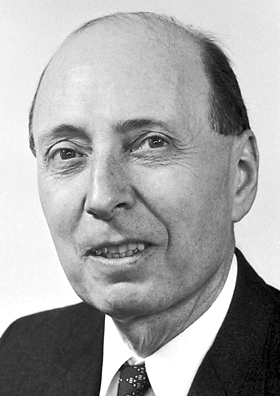
Schwinger's Covariant QED By Nobel foundation - http://nobelprize.org/nobel_prizes/physics/laureates/1965/schwinger-bio.html, Public domain, https://commons.wikimedia.org/w/index.php?curid=6138572
1947 CE
Lamb-Retherford Experiment
Willis Lamb and Robert Retherford measure the Lamb shift in hydrogen using microwave techniques, confirming the discrepancy with Dirac's theory. This motivates QED refinements. #QED #physics #experiment
1947 CE
Shelter Island Conference
A pivotal conference where physicists discuss the Lamb shift and the need for a new QED. This meeting catalyzes the development of modern QED. #QED #physics #conference
1947 CE
Kusch's Measurement of Electron Magnetic Moment
Polykarp Kusch measures the electron's magnetic moment, finding a small deviation from Dirac's prediction. This anomaly is explained by QED. #QED #physics #anomaly
1948 CE
Schwinger's Calculation of Electron g-2
Julian Schwinger calculates the anomalous magnetic moment of the electron (g-2) to first order in QED, obtaining a value in agreement with experiment. This is a triumph of renormalization. #QED #physics #gminus2
1948 CE
Tomonaga's Renormalization
Sin-Itiro Tomonaga independently develops a renormalization theory for QED, similar to Schwinger's. His work is recognized as a major contribution. #QED #physics #renormalization
1948 CE
Feynman's Path Integral Formulation
Richard Feynman introduces the path integral formulation of quantum mechanics and develops Feynman diagrams for QED. These diagrams simplify calculations and provide intuitive understanding. #QED #physics #feynman
1949 CE
Feynman's QED Papers
Richard Feynman publishes his papers on the space-time approach to QED, including Feynman diagrams and rules. These become standard tools in particle physics. #QED #physics #feynman
Feynman's QED Papers By The Nobel Foundation - http://www.nobelprize.org/nobel_prizes/physics/laureates/1965/feynman-bio.html, PD-Sweden, https://en.wikipedia.org/w/index.php?curid=34664654
1949 CE
Dyson's Proof of Renormalizability
Freeman Dyson proves that QED is renormalizable to all orders in perturbation theory, establishing the consistency of the theory. This solidifies QED as a valid quantum field theory. #QED #physics #renormalization
Dyson's Proof of Renormalizability By ioerror - Flickr, CC BY-SA 2.0, https://commons.wikimedia.org/w/index.php?curid=71877726
1950 CE
Schwinger's QED Textbook
Julian Schwinger publishes a comprehensive textbook on QED, summarizing his formalism. This influences a generation of physicists. #QED #physics #textbook
1951 CE
Bethe-Salpeter Equation
Hans Bethe and Edwin Salpeter derive a relativistic equation for bound states in QED, such as positronium. This extends QED to two-body systems. #QED #physics #boundstates
Bethe-Salpeter Equation By RolteVolte (talk) - Own work by the original uploader, CC BY-SA 3.0, https://commons.wikimedia.org/w/index.php?curid=41126794
1952 CE
Dyson's S-Matrix Formalism
Freeman Dyson develops a rigorous S-matrix formalism for QED, connecting Feynman's and Schwinger's approaches. This unifies the theory. #QED #physics #Smatrix
1953 CE
Gell-Mann and Low's Renormalization Group
Murray Gell-Mann and Francis Low introduce the renormalization group in QED, studying how coupling constants change with energy scale. This is a precursor to asymptotic freedom. #QED #physics #renormalization
1954 CE
Yang-Mills Theory
Chen Ning Yang and Robert Mills generalize QED to non-abelian gauge theories, laying the foundation for the Standard Model. This extends gauge symmetry to other forces. #QED #physics #gaugetheory
1955 CE
Lamb Shift Calculation to Higher Orders
Physicists compute the Lamb shift to higher orders in QED, achieving precise agreement with experiment. This confirms the accuracy of renormalized QED. #QED #physics #precision
1956 CE
Parity Violation in Weak Interactions
Tsung-Dao Lee and Chen Ning Yang propose parity violation in weak interactions, later confirmed by Chien-Shiung Wu. This shows that QED (which conserves parity) is not the whole story. #QED #physics #weakforce
1957 CE
Schwinger's Source Theory
Julian Schwinger develops source theory, an alternative formulation of QED that avoids some infinities. This approach emphasizes observable quantities. #QED #physics #schwinger
1958 CE
Feynman's Lectures on Physics
Richard Feynman begins his famous lectures at Caltech, which include clear explanations of QED. These lectures popularize the subject. #QED #physics #education
Feynman's Lectures on Physics By Barak Sh - Own work, Public domain, https://commons.wikimedia.org/w/index.php?curid=4010903
1959 CE
Aharonov-Bohm Effect
Yakir Aharonov and David Bohm predict that a magnetic vector potential can affect electron interference, even in regions with zero magnetic field. This highlights the role of potentials in QED. #QED #physics #quantum
Aharonov-Bohm Effect By Constant314 - Own work, CC BY-SA 4.0, https://commons.wikimedia.org/w/index.php?curid=129431725
1960 CE
Mössbauer Effect
Rudolf Mössbauer discovers recoilless nuclear resonance fluorescence, enabling precise measurements of the Lamb shift and other QED effects in nuclei. #QED #physics #nuclear
1961 CE
Gell-Mann's Eightfold Way
Murray Gell-Mann proposes the Eightfold Way, a classification of hadrons using SU(3) symmetry. This is not QED but influences the development of quantum chromodynamics. #QED #physics #symmetry
Gell-Mann's Eightfold Way By Laurascudder - Own work, CC BY-SA 3.0, https://commons.wikimedia.org/w/index.php?curid=2379550
1962 CE
Landau Pole in QED
Lev Landau and others show that QED has a Landau pole, a high-energy scale where the coupling becomes infinite. This suggests QED is not a complete theory at all energies. #QED #physics #infinities
1963 CE
Nobel Prize to Wigner, Goeppert-Mayer, Jensen
Eugene Wigner receives the Nobel Prize for his contributions to nuclear physics and symmetry principles. This recognition highlights the importance of symmetry in quantum theories. #QED #physics #nobel
Nobel Prize to Wigner, Goeppert-Mayer, Jensen By Nobel foundation - https://nobelprize.org/nobel_prizes/physics/laureates/1963/wigner-bio.html, Public domain, https://commons.wikimedia.org/w/index.php?curid=6141135
1964 CE
Higgs Mechanism
Peter Higgs and others propose the Higgs mechanism to give mass to gauge bosons, extending the ideas of gauge symmetry beyond QED. This is crucial for the electroweak theory. #QED #physics #higgs
Higgs Mechanism By Cush - Own work using: PBS NOVA [1], Fermilab, Office of Science, United States Department of Energy, Particle Data Group, Public domain, https://commons.wikimedia.org/w/index.php?curid=4286964
1965 CE
Nobel Prize to Feynman, Schwinger, Tomonaga
Richard Feynman, Julian Schwinger, and Sin-Itiro Tomonaga share the Nobel Prize in Physics for their fundamental work in QED. This marks the culmination of Epoch 2. #QED #physics #nobel
Nobel Prize to Feynman, Schwinger, Tomonaga By Photograph: JonathunderMedal: Erik Lindberg (1873-1966) - Derivative of File:NobelPrize.JPG, PD-US, https://en.wikipedia.org/w/index.php?curid=58432969
1966 CE
QED and the Standard Model
The success of QED inspires the development of gauge theories for weak and strong interactions, leading to the Standard Model. QED remains the prototype quantum field theory. #QED #physics #standardmodel
1967 CE
Weinberg's Electroweak Unification
Steven Weinberg proposes a unified theory of electromagnetic and weak interactions, incorporating QED as part of the electroweak theory. This extends QED's gauge principle. #QED #physics #unification
1968 CE
Deep Inelastic Scattering at SLAC
Experiments at SLAC reveal point-like constituents inside protons, confirming the quark model. This uses QED as a probe of hadronic structure. #QED #physics #quarks
Deep Inelastic Scattering at SLAC By E2m - Own work, Public domain, https://commons.wikimedia.org/w/index.php?curid=1796747
1969 CE
Bjorken Scaling
James Bjorken predicts scaling in deep inelastic scattering, later explained by asymptotic freedom in QCD. This shows the power of QED-like theories. #QED #physics #scaling
Bjorken Scaling By Unknown author - Downloaded from Fermilab, a.k.a. Fermi National Accelerator Laboratory image URL is: http://www.fnal.gov/pub/today/images04/bjorken.jpg Transferred from en.wikipedia to Commons by User:Magnus Manske using CommonsHelper., Public domain, https://commons.wikimedia.org/w/index.php?curid=4301389
1970 CE
't Hooft's Renormalization of Yang-Mills
Gerard 't Hooft proves that Yang-Mills theories are renormalizable, paving the way for the Standard Model. This builds on Dyson's work for QED. #QED #physics #renormalization
't Hooft's Renormalization of Yang-Mills By Wammes Waggel - Own work, CC BY-SA 3.0, https://commons.wikimedia.org/w/index.php?curid=5175482
1971 CE
Precision Tests of QED
High-precision measurements of the electron g-2 and Lamb shift continue to test QED, showing agreement to many decimal places. QED remains the most accurately tested theory. #QED #physics #precision
1972 CE
Gell-Mann and Fritzsch's QCD
Murray Gell-Mann and Harald Fritzsch formulate quantum chromodynamics (QCD), the theory of strong interactions, modeled after QED. This completes the gauge theory revolution. #QED #physics #QCD
1973 CE
Asymptotic Freedom in QCD
David Gross, Frank Wilczek, and David Politzer discover asymptotic freedom in non-abelian gauge theories, explaining why quarks behave freely at high energies. This contrasts with QED's behavior. #QED #physics #QCD
1974 CE
J/ψ Particle Discovery
The discovery of the J/ψ particle confirms the charm quark and validates the Standard Model. This uses QED in the detection process. #QED #physics #charm
J/ψ Particle Discovery By https://commons.wikimedia.org/wiki/User:Harp - File:Quark_structure_pion.svg, CC BY-SA 4.0, https://commons.wikimedia.org/w/index.php?curid=46504895
1975 CE
Tau Lepton Discovery
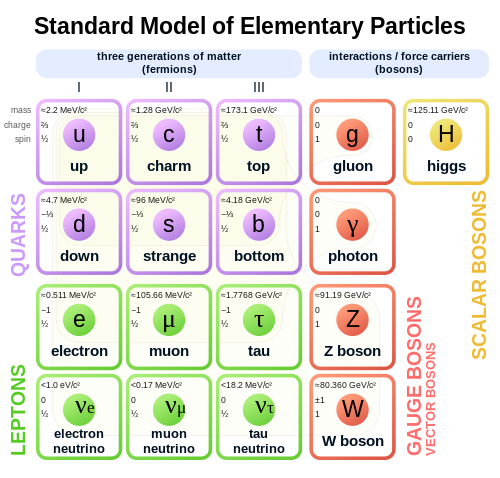
The tau lepton is discovered at SLAC, providing a third generation of leptons. QED describes its electromagnetic interactions. #QED #physics #lepton
Tau Lepton Discovery By user:MissMJ - File:Standard Model of Elementary Particles.svg, CC BY 3.0, https://commons.wikimedia.org/w/index.php?curid=24692629