Encyclopedia/1. The Cosmos & The Natural World/2. Physics & Chemistry/01. Quantum Physics & Atomic Theory • Curated by Admin Timeline.sg
Timeline of key milestones and pioneer contributions in Quantum Chromodynamics (QCD) and quark theory, from ancient atomic ideas to modern discoveries. It includes the evolution of the quark model, the development of QCD as the theory of strong interactions, and experimental confirmations.
Chronological Storyline (41 Milestones)
400 BCE
Democritus Proposes Atomic Theory
Greek philosopher Democritus postulates that matter is composed of indivisible particles called atoms. This ancient idea lays the philosophical foundation for later particle physics. #physics #history
1897 CE
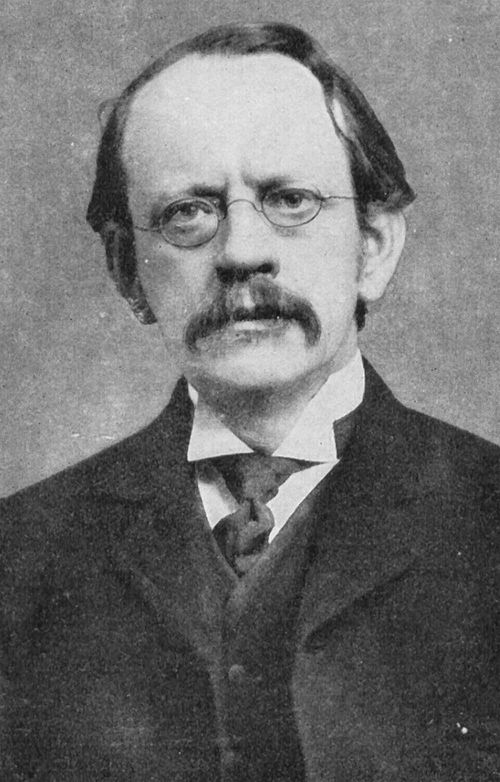
Discovery of the Electron
J.J. Thomson identifies the electron as the first fundamental particle, demonstrating that atoms have internal structure. This discovery opens the field of subatomic physics. #physics #discovery
Discovery of the Electron By Not Mentioned - First World War.com, Public domain, https://commons.wikimedia.org/w/index.php?curid=2969861
1906 CE
Birth of Hideki Yukawa
Hideki Yukawa, who proposed the pion as the mediator of the strong force, is born in Tokyo. #physics #biography
1911 CE
Rutherford Discovers the Atomic Nucleus
Ernest Rutherford's gold foil experiment reveals that atoms have a dense, positively charged nucleus, leading to the planetary model of the atom. #physics #history
Rutherford Discovers the Atomic Nucleus By Bain News Service, publisher Restored by: Bammesk - Library of Congress Catalog: https://lccn.loc.gov/2014716719 Image download: https://cdn.loc.gov/service/pnp/ggbain/36500/36570v.jpg Original url: https://www.loc.gov/pictures/item/2014716719/, Public domain, https://commons.wikimedia.org/w/index.php?curid=112190894
1918 CE
Birth of Richard Feynman
Richard Feynman, developer of the parton model and Feynman diagrams, is born in New York. #physics #biography
Birth of Richard Feynman By The Nobel Foundation - http://www.nobelprize.org/nobel_prizes/physics/laureates/1965/feynman-bio.html, PD-Sweden, https://en.wikipedia.org/w/index.php?curid=34664654
1919 CE
Rutherford Discovers the Proton
Ernest Rutherford identifies the proton as a positively charged particle in the nucleus, furthering understanding of atomic structure. #physics #discovery
Rutherford Discovers the Proton By Arpad Horvath - Own work, CC BY-SA 2.5, https://commons.wikimedia.org/w/index.php?curid=637353
1921 CE
Birth of Yoichiro Nambu
Yoichiro Nambu, who introduced the concept of spontaneous symmetry breaking and color charge, is born in Tokyo. #physics #biography
Birth of Yoichiro Nambu By Betsy Devine - Own work, CC BY-SA 3.0, https://commons.wikimedia.org/w/index.php?curid=4942053
1925 CE
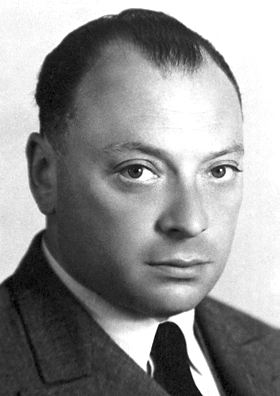
Pauli Exclusion Principle
Wolfgang Pauli formulates the exclusion principle, stating that no two fermions can occupy the same quantum state. This becomes crucial for understanding quark behavior. #physics #quantum
Pauli Exclusion Principle By Nobel foundation - http://nobelprize.org/nobel_prizes/physics/laureates/1945/pauli-bio.html, Public domain, https://commons.wikimedia.org/w/index.php?curid=6183525
1928 CE
Dirac Equation Predicts Antimatter
Paul Dirac formulates a relativistic wave equation for electrons, predicting the existence of antiparticles. This leads to the discovery of the positron and expands particle physics. #physics #quantum
1929 CE
Birth of Murray Gell-Mann
Murray Gell-Mann, who would later propose the Eightfold Way and quarks, is born in New York City. #physics #biography
Birth of Murray Gell-Mann By Melirius - Own work, CC BY-SA 3.0, https://commons.wikimedia.org/w/index.php?curid=21928851
1932 CE
Chadwick Discovers the Neutron
James Chadwick identifies the neutron, a neutral nuclear particle, completing the basic picture of the atomic nucleus. #physics #discovery
Chadwick Discovers the Neutron By Los Alamos National Laboratory, Attribution, https://commons.wikimedia.org/w/index.php?curid=36283260
1932 CE
Anderson Discovers the Positron
Carl D. Anderson discovers the positron, the antimatter counterpart of the electron, confirming Dirac's prediction and opening the study of antiparticles. #physics #discovery
Anderson Discovers the Positron By Smithsonian Institution - originally posted to Flickr as Portrait of Carl David Anderson (1905-1991), Physicist, No restrictions, https://commons.wikimedia.org/w/index.php?curid=61566033
1935 CE
Yukawa Proposes the Pion
Hideki Yukawa postulates a new particle, the pion, as the mediator of the strong nuclear force, explaining the binding of nucleons. #physics #theory
Yukawa Proposes the Pion By Nobel Foundation archive - nobelprize.org [1], Public domain, https://commons.wikimedia.org/w/index.php?curid=6182205
1941 CE
Birth of David Politzer
David Politzer, co-discoverer of asymptotic freedom, is born in New York City. #physics #biography
Birth of David Politzer By University of Hawaii High Energy Physics Group, courtesy AIP Emilio Segrè Visual Archives - https://repository.aip.org/sakurai-politzer-peterson-flugge-and-steinberger-conference, Attribution, https://commons.wikimedia.org/w/index.php?curid=174572732
1944 CE
Birth of Frank Wilczek
Frank Wilczek, co-discoverer of asymptotic freedom, is born in New York. #physics #biography
Birth of Frank Wilczek By photograph by Betsy Devine (User:Betsythedevine) - photograph taken at Nobel press conference in Stockholm by Betsy Devine, who also uploaded it to Wikimedia Commons., CC BY 2.5, https://commons.wikimedia.org/w/index.php?curid=2213816
1947 CE
Discovery of the Pion
César Lattes, Giuseppe Occhialini, and Cecil Powell discover the pion in cosmic rays, confirming Yukawa's prediction. #physics #discovery
Discovery of the Pion By No machine-readable author provided. Harp assumed (based on copyright claims). - No machine-readable source provided. Own work assumed (based on copyright claims)., CC BY-SA 2.5, https://commons.wikimedia.org/w/index.php?curid=637403
1955 CE
Discovery of the Antiproton
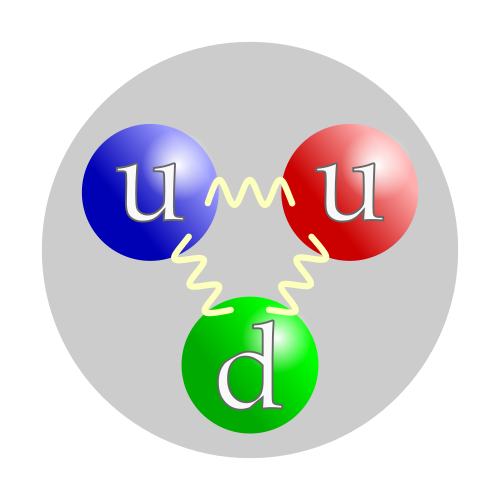
Emilio Segrè and Owen Chamberlain discover the antiproton at the Bevatron, confirming the symmetry between matter and antimatter. #physics #discovery
Discovery of the Antiproton By en real life identity: SHA-1 commitment ba62ca25da3fee2f8f36c101994f571c151abee7 - Self created using Inkscape from File:Quark structure proton.svg as a template., CC BY-SA 3.0, https://commons.wikimedia.org/w/index.php?curid=24105730
1961 CE
Eightfold Way Classification
Murray Gell-Mann and Yuval Ne'eman independently propose the Eightfold Way, a classification scheme for hadrons based on SU(3) symmetry, leading to the prediction of new particles. #physics #theory )
Eightfold Way Classification By Laurascudder - Own work, CC BY-SA 3.0, https://commons.wikimedia.org/w/index.php?curid=2379550
1964 CE
Gell-Mann and Zweig Propose Quarks
Murray Gell-Mann and George Zweig independently propose that hadrons are composed of more fundamental constituents called quarks, with fractional electric charges. #physics #quarks
1964 CE
Discovery of the Omega-Minus
The Omega-minus baryon is discovered at Brookhaven National Laboratory, confirming the Eightfold Way and the quark model. #physics #discovery
Discovery of the Omega-Minus By V. E. Barnes et al. - Observation of a Hyperon with Strangeness Minus Three, Phys. Rev. Lett. 12, 204, Public domain, https://commons.wikimedia.org/w/index.php?curid=10243833
1965 CE
Color Charge Proposed
Yoichiro Nambu and later Han and Nambu introduce the concept of color charge to reconcile the quark model with the Pauli exclusion principle. #physics #QCD
Color Charge Proposed By Cush - Own work using: PBS NOVA [1], Fermilab, Office of Science, United States Department of Energy, Particle Data Group, Public domain, https://commons.wikimedia.org/w/index.php?curid=4286964
1968 CE
Deep Inelastic Scattering at SLAC
Experiments at the Stanford Linear Accelerator Center (SLAC) reveal point-like structures inside protons, providing evidence for quarks. #physics #discovery
Deep Inelastic Scattering at SLAC By E2m - Own work, Public domain, https://commons.wikimedia.org/w/index.php?curid=1796747
1969 CE
Feynman Proposes Parton Model
Richard Feynman introduces the parton model to explain deep inelastic scattering, describing hadrons as composed of point-like partons (later identified with quarks). #physics #theory )
1970 CE
GIM Mechanism Predicts Charm Quark
Sheldon Glashow, John Iliopoulos, and Luciano Maiani propose the GIM mechanism, predicting the existence of a fourth quark (charm) to suppress flavor-changing neutral currents. #physics #theory
GIM Mechanism Predicts Charm Quark By Blibla - Own work, CC0, https://commons.wikimedia.org/w/index.php?curid=50058727
1972 CE
Asymptotic Freedom Discovered
David Gross, Frank Wilczek, and David Politzer discover asymptotic freedom in non-Abelian gauge theories, showing that the strong force weakens at short distances. #physics #QCD
1973 CE
Quantum Chromodynamics Established
The theory of QCD is formulated as a SU(3) gauge theory of quarks and gluons, with color charge as the source of the strong force. #physics #QCD
1974 CE
Discovery of the J/psi Particle
Burton Richter and Samuel Ting independently discover the J/psi meson, confirming the existence of the charm quark. #physics #discovery
Discovery of the J/psi Particle By https://commons.wikimedia.org/wiki/User:Harp - File:Quark_structure_pion.svg, CC BY-SA 4.0, https://commons.wikimedia.org/w/index.php?curid=46504895
1975 CE
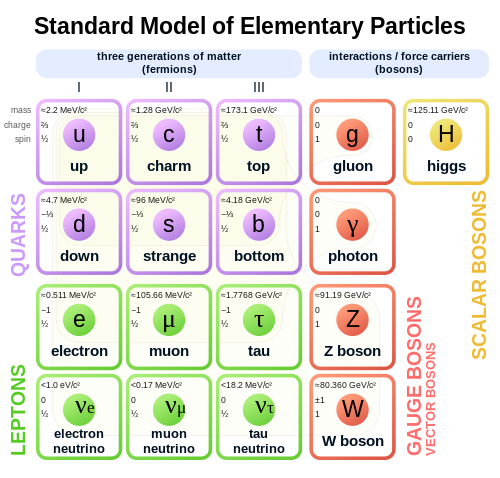
Discovery of the Tau Lepton
Martin Perl and colleagues discover the tau lepton at SLAC, the third generation lepton, deepening understanding of particle generations. #physics #discovery )
Discovery of the Tau Lepton By user:MissMJ - File:Standard Model of Elementary Particles.svg, CC BY 3.0, https://commons.wikimedia.org/w/index.php?curid=24692629
1975 CE
Lattice QCD Proposed by Wilson
Kenneth Wilson introduces lattice QCD, a non-perturbative approach to study QCD using numerical simulations on a discrete spacetime lattice. #physics #QCD
Lattice QCD Proposed by Wilson By Joel Holdsworth (Joelholdsworth) - Non-Derived SVG of Radiate gluon.png, originally the work of SilverStar at Feynmann-diagram-gluon-radiation.svg, updated by joelholdsworth., Public domain, https://commons.wikimedia.org/w/index.php?curid=1764161
1977 CE
Discovery of the Bottom Quark
The Upsilon particle is discovered at Fermilab by Leon Lederman's team, revealing the bottom quark and confirming the third generation. #physics #discovery
Discovery of the Bottom Quark By user:MissMJ - File:Standard Model of Elementary Particles.svg, CC BY 3.0, https://commons.wikimedia.org/w/index.php?curid=24657344
1979 CE
Gluon Jet Discovery at DESY
The TASSO collaboration at DESY's PETRA collider observes three-jet events, providing direct evidence for the gluon, the carrier of the strong force. #physics #QCD
1980 CE
QCD Sum Rules Developed
Mikhail Shifman, Arkady Vainshtein, and Valentin Zakharov develop QCD sum rules, a technique to extract hadron properties from QCD using operator product expansion. #physics #QCD
1983 CE
Discovery of W and Z Bosons
The UA1 and UA2 experiments at CERN discover the W and Z bosons, mediators of the weak force, completing the Standard Model gauge sector. #physics #discovery
Discovery of W and Z Bosons By Inductiveload - Own work, Public domain, https://commons.wikimedia.org/w/index.php?curid=2859203
1990 CE
HERA Electron-Proton Collider Begins
The HERA collider at DESY starts operation, allowing precise studies of deep inelastic scattering and structure functions, testing QCD. #physics #experiment )
HERA Electron-Proton Collider Begins By Jason Schwartz (talk) - I created this image entirely by myself., CC BY-SA 3.0, https://commons.wikimedia.org/w/index.php?curid=40210287
1995 CE
Discovery of the Top Quark
The CDF and DØ collaborations at Fermilab discover the top quark, the heaviest fundamental particle, completing the quark family. #physics #discovery
Discovery of the Top Quark By user:MissMJ - File:Standard Model of Elementary Particles.svg, CC BY 3.0, https://commons.wikimedia.org/w/index.php?curid=24657343
2000 CE
Quark-Gluon Plasma at RHIC
The Relativistic Heavy Ion Collider (RHIC) at Brookhaven produces evidence of quark-gluon plasma, a state of matter where quarks and gluons are deconfined. #physics #QCD
Quark-Gluon Plasma at RHIC By Rajeev S. Bhalerao(Tata Inst.) - Modified version of: Rajeev S. Bhalerao(Tata Inst.) - 1st Asia-Europe-Pacific School of High-Energy Physics (AEPSHEP 2012), pp. 219-239 Relativistic heavy-ion collisions DOI: 10.5170/CERN-2014-001.219, CC BY 4.0, https://commons.wikimedia.org/w/index.php?curid=89883392
2004 CE
First Pentaquark Claimed
Researchers at LEPS (Japan) claim discovery of a pentaquark state, later disputed; subsequent experiments confirm exotic hadrons. #physics #discovery
First Pentaquark Claimed By Headbomb - Own work, CC BY-SA 4.0, https://commons.wikimedia.org/w/index.php?curid=41591193
2008 CE
Large Hadron Collider Starts
The LHC at CERN begins operation, enabling high-energy proton collisions to probe the Standard Model and search for new physics, including QCD effects. #physics #collider
Large Hadron Collider Starts By Arpad Horvath - Drawn by Arpad Horvath with Inkscape., CC BY-SA 2.5, https://commons.wikimedia.org/w/index.php?curid=679693
2012 CE
Higgs Boson Discovery
The ATLAS and CMS experiments at the LHC discover the Higgs boson, confirming the mechanism of mass generation, a key piece of the Standard Model. #physics #discovery
Higgs Boson Discovery By CERN for the ATLAS and CMS Collaborations - https://cds.cern.ch/record/1630222, CC BY-SA 3.0, https://commons.wikimedia.org/w/index.php?curid=29737816
2015 CE
LHCb Confirms Pentaquarks
The LHCb experiment at CERN confirms the existence of pentaquarks, exotic hadrons with five quarks, opening new studies of QCD. #physics #QCD
2019 CE
Strong CP Problem and Axion Searches
Ongoing experimental searches for the axion (a hypothetical particle) aim to resolve the strong CP problem in QCD. #physics #QCD