Quantum Chromodynamics & Quarks: Major Case Studies & Paradigm Shifts
Encyclopedia/1. The Cosmos & The Natural World/2. Physics & Chemistry/01. Quantum Physics & Atomic Theory • Curated by Admin Timeline.sg
Quantum Chromodynamics (QCD) is the quantum field theory describing the strong nuclear force, governing interactions between quarks and gluons. This timeline traces key milestones from early particle discoveries through the development of the quark model and the establishment of QCD as the fundamental theory of strong interactions.
Chronological Storyline (40 Milestones)
1911 CE
Rutherford Discovers Atomic Nucleus
Ernest Rutherford's gold foil experiment reveals that atoms consist of a small, dense nucleus. This groundbreaking discovery lays the foundation for nuclear and particle physics. #physics #history
1919 CE
Rutherford Discovers the Proton
Rutherford identifies the proton as a positively charged constituent of atomic nuclei, marking the first modern subatomic particle discovery. #physics #particlephysics
Rutherford Discovers the Proton By Arpad Horvath - Own work, CC BY-SA 2.5, https://commons.wikimedia.org/w/index.php?curid=637353
1932 CE
Discovery of the Positron
Carl Anderson discovers the positron, the first antimatter particle, confirming Dirac's prediction. #physics #antimatter
Discovery of the Positron By Carl D. Anderson (1905–1991) - Anderson, Carl D. (1933). "The Positive Electron". Physical Review 43 (6): 491–494. DOI:10.1103/PhysRev.43.491., Public domain, https://commons.wikimedia.org/w/index.php?curid=93111759
1932 CE
Chadwick Discovers the Neutron
James Chadwick discovers the neutron, completing the basic picture of the atomic nucleus with protons and neutrons. #physics #particlephysics
Chadwick Discovers the Neutron By No machine-readable author provided. Harp assumed (based on copyright claims). - No machine-readable source provided. Own work assumed (based on copyright claims)., CC BY-SA 2.5, https://commons.wikimedia.org/w/index.php?curid=637381
1935 CE
Yukawa Proposes the Pion
Hideki Yukawa postulates the existence of the pion as the mediator of the strong nuclear force, introducing the concept of mesons. #physics #particlephysics
Yukawa Proposes the Pion By Nobel Foundation archive - nobelprize.org [1], Public domain, https://commons.wikimedia.org/w/index.php?curid=6182205
1936 CE
Discovery of the Muon
Carl Anderson and Seth Neddermeyer detect the muon, an unexpected particle initially thought to be Yukawa's meson. #physics #particlephysics
1947 CE
Discovery of the Pion
César Lattes, Giuseppe Occhialini, and Cecil Powell discover the pion in cosmic rays, confirming Yukawa's prediction. #physics #particlephysics
Discovery of the Pion By No machine-readable author provided. Harp assumed (based on copyright claims). - No machine-readable source provided. Own work assumed (based on copyright claims)., CC BY-SA 2.5, https://commons.wikimedia.org/w/index.php?curid=637403
1947 CE
Discovery of Strange Particles
George Rochester and Clifford Butler discover kaons and hyperons, introducing the concept of strangeness in particle physics. #physics #particlephysics
1950 CE
Discovery of the Lambda Baryon
The first hyperon, the lambda baryon, is discovered in cosmic ray experiments, further expanding the particle zoo. #physics #particlephysics
Discovery of the Lambda Baryon By Physicist2022 - Own work, Public domain, https://commons.wikimedia.org/w/index.php?curid=123178386
1952 CE
Discovery of the Delta Baryon
The delta baryon resonance is discovered, providing evidence for the existence of excited states of nucleons. #physics #particlephysics
1954 CE
Yang-Mills Theory Formulated
Chen Ning Yang and Robert Mills develop a non-abelian gauge theory, which becomes the mathematical foundation for QCD. #physics #quantumfieldtheory
Yang-Mills Theory Formulated By Joel Holdsworth (Joelholdsworth) - Non-Derived SVG of Radiate gluon.png, originally the work of SilverStar at Feynmann-diagram-gluon-radiation.svg, updated by joelholdsworth., Public domain, https://commons.wikimedia.org/w/index.php?curid=1764161
1955 CE
Discovery of the Antiproton
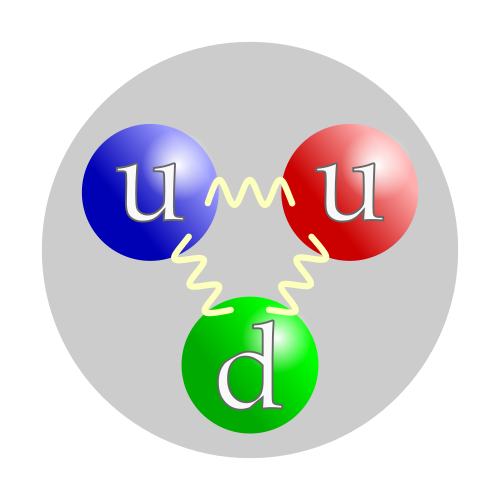
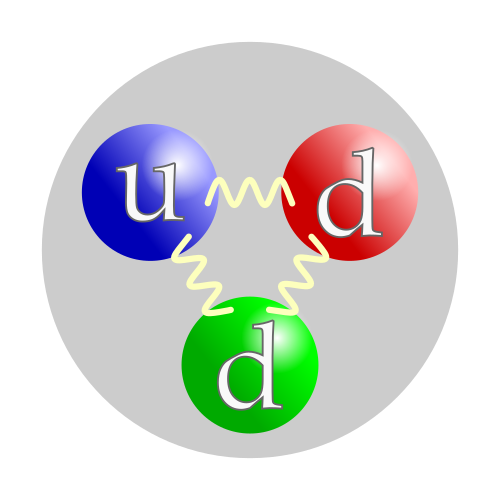
Owen Chamberlain, Emilio Segrè, and colleagues discover the antiproton, confirming the symmetry between matter and antimatter. #physics #antimatter
Discovery of the Antiproton By en real life identity: SHA-1 commitment ba62ca25da3fee2f8f36c101994f571c151abee7 - Self created using Inkscape from File:Quark structure proton.svg as a template., CC BY-SA 3.0, https://commons.wikimedia.org/w/index.php?curid=24105730
1956 CE
Sakata Model Proposed
Shoichi Sakata proposes a composite model of hadrons, with protons, neutrons, and lambda baryons as fundamental building blocks, a precursor to the quark model. #physics #particlephysics
1961 CE
Eightfold Way Classification
Murray Gell-Mann and Yuval Ne'eman independently propose the Eightfold Way, an SU(3) flavor symmetry classification of hadrons. #physics #particlephysics )
Eightfold Way Classification By Laurascudder - Own work, CC BY-SA 3.0, https://commons.wikimedia.org/w/index.php?curid=2379550
Jan 1, 1964 CE
Quark Model Introduced
Murray Gell-Mann and George Zweig independently propose the quark model, suggesting that hadrons are composed of fractionally charged quarks. #physics #quarks
Quark Model Introduced By Vectorization: Alhadis - Own work based on: 8foldway.png by Bambaiah at English Wikipedia, CC BY-SA 3.0, https://commons.wikimedia.org/w/index.php?curid=125051765
Feb 1, 1964 CE
Omega-Minus Baryon Discovered
The omega-minus baryon is discovered at Brookhaven, confirming the Eightfold Way and the quark model's predictions. #physics #particlephysics
1965 CE
Color Charge Introduced
Yoichiro Nambu and others introduce the concept of color charge to resolve the statistics problem with quarks, a key step toward QCD. #physics #quarks
Color Charge Introduced By Cush - Own work using: PBS NOVA [1], Fermilab, Office of Science, United States Department of Energy, Particle Data Group, Public domain, https://commons.wikimedia.org/w/index.php?curid=4286964
1968 CE
Deep Inelastic Scattering Experiments
SLAC experiments by Friedman, Kendall, and Taylor reveal a point-like structure inside protons, providing direct evidence for quarks. #physics #experiment
Deep Inelastic Scattering Experiments By E2m - Own work, Public domain, https://commons.wikimedia.org/w/index.php?curid=1796747
1969 CE
Feynman's Parton Model
Richard Feynman proposes the parton model to interpret deep inelastic scattering results, describing hadrons as collections of point-like constituents. #physics #partons
1970 CE
GIM Mechanism and Charm Quark
Glashow, Iliopoulos, and Maiani propose the charm quark to explain the absence of flavor-changing neutral currents, predicting a fourth quark. #physics #quarks
GIM Mechanism and Charm Quark By Blibla - Own work, CC0, https://commons.wikimedia.org/w/index.php?curid=50058727
1971 CE
Renormalizability of Yang-Mills Theory
Gerard 't Hooft proves that Yang-Mills theories are renormalizable, laying the mathematical groundwork for QCD. #physics #quantumfieldtheory
Renormalizability of Yang-Mills Theory By Wammes Waggel - Own work, CC BY-SA 3.0, https://commons.wikimedia.org/w/index.php?curid=5175482
Apr 1, 1973 CE
Asymptotic Freedom Discovered
David Gross, David Politzer, and Frank Wilczek discover asymptotic freedom in non-abelian gauge theories, showing that the strong force weakens at short distances. #physics #QCD
1973 CE
Quantum Chromodynamics Formulated
QCD is established as the gauge theory of the strong interaction based on the SU(3) color symmetry. #physics #QCD
Nov 1, 1974 CE
Discovery of the J/ψ Meson
The J/ψ meson is independently discovered by Samuel Ting and Burton Richter, providing clear evidence for the charm quark. #physics #quarks
Discovery of the J/ψ Meson By https://commons.wikimedia.org/wiki/User:Harp - File:Quark_structure_pion.svg, CC BY-SA 4.0, https://commons.wikimedia.org/w/index.php?curid=46504895
Jun 1, 1977 CE
Discovery of the Upsilon Meson
Leon Lederman's team at Fermilab discovers the upsilon meson, confirming the existence of the bottom quark. #physics #quarks
Discovery of the Upsilon Meson By Unknown author, Public domain, https://commons.wikimedia.org/w/index.php?curid=1570293
Jun 1, 1979 CE
Gluon Discovered at DESY
Three-jet events observed in electron-positron collisions at DESY provide direct evidence for the gluon, the mediator of the strong force. #physics #QCD
1980 CE
Lattice QCD Introduced
Kenneth Wilson develops lattice QCD, a non-perturbative approach to solving QCD using a discrete spacetime lattice. #physics #computational
Jul 1, 1989 CE
First Measurements of Strong Coupling at LEP
The LEP collider at CERN begins operation, enabling precise measurements of the strong coupling constant α_s. #physics #experiment
First Measurements of Strong Coupling at LEP By Juhanson - Image taken by Juhanson during CERN 50 Years OpenDay, using Canon EOS 10D camera, CC BY-SA 3.0, https://commons.wikimedia.org/w/index.php?curid=197318
Mar 1, 1995 CE
Top Quark Discovered
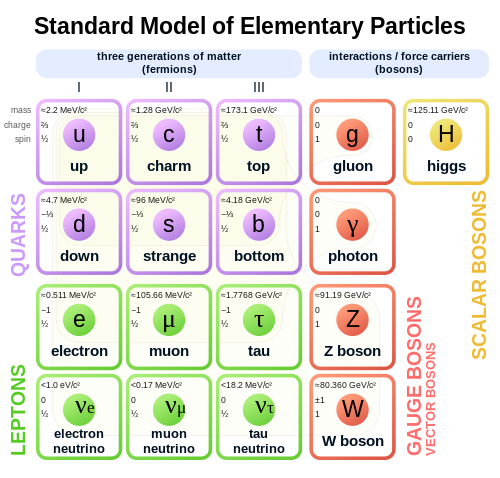
The top quark is discovered at Fermilab by the CDF and D0 collaborations, completing the quark picture of the Standard Model. #physics #quarks
Top Quark Discovered By user:MissMJ - File:Standard Model of Elementary Particles.svg, CC BY 3.0, https://commons.wikimedia.org/w/index.php?curid=24657343
Feb 1, 2000 CE
First Evidence of Quark-Gluon Plasma
Experiments at CERN's SPS provide first evidence for a quark-gluon plasma in heavy-ion collisions. #physics #QCD #plasma
First Evidence of Quark-Gluon Plasma By Rajeev S. Bhalerao(Tata Inst.) - Modified version of: Rajeev S. Bhalerao(Tata Inst.) - 1st Asia-Europe-Pacific School of High-Energy Physics (AEPSHEP 2012), pp. 219-239 Relativistic heavy-ion collisions DOI: 10.5170/CERN-2014-001.219, CC BY 4.0, https://commons.wikimedia.org/w/index.php?curid=89883392
2002 CE
RHIC Produces Quark-Gluon Plasma
The Relativistic Heavy Ion Collider (RHIC) at Brookhaven produces a strongly interacting quark-gluon plasma, advancing understanding of QCD at high temperatures. #physics #QCD
RHIC Produces Quark-Gluon Plasma By Z22 - Own work, CC BY-SA 4.0, https://commons.wikimedia.org/w/index.php?curid=61541447
Oct 5, 2004 CE
Nobel Prize for Asymptotic Freedom
David Gross, David Politzer, and Frank Wilczek receive the Nobel Prize for their discovery of asymptotic freedom in QCD. #physics #Nobel
Mar 1, 2009 CE
First Pentaquark Candidate
The LEPS experiment at SPring-8 reports a candidate for the pentaquark Θ⁺, sparking intense debate and subsequent searches. #physics #exotics
First Pentaquark Candidate By Headbomb - Own work, CC BY-SA 4.0, https://commons.wikimedia.org/w/index.php?curid=41591193
Mar 30, 2010 CE
First Pb-Pb Collisions at LHC
The Large Hadron Collider begins heavy-ion collisions, exploring QCD matter at the highest energies. #physics #QCD
First Pb-Pb Collisions at LHC By Arpad Horvath - Drawn by Arpad Horvath with Inkscape., CC BY-SA 2.5, https://commons.wikimedia.org/w/index.php?curid=679693
Jul 4, 2012 CE
Higgs Boson Discovered
The Higgs boson is discovered at CERN, confirming the mechanism of mass generation and further validating the Standard Model including QCD. #physics #higgs
Higgs Boson Discovered By CERN for the ATLAS and CMS Collaborations - https://cds.cern.ch/record/1630222, CC BY-SA 3.0, https://commons.wikimedia.org/w/index.php?curid=29737816
Jul 14, 2015 CE
LHCb Confirms Pentaquarks
The LHCb experiment at CERN reports the unambiguous observation of pentaquark states, opening a new frontier in hadron spectroscopy. #physics #exotics
Jun 1, 2016 CE
First Tetraquark Candidates
LHCb reports the observation of tetraquark candidates, further expanding the known hadron spectrum beyond the simple quark model. #physics #exotics
Jun 1, 2018 CE
Precision Measurement of Strong Coupling
The CMS collaboration at LHC publishes a precise measurement of the strong coupling constant α_s, testing QCD at the highest energies. #physics #QCD
Jul 1, 2021 CE
Lattice QCD Predicts Muon g-2
Lattice QCD calculations provide independent predictions for the muon anomalous magnetic moment, contributing to the muon g-2 puzzle. #physics #QCD
Mar 1, 2023 CE
QCD Exotics at LHCb
LHCb reports new exotic hadrons, including doubly charmed tetraquarks and pentaquarks with strangeness, deepening understanding of QCD. #physics #exotics