Quantum Chromodynamics & Quarks: Global Cross-Cultural Perspectives
Encyclopedia/1. The Cosmos & The Natural World/2. Physics & Chemistry/01. Quantum Physics & Atomic Theory • Curated by Admin Timeline.sg
This timeline traces the global development of Quantum Chromodynamics (QCD) and quark theory, highlighting contributions from ancient atomistic philosophies in India and Greece, through Islamic natural philosophy, to modern international experiments and theoretical breakthroughs. It emphasizes cross-cultural exchange and the collaborative nature of particle physics.
Chronological Storyline (39 Milestones)
600 BCE
Kanada Proposes Atomic Theory
The Indian philosopher Kanada (founder of Vaisheshika school) postulates that matter consists of indivisible particles called anu, among the earliest atomistic theories, later influencing Indian physics and metaphysics. #philosophy #physics )
Kanada Proposes Atomic Theory By Xaetherion - Own work, CC BY-SA 4.0, https://commons.wikimedia.org/w/index.php?curid=185658968
400 BCE
Democritus Proposes Atomism
Greek philosopher Democritus proposes that all matter is composed of indivisible atoms moving in the void, laying the foundation for later atomic theory in Western thought. #philosophy #science
Democritus Proposes Atomism By user:shakko - Own work, CC BY-SA 3.0, https://commons.wikimedia.org/w/index.php?curid=5535206
300 BCE
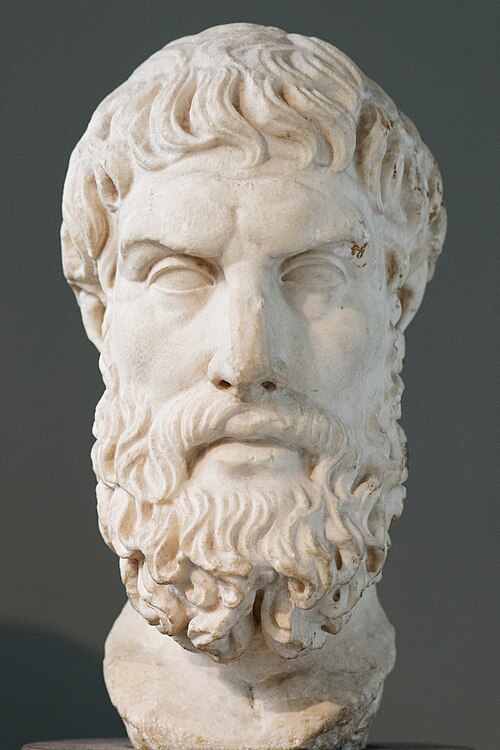
Epicurus Elaborates Atomic Theory
Epicurus further develops atomistic philosophy, emphasizing atoms as eternal, indivisible, and moving through the void, ideas later preserved in Lucretius's poem 'De Rerum Natura'. #philosophy
Epicurus Elaborates Atomic Theory By Unknown artist - Marie-Lan Nguyen (2011), Public domain, https://commons.wikimedia.org/w/index.php?curid=1447258
1025 CE
Alhazen's Optical Atomism
Islamic scholar Ibn al-Haytham (Alhazen) explores the atomic nature of light in his 'Book of Optics', contributing to early particle concepts in physics. #science #islamicgoldenage
Alhazen's Optical Atomism By Adolph Boÿ, engraved by Jeremias Falck. Used as the frontispiece to Johannes Hevelius, Selenographia, 1647 - https://www.loc.gov/resource/rbctos.2017rosen1321/?sp=9&r=0.059,0.617,0.327,0.182,0, Public domain, https://commons.wikimedia.org/w/index.php?curid=165125519
1803 CE
Dalton's Atomic Theory
John Dalton proposes the modern atomic theory based on experimental evidence, stating elements are composed of atoms of fixed mass, sparking the field of chemistry. #chemistry #science
Dalton's Atomic Theory By Thomas Phillips - National Portrait Gallery, London, Public domain, https://commons.wikimedia.org/w/index.php?curid=11727058
1897 CE
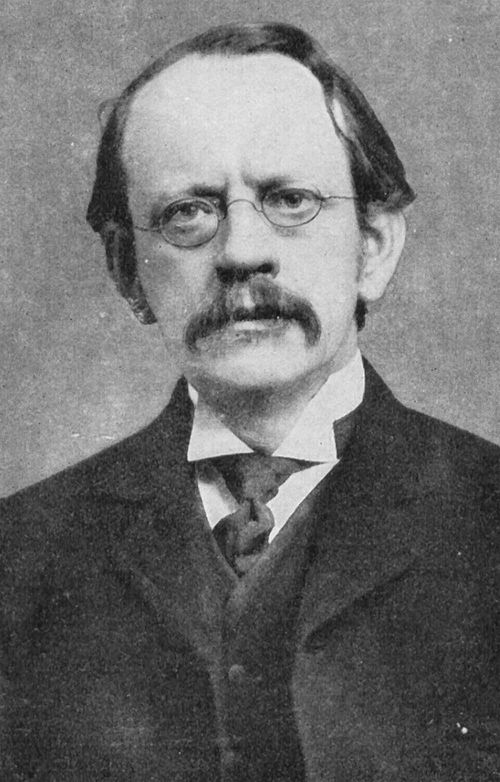
Thomson Discovers Electron
J.J. Thomson discovers the electron, the first subatomic particle, using cathode ray experiments, showing atoms have internal structure. #physics #discovery
Thomson Discovers Electron By Not Mentioned - First World War.com, Public domain, https://commons.wikimedia.org/w/index.php?curid=2969861
1911 CE
Rutherford Proposes Nuclear Atom
Ernest Rutherford's gold foil experiment reveals the atomic nucleus, composed of protons, leading to the planetary model of the atom. #physics
Rutherford Proposes Nuclear Atom By Bain News Service, publisher Restored by: Bammesk - Library of Congress Catalog: https://lccn.loc.gov/2014716719 Image download: https://cdn.loc.gov/service/pnp/ggbain/36500/36570v.jpg Original url: https://www.loc.gov/pictures/item/2014716719/, Public domain, https://commons.wikimedia.org/w/index.php?curid=112190894
1932 CE
Chadwick Discovers Neutron
James Chadwick discovers the neutron, completing the basic picture of the atomic nucleus as composed of protons and neutrons. #physics #discovery
Chadwick Discovers Neutron By Los Alamos National Laboratory, Attribution, https://commons.wikimedia.org/w/index.php?curid=36283260
1947 CE
Discovery of Pions and Muons
Pions (mesons) and muons are discovered in cosmic rays, leading to the classification of particles hadrons and leptons, and inspiring Yukawa's theory of nuclear force. #physics #particlephysics
Discovery of Pions and Muons By No machine-readable author provided. Harp assumed (based on copyright claims). - No machine-readable source provided. Own work assumed (based on copyright claims)., CC BY-SA 2.5, https://commons.wikimedia.org/w/index.php?curid=637403
1955 CE
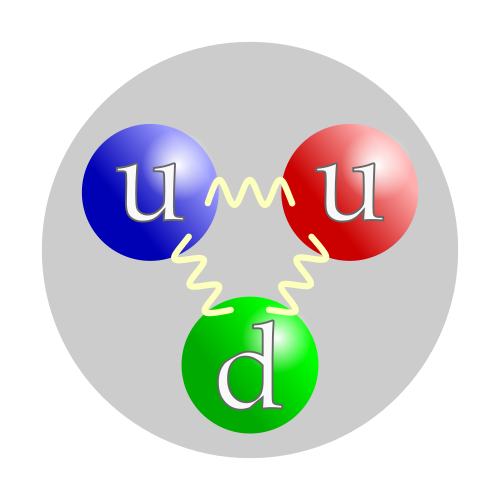
Chamberlain and Segrè Discover Antiproton
Owen Chamberlain and Emilio Segrè discover the antiproton at the Bevatron, confirming the existence of antimatter baryons. #physics
Chamberlain and Segrè Discover Antiproton By en real life identity: SHA-1 commitment ba62ca25da3fee2f8f36c101994f571c151abee7 - Self created using Inkscape from File:Quark structure proton.svg as a template., CC BY-SA 3.0, https://commons.wikimedia.org/w/index.php?curid=24105730
1961 CE
Gell-Mann and Ne'eman Propose Eightfold Way
Murray Gell-Mann and Yuval Ne'eman independently develop the Eightfold Way classification of hadrons, using SU(3) flavor symmetry, a precursor to the quark model. #physics #theory )
Gell-Mann and Ne'eman Propose Eightfold Way By Laurascudder - Own work, CC BY-SA 3.0, https://commons.wikimedia.org/w/index.php?curid=2379550
1964 CE
Greenberg Introduces Color Charge
Oscar W. Greenberg proposes that quarks possess a new quantum number called color charge to resolve the spin-statistics issue for baryons, a key step toward QCD. #physics #QCD
Greenberg Introduces Color Charge By Cush - Own work using: PBS NOVA [1], Fermilab, Office of Science, United States Department of Energy, Particle Data Group, Public domain, https://commons.wikimedia.org/w/index.php?curid=4286964
1964 CE
Gell-Mann and Zweig Propose Quarks
Murray Gell-Mann and George Zweig independently propose that hadrons are composed of fractionally charged quarks (and antiquarks), laying the foundation for the quark model. #physics #quarks
Gell-Mann and Zweig Propose Quarks By Arpad Horvath - Own work, CC BY-SA 2.5, https://commons.wikimedia.org/w/index.php?curid=637353
1965 CE
Han and Nambu Extend Color Idea
Moo-Young Han and Yoichiro Nambu propose that color is the source of a gauge interaction, anticipating the gluon and the non-Abelian nature of the strong force. #physics #QCD
1967 CE
Weinberg and Salam Unify Electromagnetism and Weak Force
Steven Weinberg and Abdus Salam independently propose the electroweak theory, unifying electromagnetic and weak interactions, later confirmed by experiment. #physics #standardmodel
1968 CE
Deep Inelastic Scattering Reveals Pointlike Partons
Experiments at SLAC using electron scattering off protons show evidence of pointlike constituents (partons), later identified with quarks and gluons. #physics #experiment
Deep Inelastic Scattering Reveals Pointlike Partons By E2m - Own work, Public domain, https://commons.wikimedia.org/w/index.php?curid=1796747
1972 CE
Fritzsch and Gell-Mann Propose Quantum Chromodynamics
Harald Fritzsch and Murray Gell-Mann propose QCD as the gauge theory of the strong interaction with color-charged quarks and gluons, using SU(3) gauge group. #physics #QCD
1973 CE
Asymptotic Freedom Discovered
David Gross, Frank Wilczek, and David Politzer discover that the strong coupling constant decreases at high energies (asymptotic freedom), a crucial feature confirming QCD as the correct theory. #physics #nobel
1974 CE
Discovery of the J/ψ Meson
Two independent teams (led by Sam Ting and Burton Richter) discover the J/ψ meson, a bound state of charm quark and antiquark, confirming the existence of a fourth quark. #physics #experiment
Discovery of the J/ψ Meson By https://commons.wikimedia.org/wiki/User:Harp - File:Quark_structure_pion.svg, CC BY-SA 4.0, https://commons.wikimedia.org/w/index.php?curid=46504895
1975 CE
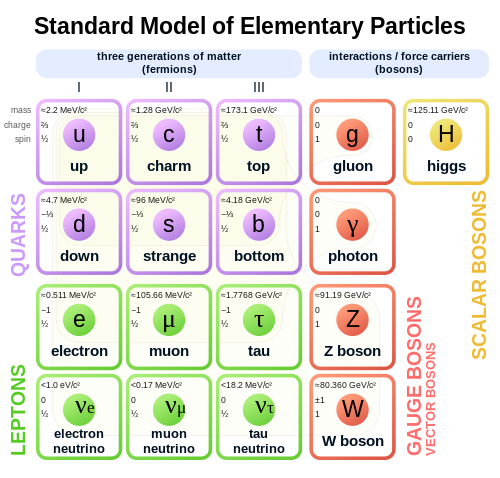
Perl Discovers Tau Lepton
Martin Perl discovers the tau lepton at SLAC, the third generation charged lepton, indicating further particle families beyond the first two. #physics #lepton )
Perl Discovers Tau Lepton By user:MissMJ - File:Standard Model of Elementary Particles.svg, CC BY 3.0, https://commons.wikimedia.org/w/index.php?curid=24692629
1977 CE
Upsilon Meson Reveals Bottom Quark
The Upsilon meson (bottomonium) is discovered at Fermilab, providing evidence for the bottom quark, the fifth quark. #physics #discovery
Upsilon Meson Reveals Bottom Quark By Unknown author, Public domain, https://commons.wikimedia.org/w/index.php?curid=1570293
1979 CE
Gluon Discovered in Three-Jet Events
Experiments at DESY's PETRA collider (TASSO, MARK-J, PLUTO) observe three-jet events from e+e- collisions, confirming the existence of gluons, the carriers of the strong force. #physics #experiment
Gluon Discovered in Three-Jet Events By Joel Holdsworth (Joelholdsworth) - Non-Derived SVG of Radiate gluon.png, originally the work of SilverStar at Feynmann-diagram-gluon-radiation.svg, updated by joelholdsworth., Public domain, https://commons.wikimedia.org/w/index.php?curid=1764161
1983 CE
W and Z Bosons Discovered
The UA1 and UA2 experiments at CERN discover the W and Z bosons, carriers of the weak force, validating the electroweak theory and the Standard Model. #physics #standardmodel
W and Z Bosons Discovered By Inductiveload - Own work, Public domain, https://commons.wikimedia.org/w/index.php?curid=2859203
1995 CE
Top Quark Discovered at Fermilab
The CDF and DØ experiments at Fermilab discover the top quark, the heaviest known elementary particle, completing the third generation of quarks. #physics #discovery
Top Quark Discovered at Fermilab By user:MissMJ - File:Standard Model of Elementary Particles.svg, CC BY 3.0, https://commons.wikimedia.org/w/index.php?curid=24657343
1998 CE
Super-Kamiokande Finds Neutrino Oscillations
The Super-Kamiokande experiment in Japan provides first definitive evidence that neutrinos have mass, confirming beyond Standard Model physics. #physics #neutrino
Super-Kamiokande Finds Neutrino Oscillations By Lucas Taylor / CERN - http://cdsweb.cern.ch/record/628469, CC BY-SA 3.0, https://commons.wikimedia.org/w/index.php?curid=1433671
2000 CE
RHIC Begins Operation: Quark-Gluon Plasma
The Relativistic Heavy Ion Collider (RHIC) at Brookhaven National Laboratory starts colliding gold ions, creating a quark-gluon plasma, the hottest matter ever created. #physics #experiment
RHIC Begins Operation: Quark-Gluon Plasma By Z22 - Own work, CC BY-SA 4.0, https://commons.wikimedia.org/w/index.php?curid=61541447
2004 CE
Asymptotic Freedom Nobel Prize
David Gross, Frank Wilczek, and David Politzer share the Nobel Prize for their 1973 discovery of asymptotic freedom in QCD. #physics #nobel
2005 CE
Lattice QCD Achieves Pure Gauge Predictions
Lattice QCD calculations accurately predict the hadron spectrum from first principles, confirming QCD as the theory of the strong interaction. #physics #QCD
2008 CE
LHC Begins Operation at CERN
The Large Hadron Collider (LHC) starts colliding protons at unprecedented energies, designed to explore physics beyond the Standard Model including QCD at extreme densities. #physics #experiment
LHC Begins Operation at CERN By Arpad Horvath - Drawn by Arpad Horvath with Inkscape., CC BY-SA 2.5, https://commons.wikimedia.org/w/index.php?curid=679693
2012 CE
Higgs Boson Discovered at LHC
ATLAS and CMS experiments at CERN discover the Higgs boson, confirming the mechanism of mass generation for W, Z, and fermions. #physics #standardmodel
Higgs Boson Discovered at LHC By CERN for the ATLAS and CMS Collaborations - https://cds.cern.ch/record/1630222, CC BY-SA 3.0, https://commons.wikimedia.org/w/index.php?curid=29737816
2015 CE
Pentaquark Discovered at LHCb
The LHCb experiment at CERN discovers pentaquarks, particles composed of five quarks, confirming predictions from QCD. #physics #hadron
Pentaquark Discovered at LHCb By Headbomb - Own work, CC BY-SA 4.0, https://commons.wikimedia.org/w/index.php?curid=41591193
2016 CE
Exotic Tetraquark States Confirmed
LHCb and other experiments confirm existence of tetraquarks (four-quark states), expanding the hadron spectrum beyond simple mesons and baryons. #physics #QCD
2017 CE
Color Confinement Demonstrated in Lattice QCD
Lattice QCD simulations conclusively show the phenomenon of color confinement, explaining why quarks are never isolated. #physics #QCD
Color Confinement Demonstrated in Lattice QCD By Lokal_Profil - Created by Lokal_Profil inspired by: Quarkconfinement.PNG by Texas Chainstore Manager, CC BY-SA 2.5, https://commons.wikimedia.org/w/index.php?curid=8235410
2018 CE
DØ and CDF Confirm Top Quark Properties
Combined analysis from Tevatron experiments precisely measures top quark mass and production cross-section, further validating QCD. #physics #experiment
2020 CE
LHCb Observes CP Violation in Charm Mesons
LHCb announces first observation of CP violation in D0 mesons, providing a new probe of the Standard Model and potentially hinting at new physics. #physics #CPviolation
2021 CE
Muon g-2 Anomaly Hints at New Physics
The Fermilab Muon g-2 experiment confirms a discrepancy with Standard Model predictions, possibly indicating new particles or forces beyond QCD and the Standard Model. #physics #experiment
Muon g-2 Anomaly Hints at New Physics By Reidar Hahn - https://vms.fnal.gov/asset/detail?recid=1950114, CC BY-SA 4.0, https://commons.wikimedia.org/w/index.php?curid=58326280
2022 CE
LHC Run 3 Begins: Higher Energies for QCD Studies
CERN's LHC starts Run 3 at record collision energies of 13.6 TeV, aiming to probe the quark-gluon plasma and search for exotic hadrons. #physics #experiment
2023 CE
JLab's 12 GeV Upgrade Explores Hadron Structure
Jefferson Lab's upgraded Continuous Electron Beam Accelerator Facility probes the internal structure of nucleons and mesons, testing QCD predictions. #physics #experiment
JLab's 12 GeV Upgrade Explores Hadron Structure By Unknown author - http://www.jlab.org/div_dept/physics_division/GeV/index.html, Public domain, https://commons.wikimedia.org/w/index.php?curid=33610640
2024 CE
EIC Construction Advances for QCD Frontier
The Electron-Ion Collider (EIC) at Brookhaven Lab passes key milestones, aiming to unveil the gluon's role in hadron structure and QCD dynamics. #physics #QCD