Encyclopedia/1. The Cosmos & The Natural World/2. Physics & Chemistry/01. Quantum Physics & Atomic Theory • Curated by Admin Timeline.sg
A timeline of the development of Quantum Chromodynamics (QCD) and the quark model, from early hadron classification to modern lattice QCD and quark-gluon plasma discoveries.
Chronological Storyline (44 Milestones)
1932 CE
Discovery of the Neutron
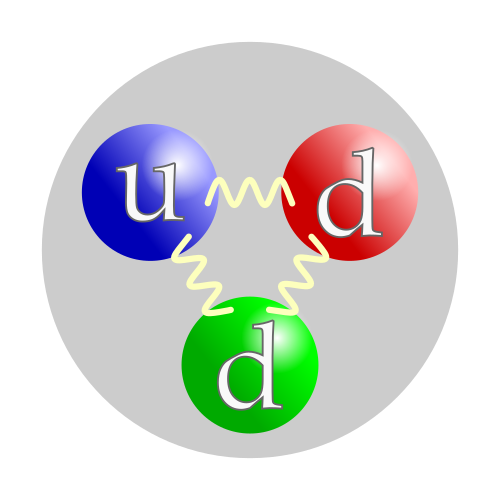
James Chadwick discovers the neutron, leading to the understanding that atomic nuclei consist of protons and neutrons, which later are considered composite particles made of quarks. #physics #history
Discovery of the Neutron By No machine-readable author provided. Harp assumed (based on copyright claims). - No machine-readable source provided. Own work assumed (based on copyright claims)., CC BY-SA 2.5, https://commons.wikimedia.org/w/index.php?curid=637381
1937 CE
Discovery of the Muon
The muon is discovered in cosmic rays by Carl D. Anderson and Seth Neddermeyer, marking the first detection of a lepton and hinting at a deeper substructure of matter. #physics #particle
1947 CE
Discovery of the Pion
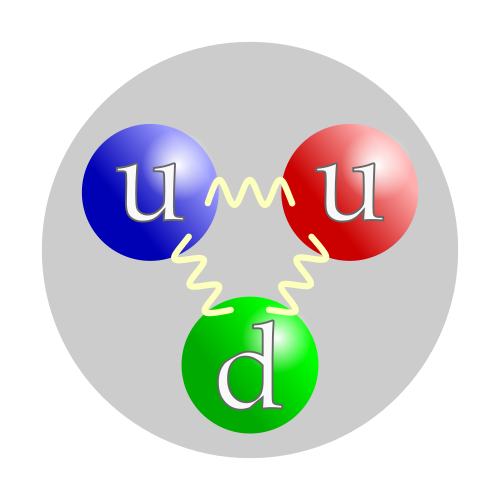
Cecil Powell and colleagues discover the pion, the mediator of the strong nuclear force, confirming Yukawa's prediction and advancing the study of hadrons. #physics #nuclear
Discovery of the Pion By No machine-readable author provided. Harp assumed (based on copyright claims). - No machine-readable source provided. Own work assumed (based on copyright claims)., CC BY-SA 2.5, https://commons.wikimedia.org/w/index.php?curid=637403
1952 CE
Discovery of the Delta Baryon
The Δ++ resonance is discovered at the University of Chicago cyclotron, providing early evidence for the existence of internal quark structure in baryons. #physics #hadron
1953 CE
Introduction of Strangeness
Murray Gell-Mann and Kazuhiko Nishijima independently introduce the concept of strangeness to explain the behavior of newly discovered particles, laying groundwork for the quark model. #physics #theory
1961 CE
The Eightfold Way
Murray Gell-Mann and Yuval Ne'eman propose the Eightfold Way, a SU(3) symmetry classification of hadrons, leading directly to the prediction of quarks. #physics #symmetry )
The Eightfold Way By Laurascudder - Own work, CC BY-SA 3.0, https://commons.wikimedia.org/w/index.php?curid=2379550
1964 CE
Prediction of the Omega-minus Baryon
The Omega-minus baryon, predicted by the quark model, is discovered at Brookhaven National Laboratory, confirming the SU(3) symmetry and quark hypothesis. #physics #discovery
Prediction of the Omega-minus Baryon By V. E. Barnes et al. - Observation of a Hyperon with Strangeness Minus Three, Phys. Rev. Lett. 12, 204, Public domain, https://commons.wikimedia.org/w/index.php?curid=10243833
1964 CE
Quark Model Proposed
Murray Gell-Mann and George Zweig independently propose the quark model, postulating that hadrons are composed of fractionally charged quarks. This revolutionizes particle physics. #physics #quarks
Quark Model Proposed By Vectorization: Alhadis - Own work based on: 8foldway.png by Bambaiah at English Wikipedia, CC BY-SA 3.0, https://commons.wikimedia.org/w/index.php?curid=125051765
1965 CE
Color Charge Introduced
Yoichiro Nambu, Moo-Young Han, and Oscar Greenberg introduce the concept of color charge to resolve the Pauli exclusion principle violation in baryons, a crucial step toward QCD. #physics #color
Color Charge Introduced By Cush - Own work using: PBS NOVA [1], Fermilab, Office of Science, United States Department of Energy, Particle Data Group, Public domain, https://commons.wikimedia.org/w/index.php?curid=4286964
1967 CE
SLAC Deep Inelastic Scattering Begins
Experiments at the Stanford Linear Accelerator Center (SLAC) begin deep inelastic scattering of electrons off protons, revealing pointlike constituents inside the proton, later identified as quarks. #physics #experiment
SLAC Deep Inelastic Scattering Begins By E2m - Own work, Public domain, https://commons.wikimedia.org/w/index.php?curid=1796747
1969 CE
Parton Model Proposed
Richard Feynman introduces the parton model to explain deep inelastic scattering results, envisaging hadrons as composed of pointlike partons, which are later identified with quarks and gluons. #physics #theory )
1971 CE
Discovery of Neutral Currents
Neutral weak currents are discovered at CERN, supporting the electroweak theory and paving the way for the Standard Model, which includes QCD. #physics #standardmodel
1973 CE
QCD Proposed as the Theory of Strong Interactions
Harald Fritzsch, Murray Gell-Mann, and Heinrich Leutwyler propose Quantum Chromodynamics (QCD) as the gauge theory of the strong interaction, based on the color SU(3) symmetry. #physics #QCD
1973 CE
Asymptotic Freedom Discovered
David Gross, Frank Wilczek, and David Politzer discover asymptotic freedom in non-Abelian gauge theories, showing that the strong force weakens at short distances, leading directly to QCD. #physics #Nobel
1974 CE
Discovery of the J/psi Meson
The J/ψ particle is independently discovered at SLAC and Brookhaven, providing evidence for the charm quark and demonstrating the power of the quark model and QCD. #physics #charm
Discovery of the J/psi Meson By https://commons.wikimedia.org/wiki/User:Harp - File:Quark_structure_pion.svg, CC BY-SA 4.0, https://commons.wikimedia.org/w/index.php?curid=46504895
1975 CE
Discovery of the Tau Lepton
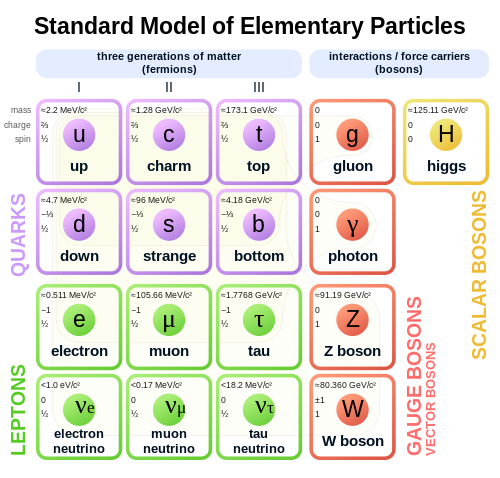
The tau lepton is discovered at SLAC by Martin Perl and colleagues, completing the third generation of leptons and hinting at the top and bottom quarks. #physics #lepton )
Discovery of the Tau Lepton By user:MissMJ - File:Standard Model of Elementary Particles.svg, CC BY 3.0, https://commons.wikimedia.org/w/index.php?curid=24692629
1977 CE
Discovery of the Upsilon Meson
The upsilon particle is discovered at Fermilab, confirming the existence of the bottom quark and further validating the quark model and QCD. #physics #bottom
Discovery of the Upsilon Meson By Unknown author, Public domain, https://commons.wikimedia.org/w/index.php?curid=1570293
1978 CE
Gluon Discovery at DESY
The gluon, the gauge boson of QCD, is indirectly discovered in three-jet events at the PETRA collider in DESY, confirming the existence of the force carrier of the strong interaction. #physics #gluon
Gluon Discovery at DESY By Joel Holdsworth (Joelholdsworth) - Non-Derived SVG of Radiate gluon.png, originally the work of SilverStar at Feynmann-diagram-gluon-radiation.svg, updated by joelholdsworth., Public domain, https://commons.wikimedia.org/w/index.php?curid=1764161
1979 CE
Discovery of Three-Jet Events
Experiments at DESY's PETRA collider observe three-jet events, providing direct evidence for gluon radiation and confirming the non-Abelian nature of QCD. #physics #QCD
Discovery of Three-Jet Events By SCZenz - https://en.wikipedia.org/wiki/File:Three_jet_gluon_string.png, CC BY-SA 3.0, https://commons.wikimedia.org/w/index.php?curid=28848681
1980 CE
Lattice QCD Introduced
Kenneth Wilson introduces lattice gauge theory, enabling non-perturbative calculations in QCD using a discretized spacetime lattice, a major computational breakthrough. #physics #lattice
1981 CE
Instanton Effects in QCD
The role of instantons in QCD is elucidated by 't Hooft and others, explaining the U(1) problem and providing insights into non-perturbative aspects of the theory. #physics #instanton
Instanton Effects in QCD By Tazerenix - Own work, CC BY-SA 4.0, https://commons.wikimedia.org/w/index.php?curid=109884236
1983 CE
Discovery of W and Z Bosons
The W and Z bosons are discovered at CERN, confirming the electroweak theory and establishing the Standard Model framework within which QCD is embedded. #physics #electroweak
Discovery of W and Z Bosons By Inductiveload - Own work, Public domain, https://commons.wikimedia.org/w/index.php?curid=2859203
1987 CE
First Measurement of the Strong Coupling Constant
Precise measurements of α_s from deep inelastic scattering and other processes begin, providing crucial tests of QCD and asymptotic freedom. #physics #coupling
1990 CE
Nobel Prize in Physics for QCD Pioneers
Jerome Friedman, Henry Kendall, and Richard Taylor receive the Nobel Prize for their deep inelastic scattering experiments at SLAC, which confirmed the existence of quarks. #physics #Nobel
Nobel Prize in Physics for QCD Pioneers By Copyright OIST (Okinawa Institute of Science and Technology Graduate University, 沖縄科学技術大学院大学) - 安倍晋三総理大臣との会談後のOIST理事会メンバーたち(2013年10月4日) | 沖縄科学技術大学院大学(OIST), CC BY 4.0, https://commons.wikimedia.org/w/index.php?curid=179782325
1994 CE
Top Quark Discovery at Fermilab
The top quark, the sixth and heaviest quark, is discovered by the CDF and DØ collaborations at Fermilab, completing the quark sector of the Standard Model. #physics #top
Top Quark Discovery at Fermilab By user:MissMJ - File:Standard Model of Elementary Particles.svg, CC BY 3.0, https://commons.wikimedia.org/w/index.php?curid=24657343
2000 CE
Quark-Gluon Plasma Observed at CERN
Experiments at CERN's Super Proton Synchrotron provide first evidence for a new state of matter, the quark-gluon plasma, at high temperatures and densities. #physics #QGP
Quark-Gluon Plasma Observed at CERN By Rajeev S. Bhalerao(Tata Inst.) - Modified version of: Rajeev S. Bhalerao(Tata Inst.) - 1st Asia-Europe-Pacific School of High-Energy Physics (AEPSHEP 2012), pp. 219-239 Relativistic heavy-ion collisions DOI: 10.5170/CERN-2014-001.219, CC BY 4.0, https://commons.wikimedia.org/w/index.php?curid=89883392
2001 CE
RHIC Begins Operations
The Relativistic Heavy Ion Collider (RHIC) at Brookhaven starts operations, dedicated to studying quark-gluon plasma and the strong interaction under extreme conditions. #physics #collider
RHIC Begins Operations By Z22 - Own work, CC BY-SA 4.0, https://commons.wikimedia.org/w/index.php?curid=61541447
2003 CE
First Lattice QCD Calculation of Hadron Masses
Large-scale lattice QCD calculations successfully compute the masses of light hadrons from first principles, demonstrating the predictive power of QCD. #physics #lattice
2004 CE
Nobel Prize for Asymptotic Freedom
David Gross, Frank Wilczek, and David Politzer receive the Nobel Prize for their discovery of asymptotic freedom in QCD. #physics #Nobel
2008 CE
LHC Starts Operations
The Large Hadron Collider at CERN begins operations, enabling high-energy proton-proton and heavy-ion collisions to test QCD at unprecedented energies. #physics #LHC
LHC Starts Operations By Arpad Horvath - Drawn by Arpad Horvath with Inkscape., CC BY-SA 2.5, https://commons.wikimedia.org/w/index.php?curid=679693
2010 CE
First Observation of Quark-Gluon Plasma at LHC
The ALICE experiment at the LHC observes a quark-gluon plasma with properties consistent with a nearly perfect liquid. #physics #QGP
First Observation of Quark-Gluon Plasma at LHC By Antonio Saba - http://cds.cern.ch/record/1436153?ln=it, CC BY-SA 3.0, https://commons.wikimedia.org/w/index.php?curid=31414778
2011 CE
Discovery of the Pentaquark
The LHCb experiment at CERN reports evidence for a pentaquark state, a hadron composed of five quarks, providing new insights into QCD bound states. #physics #pentaquark
Discovery of the Pentaquark By Headbomb - Own work, CC BY-SA 4.0, https://commons.wikimedia.org/w/index.php?curid=41591193
2012 CE
Discovery of the Higgs Boson
The Higgs boson is discovered at the LHC, confirming the mechanism of mass generation and completing the Standard Model particle roster, though QCD remains a key component. #physics #Higgs
Discovery of the Higgs Boson By CERN for the ATLAS and CMS Collaborations - https://cds.cern.ch/record/1630222, CC BY-SA 3.0, https://commons.wikimedia.org/w/index.php?curid=29737816
2013 CE
Observation of the Z(4430) Tetraquark Candidate
The Belle and LHCb collaborations confirm the existence of the Z(4430) tetraquark candidate, a state with four quarks, expanding the hadron spectrum predicted by QCD. #physics #tetraquark
2015 CE
Lattice QCD Calculation of Proton Structure
Advances in lattice QCD allow precise calculations of the proton's internal structure, including parton distribution functions and spin contributions. #physics #lattice
2017 CE
Observation of the Double-Charm Baryon Xi_cc
The LHCb experiment discovers the Ξ_cc++ baryon, a particle with two charm quarks, providing a new test for QCD models of heavy baryons. #physics #baryon
Observation of the Double-Charm Baryon Xi_cc By Arpad Horvath - Own work, CC BY-SA 2.5, https://commons.wikimedia.org/w/index.php?curid=637353
2018 CE
First Glimpse of the Proton's Gluon Density
Using lattice QCD, researchers map the gluon distribution inside the proton, deepening understanding of its internal dynamics. #physics #gluon
2019 CE
Electron-Ion Collider Approved
The US Department of Energy approves the construction of the Electron-Ion Collider (EIC) to study the gluon structure of hadrons with unprecedented precision. #physics #EIC
2020 CE
Evidence for Gluon Saturation
The LHCb experiment reports evidence for gluon saturation at low momentum fraction, a phenomenon predicted by QCD in high-energy collisions. #physics #saturation
2021 CE
Muonic Atom Spectroscopy Tests QED/QCD
Precision measurements of muonic hydrogen and muonic atoms provide stringent tests of quantum electrodynamics and hadronic contributions, refining parameters like the proton charge radius. #physics #QED
2022 CE
Breakthrough in Lattice QCD for Neutron Properties
Lattice QCD calculations achieve a precise determination of the neutron electric dipole moment, constraining CP violation in the strong force. #physics #neutron
2023 CE
Observation of a New Type of Pentaquark
The LHCb experiment observes a new pentaquark state with an open charm, adding to the growing family of exotic hadrons. #physics #pentaquark
2024 CE
Proton Spin Puzzle Progress
Experiments at RHIC and theoretical advances refine our understanding of the proton spin composition, showing significant contributions from gluons and sea quarks. #physics #spin
2024 CE
High-Statistics Measurement of the Strong Coupling Constant
The CMS experiment at the LHC publishes the most precise determination of α_s from jet cross sections, further testing QCD predictions. #physics #coupling