Qin Shi Huang: First Emperor, Terracotta Army & Great Wall Unification
Encyclopedia/3. History, Societies & Civilizations/01. East Asian Civilizations/05. East Asian Biographies • Curated by Admin Timeline.sg
Qin Shi Huang (Ying Zheng) was the first emperor of a unified China, known for standardizing laws, writing, and measurements, constructing the Great Wall, and commissioning the Terracotta Army. His reign from 246 BCE to 210 BCE marked the beginning of the Qin dynasty and laid the foundations for imperial China.
Chronological Storyline (40 Milestones)
260 BCE
Battle of Changping
Qin defeats Zhao in a brutal battle, massacring 400,000 captives—a precursor to unification. #history #china
Battle of Changping By SY - Own work, CC BY-SA 4.0, https://commons.wikimedia.org/w/index.php?curid=60821414
259 BCE
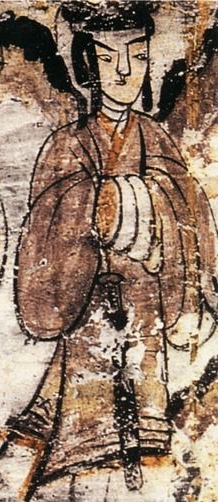
Birth of Ying Zheng
Ying Zheng is born in Handan, the capital of Zhao, to Qin prince Yiren and Lady Zhao. #history #china
Birth of Ying Zheng By Unknown (18??–18??) - Portal, Jane (Ed.). The first emperor: China's Terracotta Army. Cambridge, Massachusetts: Harvard University Press, 2007 ISBN 978-0-674-02697-7 Invalid ISBN (p.29), Public domain, https://commons.wikimedia.org/w/index.php?curid=164928091
257 BCE
Escape from Handan
Young Ying Zheng escapes from Zhao with his father Yiren, aided by merchant Lü Buwei. #history #china
250 BCE
Father Yiren becomes King Zhuangxiang of Qin
Yiren ascends the throne as King Zhuangxiang, with Lü Buwei as chancellor. #history #china
247 BCE
Ascension as King of Qin
At age 13, Ying Zheng becomes King of Qin after his father's death, with Lü Buwei as regent. #history #china
246 BCE
Start of irrigation projects
The Zheng Guo Canal is completed later, transforming the Guanzhong plain into a granary. #history #china
246 BCE
Start of Zheng Guo Canal construction
Engineer Zheng Guo begins building an irrigation canal to boost Qin's agricultural productivity. #history #china
241 BCE
First coalition of remaining states against Qin
Five states unite to attack Qin but are defeated, showcasing Qin's military strength. #history #china
238 BCE
Lao Ai rebellion suppressed
King Ying Zheng crushes a rebellion led by Lao Ai, a rival court eunuch, consolidating his power. #history #china
237 BCE
Lü Buwei dismissed
Ying Zheng forces chancellor Lü Buwei into exile after scandal, taking full control of the state. #history #china
Lü Buwei dismissed By 取自清代修《安徽旌德吕氏宗谱》 - http://diglweb.zjlib.cn:8081/zjtsg/mingren/cyxl.jsp?record=2267&back=-67&channelid=91673, Public domain, https://commons.wikimedia.org/w/index.php?curid=121645362
230 BCE
Conquest of Han
Qin annexes the Han state, the weakest of the Warring States, beginning the unification campaign. #history #china
228 BCE
Conquest of Zhao
Qin defeats Zhao after a siege of Handan, with General Wang Jian leading the campaign. #history #china
Conquest of Zhao By Philg88 - Own work, CC BY-SA 3.0, https://commons.wikimedia.org/w/index.php?curid=11962962
225 BCE
Conquest of Wei
Qin forces capture the Wei capital Daliang, ending the Wei state. #history #china
Conquest of Wei By Philg88 - Own work, CC BY-SA 3.0, https://commons.wikimedia.org/w/index.php?curid=11944658
223 BCE
Conquest of Chu
After initial setbacks, Qin under Wang Jian conquers Chu, the largest southern state. #history #china
Conquest of Chu By Jiu Qiaozai - Own work 地形圖數據:ETOPO1 矢量底图数据:www.naturalearthdata.com 参考地图:zh:中国历史地图_(1980年)战国部分、zh:中国历史地图集战国部分 参考书籍:周振鹤主编《中国行政区划通史·总论、先秦卷》, CC BY-SA 3.0, https://commons.wikimedia.org/w/index.php?curid=20477957
222 BCE
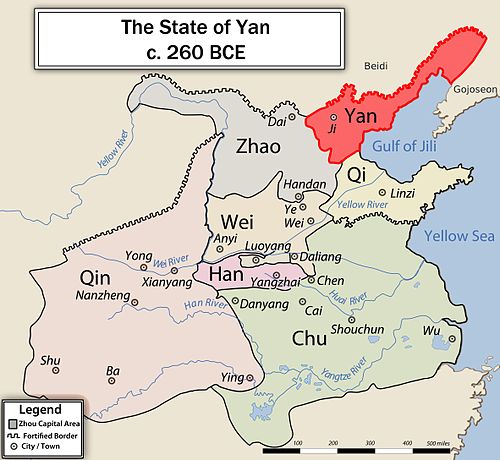
Conquest of Yan
Qin forces defeat Yan, capturing Prince Dan who had sent an assassin. #history #china
Conquest of Yan By Philg88 - Own work, CC BY-SA 3.0, https://commons.wikimedia.org/w/index.php?curid=11953752
221 BCE
Conquest of Qi
Qi surrenders without major resistance, completing the unification of China under Qin. #history #china
Conquest of Qi By Philg88 - Own work, CC BY-SA 3.0, https://commons.wikimedia.org/w/index.php?curid=11926165
221 BCE
Standardization of script and measures
The emperor orders uniform written characters, weights, measures, and axle lengths across the empire. #history #china
Standardization of script and measures By Ian Remsen - Modern natural borders from Natural Earth Albers used for the map projection, via svgis λ 0 = 110 {\displaystyle \lambda _{0}=110} φ 0 = 30 {\displaystyle \varphi _{0}=30} φ 1 = 25 {\displaystyle \varphi _{1}=25} φ 2 = 37 {\displaystyle \varphi _{2}=37} Political borders, location of the Great Wall, and adjustments to reflect ancient borders from Li, Feng (2013) Early China: A Social and Cultural History, New Approaches to Asian History, 12, Cambridge University Press, p. 246 DOI: 10.1017/CBO9781139034395. ISBN: 978-0-521-89552-1. Square represents the Qin capital at Xianyang Dotted open circles represent population centers whose precise locations are unclear, CC0, https://commons.wikimedia.org/w/index.php?curid=158113722
221 BCE
Standardization of currency
Ban Liang coins are introduced as the national currency, replacing varied state coinages. #history #china
221 BCE
Proclamation as Shi Huangdi
Ying Zheng adopts the title 'Shi Huangdi' (First Emperor), claiming a divine mandate to rule. #history #china
221 BCE
Standardization of axle lengths
Axle lengths are standardized to fit into uniform ruts, improving road transport efficiency. #history #china
220 BCE
First imperial inspection tour
Qin Shi Huang travels to the west, erecting steles to proclaim his achievements. #history #china
219 BCE
Mount Tai sacrifices and Eastern tour
The emperor performs the Feng and Shan sacrifices on Mount Tai, asserting his heavenly mandate. #history #china
Mount Tai sacrifices and Eastern tour By xiquinhosilva - 50304-Taishan, CC BY 2.0, https://commons.wikimedia.org/w/index.php?curid=138503943
218 BCE
Assassination attempt at Bolangsha
Zhang Liang attempts to assassinate the emperor with a heavy iron cone but misses. #history #china
Assassination attempt at Bolangsha By 西汉画家 - 洛阳古墓博物馆, CC BY-SA 4.0, https://commons.wikimedia.org/w/index.php?curid=59655552
215 BCE
Campaign against the Xiongnu
General Meng Tian leads a large army north to expel the Xiongnu nomads and secure the frontier. #history #china
215 BCE
Construction of national road network
Roads and highways are built to connect the empire, including the Straight Road to the north. #history #china
214 BCE
Great Wall linked and expanded
Existing northern fortifications are linked to form a continuous defensive wall against the Xiongnu. #history #china
Great Wall linked and expanded By Severin.stalder - Own work, CC BY-SA 3.0, https://commons.wikimedia.org/w/index.php?curid=39661035
214 BCE
Conquest of Yue tribes in the south
Qin armies subdue the Baiyue peoples in what is now Guangdong and Guangxi. #history #china
214 BCE
Construction of Lingqu Canal
The Lingqu Canal is built to connect the Xiang and Li rivers for military transport to the south. #history #china
Construction of Lingqu Canal By Farm - Own work, CC BY 3.0, https://commons.wikimedia.org/w/index.php?curid=6907371
213 BCE
Li Si's legalist reforms
Chancellor Li Si enforces strict legalist policies, including harsh punishments and centralized control. #history #china
213 BCE
Book burning decree
Li Si proposes burning of books that criticize the new regime, keeping only practical and Qin records. #history #china
Book burning decree By Itsmine - Self-published work by Itsmine, CC BY-SA 3.0, https://commons.wikimedia.org/w/index.php?curid=1389340
212 BCE
Execution of scholars and burying alive
Over 460 scholars are executed or buried alive for opposing the burning of books. #history #china
212 BCE
Construction of Epang Palace
The Epang Palace, a lavish complex, is begun on the south bank of the Wei River. #history #china
Construction of Epang Palace By Kcx36 - Own work, CC BY-SA 4.0, https://commons.wikimedia.org/w/index.php?curid=138426500
212 BCE
Attempts to build palaces and parks
Hundreds of palaces are constructed across the empire, imitating the conquered states' architecture. #history #china
210 BCE
Terracotta Army created
Thousands of life-sized terracotta warriors are crafted to accompany the emperor in the afterlife. #history #china #art
Terracotta Army created By xiquinhosilva - https://www.flickr.com/photos/xiquinho/27718581472/in/album-72157669496699682/, CC BY 2.0, https://commons.wikimedia.org/w/index.php?curid=147287690
210 BCE
Death of Qin Shi Huang
Qin Shi Huang dies at age 49 during a tour; death is kept secret to allow political maneuvering. #history #china
210 BCE
Second imperial tour and search for immortality
The emperor travels east, seeking the elixir of life from immortals. #history #china
210 BCE
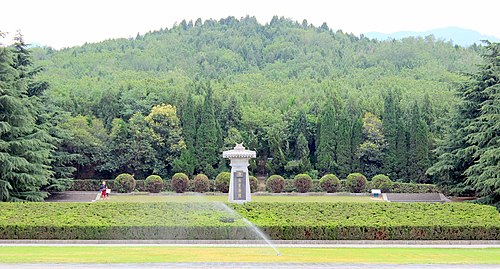
Burial in Mount Li mausoleum
The emperor is interred in a massive tomb complex near modern Xi'an, guarded by the Terracotta Army. #history #china #archaeology
Burial in Mount Li mausoleum By Aaron Zhu - https://web.archive.org/web/20161103115623/http://www.panoramio.com/photo/131608425, CC BY-SA 3.0, https://commons.wikimedia.org/w/index.php?curid=61014258
210 BCE
Zhao Gao's plot and rise
Eunuch Zhao Gao conspires with Hu Hai to alter the succession after the emperor's death. #history #china
209 BCE
Dazexiang Uprising begins
Peasant revolt led by Chen Sheng and Wu Guang initiates rebellions that will topple the Qin dynasty. #history #china
Dazexiang Uprising begins By SY - Own work, CC BY-SA 4.0, https://commons.wikimedia.org/w/index.php?curid=63577599
209 BCE
Qin Er Shi succeeds to the throne
Hu Hai, son of Qin Shi Huang, ascends as the Second Emperor under the influence of Zhao Gao. #history #china