Qin & Han Dynasties: Unification, Great Wall & The First Silk Road
Encyclopedia/3. History, Societies & Civilizations/01. East Asian Civilizations/01. Chinese Dynasties • Curated by Admin Timeline.sg
The Qin and Han dynasties (221 BCE–220 CE) established the foundations of imperial China through unification, standardization, territorial expansion, and the opening of the Silk Road. Key milestones include Qin Shi Huang's reforms, Han Wudi's campaigns, Zhang Qian's missions to Central Asia, and Sima Qian's historical records.
Chronological Storyline (47 Milestones)
230 BCE
Qin Conquest of Han
The state of Qin conquers the Han state, beginning the final phase of the Warring States period. This marks the first step toward Qin's unification of China. #QinDynasty #WarringStates
Qin Conquest of Han By Benedetta blair - Own work, CC BY-SA 4.0, https://commons.wikimedia.org/w/index.php?curid=45623632
228 BCE
Qin Conquest of Zhao
Qin forces capture the Zhao capital of Handan, defeating the Zhao state. The conquest weakens remaining resistance to Qin hegemony. #QinDynasty #WarringStates
225 BCE
Qin Conquest of Wei
The Qin army destroys the Wei state, further consolidating Qin control over central China. This victory brings Qin closer to total unification. #QinDynasty #WarringStates
223 BCE
Qin Conquest of Chu
Qin defeats the large southern state of Chu, overcoming its vast territory and military strength. The conquest removes a major obstacle to unification. #QinDynasty #WarringStates
222 BCE
Qin Conquest of Yan and Dai
Qin forces conquer the northeastern states of Yan and Dai, extending Qin control to the Korean border. The remaining independent states are now isolated. #QinDynasty #WarringStates
221 BCE
Qin Unification of China
King Zheng of Qin conquers the last independent state of Qi, unifying China under the Qin dynasty. He proclaims himself Qin Shi Huang (First Emperor), standardizing script, currency, weights, and measures. #QinDynasty #Unification
Qin Unification of China By Unknown (18??–18??) - Portal, Jane (Ed.). The first emperor: China's Terracotta Army. Cambridge, Massachusetts: Harvard University Press, 2007 ISBN 978-0-674-02697-7 Invalid ISBN (p.29), Public domain, https://commons.wikimedia.org/w/index.php?curid=164928091
220 BCE
Standardization of Script and Measures
Qin Shi Huang orders the standardization of Chinese characters, currency, and axle lengths to unify the empire. These reforms facilitate administration and trade across the newly conquered territories. #QinDynasty #Standardization
215 BCE
Construction of the Great Wall Begins
Qin Shi Huang orders the connection and extension of existing fortifications to form a unified Great Wall against northern nomads. The project mobilizes millions of laborers and becomes a symbol of imperial power. #GreatWall #QinDynasty
Construction of the Great Wall Begins By Severin.stalder - Own work, CC BY-SA 3.0, https://commons.wikimedia.org/w/index.php?curid=39661035
213 BCE
Burning of Books and Burying of Scholars
Qin Shi Huang orders the burning of historical records and philosophical texts to suppress dissent and consolidate ideological control. Hundreds of Confucian scholars are executed, marking a dark chapter in Chinese history. #QinDynasty #Censorship
Burning of Books and Burying of Scholars By Itsmine - Self-published work by Itsmine, CC BY-SA 3.0, https://commons.wikimedia.org/w/index.php?curid=1389340
210 BCE
Death of Qin Shi Huang
Qin Shi Huang dies during an eastern inspection tour, possibly from mercury poisoning due to his elixir of immortality. His death triggers a succession crisis and widespread rebellion. #QinDynasty #Death
209 BCE
Dazexiang Uprising
Chen Sheng and Wu Guang lead a revolt of conscripted peasants against Qin rule, sparking widespread rebellions. The uprising marks the beginning of the end for the Qin dynasty. #QinDynasty #Rebellion
Dazexiang Uprising By SY - Own work, CC BY-SA 4.0, https://commons.wikimedia.org/w/index.php?curid=63577599
207 BCE
Battle of Julu
Xiang Yu defeats the main Qin army at Julu, decisively breaking Qin military power. The victory paves the way for the collapse of the Qin dynasty. #QinDynasty #Battle
Battle of Julu By Vitsuha - Own work, CC0, https://commons.wikimedia.org/w/index.php?curid=170999727
206 BCE
Fall of the Qin Dynasty
The last Qin ruler, Ziying, surrenders to rebel forces led by Liu Bang, ending the Qin dynasty. The capital Xianyang is sacked, and China descends into civil war. #QinDynasty #Fall
Fall of the Qin Dynasty By Ian Remsen - Modern natural borders from Natural Earth Albers used for the map projection, via svgis λ 0 = 110 {\displaystyle \lambda _{0}=110} φ 0 = 30 {\displaystyle \varphi _{0}=30} φ 1 = 25 {\displaystyle \varphi _{1}=25} φ 2 = 37 {\displaystyle \varphi _{2}=37} Political borders, location of the Great Wall, and adjustments to reflect ancient borders from Li, Feng (2013) Early China: A Social and Cultural History, New Approaches to Asian History, 12, Cambridge University Press, p. 246 DOI: 10.1017/CBO9781139034395. ISBN: 978-0-521-89552-1. Square represents the Qin capital at Xianyang Dotted open circles represent population centers whose precise locations are unclear, CC0, https://commons.wikimedia.org/w/index.php?curid=158113722
202 BCE
Battle of Gaixia
Liu Bang defeats Xiang Yu at Gaixia, ending the Chu-Han Contention. Liu Bang proclaims himself Emperor Gaozu of Han, founding the Han dynasty. #HanDynasty #Battle
200 BCE
Siege of Baideng
Emperor Gaozu is trapped by Xiongnu forces at Baideng, leading to a humiliating treaty. The Han dynasty agrees to a heqin marriage alliance and tribute payments to the Xiongnu. #HanDynasty #Xiongnu
195 BCE
Death of Emperor Gaozu
Liu Bang dies, succeeded by his son Emperor Hui. The early Han period sees consolidation of power and restoration of Confucian learning. #HanDynasty #Death
Death of Emperor Gaozu By Unknown author - http://earlyworldhistory.blogspot.com/2012/03/liu-bang.html, Public domain, https://commons.wikimedia.org/w/index.php?curid=70464970
180 BCE
Lü Clan Disturbance
After the death of Empress Lü Zhi, the Lü clan attempts to seize power but is crushed by loyalist forces. The event restores Liu family rule and leads to the ascension of Emperor Wen. #HanDynasty #PowerStruggle
Lü Clan Disturbance By Jean-Pierre Dalbéra from Paris, France - Splendeurs des Han (musée Guimet), CC BY 2.0, https://commons.wikimedia.org/w/index.php?curid=37212840
141 BCE
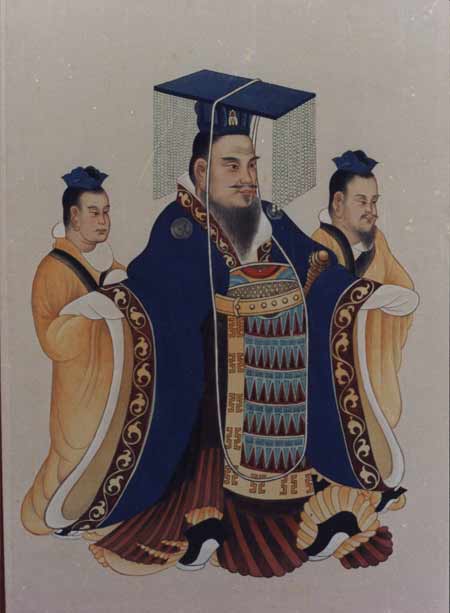
Accession of Emperor Wu of Han
Emperor Wu (Han Wudi) ascends the throne at age 16, beginning a 54-year reign. His rule marks the height of Han power with military expansion and cultural flourishing. #HanDynasty #EmperorWu
Accession of Emperor Wu of Han By Unknown author - Colored portrait and a black and white rubbing of the portrait, Public domain, https://commons.wikimedia.org/w/index.php?curid=8151462
138 BCE
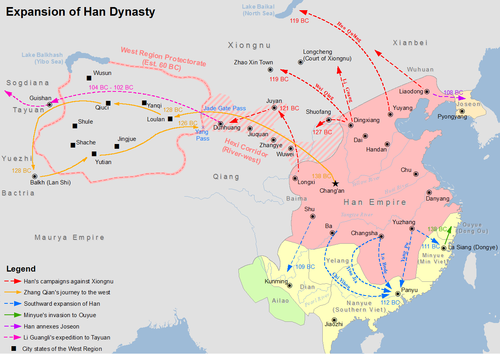
Zhang Qian's First Mission to the West
Emperor Wu sends Zhang Qian on a diplomatic mission to seek allies against the Xiongnu. Although captured by Xiongnu, Zhang Qian gathers crucial intelligence about Central Asia. #SilkRoad #HanDynasty
Zhang Qian's First Mission to the West By PHG - copied from en wp, Public domain, https://commons.wikimedia.org/w/index.php?curid=721599
133 BCE
Battle of Mayi
Emperor Wu launches a failed ambush against the Xiongnu at Mayi, ending the heqin policy. This marks the beginning of large-scale Han offensives against the Xiongnu. #HanDynasty #Xiongnu
127 BCE
Han Conquest of the Ordos Loop
General Wei Qing defeats the Xiongnu and captures the Ordos region, securing the northern frontier. The area is settled with Han colonists and fortified. #HanDynasty #Xiongnu
126 BCE
Zhang Qian Returns to China
Zhang Qian returns to Chang'an after 12 years, bringing detailed reports of Central Asian kingdoms. His mission lays the groundwork for the Silk Road trade network. #SilkRoad #HanDynasty
121 BCE
Battle of the Hexi Corridor
General Huo Qubing defeats the Xiongnu and secures the Hexi Corridor, opening the route to the Western Regions. The Han establish commanderies and military colonies along the corridor. #HanDynasty #Xiongnu
119 BCE
Battle of Mobei
Han forces under Wei Qing and Huo Qubing launch a massive campaign deep into Xiongnu territory, inflicting a decisive defeat. The Xiongnu are forced to retreat north of the Gobi Desert. #HanDynasty #Xiongnu
Battle of Mobei By Rob Oo from NL - See the world in one glance, CC BY 2.0, https://commons.wikimedia.org/w/index.php?curid=97521980
115 BCE
Zhang Qian's Second Mission
Zhang Qian leads a second mission to the Western Regions, establishing diplomatic relations with Wusun and other states. The mission strengthens Han influence and trade along the Silk Road. #SilkRoad #HanDynasty
111 BCE
Han Conquest of Nanyue
Emperor Wu conquers the kingdom of Nanyue (modern Vietnam and southern China), expanding Han territory to the South China Sea. The region is incorporated as Han commanderies. #HanDynasty #Expansion
Han Conquest of Nanyue By SY - Own work, CC BY-SA 4.0, https://commons.wikimedia.org/w/index.php?curid=60814987
109 BCE
Han Conquest of Dian
The Han dynasty conquers the Dian kingdom in Yunnan, bringing the southwest under imperial control. The region is integrated into the Han administrative system. #HanDynasty #Expansion
108 BCE
Han Conquest of Gojoseon
Emperor Wu conquers the Korean kingdom of Gojoseon, establishing four commanderies in northern Korea. This marks the first direct Chinese rule over part of the Korean peninsula. #HanDynasty #Korea
104 BCE
Sima Qian Begins Writing Shiji
Sima Qian begins compiling the Records of the Grand Historian (Shiji), a comprehensive history of China from mythical origins to his own time. The work sets the standard for Chinese historiography. #Shiji #History
Sima Qian Begins Writing Shiji By Unknown author - scan from 《社会历史博物馆》 ISBN 7-5347-1397-8, Public domain, https://commons.wikimedia.org/w/index.php?curid=93327
100 BCE
Su Wu's Mission to the Xiongnu
Han envoy Su Wu is captured by the Xiongnu and held for 19 years, refusing to defect. His loyalty becomes a symbol of Han patriotism and diplomatic integrity. #HanDynasty #Diplomacy
Su Wu's Mission to the Xiongnu By Huang Shen (1687–after 1770) - https://www.shanximuseum.com.cn/sx/collection/detail/id/903, Public domain, https://commons.wikimedia.org/w/index.php?curid=190523197
91 BCE
Completion of the Shiji
Sima Qian completes the Shiji, covering over 2,500 years of Chinese history in 130 chapters. The work introduces the biographical format and remains a foundational text of Chinese historiography. #Shiji #History
Completion of the Shiji By Zhonghua Book Company - Photo taken by Chinese Wikipedia user huowax, Public domain, https://commons.wikimedia.org/w/index.php?curid=48989967
87 BCE
Death of Emperor Wu
Emperor Wu dies after a 54-year reign, leaving a legacy of expansion and centralization. His later years saw economic strain and a succession crisis. #HanDynasty #Death
60 BCE
Establishment of the Protectorate of the Western Regions
The Han dynasty establishes the Protectorate of the Western Regions to administer the Tarim Basin city-states. This formalizes Han control over the Silk Road and facilitates trade. #SilkRoad #HanDynasty
33 BCE
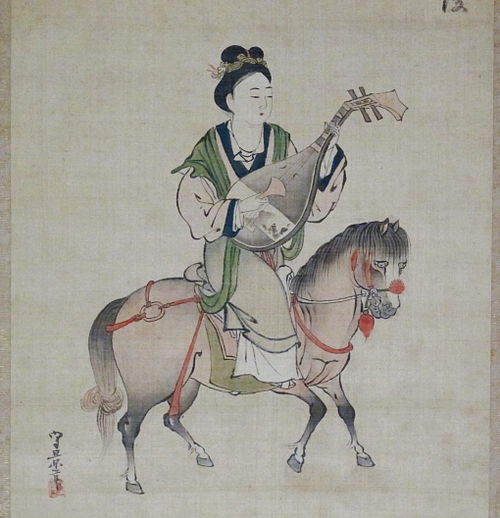
Wang Zhaojun Marries Xiongnu Chanyu
Han court lady Wang Zhaojun is married to the Xiongnu chanyu Huhanye as part of a peace alliance. The marriage brings a period of peace between Han and Xiongnu. #HanDynasty #Xiongnu
Wang Zhaojun Marries Xiongnu Chanyu By Sailko - Own work, CC BY-SA 3.0, https://commons.wikimedia.org/w/index.php?curid=19831108
9 CE
Wang Mang Seizes Power
Regent Wang Mang usurps the Han throne, founding the Xin dynasty. His radical reforms, including land redistribution and currency changes, lead to widespread unrest. #XinDynasty #Usurpation
Wang Mang Seizes Power By 鍾 惺, 1574-1624 - Waseda University Library, Public domain, https://commons.wikimedia.org/w/index.php?curid=178862384
23 CE
Battle of Kunyang
Rebel forces under Liu Xiu defeat Wang Mang's army at Kunyang, a decisive victory that leads to the fall of the Xin dynasty. Liu Xiu later restores the Han dynasty as Emperor Guangwu. #HanDynasty #Rebellion
Battle of Kunyang By SY - Own work, CC BY-SA 4.0, https://commons.wikimedia.org/w/index.php?curid=63223565
25 CE
Restoration of the Han Dynasty
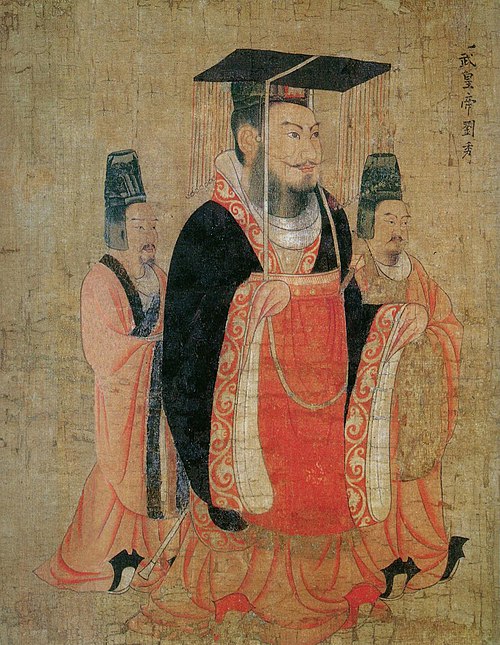
Liu Xiu proclaims himself Emperor Guangwu, reestablishing the Han dynasty with its capital at Luoyang. This marks the beginning of the Eastern Han period. #HanDynasty #Restoration
Restoration of the Han Dynasty By Yan Li-pen - Taken from http://hi.baidu.com/%CB%CE%BE%FC%D2%C5%C3%F1/album/%D1%D6%C1%A2%B1%BE%20%C0%FA%B4%FA%B5%DB%CD%F5%CD%BC%BE%ED. Original collection can be viewed at Museum of Fine Arts., Public domain, https://commons.wikimedia.org/w/index.php?curid=2233718
73 CE
Ban Chao's Mission to the Western Regions
General Ban Chao leads a diplomatic and military mission to reassert Han control over the Western Regions. His efforts restore the Silk Road and extend Han influence to the Caspian Sea. #SilkRoad #HanDynasty
Ban Chao's Mission to the Western Regions By Unknown artist - National Palace Museum, Public domain, https://commons.wikimedia.org/w/index.php?curid=151461164
89 CE
Battle of the Altai Mountains
Han forces under Dou Xian defeat the Northern Xiongnu, destroying their power. The victory secures the northern frontier and allows Han expansion into Mongolia. #HanDynasty #Xiongnu
97 CE
Gan Ying's Mission to the Roman Empire
Ban Chao sends envoy Gan Ying to reach the Roman Empire, but he turns back at the Persian Gulf. The mission demonstrates Han interest in long-distance diplomacy and trade. #SilkRoad #HanDynasty
105 CE
Cai Lun Improves Papermaking
Cai Lun, a Han court eunuch, perfects a method for making paper from tree bark, hemp, and rags. This innovation revolutionizes record-keeping and spreads across the world. #HanDynasty #Invention
Cai Lun Improves Papermaking By Unknown author - Tsien Tsuen-Hsuin (1985) Needham, Joseph, ed. Science and Civilisation in China: Volume 5, Chemistry and Chemical Technology, Part 1, Paper and Printing, Taipei: Caves Books, pp. 108–109 ISBN: 978-0-521-08690-5. Etnografiska museet, Stockholm: 1935.50.3366.30, Public domain, https://commons.wikimedia.org/w/index.php?curid=3154438
132 CE
Zhang Heng Invents the Seismoscope
Han scientist Zhang Heng creates the first seismoscope, a device that detects earthquakes from hundreds of kilometers away. The invention demonstrates advanced Han engineering and scientific knowledge. #HanDynasty #Science
Zhang Heng Invents the Seismoscope By Windmemories - Own work, CC BY-SA 4.0, https://commons.wikimedia.org/w/index.php?curid=176246974
166 CE
First Roman Embassy to China
A group of Roman merchants, claiming to be envoys from Emperor Antoninus Pius, arrives at the Han court. This marks the first direct contact between the Roman and Han empires. #SilkRoad #HanDynasty
First Roman Embassy to China By Thomas Lessman (Contact!) - Own work (For reference information, see the Map Source References section below.), CC BY-SA 3.0, https://commons.wikimedia.org/w/index.php?curid=4019603
184 CE
Yellow Turban Rebellion
The Yellow Turban Rebellion, led by Zhang Jue, erupts against Han corruption and high taxes. Although suppressed, the rebellion weakens central authority and leads to warlordism. #HanDynasty #Rebellion
Yellow Turban Rebellion By SY - Own work, CC BY-SA 4.0, https://commons.wikimedia.org/w/index.php?curid=62648652
189 CE
Massacre of the Eunuchs
Warlord Yuan Shao leads a massacre of eunuchs in the Han palace, ending their political influence. The power vacuum leads to the rise of Dong Zhuo and the collapse of central authority. #HanDynasty #PowerStruggle
Massacre of the Eunuchs By 周曰校(Before 1640) - 《新刊校正古本大字音释三国志通俗演义》.内附版画.二百四十幅.明万历十九年书林周曰校刊本, Public domain, https://commons.wikimedia.org/w/index.php?curid=81270257
190 CE
Campaign Against Dong Zhuo
A coalition of warlords led by Yuan Shao rises against the tyrant Dong Zhuo, who controls the Han court. The campaign plunges China into civil war, marking the end of effective Han rule. #HanDynasty #Warlords
Campaign Against Dong Zhuo By Shizhao - Own work, Public domain, https://commons.wikimedia.org/w/index.php?curid=1166335
220 CE
End of the Han Dynasty
Cao Pi, son of warlord Cao Cao, forces Emperor Xian to abdicate, ending the Han dynasty. The event ushers in the Three Kingdoms period, with Wei, Shu, and Wu vying for control. #HanDynasty #ThreeKingdoms
End of the Han Dynasty By Gary Lee Todd - http://www.garyleetodd.com/chinese-museums-online/luoyang-6-horse-chariot-burial-tomb-museum/, CC BY-SA 4.0, https://commons.wikimedia.org/w/index.php?curid=4918196