Encyclopedia/3. History, Societies & Civilizations/01. East Asian Civilizations • Curated by Admin Timeline.sg
The Qin dynasty (221–207 BCE) ended the Warring States period to unify China under a centralized imperial system, standardizing writing, currency, and measures. The Han dynasty (206 BCE–220 CE) succeeded, expanding the empire, developing bureaucracy, and fostering cultural and technological innovations that shaped East Asian civilization.
Chronological Storyline (43 Milestones)
770 BCE
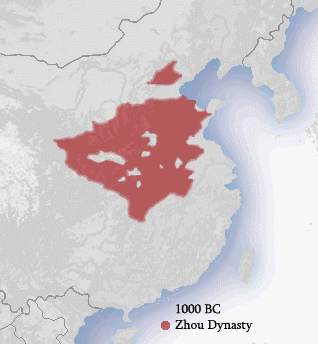
Eastern Zhou Dynasty Begins
The Zhou dynasty moves east to Luoyang, marking the start of the Spring and Autumn period. This era of feudal fragmentation precedes the Warring States period. #history #china
Eastern Zhou Dynasty Begins By Territories_of_Dynasties_in_China.gif: Ian Kiu - Territories_of_Dynasties_in_China.gif: Albert Herrmann (1935). History and Commercial Atlas of China. Harvard University Press. from "The Chou Dynasty, 11th-9th Centuries B.C.", CC BY-SA 3.0, https://commons.wikimedia.org/w/index.php?curid=13309273
475 BCE
Warring States Period Begins
The Warring States period begins, characterized by intense warfare among seven major states. This era ends with Qin's unification. #history #china
Warring States Period Begins By Philg88 - Own work, CC BY-SA 3.0, https://commons.wikimedia.org/w/index.php?curid=11900403
403 BCE
Partition of Jin
The state of Jin is divided into Han, Zhao, and Wei, marking a key moment in the Warring States period and altering the balance of power. #history #china
356 BCE
Shang Yang Reforms in Qin
Shang Yang initiates sweeping legalist reforms in Qin, centralizing power, promoting meritocracy, and strengthening the military. These reforms lay the foundation for Qin's eventual unification. #history #china #legalism
Shang Yang Reforms in Qin By Taken by Fanghong - Own work, CC BY 2.5, https://commons.wikimedia.org/w/index.php?curid=844037
316 BCE
Qin Conquers Shu
Qin conquers the Shu state, gaining control of the Sichuan Basin's resources and agricultural output, boosting its economic and military power. #history #china )
Qin Conquers Shu By Philg88 - Own work, CC BY-SA 3.0, https://commons.wikimedia.org/w/index.php?curid=11936378
260 BCE
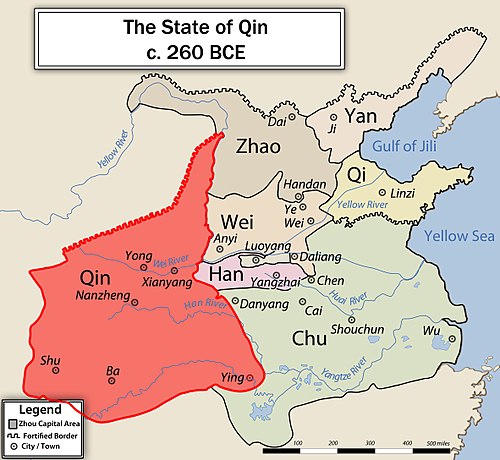
Battle of Changping
Qin decisively defeats Zhao at Changping, killing hundreds of thousands of soldiers. This battle eliminates a major rival and paves the way for Qin domination. #history #china #warfare
Battle of Changping By SY - Own work, CC BY-SA 4.0, https://commons.wikimedia.org/w/index.php?curid=60821414
256 BCE
Qin Annexes the Zhou
Qin absorbs the remaining Zhou territories, ending the Zhou dynasty's nominal rule. This symbolic act removes the last vestige of the old order. #history #china
221 BCE
Standardization Under Qin
Qin Shi Huang standardizes writing, currency, weights, measures, and axle lengths, unifying the empire and facilitating administration and trade. #history #china #standardization
Standardization Under Qin By Ian Remsen - Modern natural borders from Natural Earth Albers used for the map projection, via svgis λ 0 = 110 {\displaystyle \lambda _{0}=110} φ 0 = 30 {\displaystyle \varphi _{0}=30} φ 1 = 25 {\displaystyle \varphi _{1}=25} φ 2 = 37 {\displaystyle \varphi _{2}=37} Political borders, location of the Great Wall, and adjustments to reflect ancient borders from Li, Feng (2013) Early China: A Social and Cultural History, New Approaches to Asian History, 12, Cambridge University Press, p. 246 DOI: 10.1017/CBO9781139034395. ISBN: 978-0-521-89552-1. Square represents the Qin capital at Xianyang Dotted open circles represent population centers whose precise locations are unclear, CC0, https://commons.wikimedia.org/w/index.php?curid=158113722
221 BCE
Qin Unifies China
Qin Shi Huang completes the conquest of the six warring states, establishing the first unified imperial dynasty in Chinese history. He proclaims himself the First Emperor. #history #china #empire
Qin Unifies China By Unknown (18??–18??) - Portal, Jane (Ed.). The first emperor: China's Terracotta Army. Cambridge, Massachusetts: Harvard University Press, 2007 ISBN 978-0-674-02697-7 Invalid ISBN (p.29), Public domain, https://commons.wikimedia.org/w/index.php?curid=164928091
220 BCE
Construction of the Great Wall Begins
Qin Shi Huang orders the connection and extension of existing walls to form the first Great Wall, defending against nomadic Xiongnu invasions. #history #china #architecture
Construction of the Great Wall Begins By Severin.stalder - Own work, CC BY-SA 3.0, https://commons.wikimedia.org/w/index.php?curid=39661035
214 BCE
Lingqu Canal Completed
The Lingqu Canal, connecting the Xiang and Li rivers, is built to transport supplies for Qin's southern campaigns, demonstrating advanced hydraulic engineering. #history #china #engineering
Lingqu Canal Completed By Farm - Own work, CC BY 3.0, https://commons.wikimedia.org/w/index.php?curid=6907371
213 BCE
Burning of Books and Burying of Scholars
Qin Shi Huang orders the destruction of historical texts and philosophical works to suppress dissenting ideas, and buries 460 Confucian scholars alive. This event symbolizes legalist repression. #history #china #legalism
Burning of Books and Burying of Scholars By Itsmine - Self-published work by Itsmine, CC BY-SA 3.0, https://commons.wikimedia.org/w/index.php?curid=1389340
210 BCE
Death of Qin Shi Huang
Qin Shi Huang dies during an eastern tour. His tomb, guarded by the Terracotta Army, remains unexcavated. His death triggers a succession crisis and uprisings. #history #china #archaeology
209 BCE
Dazexiang Uprising
Chen Sheng and Wu Guang lead a peasant revolt against Qin rule, marking the start of widespread rebellions that eventually topple the dynasty. #history #china #revolution
Dazexiang Uprising By SY - Own work, CC BY-SA 4.0, https://commons.wikimedia.org/w/index.php?curid=63577599
207 BCE
Battle of Julu
Xiang Yu defeats the Qin army at Julu, killing the Qin general Zhang Han. This victory breaks Qin military power and leads to the collapse of the dynasty. #history #china #warfare
Battle of Julu By Vitsuha - Own work, CC0, https://commons.wikimedia.org/w/index.php?curid=170999727
206 BCE
Fall of the Qin Dynasty
Liu Bang enters Xianyang, the Qin capital, and accepts the surrender of the last Qin ruler, Ziying. The Qin dynasty ends after 15 years. #history #china
202 BCE
Liu Bang Founds the Han Dynasty
After defeating Xiang Yu at the Battle of Gaixia, Liu Bang proclaims himself Emperor Gaozu of Han, establishing the Han dynasty with its capital at Chang'an. #history #china #empire
Liu Bang Founds the Han Dynasty By DannamEmpire - Own work using: Based on: Map, p. 63, Mapping History: World History (London: Cartographica, 2007), by Dr. Ian Barnes. ISBN 978-1-84573-323-0, CC BY 4.0, https://commons.wikimedia.org/w/index.php?curid=162847450
195 BCE
Death of Emperor Gaozu
Liu Bang dies after a reign of seven years. His successors continue his policies, consolidating the Han state and reducing the power of regional kings. #history #china
Death of Emperor Gaozu By Unknown author - http://earlyworldhistory.blogspot.com/2012/03/liu-bang.html, Public domain, https://commons.wikimedia.org/w/index.php?curid=70464970
179 BCE
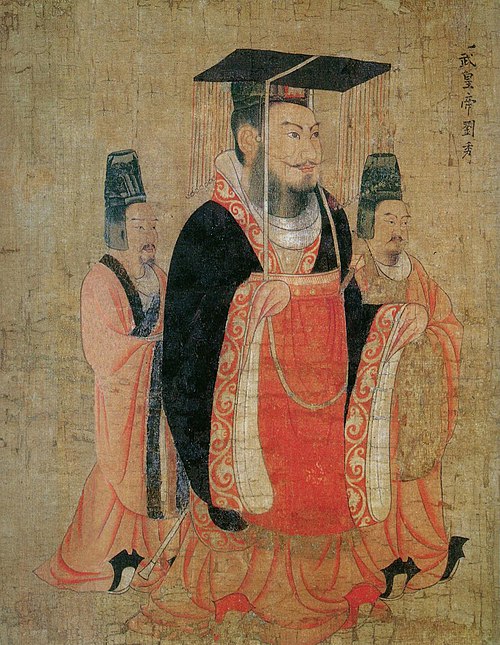
Emperor Wen Ascends the Throne
Emperor Wen of Han, known for his frugality and benevolent rule, begins his reign. He reduces taxes and promotes Confucianism, laying the foundation for the Han golden age. #history #china #governance
Emperor Wen Ascends the Throne By AnonymousUnknown author - Descriptions of the Works. Another Look at National Treasures: Select Masterpieces of Painting and Calligraphy in the Museum Collection (exhibit). Taipei: National Palace Museum., Public domain, https://commons.wikimedia.org/w/index.php?curid=78366992
141 BCE
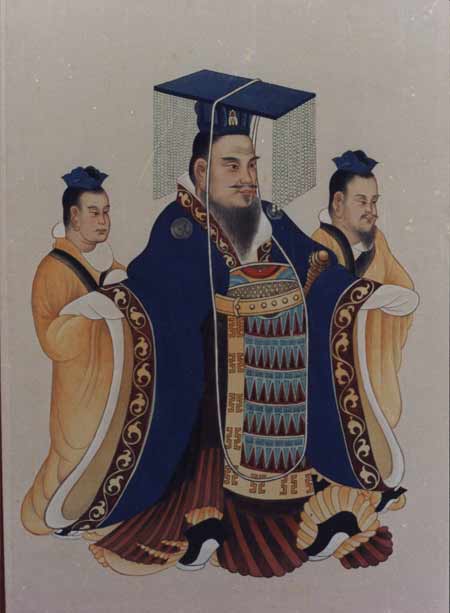
Emperor Wu Ascends the Throne
Emperor Wu of Han begins his 54-year reign, expanding the empire militarily and promoting Confucianism as state ideology. His reign marks the peak of Western Han power. #history #china #leadership
Emperor Wu Ascends the Throne By Unknown author - Colored portrait and a black and white rubbing of the portrait, Public domain, https://commons.wikimedia.org/w/index.php?curid=8151462
138 BCE
Zhang Qian's First Mission to the West
Emperor Wu sends Zhang Qian on a diplomatic mission to forge alliances against the Xiongnu. Though captured, Zhang returns with knowledge of Central Asia, spurring the Silk Road. #history #china #silkroad
Zhang Qian's First Mission to the West By PHG - copied from en wp, Public domain, https://commons.wikimedia.org/w/index.php?curid=721599
130 BCE
Han Campaigns Against the Xiongnu
Emperor Wu launches a series of large-scale military campaigns to defeat the Xiongnu confederation, securing the northern frontier and expanding Han territory. #history #china #warfare
124 BCE
Establishment of the Imperial Academy
Emperor Wu founds the Imperial Academy (Taixue) to train Confucian scholars for government service, strengthening the bureaucracy and promoting Confucian education. #history #china #education
Establishment of the Imperial Academy By Internet Archive Book Images - https://www.flickr.com/photos/internetarchivebookimages/14761496004/ Source book page: https://archive.org/stream/cu31924023119880/cu31924023119880#page/n124/mode/1up, No restrictions, https://commons.wikimedia.org/w/index.php?curid=43580680
119 BCE
Battle of Mobei
Han forces under Wei Qing and Huo Qubing decisively defeat the Xiongnu in the Gobi Desert, breaking their power and securing the Hexi Corridor. #history #china #warfare
Battle of Mobei By Rob Oo from NL - See the world in one glance, CC BY 2.0, https://commons.wikimedia.org/w/index.php?curid=97521980
108 BCE
Han Conquest of Gojoseon
The Han dynasty conquers Gojoseon in northern Korea, establishing four commanderies, including Lelang, which control the region for centuries. #history #china #korea
Han Conquest of Gojoseon By Asieon - Own work, CC0, https://commons.wikimedia.org/w/index.php?curid=191841772
104 BCE
Taichu Calendar Introduced
Emperor Wu adopts the Taichu calendar, a revised lunisolar system that improves accuracy and becomes the foundation for later Chinese calendars. #history #china #science
Taichu Calendar Introduced By AHxiMO RPPLOU - Own work, CC BY-SA 4.0, https://commons.wikimedia.org/w/index.php?curid=107691997
100 BCE
Sima Qian Completes Records of the Grand Historian
Sima Qian finishes the Shiji, a monumental history covering 2,500 years. It sets the standard for Chinese historiography and remains a classic. #history #china #literature
Sima Qian Completes Records of the Grand Historian By Zhonghua Book Company - Photo taken by Chinese Wikipedia user huowax, Public domain, https://commons.wikimedia.org/w/index.php?curid=48989967
51 BCE
Conference at White Tiger Hall
Emperor Xuan convenes a scholarly conference to resolve disputes over Confucian classics, resulting in the authoritative White Tiger Hall discussions that shape Han orthodoxy. #history #china #philosophy
9 CE
Wang Mang Usurps the Throne
Wang Mang, a Han regent, seizes power and proclaims the Xin Dynasty. His radical reforms, including land redistribution and currency changes, lead to chaos and rebellion. #history #china #reform
Wang Mang Usurps the Throne By 鍾 惺, 1574-1624 - Waseda University Library, Public domain, https://commons.wikimedia.org/w/index.php?curid=178862384
25 CE
Eastern Han Dynasty Founded
Liu Xiu, a descendant of the Han royal house, defeats the Red Eyebrows and restores Han rule, establishing the Eastern Han dynasty with its capital at Luoyang. #history #china
Eastern Han Dynasty Founded By Yan Li-pen - Taken from http://hi.baidu.com/%CB%CE%BE%FC%D2%C5%C3%F1/album/%D1%D6%C1%A2%B1%BE%20%C0%FA%B4%FA%B5%DB%CD%F5%CD%BC%BE%ED. Original collection can be viewed at Museum of Fine Arts., Public domain, https://commons.wikimedia.org/w/index.php?curid=2233718
67 CE
Buddhism Officially Introduced to China
Emperor Ming of Han sends envoys to the Western Regions, who return with Buddhist scriptures and monks. The White Horse Temple is built, marking the official introduction of Buddhism. #history #china #buddhism
73 CE
Ban Chao's Mission to the Western Regions
General Ban Chao leads a diplomatic-military mission to reassert Han control over the Silk Road, pacifying the Tarim Basin and restoring trade routes. #history #china #silkroad
Ban Chao's Mission to the Western Regions By Unknown artist - National Palace Museum, Public domain, https://commons.wikimedia.org/w/index.php?curid=151461164
97 CE
Gan Ying Sent to the Roman Empire
Ban Chao dispatches Gan Ying to establish contact with the Roman Empire, but he turns back at the Persian Gulf, missing the first direct Sino-Roman encounter. #history #china #rome
102 CE
Ban Chao Returns to Luoyang
After decades in the Western Regions, Ban Chao returns to the capital and dies soon after. His achievements secure Han influence in Central Asia. #history #china
105 CE
Cai Lun Perfects Papermaking
Cai Lun, a Han court eunuch, improves papermaking techniques using tree bark, hemp, and rags, creating a practical writing material. Paper spreads globally, revolutionizing communication. #history #china #invention #papermaking
Cai Lun Perfects Papermaking By Unknown author - Tsien Tsuen-Hsuin (1985) Needham, Joseph, ed. Science and Civilisation in China: Volume 5, Chemistry and Chemical Technology, Part 1, Paper and Printing, Taipei: Caves Books, pp. 108–109 ISBN: 978-0-521-08690-5. Etnografiska museet, Stockholm: 1935.50.3366.30, Public domain, https://commons.wikimedia.org/w/index.php?curid=3154438
132 CE
Zhang Heng Invents Seismoscope
Zhang Heng, a Han astronomer and inventor, creates the first seismoscope, capable of detecting distant earthquakes. It demonstrates advanced ancient engineering and scientific observation. #history #china #science #invention
Zhang Heng Invents Seismoscope By Windmemories - Own work, CC BY-SA 4.0, https://commons.wikimedia.org/w/index.php?curid=176246974
166 CE
First Roman Embassy to China
A group of Romans claiming to be envoys from Emperor Marcus Aurelius arrives at the Han court, marking the first direct contact between the Roman and Chinese empires. #history #china #rome
First Roman Embassy to China By Thomas Lessman (Contact!) - Own work (For reference information, see the Map Source References section below.), CC BY-SA 3.0, https://commons.wikimedia.org/w/index.php?curid=4019603
175 CE
Xiping Stone Classics Carved
Emperor Ling orders the carving of Confucian classics on stone tablets to preserve the standard texts. These Xiping Stone Classics are erected at the Imperial Academy. #history #china #literature
Xiping Stone Classics Carved By Editor at Large - Own work, CC BY-SA 2.5, https://commons.wikimedia.org/w/index.php?curid=5839111
184 CE
Yellow Turban Rebellion
The Yellow Turban rebellion, led by Zhang Jiao, erupts against Han corruption and natural disasters. Although suppressed, it weakens the dynasty and leads to warlordism. #history #china #rebellion
Yellow Turban Rebellion By SY - Own work, CC BY-SA 4.0, https://commons.wikimedia.org/w/index.php?curid=62648652
189 CE
He Jin Assassinated; Dong Zhuo Seizes Power
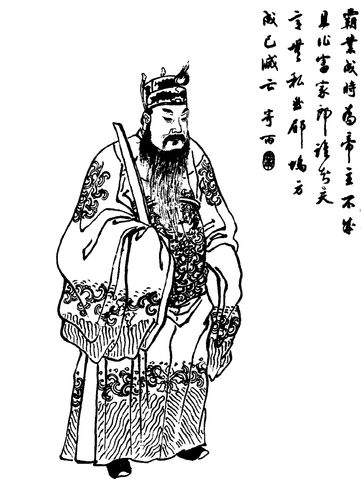
After the death of Emperor Ling, a power struggle leads to the assassination of He Jin and the rise of the warlord Dong Zhuo, who installs a puppet emperor and sacks Luoyang. #history #china #warlord
He Jin Assassinated; Dong Zhuo Seizes Power By Unknown author - Zengxiang quantu SanguoyanyiTaken from http://threekingdoms.wikia.com/wiki/File:Dong_Zhuo_-_Qing_ZQ-SGYY.jpg, Public domain, https://commons.wikimedia.org/w/index.php?curid=37570496
196 CE
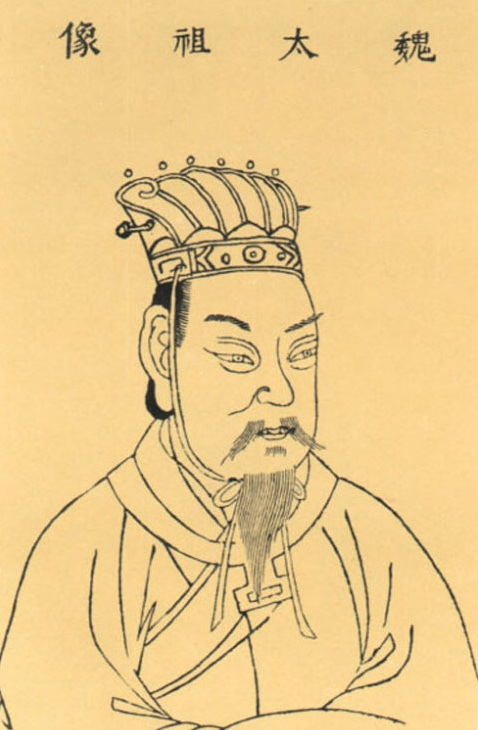
Cao Cao Takes Control of Emperor Xian
Cao Cao welcomes Emperor Xian to Xuchang, gaining the authority to issue imperial decrees. He legitimizes his campaigns and consolidates power over northern China. #history #china #politics
Cao Cao Takes Control of Emperor Xian By Wang Qi - A copy of w:Sancai Tuhui, Public domain, https://commons.wikimedia.org/w/index.php?curid=10217506
208 CE
Battle of Red Cliffs
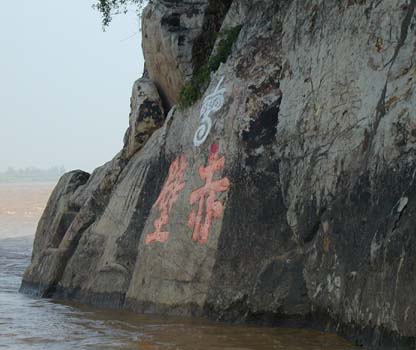
Cao Cao's southern invasion is thwarted by the allied forces of Sun Quan and Liu Bei at Red Cliffs. This battle determines the tripartite division of China. #history #china #warfare
Battle of Red Cliffs By User Jie on en.wikipedia - Originally from en.wikipedia; description page is (was) here 08:26, 29 August 2004 Jie 416x350 (24,260 bytes) (Photo of the traditional site of Chibi, north of Wulin, taken in 2003.), CC BY-SA 3.0, https://commons.wikimedia.org/w/index.php?curid=612393
220 CE
End of the Han Dynasty
Emperor Xian abdicates under pressure from Cao Pi, son of Cao Cao, ending the Han dynasty after 426 years. Cao Pi establishes the Wei dynasty, beginning the Three Kingdoms period. #history #china
End of the Han Dynasty By Gary Lee Todd - http://www.garyleetodd.com/chinese-museums-online/luoyang-6-horse-chariot-burial-tomb-museum/, CC BY-SA 4.0, https://commons.wikimedia.org/w/index.php?curid=4918196