Qin & Han Dynasties: Imperial Unification, Great Wall & The Silk Road
Encyclopedia/3. History, Societies & Civilizations/01. East Asian Civilizations/01. Chinese Dynasties • Curated by Admin Timeline.sg
The Qin dynasty (221–206 BCE) initiated China's imperial unification under Qin Shi Huang, standardizing scripts, currencies, and weights while constructing the Great Wall. The Han dynasty (202 BCE–220 CE) expanded the empire, opened the Silk Road under Emperor Wu, and produced seminal works like Sima Qian's Shiji, establishing the foundation for Chinese civilization.
Chronological Storyline (45 Milestones)
221 BCE
Qin Shi Huang Unifies China
Following the conquest of the six warring states, Qin Shi Huang declared himself the First Emperor, establishing the Qin dynasty and unifying China under a centralized government. #history #china #qin
Qin Shi Huang Unifies China By Unknown (18??–18??) - Portal, Jane (Ed.). The first emperor: China's Terracotta Army. Cambridge, Massachusetts: Harvard University Press, 2007 ISBN 978-0-674-02697-7 Invalid ISBN (p.29), Public domain, https://commons.wikimedia.org/w/index.php?curid=164928091
220 BCE
Standardization of Weights and Script
The Qin government imposed uniform standards for writing characters, weights, measures, and coinage across the empire to facilitate administration and trade. #history #china #qin
Standardization of Weights and Script By Ian Remsen - Modern natural borders from Natural Earth Albers used for the map projection, via svgis λ 0 = 110 {\displaystyle \lambda _{0}=110} φ 0 = 30 {\displaystyle \varphi _{0}=30} φ 1 = 25 {\displaystyle \varphi _{1}=25} φ 2 = 37 {\displaystyle \varphi _{2}=37} Political borders, location of the Great Wall, and adjustments to reflect ancient borders from Li, Feng (2013) Early China: A Social and Cultural History, New Approaches to Asian History, 12, Cambridge University Press, p. 246 DOI: 10.1017/CBO9781139034395. ISBN: 978-0-521-89552-1. Square represents the Qin capital at Xianyang Dotted open circles represent population centers whose precise locations are unclear, CC0, https://commons.wikimedia.org/w/index.php?curid=158113722
215 BCE
Construction of the Great Wall Intensifies
Qin Shi Huang ordered the linking and strengthening of existing northern fortifications to create a unified Great Wall against Xiongnu incursions. #history #china #greatwall
Construction of the Great Wall Intensifies By Severin.stalder - Own work, CC BY-SA 3.0, https://commons.wikimedia.org/w/index.php?curid=39661035
210 BCE
Death of Qin Shi Huang and Terracotta Army
The First Emperor died and was buried in a massive mausoleum accompanied by the Terracotta Army—thousands of life-sized clay soldiers to protect him in the afterlife. #history #china #terracotta
Death of Qin Shi Huang and Terracotta Army By xiquinhosilva - https://www.flickr.com/photos/xiquinho/27718581472/in/album-72157669496699682/, CC BY 2.0, https://commons.wikimedia.org/w/index.php?curid=147287690
209 BCE
Chen Sheng and Wu Guang Uprising
Two peasant leaders sparked a rebellion against Qin rule, igniting widespread revolts that ultimately led to the dynasty's collapse. #history #china #rebellion
Chen Sheng and Wu Guang Uprising By SY - Own work, CC BY-SA 4.0, https://commons.wikimedia.org/w/index.php?curid=63577599
207 BCE
Battle of Julu: Fall of Qin
Xiang Yu's forces decisively defeated the Qin army at Julu, leading to the surrender of the last Qin ruler and the end of the Qin dynasty. #history #china #war
Battle of Julu: Fall of Qin By Vitsuha - Own work, CC0, https://commons.wikimedia.org/w/index.php?curid=170999727
206 BCE
Liu Bang Enters Xianyang
Liu Bang captured the Qin capital Xianyang, symbolizing the transfer of power and his eventual rise to found the Han dynasty. #history #china #han
Liu Bang Enters Xianyang By Unknown author - http://earlyworldhistory.blogspot.com/2012/03/liu-bang.html, Public domain, https://commons.wikimedia.org/w/index.php?curid=70464970
202 BCE
Han Dynasty Founded by Emperor Gaozu
After defeating Xiang Yu at the Battle of Gaixia, Liu Bang proclaimed himself Emperor Gaozu, establishing the Han dynasty with its capital at Chang'an. #history #china #han
Han Dynasty Founded by Emperor Gaozu By DannamEmpire - Own work using: Based on: Map, p. 63, Mapping History: World History (London: Cartographica, 2007), by Dr. Ian Barnes. ISBN 978-1-84573-323-0, CC BY 4.0, https://commons.wikimedia.org/w/index.php?curid=162847450
200 BCE
Siege of Baideng: Han Defeated by Xiongnu
Emperor Gaozu was surrounded by Xiongnu forces at Baideng, leading to a humiliating treaty and the beginning of a policy of appeasement toward the nomads. #history #china #war
195 BCE
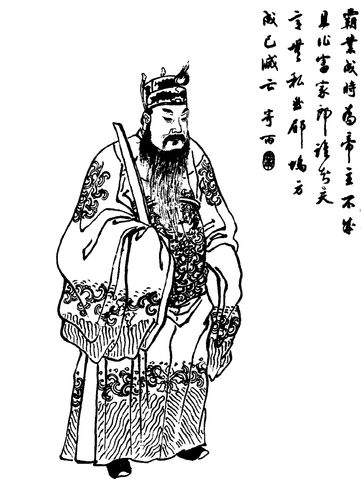
Death of Emperor Gaozu and Regency of Empress Lü
Gaozu died, and his wife Empress Lü Zhi became the de facto ruler, the first woman to govern the Chinese empire. #history #china #han
Death of Emperor Gaozu and Regency of Empress Lü By 鍾 惺, 1574-1624 - Waseda University Library, Public domain, https://commons.wikimedia.org/w/index.php?curid=178863157
188 BCE
Formal Regency of Empress Lü
After the death of her son Emperor Hui, Empress Lü ruled through puppet emperors, consolidating her power over the Han court. #history #china #han
180 BCE
Lü Clan Purge and Ascension of Emperor Wen
After Empress Lü's death, the Lü clan was exterminated, and Liu Heng (Emperor Wen) was installed, ushering in a period of peace and prosperity. #history #china #han
Lü Clan Purge and Ascension of Emperor Wen By AnonymousUnknown author - Descriptions of the Works. Another Look at National Treasures: Select Masterpieces of Painting and Calligraphy in the Museum Collection (exhibit). Taipei: National Palace Museum., Public domain, https://commons.wikimedia.org/w/index.php?curid=78366992
168 BCE
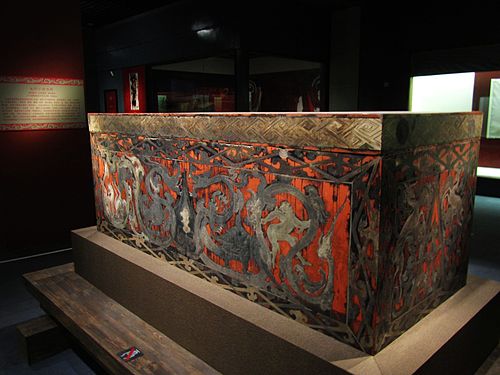
Mawangdui Tombs Buried
The rich tombs of the Marquis of Dai and his family were sealed near Changsha, later discovered with exceptionally preserved artifacts and texts. #history #china #archaeology
Mawangdui Tombs Buried By 猫猫的日记本 - Own work, CC BY-SA 4.0, https://commons.wikimedia.org/w/index.php?curid=38272681
157 BCE
Death of Emperor Wen
Emperor Wen died after a frugal and peaceful reign; he was succeeded by his son Emperor Jing. #history #china #han
141 BCE
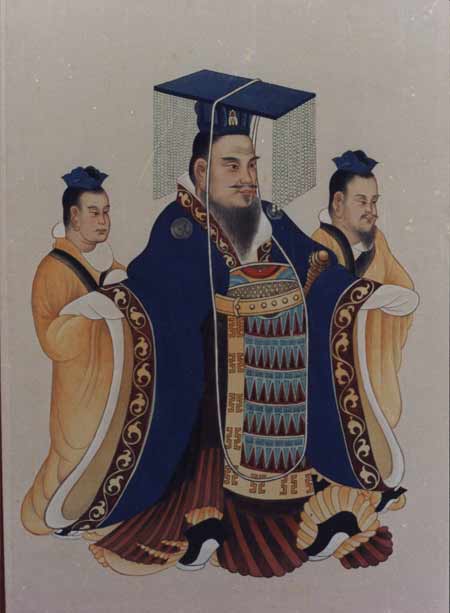
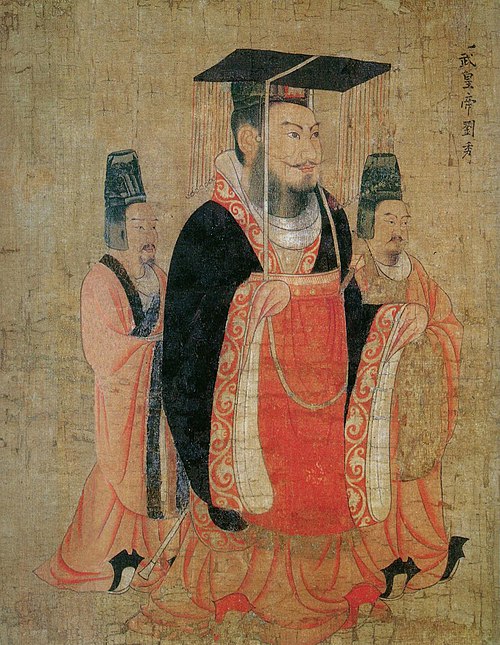
Emperor Wu Ascends the Throne
At age 15, Liu Che became Emperor Wu of Han, initiating an ambitious expansionist policy and a golden age of Chinese culture. #history #china #han
Emperor Wu Ascends the Throne By Unknown author - Colored portrait and a black and white rubbing of the portrait, Public domain, https://commons.wikimedia.org/w/index.php?curid=8151462
138 BCE
Zhang Qian Departs on First Silk Road Mission
Emperor Wu dispatched Zhang Qian to seek allies against the Xiongnu; his journey opened direct contact between China and Central Asia. #history #china #silkyroad
Zhang Qian Departs on First Silk Road Mission By PHG - copied from en wp, Public domain, https://commons.wikimedia.org/w/index.php?curid=721599
130 BCE
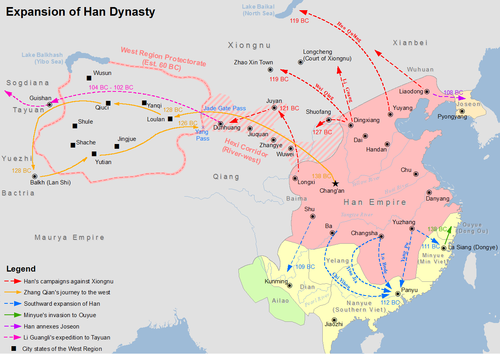
Han Annexation of Minyue
The Han empire conquered the kingdom of Minyue (modern Fujian), incorporating it into the Chinese realm. #history #china #han
Han Annexation of Minyue By Perinbaba - Own work, CC BY 4.0, https://commons.wikimedia.org/w/index.php?curid=148505374
127 BCE
Han Conquest of the Ordos Loop
Han forces expelled the Xiongnu from the Ordos region, securing the bend of the Yellow River and establishing commanderies. #history #china #war
121 BCE
Huo Qubing's Campaigns Against Xiongnu
The young general Huo Qubing led successful deep strikes into Xiongnu territory, capturing the Hexi Corridor and opening the way to the West. #history #china #war
Huo Qubing's Campaigns Against Xiongnu By Ma Tai (馬駘; C.E.1885-1937) - the Chinese book "Ma Tai Hua Bao" (馬駘畫寶, published C.E.1928), Public domain, https://commons.wikimedia.org/w/index.php?curid=103430922
119 BCE
Battle of Mobei: Decisive Han Victory
Han forces under Wei Qing and Huo Qubing inflicted a crushing defeat on the Xiongnu at Mobei (north of the Gobi), breaking their power. #history #china #war
Battle of Mobei: Decisive Han Victory By Rob Oo from NL - See the world in one glance, CC BY 2.0, https://commons.wikimedia.org/w/index.php?curid=97521980
111 BCE
Han Annexation of Nanyue
After a brief war, Han forces conquered the kingdom of Nanyue (modern Guangdong, Guangxi, Vietnam), expanding Chinese territory southward. #history #china #han
Han Annexation of Nanyue By People's_Republic_of_China_(orthographic_projection).svg: Ssolbergj (talk) derivative work: 长夜无风 (talk)、玖巧仔 (talk) - People's_Republic_of_China_(orthographic_projection).svg, CC BY-SA 3.0, https://commons.wikimedia.org/w/index.php?curid=10576871
108 BCE
Han Conquest of Gojoseon (Korea)
Han armies invaded and conquered Gojoseon in northern Korea, establishing four commanderies including Lelang. #history #china #korea
Han Conquest of Gojoseon (Korea) By Asieon - Own work, CC0, https://commons.wikimedia.org/w/index.php?curid=191841772
104 BCE
Sima Qian Begins Writing the Shiji
The historian Sima Qian started compiling the Records of the Grand Historian, a monumental history of China from mythical origins to his day. #history #china #literature
Sima Qian Begins Writing the Shiji By Unknown author - scan from 《社会历史博物馆》 ISBN 7-5347-1397-8, Public domain, https://commons.wikimedia.org/w/index.php?curid=93327
100 BCE
Han Control of the Tarim Basin
By establishing protectorates, the Han extended influence over the city-states of the Tarim Basin, securing the Silk Road. #history #china #silkyroad
Han Control of the Tarim Basin By SY - Own work, CC BY-SA 4.0, https://commons.wikimedia.org/w/index.php?curid=60814987
91 BCE
Completion of the Shiji
Sima Qian finished the Shiji, a 130-chapter work that became the model for official Chinese historiography. #history #china #literature
Completion of the Shiji By Zhonghua Book Company - Photo taken by Chinese Wikipedia user huowax, Public domain, https://commons.wikimedia.org/w/index.php?curid=48989967
87 BCE
Death of Emperor Wu
Emperor Wu died after 54 years of reign; his later years were marred by paranoia and a succession crisis. #history #china #han
74 BCE
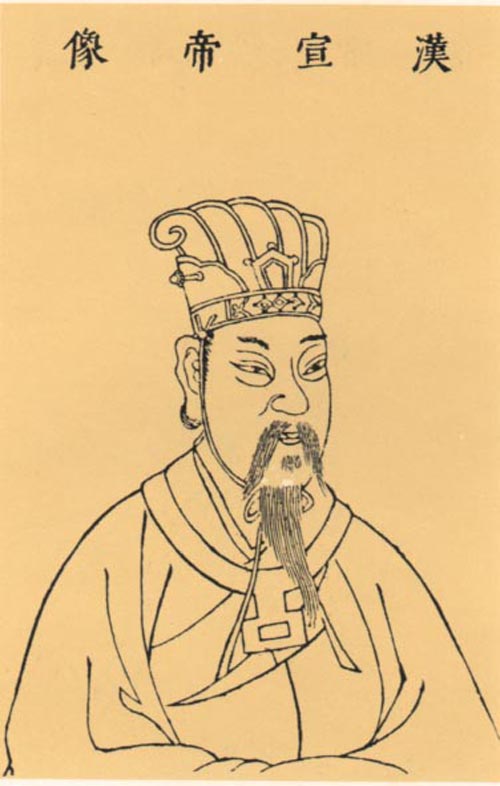
Heir Dispute and Ascension of Emperor Xuan
After a brief reign by the child emperor Liu He, Liu Xun (Emperor Xuan) was chosen as emperor, marking a restoration of Han stability. #history #china #han
Heir Dispute and Ascension of Emperor Xuan By Wang Qi (1529 - 1612) - Sancai Tuhui, Public domain, https://commons.wikimedia.org/w/index.php?curid=18754172
9 CE
Wang Mang Establishes the Xin Dynasty
The Han regent Wang Mang usurped the throne and proclaimed the Xin dynasty, implementing radical reforms that soon led to chaos. #history #china #xin
Wang Mang Establishes the Xin Dynasty By 鍾 惺, 1574-1624 - Waseda University Library, Public domain, https://commons.wikimedia.org/w/index.php?curid=178862384
23 CE
Battle of Kunyang and Fall of Xin
Rebel forces led by Liu Xiu (later Emperor Guangwu) defeated Wang Mang's army at Kunyang, ending the Xin dynasty. #history #china #war
Battle of Kunyang and Fall of Xin By SY - Own work, CC BY-SA 4.0, https://commons.wikimedia.org/w/index.php?curid=63223565
25 CE
Eastern Han Founded by Emperor Guangwu
Liu Xiu declared himself emperor, reestablishing the Han dynasty with its capital at Luoyang, initiating the Eastern Han period. #history #china #han
Eastern Han Founded by Emperor Guangwu By Yan Li-pen - Taken from http://hi.baidu.com/%CB%CE%BE%FC%D2%C5%C3%F1/album/%D1%D6%C1%A2%B1%BE%20%C0%FA%B4%FA%B5%DB%CD%F5%CD%BC%BE%ED. Original collection can be viewed at Museum of Fine Arts., Public domain, https://commons.wikimedia.org/w/index.php?curid=2233718
34 CE
Pacification of Gansu
General Ma Yuan conquered the Gansu region, eliminating local warlords and consolidating Eastern Han control. #history #china #war )
Pacification of Gansu By Gisling - Own work, CC BY-SA 3.0, https://commons.wikimedia.org/w/index.php?curid=12824654
57 CE
First Recorded Contact with Japan
Emperor Guangwu received an envoy from the Japanese state of Na and presented a golden seal, marking the earliest known diplomatic contact between China and Japan. #history #china #japan
67 CE
White Horse Temple Founded: Buddhism Arrives in China
According to tradition, the first Buddhist temple was built in Luoyang, housing monks from Central Asia and symbolizing the formal introduction of Buddhism to China. #history #china #buddhism
73 CE
Ban Chao Resecures the Western Regions
General Ban Chao launched a campaign that reestablished Han control over the Tarim Basin and reopened the Silk Road trade routes. #history #china #silkyroad
Ban Chao Resecures the Western Regions By Unknown artist - National Palace Museum, Public domain, https://commons.wikimedia.org/w/index.php?curid=151461164
89 CE
Battle of Ikh Bayan
Han forces under Dou Xian defeated the Northern Xiongnu at Ikh Bayan, destroying their confederation and driving them westward. #history #china #war
Battle of Ikh Bayan By Rudyologist - Own work, CC BY-SA 4.0, https://commons.wikimedia.org/w/index.php?curid=42868766
97 CE
Gan Ying's Mission to the Roman Empire
Ban Chao sent envoy Gan Ying to explore the Roman Empire; he reached the Persian Gulf but was turned back, gaining knowledge of the West. #history #china #silkyroad
105 CE
Cai Lun Invents Papermaking
The court eunuch Cai Lun is credited with developing the first reliable papermaking process, using tree bark, hemp, and rags. #history #china #invention
Cai Lun Invents Papermaking By Unknown author - Tsien Tsuen-Hsuin (1985) Needham, Joseph, ed. Science and Civilisation in China: Volume 5, Chemistry and Chemical Technology, Part 1, Paper and Printing, Taipei: Caves Books, pp. 108–109 ISBN: 978-0-521-08690-5. Etnografiska museet, Stockholm: 1935.50.3366.30, Public domain, https://commons.wikimedia.org/w/index.php?curid=3154438
132 CE
Zhang Heng Invents Seismoscope
The polymath Zhang Heng created the first seismoscope, a device that could detect earthquakes from hundreds of kilometers away. #history #china #science
Zhang Heng Invents Seismoscope By Windmemories - Own work, CC BY-SA 4.0, https://commons.wikimedia.org/w/index.php?curid=176246974
166 CE
Roman Embassy Arrives in Han China
A group claiming to be envoys from Roman Emperor Antoninus Pius (or Marcus Aurelius) reached the Han court, establishing the first direct contact. #history #china #rome
Roman Embassy Arrives in Han China By Thomas Lessman (Contact!) - Own work (For reference information, see the Map Source References section below.), CC BY-SA 3.0, https://commons.wikimedia.org/w/index.php?curid=4019603
184 CE
Yellow Turban Rebellion
A massive Daoist-led peasant uprising erupted under Zhang Jue, seriously weakening the Eastern Han dynasty. #history #china #rebellion
Yellow Turban Rebellion By SY - Own work, CC BY-SA 4.0, https://commons.wikimedia.org/w/index.php?curid=62648652
189 CE
Dong Zhuo Seizes the Han Capital
General Dong Zhuo entered Luoyang, deposed the emperor, and triggered a power struggle that ultimately disintegrated the Han empire. #history #china #war
Dong Zhuo Seizes the Han Capital By Unknown author - Zengxiang quantu SanguoyanyiTaken from http://threekingdoms.wikia.com/wiki/File:Dong_Zhuo_-_Qing_ZQ-SGYY.jpg, Public domain, https://commons.wikimedia.org/w/index.php?curid=37570496
190 CE
Coalition Against Dong Zhuo
Regional warlords formed a coalition to overthrow Dong Zhuo, but internal conflicts prevented decisive action, leading to widespread civil war. #history #china #war
Coalition Against Dong Zhuo By Shizhao - Own work, Public domain, https://commons.wikimedia.org/w/index.php?curid=1166335
200 CE
Battle of Guandu
Cao Cao defeated Yuan Shao at Guandu, securing dominance over northern China and setting the stage for the Three Kingdoms. #history #china #war
Battle of Guandu By Guanduzhizhan.png: User Zhuwq on zh.wikipedia derivative work: Deadkid dk (talk) 02:40, 10 July 2009 (UTC) - Guanduzhizhan.png, CC BY-SA 3.0, https://commons.wikimedia.org/w/index.php?curid=7265577
208 CE
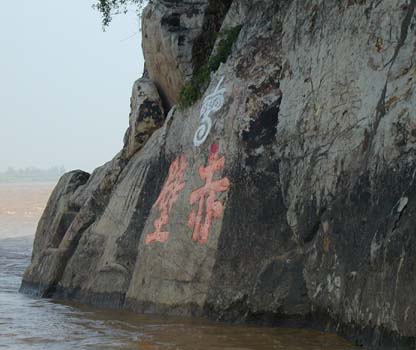
Battle of Red Cliffs
The allied forces of Sun Quan and Liu Bei defeated Cao Cao's fleet at Red Cliffs, preventing his conquest of the south and solidifying the division of China. #history #china #war
Battle of Red Cliffs By User Jie on en.wikipedia - Originally from en.wikipedia; description page is (was) here 08:26, 29 August 2004 Jie 416x350 (24,260 bytes) (Photo of the traditional site of Chibi, north of Wulin, taken in 2003.), CC BY-SA 3.0, https://commons.wikimedia.org/w/index.php?curid=612393
220 CE
End of the Han Dynasty
Cao Pi forced Emperor Xian to abdicate, proclaimed the Wei dynasty, and formally ended the Han dynasty after over 400 years. #history #china #han
End of the Han Dynasty By Gary Lee Todd - http://www.garyleetodd.com/chinese-museums-online/luoyang-6-horse-chariot-burial-tomb-museum/, CC BY-SA 4.0, https://commons.wikimedia.org/w/index.php?curid=4918196