Qian Xuesen (錢學森): Father of Chinese Rocketry & Space Exploration
Encyclopedia/2. Technology & The Built World/4. Energy & Transportation/06. Energy & Transportation Biographies • Curated by Admin Timeline.sg
Biographical timeline of Qian Xuesen (1911-2009), the pioneering aerodynamicist who co-founded Caltech's Jet Propulsion Laboratory, returned to China in 1955, and led the Two Bombs, One Satellite program, establishing China's missile and space capabilities.
Chronological Storyline (37 Milestones)
Dec 11, 1911 CE
Qian Xuesen Born in Shanghai
Qian Xuesen was born in Shanghai, China, to a wealthy family. His father was an educator, and his early exposure to Western science and engineering shaped his future career. #birth #ChineseHistory #Aerospace
Qian Xuesen Born in Shanghai By Unknown author - https://glory.ucas.ac.cn/index.php?option=com_content&view=article&id=867:2016-06-29-15-58-22&catid=37&Itemid=211, Public domain, https://commons.wikimedia.org/w/index.php?curid=152285378
Sep 1, 1929 CE
Enters National Chiao Tung University
Qian enrolled at National Chiao Tung University (now Shanghai Jiao Tong University) to study mechanical engineering. He graduated in 1934 with a degree in railway engineering. #education #engineering
Aug 1, 1935 CE
Travels to the United States on Boxer Indemnity Scholarship
Qian sailed to the U.S. to pursue graduate studies at the Massachusetts Institute of Technology (MIT), where he earned a master's degree in aeronautical engineering in 1936. #education #USA
Travels to the United States on Boxer Indemnity Scholarship By Xinbenlv - Own work, CC BY-SA 4.0, https://commons.wikimedia.org/w/index.php?curid=138245830
Sep 1, 1936 CE
Transfers to Caltech to Study Under Theodore von Kármán
Dissatisfied with MIT's focus on practice over theory, Qian moved to the California Institute of Technology (Caltech) to work with renowned aerodynamicist Theodore von Kármán. This collaboration defined his career. #Caltech #aerodynamics
Transfers to Caltech to Study Under Theodore von Kármán By NASA/JPL-Caltech - https://www.jpl.nasa.gov/images/slice-of-history-happy-birthday-dr-von-karman, Public domain, https://commons.wikimedia.org/w/index.php?curid=132626648
Jun 1, 1939 CE
Earns PhD from Caltech
Qian completed his PhD in aeronautics and mathematics under von Kármán. His thesis on compressible flow and boundary layers advanced supersonic flight theory. #PhD #aerodynamics
Jan 1, 1943 CE
Co-founds Jet Propulsion Laboratory (JPL)
During World War II, Qian and von Kármán established the Jet Propulsion Laboratory at Caltech, initially focused on rocket-assisted takeoff for aircraft. JPL later became NASA's leading center for robotic space exploration. #JPL #rocketry
Co-founds Jet Propulsion Laboratory (JPL) By NASA - NASA JPL image, Public domain, https://commons.wikimedia.org/w/index.php?curid=526080
May 1, 1945 CE
Member of U.S. Scientific Advisory Group to Germany
Qian served as a colonel in the U.S. Army Air Forces, traveling to Germany to study Nazi rocket technology, including V-2 missiles. He interviewed Wernher von Braun and gathered critical intelligence. #WWII #rockets
Member of U.S. Scientific Advisory Group to Germany By NASA/photographer unknown - https://images.nasa.gov/details/KSC-62C-1443 http://grin.hq.nasa.gov/IMAGES/LARGE/GPN-2000-000605.jpg on the Wayback Machine at the Wayback Machine http://grin.hq.nasa.gov/ABSTRACTS/GPN-2000-000605.html on the Wayback Machine at the Wayback Machine, Public domain, https://commons.wikimedia.org/w/index.php?curid=6448829
Sep 1, 1946 CE
Returns to MIT as Professor
After the war, Qian joined MIT as an associate professor of aeronautical engineering. He taught and researched jet propulsion, but faced racial discrimination and limited opportunities. #academia #MIT
Returns to MIT as Professor By Matthew Carter and others, owned by Massachusetts Institute of Technology - MIT Logo See also: Source: Q., CJ (22 October 2021). Why didn’t MIT have a logo until 2003?. MIT Admissions Blog., Public domain, https://commons.wikimedia.org/w/index.php?curid=168394775
Sep 1, 1947 CE
Marries Jiang Ying
Qian married Jiang Ying, a Chinese-born soprano and daughter of military strategist Jiang Baili. The marriage was arranged by their families, and they remained together until Qian's death. #family #marriage
Oct 1, 1949 CE
People's Republic of China Established
Mao Zedong proclaimed the founding of the People's Republic of China. Qian, still in the U.S., began planning to return and contribute to China's development. #China #history
People's Republic of China Established By Zeng Liansong - Standard version of national flag image for online usage is released on the website of the National People's Congress and the Government of China. (网络使用的国旗图案标准版本在中国人大网和中国政府网上发布。), Public domain, https://commons.wikimedia.org/w/index.php?curid=436175
Jun 1, 1950 CE
Accused of Communist Sympathies and Loses Security Clearance
During the Red Scare, the U.S. government revoked Qian's security clearance, suspecting him of communist ties. He was placed under surveillance and his travel was restricted. #ColdWar #persecution
Accused of Communist Sympathies and Loses Security Clearance By Anticommunist_Literature_1950s.tiff: Myron Coureval Fagan derivative work: Comte0 (talk) - Anticommunist_Literature_1950s.tiff, Public domain, https://commons.wikimedia.org/w/index.php?curid=12640832
Sep 9, 1950 CE
Detained and Deported by U.S. Immigration
Qian was arrested at the Port of Los Angeles while attempting to return to China. He was held for 15 days and then placed under house arrest for five years, during which he continued research. #detention #injustice
Sep 17, 1955 CE
Returns to China After Prisoner Swap
The U.S. and China negotiated a prisoner exchange: Qian was allowed to leave for China in exchange for American POWs from the Korean War. He sailed to Hong Kong and then to mainland China. #repatriation #ColdWar
Feb 1, 1956 CE
Proposes Chinese Missile Program to Mao Zedong
Shortly after returning, Qian submitted a proposal to develop China's own missile and rocket technology. Mao approved the plan, making Qian the chief architect of China's aerospace program. #missiles #China
Oct 8, 1956 CE
Establishes the Fifth Academy of the Ministry of National Defense
Qian founded the Fifth Academy, China's first dedicated missile research institute. He served as its first director, overseeing the development of ballistic missiles and rockets. #institution #defense
Jan 1, 1958 CE
Begins Development of Dongfeng-1 Missile
Qian initiated the Dongfeng (East Wind) series of ballistic missiles. The DF-1 was a short-range missile based on Soviet R-2 technology, but it laid the foundation for future Chinese rockets. #missiles #Dongfeng
Begins Development of Dongfeng-1 Missile By DoD & Los688 - https://apps.dtic.mil/sti/citations/ADA528060 "Military Power of the People’s Republic of China 2007" P.19 & add text., Public domain, https://commons.wikimedia.org/w/index.php?curid=3982324
Nov 5, 1960 CE
First Successful Launch of Dongfeng-1
China successfully launched its first domestically produced ballistic missile, the Dongfeng-1, from the Jiuquan Satellite Launch Center. This milestone marked China's entry into the missile age. #launch #missile
Oct 16, 1964 CE
China's First Atomic Bomb Test (Project 596)
China detonated its first atomic bomb at Lop Nur. Qian's missile program was crucial for delivering nuclear warheads, linking the Two Bombs (atomic and hydrogen bombs) with the One Satellite. #nuclear #weapons
China's First Atomic Bomb Test (Project 596) By 《人民画报》 - 《人民画报》1965年第1期, Public domain, https://commons.wikimedia.org/w/index.php?curid=65155282
Jan 1, 1965 CE
Proposes Long March Rocket Family
Qian outlined plans for the Long March (Changzheng) series of launch vehicles, based on Dongfeng missile technology. The Long March rockets became China's primary satellite launchers. #rockets #space
Oct 27, 1966 CE
First Test of Nuclear Missile (Dongfeng-2A with Nuclear Warhead)
China launched a Dongfeng-2A missile carrying a nuclear warhead, which detonated at the target range. This demonstrated China's nuclear deterrent capability and integrated missile-nuclear technology. #nuclear #missile
Jun 17, 1967 CE
China's First Hydrogen Bomb Test
China successfully tested its first hydrogen bomb (thermonuclear weapon), becoming the fourth country to do so. Qian's missile program provided the delivery system for such weapons. #nuclear #hydrogen
China's First Hydrogen Bomb Test By Unknown author - https://www.ctbto.org/uploads/pics/China_H-bomb_1967.jpg, Public domain, https://commons.wikimedia.org/w/index.php?curid=97713003
Apr 24, 1970 CE
China Launches First Satellite (Dongfanghong-1)
The Long March-1 rocket successfully placed China's first satellite, Dongfanghong-1, into orbit. The satellite broadcast the song 'The East Is Red,' marking China's entry into the space age. #satellite #space
China Launches First Satellite (Dongfanghong-1) By 新华社 1970 - https://www.xinhuanet.com/politics/2020-04/24/c_1125902168.htm, Public domain, https://commons.wikimedia.org/w/index.php?curid=122408114
Mar 1, 1971 CE
Becomes Vice President of Chinese Academy of Sciences
Qian was appointed vice president of the Chinese Academy of Sciences, overseeing scientific research and policy. He used this position to promote aerospace and defense technologies. #academia #leadership
Becomes Vice President of Chinese Academy of Sciences By Chinese Academy of Sciences - https://www.cas.cn, Public domain, https://commons.wikimedia.org/w/index.php?curid=142141358
Nov 26, 1975 CE
First Recoverable Satellite (FSW-0) Launched
China launched its first recoverable satellite (FSW-0), which returned to Earth after several days. This technology was essential for reconnaissance and later human spaceflight. #satellite #recovery
First Recoverable Satellite (FSW-0) Launched By Hibiki Watabe - https://www.flickr.com/photos/whibiki/5184500282/, CC BY 2.0, https://commons.wikimedia.org/w/index.php?curid=93422288
Mar 1, 1978 CE
Elected to Chinese People's Political Consultative Conference
Qian became a member of the CPPCC, a political advisory body. He used his influence to advocate for science and technology development during China's reform era. #politics #science
Elected to Chinese People's Political Consultative Conference By Chinese People's Political Consultative Conference - 中国人民政治协商会议会徽制作和使用规定, Public domain, https://commons.wikimedia.org/w/index.php?curid=116618174
May 18, 1980 CE
First Intercontinental Ballistic Missile (ICBM) Test (Dongfeng-5)
China successfully tested the Dongfeng-5 ICBM, capable of reaching the continental United States. This solidified China's status as a major nuclear power and strategic deterrent. #ICBM #missile
Sep 1, 1982 CE
Elected to Central Committee of Chinese Communist Party
Qian was elected to the 12th Central Committee of the CCP, reflecting his high political status. He continued to advise on national defense and space policy. #politics #CCP
Elected to Central Committee of Chinese Communist Party By Converted from File:Flag of the Chinese Communist Party.svg by User:PhiLiP with Inkscape.Optimized version by Mike Rohsopht - Own work based on http://www.gov.cn/zhengce/2021-06/28/content_5621310.htm, Public domain, https://commons.wikimedia.org/w/index.php?curid=607363
Mar 1, 1986 CE
Proposes '863 Program' for High-Tech Development
Qian co-authored a letter to Deng Xiaoping advocating for a national high-tech research program. This led to the '863 Program,' which funded advancements in aerospace, biotechnology, and information technology. #technology #policy
Jun 1, 1989 CE
Receives National Outstanding Contribution Award
The Chinese government awarded Qian the National Outstanding Contribution Award for his role in developing China's missile and space programs. He was hailed as a national hero. #award #honor
Oct 16, 1991 CE
Awarded 'State Preeminent Science and Technology Award'
Qian received the first State Preeminent Science and Technology Award, China's highest scientific honor, for his lifetime achievements in aerospace and defense. #award #science
Jun 1, 1994 CE
Elected to Chinese Academy of Engineering
Qian was elected as a founding member of the Chinese Academy of Engineering, recognizing his contributions to engineering and technology in China. #academy #engineering
Elected to Chinese Academy of Engineering By N509FZ - Own work, CC BY-SA 4.0, https://commons.wikimedia.org/w/index.php?curid=102587583
Sep 18, 1999 CE
Awarded 'Two Bombs, One Satellite' Meritorious Medal
On the 50th anniversary of the PRC, Qian was awarded the 'Two Bombs, One Satellite' Meritorious Medal for his leadership in developing nuclear weapons and satellites. #award #space
Dec 11, 2001 CE
90th Birthday Celebrated with National Tribute
Qian's 90th birthday was marked by state media tributes and scientific conferences. He remained a revered figure in China's aerospace community. #birthday #legacy
Oct 15, 2003 CE
China's First Manned Spaceflight (Shenzhou 5)
China launched its first astronaut, Yang Liwei, into space aboard Shenzhou 5. Qian's earlier work on rockets and satellites made this achievement possible, though he was too frail to attend. #space #human
China's First Manned Spaceflight (Shenzhou 5) By Shujianyang - Own work, CC BY-SA 4.0, https://commons.wikimedia.org/w/index.php?curid=134224775
Oct 24, 2007 CE
China's First Lunar Orbiter (Chang'e 1)
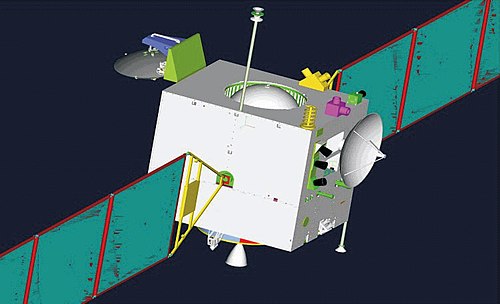
China launched its first lunar probe, Chang'e 1, which orbited the Moon and mapped its surface. This mission built on Qian's legacy of space exploration. #moon #space
China's First Lunar Orbiter (Chang'e 1) By Nasa - [1], Public domain, https://commons.wikimedia.org/w/index.php?curid=199351
Sep 25, 2008 CE
Shenzhou 7 Mission with First Chinese Spacewalk
China conducted its first spacewalk during the Shenzhou 7 mission. Qian's foundational work in rocketry enabled China's human spaceflight program. #spacewalk #human
Shenzhou 7 Mission with First Chinese Spacewalk By 中国新闻社 - YouTube: https://www.youtube.com/watch?v=EpFkHyl1NS0 – View/save archived versions on archive.org, CC BY 4.0, https://commons.wikimedia.org/w/index.php?curid=122166753
Oct 31, 2009 CE
Qian Xuesen Dies at Age 97
Qian passed away in Beijing. His death was widely mourned, and he was given a state funeral. He is remembered as the father of Chinese rocketry and space exploration. #death #legacy