Encyclopedia/1. The Cosmos & The Natural World/1. Mathematics & Formal Systems/01. Geometry & Spatial Systems • Curated by Admin Timeline.sg
A biographical timeline of seminal contributors to projective and fractal geometry, from ancient foundations to modern applications. These pioneers shaped our understanding of spatial relationships and self-similar structures, influencing mathematics, science, and engineering.
Chronological Storyline (38 Milestones)
300 BCE
Euclid Publishes Elements
Euclid's 'Elements' systematizes Greek geometry, laying the groundwork for all subsequent mathematical geometry including projective concepts. #projectivegeometry #geometry #history
Euclid Publishes Elements By Jusepe de Ribera (Spanish / Italian, 1591 - 1652) (1591 - 1652) – artist (Spanish / Italian) Details on Google Art Project - wAGVeSb2M1HfDA at Google Cultural Institute maximum zoom level, Public domain, https://commons.wikimedia.org/w/index.php?curid=21993409
200 BCE
Apollonius Writes Conics
Apollonius of Perga's 'Conics' classifies conic sections, essential for later projective geometry and perspective drawing. #projectivegeometry #conics #history
Apollonius Writes Conics By Giovanni Battista Memo - File:ApolloniiPergeiOpera1537.jpg, Public domain, https://commons.wikimedia.org/w/index.php?curid=70830662
320 CE
Pappus Records Projective Theorems
Pappus of Alexandria's 'Mathematical Collection' includes Pappus's hexagon theorem, a foundational result in projective geometry. #projectivegeometry #history
Pappus Records Projective Theorems By Pappus Alexandrinus - https://www.christies.com/en/lot/lot-6069499, Public domain, https://commons.wikimedia.org/w/index.php?curid=132586197
1011 CE
Alhazen's Book of Optics Advances Perspective
Ibn al-Haytham (Alhazen) writes 'Book of Optics', pioneering the mathematical study of perspective and projection, influencing European Renaissance art and projective geometry. #projectivegeometry #optics #history
Alhazen's Book of Optics Advances Perspective By Adolph Boÿ, engraved by Jeremias Falck. Used as the frontispiece to Johannes Hevelius, Selenographia, 1647 - https://www.loc.gov/resource/rbctos.2017rosen1321/?sp=9&r=0.059,0.617,0.327,0.182,0, Public domain, https://commons.wikimedia.org/w/index.php?curid=165125519
1413 CE
Brunelleschi Demonstrates Linear Perspective
Filippo Brunelleschi conducts his famous perspective experiments, demonstrating the projection of three-dimensional space onto a two-dimensional plane, a key practical step toward projective geometry. #projectivegeometry #renaissance #art
Brunelleschi Demonstrates Linear Perspective By scan uploaded by Sailko, cropped by MenkinAlRire - Wikimedia Commons; Sailko; book: Elena Capretti, Brunelleschi, Giunti Editore, Firenze 2003, Public domain, https://commons.wikimedia.org/w/index.php?curid=171034830
1435 CE
Alberti Codifies Perspective in De Pictura
Leon Battista Alberti's treatise 'De pictura' formally documents linear perspective, providing mathematical rules that underpin projective geometry. #projectivegeometry #art #history
Alberti Codifies Perspective in De Pictura By Leon Battista Alberti - https://archive.org/stream/dellapitturaedel00albe#page/n177/mode/2up, Public domain, https://commons.wikimedia.org/w/index.php?curid=42911315
1636 CE
Desargues Publishes Projective Geometry Work
Girard Desargues publishes 'Brouillon projet d'une atteinte aux événements des rencontres d'un cône avec un plan', introducing fundamental concepts of projective geometry such as points at infinity. #projectivegeometry #history
Desargues Publishes Projective Geometry Work By Théobald Chartran - https://medium.com/language-lab/i-think-therefore-i-am-cartesian-3ebfa6afd44e, Public domain, https://commons.wikimedia.org/w/index.php?curid=187058981
1639 CE
Pascal Formulates His Theorem
Blaise Pascal writes 'Essay on Conics', presenting Pascal's theorem that hexagon vertices on a conic lie on a line, a landmark in projective geometry. #projectivegeometry #conics #history
Pascal Formulates His Theorem By Wcherowi - Own work, CC BY-SA 3.0, https://commons.wikimedia.org/w/index.php?curid=22820278
1795 CE
Monge Develops Descriptive Geometry
Gaspard Monge creates descriptive geometry, a practical projection method essential for engineering and architecture, and foundational for projective geometry. #projectivegeometry #descriptivegeometry #engineering
Monge Develops Descriptive Geometry By François-Séraphin Delpech - http://www.sil.si.edu/digitalcollections/hst/scientific-identity/CF/by_name_display_results.cfm?scientist=Monge,%20Gaspard, Public domain, https://commons.wikimedia.org/w/index.php?curid=646122
1806 CE
Brianchon's Theorem Published
Charles Julien Brianchon proves his theorem that the sides of a circumscribed hexagon meet in three collinear points, the dual of Pascal's theorem, advancing projective geometry. #projectivegeometry #theorem #history
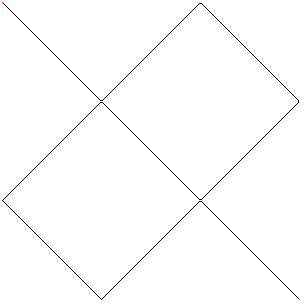
Brianchon's Theorem Published By Ag2gaeh - Own work, CC BY-SA 4.0, https://commons.wikimedia.org/w/index.php?curid=76024867
1822 CE
Poncelet's Traité Revives Projective Geometry
Jean-Victor Poncelet publishes 'Traité des propriétés projectives', systematically developing projective geometry independently of measurement, laying a rigorous foundation. #projectivegeometry #geometry #history
Poncelet's Traité Revives Projective Geometry By Smithsonian Libraries, https://library.si.edu/image-gallery/74037 (You must cite and link to, when possible, the SI Website as the source of the Content) see [3] - [1] and [2], Public domain, https://commons.wikimedia.org/w/index.php?curid=179179
1829 CE
Plücker Introduces Line Geometry
Julius Plücker publishes work on line geometry, using homogeneous coordinates that simplify projective geometry and link to analytic geometry. #projectivegeometry #linegeometry #mathematics
Plücker Introduces Line Geometry By Rudolf Hoffmann (Lithograph), nach einer Photographie von Schafgans in Bonn. - [1]; transferred from en.wikipedia; description page was here 10:04, 15 June 2004 Magnus Manske 728x909 (133,849 bytes), Public domain, https://commons.wikimedia.org/w/index.php?curid=813547
1832 CE
Steiner's Synthetic Projective Geometry
Jakob Steiner publishes 'Systematische Entwickelung der Abhängigkeit geometrischer Gestalten voneinander', establishing synthetic projective geometry with cross-ratio and projective transformations. #projectivegeometry #syntheticgeometry #history
Steiner's Synthetic Projective Geometry By Unknown author - Hanns Peter Holl: Jeremias Gotthelf. Zürich/München 1988, S. 33 – originally uploaded to german wikipedia: 9. Sep. 2005, 19:18 Paenultima (Diskussion / Beiträge) hat „Bild:JakobSteiner.jpg“ hochgeladen (Jakob Steiner Quelle: Hanns Peter Holl, Jeremias Gotthelf, Zürich / München 1988, S. 33 {{PD-old}} ), Public domain, https://commons.wikimedia.org/w/index.php?curid=658272
1847 CE
von Staudt Defines Projective Coordinates
Karl von Staudt's 'Beiträge zur Geometrie der Lage' introduces projective coordinates using only projective axioms, freeing projective geometry from metric dependencies. #projectivegeometry #coordinates #history
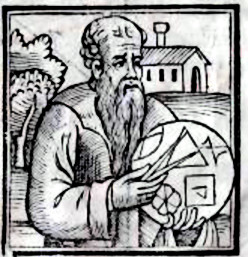
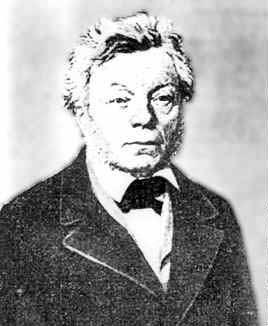
von Staudt Defines Projective Coordinates By Unknown author - http://www.rsg.rothenburg.de/, Public domain, https://commons.wikimedia.org/w/index.php?curid=5533638
1852 CE
Chasles' Traité de Géométrie Supérieure
Michel Chasles publishes his treatise consolidating projective geometry, emphasizing cross-ratio and harmonic division, and influencing later unification. #projectivegeometry #geometry #history
Chasles' Traité de Géométrie Supérieure By Unknown author, Public domain, https://commons.wikimedia.org/w/index.php?curid=252140
1859 CE
Cayley Defines Projective Metrics
Arthur Cayley publishes 'A Sixth Memoir upon Quantics', showing that Euclidean and non-Euclidean geometries are subsumed within projective geometry via a metric, a key insight. #projectivegeometry #metrics #unification
Cayley Defines Projective Metrics By Herbert Beraud (1845–1896) - http://www-groups.dcs.st-and.ac.uk/~history/PictDisplay/Cayley.html, Public domain, https://commons.wikimedia.org/w/index.php?curid=904674
1872 CE
Klein's Erlangen Program Unifies Geometries
Felix Klein publishes the Erlangen Program, classifying geometries by their invariant groups, with projective geometry as the most general, unifying all others. #projectivegeometry #erlangenprogram #mathematics
Klein's Erlangen Program Unifies Geometries By Unknown author, Public domain, https://commons.wikimedia.org/w/index.php?curid=38617
1872 CE
Weierstrass Presents Continuous Nowhere Differentiable Function
Karl Weierstrass presents a function that is continuous but nowhere differentiable, an early fractal-like construction challenging intuitive notions of curves. #fractalgeometry #analysis #history
Weierstrass Presents Continuous Nowhere Differentiable Function By Eeyore22 - Own work, Public domain, https://commons.wikimedia.org/w/index.php?curid=5075959
1883 CE
Cantor Defines the Cantor Set
Georg Cantor introduces the Cantor set, an uncountable set of measure zero that is self-similar and a prototype for fractal geometry. #fractalgeometry #cantorset #settheory
Cantor Defines the Cantor Set By Thefrettinghand at English Wikibooks - Transferred from en.wikibooks to Commons., CC BY-SA 3.0, https://commons.wikimedia.org/w/index.php?curid=61785435
1890 CE
Peano Constructs a Space-Filling Curve
Giuseppe Peano describes a continuous curve that passes through every point of a square, a fractal curve challenging traditional dimension concepts. #fractalgeometry #spacefilling #curves
Peano Constructs a Space-Filling Curve By No machine-readable author provided. Arbol01 assumed (based on copyright claims). - No machine-readable source provided. Own work assumed (based on copyright claims)., CC BY-SA 3.0, https://commons.wikimedia.org/w/index.php?curid=1776029
1904 CE
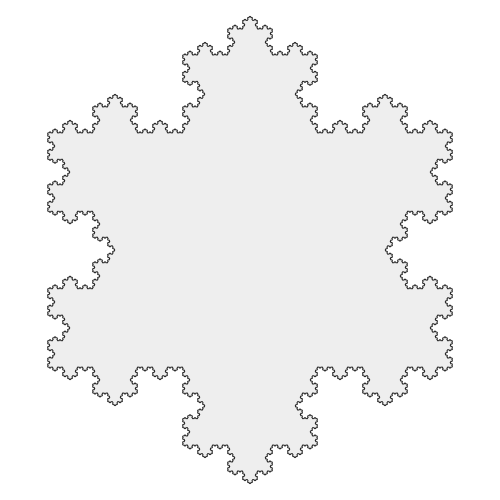
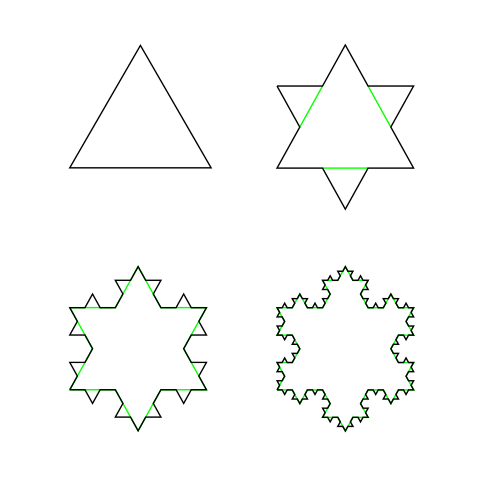
Koch Describes the Koch Snowflake
Helge von Koch publishes the Koch snowflake, a continuous, nowhere differentiable fractal curve with infinite perimeter but finite area, illustrating self-similarity. #fractalgeometry #koshsnowflake #selfsimilarity
Koch Describes the Koch Snowflake By Wrtlprnft - Own work, Public domain, https://commons.wikimedia.org/w/index.php?curid=1225322
1915 CE
Sierpiński Introduces the Sierpiński Triangle
Wacław Sierpiński describes the Sierpiński triangle, a self-similar fractal created by iteratively removing triangles, now a classic example in fractal geometry. #fractalgeometry #sierpinskitriangle #selfsimilarity
Sierpiński Introduces the Sierpiński Triangle By Unknown author, CC BY-SA 3.0, https://commons.wikimedia.org/w/index.php?curid=8862246
1917 CE
Fatou Studies Iteration of Rational Functions
Pierre Fatou publishes 'Sur les substitutions rationnelles', investigating Julia sets and their fractal behavior, laying groundwork for complex dynamics. #fractalgeometry #complexdynamics #juliasets
Fatou Studies Iteration of Rational Functions By Unknown author - http://www.math.sunysb.edu/~zakeri/mat542/men/Fatou.jpeg, Public domain, https://commons.wikimedia.org/w/index.php?curid=3232378
1918 CE
Hausdorff Defines Fractional Dimension
Felix Hausdorff introduces the concept of fractional dimension (Hausdorff dimension), a key metric for quantifying the complexity of fractals. #fractalgeometry #hausdorffdimension #dimension
Hausdorff Defines Fractional Dimension By Original: Chas_zzz_brown,Shibboleth Vector: The original uploader was Wxs at Wikimedia Commons. - Own work based on: KochFlake.png, CC BY-SA 3.0, https://commons.wikimedia.org/w/index.php?curid=1898291
1918 CE
Julia's Memoir on Iteration Wins Prize
Gaston Julia publishes 'Mémoire sur l'itération des fonctions rationnelles', winning the Grand Prix of the Académie des Sciences and establishing Julia sets as fractal objects. #fractalgeometry #juliasets #complexdynamics
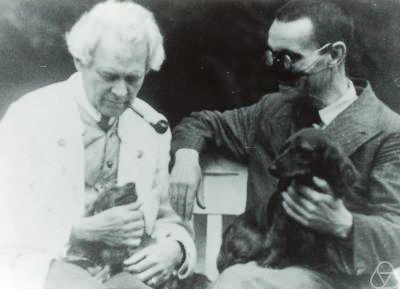
Julia's Memoir on Iteration Wins Prize By Konrad Jacobs, Erlangen - https://opc.mfo.de/detail?photo_id=1680, CC BY-SA 2.0 de, https://commons.wikimedia.org/w/index.php?curid=6615446
1961 CE
Richardson Studies Coastline Length Paradox
Lewis Fry Richardson discovers that measured coastline length increases with scale, revealing fractal-like self-similarity and inspiring Mandelbrot's later work. #fractalgeometry #coastline #selfsimilarity
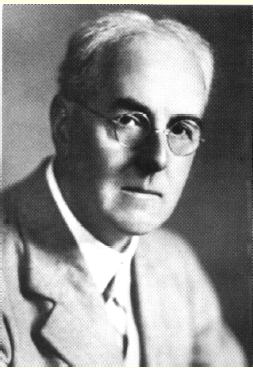
Richardson Studies Coastline Length Paradox By NOAA - NOAA presentation, Public domain, https://commons.wikimedia.org/w/index.php?curid=1506000
1963 CE
Lorenz Identifies the Strange Attractor
Edward Lorenz publishes on the Lorenz system, introducing the Lorenz attractor, a fractal structure in chaos theory that illustrates deterministic chaos and fractal geometry. #fractalgeometry #chaostheory #strangeattractor
Lorenz Identifies the Strange Attractor By Dan Quinn - Own work, CC BY-SA 3.0, https://commons.wikimedia.org/w/index.php?curid=29370723
1967 CE
Mandelbrot's 'How Long Is the Coast of Britain?'
Benoit Mandelbrot publishes his seminal paper linking statistical self-similarity to fractional dimension, applying fractal concepts to natural phenomena like coastlines. #fractalgeometry #mandelbrot #fractionaldimension
Mandelbrot's 'How Long Is the Coast of Britain?' By Unknown author, CC BY-SA 3.0, https://commons.wikimedia.org/w/index.php?curid=642220
1975 CE
Mandelbrot Coins the Term 'Fractal'
Benoit Mandelbrot introduces the term 'fractal' from Latin 'fractus' (broken), synthesizing previous work and establishing fractal geometry as a new field. #fractalgeometry #mandelbrot #terminology
Mandelbrot Coins the Term 'Fractal' By Steve Jurvetson - https://www.flickr.com/photos/jurvetson/4770047266/, CC BY 2.0, https://commons.wikimedia.org/w/index.php?curid=155438846
1977 CE
Mandelbrot Publishes 'Fractals: Form, Chance and Dimension'
Mandelbrot's first book on fractals popularizes the concept, showcasing their beauty and ubiquity in nature, art, and mathematics. #fractalgeometry #mandelbrot #book
1980 CE
Mandelbrot Set Visualized
Benoit Mandelbrot uses computer graphics to produce the first image of the Mandelbrot set, revealing its infinite complexity and self-similarity. #fractalgeometry #mandelbrotset #complexdynamics
Mandelbrot Set Visualized By Created by Wolfgang Beyer with the program Ultra Fractal 3. - Own work, CC BY-SA 3.0, https://commons.wikimedia.org/w/index.php?curid=321973
1982 CE
Mandelbrot's 'The Fractal Geometry of Nature' Published
Mandelbrot's influential book 'The Fractal Geometry of Nature' establishes fractals as a unified tool for describing irregular natural shapes, spreading fractal concepts widely. #fractalgeometry #mandelbrot #book
1982 CE
Douady and Hubbard Prove Connectedness of Mandelbrot Set
Adrien Douady and John H. Hubbard prove the Mandelbrot set is connected, deepening understanding of complex dynamics and fractal structures. #fractalgeometry #mandelbrotset #complexdynamics
Douady and Hubbard Prove Connectedness of Mandelbrot Set By François Tisseyre - Photo prise à l'IHP., CC BY 2.5, https://commons.wikimedia.org/w/index.php?curid=1362963
1985 CE
Barnsley Develops Iterated Function Systems
Michael Barnsley introduces iterated function systems (IFS), a method for generating fractals from contractive affine transformations, enabling fractal image compression. #fractalgeometry #ifra #compression
Barnsley Develops Iterated Function Systems By António Miguel de Campos - self made using own JAVA animation, Public domain, https://commons.wikimedia.org/w/index.php?curid=2091769
1988 CE
Fractal Image Compression Introduced
Barnsley and Alan D. Sloan patent fractal image compression, a method exploiting self-similarity to achieve high compression ratios for digital images. #fractalgeometry #compression #imageprocessing
Fractal Image Compression Introduced By Original: Marekd Vector: Theki - Own work, Public domain, https://commons.wikimedia.org/w/index.php?curid=162766420
1993 CE
Journal 'Fractals' Founded
The interdisciplinary journal 'Fractals' launches, providing a dedicated platform for research in fractal geometry and its applications across sciences. #fractalgeometry #journal #research )
1995 CE
Fractal Antenna Patented by Nathan Cohen
Nathan Cohen patents the fractal antenna, using self-similar shapes to achieve multiband and miniaturized performance, revolutionizing antenna design. #fractalgeometry #antenna #engineering
Fractal Antenna Patented by Nathan Cohen By Nathan Cohen - http://patft.uspto.gov/netacgi/nph-Parser?Sect1=PTO2&Sect2=HITOFF&p=1&u=%2Fnetahtml%2FPTO%2Fsearch-bool.html&r=1&f=G&l=50&co1=AND&d=PTXT&s1=6452553.PN.&OS=PN/6452553&RS=PN/6452553, Public domain, https://commons.wikimedia.org/w/index.php?curid=41700498
1998 CE
Fractal Geometry in Cosmology Proposed
Francesco Sylos Labini and Luciano Pietronero propose that the large-scale distribution of galaxies exhibits fractal behavior, sparking debate on the structure of the universe. #fractalgeometry #cosmology #galaxies
Fractal Geometry in Cosmology Proposed By Jonathan Huot - https://www.facebook.com/photo.php?fbid=10153188043864019&set=a.10151374960234019.501003.730509018&type=1&theater, CC BY-SA 4.0, https://commons.wikimedia.org/w/index.php?curid=43087770