300 CE
Pappus's Theorem
Greek mathematician Pappus of Alexandria publishes his Collection, which includes Pappus's theorem, an early result in projective geometry concerning collinearity of points on lines. #math #geometry
This timeline traces the development of projective and fractal geometry from ancient perspectives through modern breakthroughs, highlighting key theorems, pioneers, and applications that have shaped these fields.
Greek mathematician Pappus of Alexandria publishes his Collection, which includes Pappus's theorem, an early result in projective geometry concerning collinearity of points on lines. #math #geometry
Filippo Brunelleschi demonstrates linear perspective, establishing mathematical principles for projecting three-dimensional space onto a plane, a precursor to projective geometry. #art #math

Girard Desargues publishes his theorem on perspective triangles, a foundational result in projective geometry that relates triangle vertices and lines. #geometry #history

Blaise Pascal, at age 16, publishes his theorem on hexagons inscribed in conic sections, a key result in projective geometry. #math #youth

French mathematician Philippe de La Hire publishes works on conics and projective geometry, advancing the field. #geometry

Gaspard Monge develops descriptive geometry, a system for representing three-dimensional objects in two dimensions using projections, influencing projective geometry. #geometry #engineering
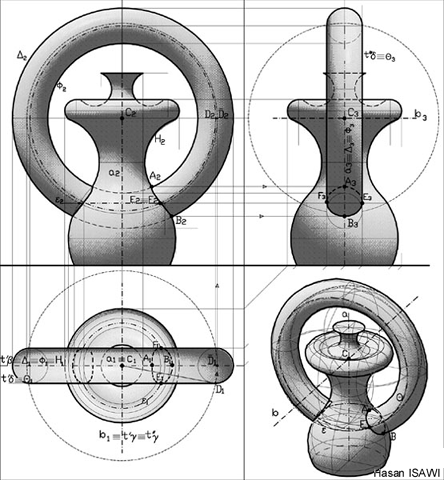
Jean-Victor Poncelet publishes the first systematic treatise on projective geometry, introducing continuity principle and cross-ratio. #math #history

August Ferdinand Möbius introduces barycentric coordinates, a coordinate system for projective geometry. #geometry #algebra

Jakob Steiner publishes a synthetic approach to projective geometry, developing the concept of harmonic bundles. #geometry

Karl Georg Christian von Staudt publishes a purely projective geometry without metric concepts, establishing foundations. #math
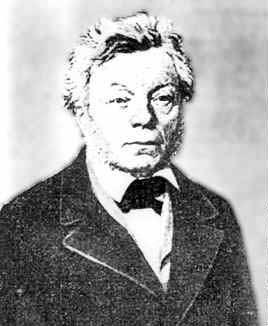
Arthur Cayley unifies projective geometry with algebra via homogeneous coordinates. #algebra #geometry

Julius Plücker introduces line coordinates and studies line geometry, contributing to projective geometry. #geometry
Felix Klein proposes the Erlangen Program, classifying geometries by transformation groups, with projective geometry as a central case. #math #group

Georg Cantor describes the Cantor set, a fractal-like set of points with self-similarity, laying groundwork for fractal geometry. #fractals #settheory

Giuseppe Peano constructs a continuous curve that fills a square, challenging notions of dimension and inspiring fractal concepts. #fractals #dimension
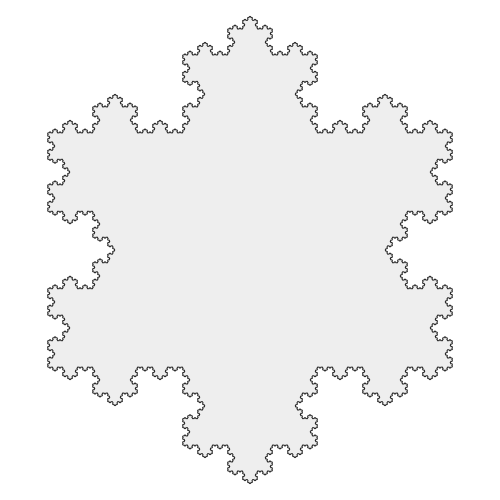
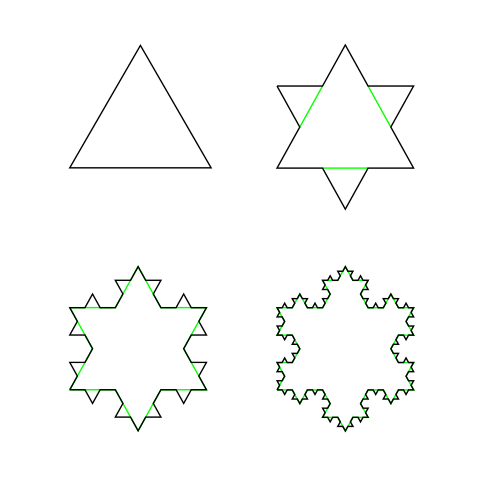
Helge von Koch describes the Koch snowflake, a continuous curve with infinite length but finite area, a classic fractal. #fractals #geometry
Wacław Sierpiński introduces the Sierpinski triangle, a self-similar fractal constructed by recursively removing triangles. #fractals

Felix Hausdorff defines fractional dimensions, crucial for quantifying fractal structures. #fractals #math
Gaston Julia and Pierre Fatou study iterated rational functions, leading to Julia sets, foundational in complex dynamics and fractals. #fractals #complex

Pierre Bézier develops parametric curves for car design, using projective geometry concepts; later used in computer graphics. #geometry #design

Paul Lévy describes the Lévy C curve, a continuous fractal curve with self-similarity. #fractals
H.S.M. Coxeter publishes introductory text on projective geometry, influencing modern teaching. #geometry #textbook

Algebraic geometry adopts projective spaces extensively via Grothendieck's schemes, linking projective geometry to algebra. #algebra #geometry

Benoit Mandelbrot introduces the term 'fractal' to describe irregular, self-similar shapes, revolutionizing geometry and nature study. #fractals #math

Aristid Lindenmayer develops L-systems for simulating plant growth and fractal patterns, used in biology and computer graphics. #fractals #biology

Benoit Mandelbrot produces first computer visualizations of the Mandelbrot set, an iconic fractal from complex dynamics. #fractals #computergraphics

Mandelbrot publishes his seminal book, popularizing fractals and their applications in nature, art, and science. #fractals #book
Michael Barnsley develops fractal image compression, using self-similarity to compress images efficiently. #fractals #compression

Michael Barnsley and Stephen Demko introduce iterated function systems (IFS) for generating fractals. #fractals #math

Nathan Cohen patents first fractal antenna, demonstrating fractal geometry improves antenna performance. #fractals #engineering

Computer vision adopts projective geometry for camera calibration and 3D reconstruction from images. #computervision #geometry
Astrophysicists propose fractal models for the large-scale structure of the universe, sparking debate. #fractals #cosmology

Scott Draves creates fractal flame algorithm, generating intricate, colorful fractal art. #fractals #art

3D graphics pipelines use projective transformations for perspective rendering, standardizing projective geometry in computer graphics. #graphics #geometry
Mandelbrot applies fractal geometry to financial markets, modeling price fluctuations with self-similarity. #fractals #finance
Fractal software like Fractint enables wide creation and appreciation of fractal art, entering mainstream culture. #fractals #art

Robotics uses projective geometry for visual servoing and object recognition, enhancing autonomy. #robotics #geometry
Fractal antennas become common in mobile devices, offering compact, efficient designs. #fractals #tech
Researchers explore integrating projective geometry into neural networks for improved spatial understanding. #deeplearning #geometry
Discovery of fractal patterns in cellular automata rules, linking complexity to self-similarity. #fractals #complexity
Fractal geometry analyzes lung damage caused by COVID-19, aiding medical imaging diagnostics. #fractals #medical