Encyclopedia/1. The Cosmos & The Natural World/1. Mathematics & Formal Systems/01. Geometry & Spatial Systems • Curated by Admin Timeline.sg
Projective geometry originated from Renaissance perspective studies and was formalized in the 19th century, while fractal geometry emerged from 19th-century pathological functions and evolved into a modern discipline through Mandelbrot's work. Together they explore properties invariant under transformation and self-similar structures.
Chronological Storyline (35 Milestones)
300 BCE
Euclid's Elements
Euclid's Elements lays the foundation for geometry, including the concept of conic sections later used in projective geometry. #geometry #history
Euclid's Elements By University of Pennsylvania Museum of Archaeology and Anthropology - https://openn.library.upenn.edu/Data/0016/html/e2748.html, CC BY-SA 4.0, https://commons.wikimedia.org/w/index.php?curid=169166171
200 BCE
Apollonius's Conics
Apollonius of Perga writes Conics, a comprehensive study of conic sections that later influences projective geometry. #geometry #classical
Apollonius's Conics By Giovanni Battista Memo - File:ApolloniiPergeiOpera1537.jpg, Public domain, https://commons.wikimedia.org/w/index.php?curid=70830662
300 CE
Pappus's Collection
Pappus of Alexandria compiles the Mathematical Collection, containing Pappus's theorem, a key result in projective geometry. #geometry #ancient
Pappus's Collection By Pappus Alexandrinus - https://www.christies.com/en/lot/lot-6069499, Public domain, https://commons.wikimedia.org/w/index.php?curid=132586197
1021 CE
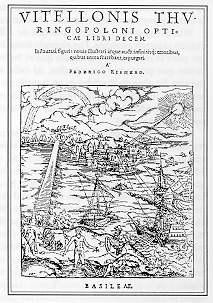
Alhazen's Optics
Ibn al-Haytham (Alhazen) writes Book of Optics, discussing perspective and the geometric principles of vision, anticipating projective ideas. #optics #islamic
Alhazen's Optics By Ibn al-Haytham, Vitello, Friedrich Risner - University of Oklahoma History of Science Collections et BnF Gallica : http://gallica.bnf.fr/ark:/12148/bpt6k312873d.r=Haytham?rk=407727;2, Public domain, https://commons.wikimedia.org/w/index.php?curid=48189707
1260 CE
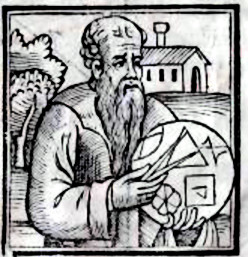
Witelo's Perspectiva
Witelo's Perspectiva expands on Alhazen's optics, further developing geometric perspective theory. #optics #medieval
Witelo's Perspectiva By Unknown author, Public domain, https://commons.wikimedia.org/w/index.php?curid=1114772
1415 CE
Brunelleschi's Perspective Demonstration
Filippo Brunelleschi demonstrates linear perspective using a mirror, a crucial step toward projective geometry. #art #renaissance
Brunelleschi's Perspective Demonstration By scan uploaded by Sailko, cropped by MenkinAlRire - Wikimedia Commons; Sailko; book: Elena Capretti, Brunelleschi, Giunti Editore, Firenze 2003, Public domain, https://commons.wikimedia.org/w/index.php?curid=171034830
1435 CE
Alberti's Della Pittura
Leon Battista Alberti's treatise On Painting codifies linear perspective, influencing projective geometry. #art #renaissance
Alberti's Della Pittura By Leon Battista Alberti - https://archive.org/stream/dellapitturaedel00albe#page/n177/mode/2up, Public domain, https://commons.wikimedia.org/w/index.php?curid=42911315
1525 CE
Dürer's Underweysung der Messung
Albrecht Dürer's treatise on measurement discusses perspective and geometric constructions. #geometry #renaissance
1604 CE
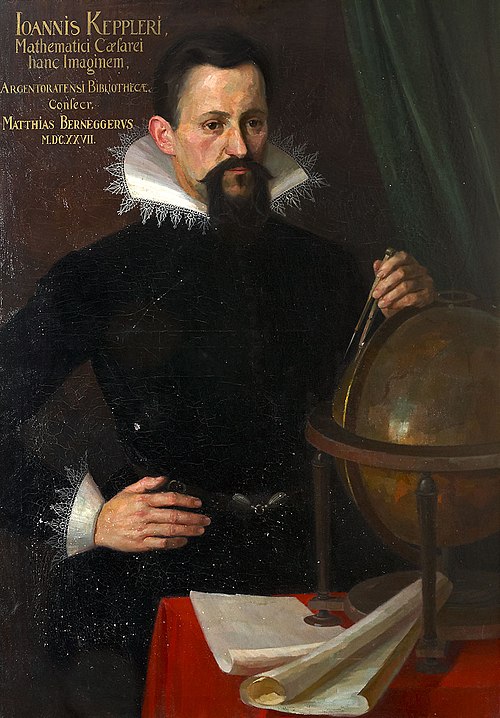
Kepler's Conics
Johannes Kepler's Ad Vitellionem paralipomena discusses conics and the principle of continuity, influential for projective geometry. #astronomy #geometry
Kepler's Conics By August Köhler [1] - Kepler-Museum in Weil der Stadt, Public domain, https://commons.wikimedia.org/w/index.php?curid=9406242
1636 CE
Desargues's Brouillon Project
Girard Desargues publishes Brouillon project d'une atteinte aux événemens des rencontres du cône avec un plan, introducing projective geometry concepts like points at infinity. #geometry #pioneer
Desargues's Brouillon Project By Théobald Chartran - https://medium.com/language-lab/i-think-therefore-i-am-cartesian-3ebfa6afd44e, Public domain, https://commons.wikimedia.org/w/index.php?curid=187058981
1640 CE
Pascal's Hexagrammum Mysticum
Blaise Pascal publishes Essay on Conics, stating Pascal's theorem about hexagons inscribed in a conic. #geometry #pioneer
Pascal's Hexagrammum Mysticum By Wcherowi - Own work, CC BY-SA 3.0, https://commons.wikimedia.org/w/index.php?curid=22820278
1685 CE
La Hire's Conics
Philippe de La Hire publishes Sectiones conicae, using projective methods to study conics. #geometry #french
La Hire's Conics By Unknown author - Unknown. This is a contemporary engraving., Public domain, https://commons.wikimedia.org/w/index.php?curid=1139639
1822 CE
Poncelet's Traité des Propriétés Projectives
Jean-Victor Poncelet publishes Traité des propriétés projectives des figures, founding modern projective geometry. #geometry #pioneer
1826 CE
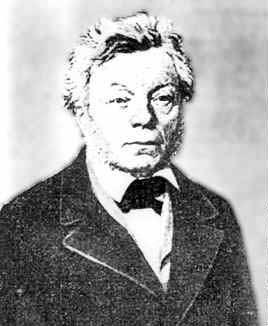
Möbius's Barycentric Calculus
August Ferdinand Möbius develops barycentric coordinates, a projective coordinate system. #geometry #german
Möbius's Barycentric Calculus By Adolf Neumann - http://www.portraitindex.de/documents/obj/33213645, Public domain, https://commons.wikimedia.org/w/index.php?curid=58320662
1829 CE
Gergonne's Duality Principle
Joseph Diaz Gergonne introduces the principle of duality in projective geometry. #geometry #french
Gergonne's Duality Principle By Unknown author - McTutor History of Mathematics: http://www-history.mcs.st-andrews.ac.uk/PictDisplay/Gergonne.html, Public domain, https://commons.wikimedia.org/w/index.php?curid=47496016
1832 CE
Steiner's Systematic Development
Jakob Steiner publishes Systematische Entwickelung der Abhängigkeit geometrischer Gestalten, a synthetic approach to projective geometry. #geometry #german
Steiner's Systematic Development By Unknown author - Hanns Peter Holl: Jeremias Gotthelf. Zürich/München 1988, S. 33 – originally uploaded to german wikipedia: 9. Sep. 2005, 19:18 Paenultima (Diskussion / Beiträge) hat „Bild:JakobSteiner.jpg“ hochgeladen (Jakob Steiner Quelle: Hanns Peter Holl, Jeremias Gotthelf, Zürich / München 1988, S. 33 {{PD-old}} ), Public domain, https://commons.wikimedia.org/w/index.php?curid=658272
1847 CE
von Staudt's Geometrie der Lage
Karl Georg Christian von Staudt's Geometrie der Lage establishes projective geometry without metric concepts. #geometry #german
von Staudt's Geometrie der Lage By Unknown author - http://www.rsg.rothenburg.de/, Public domain, https://commons.wikimedia.org/w/index.php?curid=5533638
1849 CE
Plücker's Line Geometry
Julius Plücker develops line geometry using homogeneous coordinates, a projective approach. #geometry #german
Plücker's Line Geometry By Rudolf Hoffmann (Lithograph), nach einer Photographie von Schafgans in Bonn. - [1]; transferred from en.wikipedia; description page was here 10:04, 15 June 2004 Magnus Manske 728x909 (133,849 bytes), Public domain, https://commons.wikimedia.org/w/index.php?curid=813547
1854 CE
Riemann's On the Hypotheses which lie at the Bases of Geometry
Bernhard Riemann's lecture lays foundations for Riemannian geometry, influencing projective geometry's generalization. #geometry #foundations
1859 CE
Cayley's Projective Metric
Arthur Cayley's Sixth Memoir on Quantics introduces a projective metric deriving Euclidean geometry as a special case. #geometry #british
Cayley's Projective Metric By Herbert Beraud (1845–1896) - http://www-groups.dcs.st-and.ac.uk/~history/PictDisplay/Cayley.html, Public domain, https://commons.wikimedia.org/w/index.php?curid=904674
1872 CE
Klein's Erlangen Program
Felix Klein's Erlangen Program classifies geometries based on group invariance, placing projective geometry as a fundamental framework. #geometry #foundations
Klein's Erlangen Program By Unknown author, Public domain, https://commons.wikimedia.org/w/index.php?curid=38617
1883 CE
Cantor Set
Georg Cantor describes the Cantor set, an early example of a fractal and a perfect nowhere-dense set. #fractals #analysis
Cantor Set By Thefrettinghand at English Wikibooks - Transferred from en.wikibooks to Commons., CC BY-SA 3.0, https://commons.wikimedia.org/w/index.php?curid=61785435
1890 CE
Peano Space-Filling Curve
Giuseppe Peano constructs the first space-filling curve, a continuous curve passing through every point of a square, highlighting self-similarity. #fractals #topology
Peano Space-Filling Curve By No machine-readable author provided. Arbol01 assumed (based on copyright claims). - No machine-readable source provided. Own work assumed (based on copyright claims)., CC BY-SA 3.0, https://commons.wikimedia.org/w/index.php?curid=1776029
1904 CE
Koch Snowflake
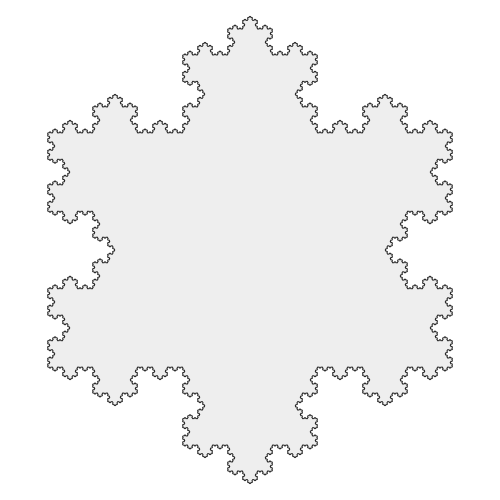
Helge von Koch describes the Koch snowflake, a continuous nowhere-differentiable curve and early fractal. #fractals #geometry
Koch Snowflake By Wrtlprnft - Own work, Public domain, https://commons.wikimedia.org/w/index.php?curid=1225322
1915 CE
Sierpinski Triangle
Wacław Sierpiński describes the Sierpinski triangle, a self-similar fractal with topological dimension 1 and Hausdorff dimension ~1.585. #fractals #polish
Sierpinski Triangle By Unknown author, CC BY-SA 3.0, https://commons.wikimedia.org/w/index.php?curid=8862246
1918 CE
Julia Sets
Gaston Julia publishes his work on iteration of rational functions, describing Julia sets, which later become central to complex dynamics. #fractals #complex
Julia Sets By Morn - Own work, CC BY-SA 4.0, https://commons.wikimedia.org/w/index.php?curid=75993344
1938 CE
Lévy C Curve
Paul Lévy describes the Lévy C curve, a self-similar fractal derived from iterating a linear transformation. #fractals #french
1975 CE
Mandelbrot Coins 'Fractal'
Benoit Mandelbrot coins the term 'fractal' in his essay Les Objets Fractals: Forme, Hasard et Dimension, unifying the study of irregular shapes. #fractals #pioneer
Mandelbrot Coins 'Fractal' By Steve Jurvetson - https://www.flickr.com/photos/jurvetson/4770047266/, CC BY 2.0, https://commons.wikimedia.org/w/index.php?curid=155438846
1977 CE
Mandelbrot's The Fractal Geometry of Nature
Mandelbrot publishes The Fractal Geometry of Nature, popularizing fractals and their applications. #fractals #book
1980 CE
Mandelbrot Set Visualized
The Mandelbrot set is first visualized via computer graphics, revealing its infinite complexity and self-similarity. #fractals #computers
Mandelbrot Set Visualized By Created by Wolfgang Beyer with the program Ultra Fractal 3. - Own work, CC BY-SA 3.0, https://commons.wikimedia.org/w/index.php?curid=321973
1982 CE
Fractal Compression Introduced
Michael Barnsley develops fractal image compression, a practical application of fractal geometry. #fractals #compression
Fractal Compression Introduced By Original: Marekd Vector: Theki - Own work, Public domain, https://commons.wikimedia.org/w/index.php?curid=162766420
1991 CE
Iterated Function Systems
John Hutchinson formalizes iterated function systems (IFS), a framework for constructing fractals via contraction mappings. #fractals #math
Iterated Function Systems By António Miguel de Campos - self made using own JAVA animation, Public domain, https://commons.wikimedia.org/w/index.php?curid=2091769
2000 CE
Fractal Antennas
Fractal geometry is applied to antenna design, enabling multiband performance in compact devices. #fractals #engineering
Fractal Antennas By Nathan Cohen - http://patft.uspto.gov/netacgi/nph-Parser?Sect1=PTO2&Sect2=HITOFF&p=1&u=%2Fnetahtml%2FPTO%2Fsearch-bool.html&r=1&f=G&l=50&co1=AND&d=PTXT&s1=6452553.PN.&OS=PN/6452553&RS=PN/6452553, Public domain, https://commons.wikimedia.org/w/index.php?curid=41700498
2004 CE
Fractals in Finance
Benoit Mandelbrot's work on fractal scaling in financial markets gains widespread recognition with his book The (Mis)behavior of Markets. #fractals #finance
2010 CE
Fractal Geometry in Nature Confirmed
Research confirms fractal scaling in various natural phenomena, from coastlines to tree branching. #fractals #nature
Fractal Geometry in Nature Confirmed By António Miguel de Campos - en:User:Tó campos - self made based in own JAVA animation, Public domain, https://commons.wikimedia.org/w/index.php?curid=618030