Encyclopedia/1. The Cosmos & The Natural World/1. Mathematics & Formal Systems • Curated by Admin Timeline.sg
Probability and stochastic processes trace the mathematical modeling of randomness from ancient games of chance to modern measure-theoretic foundations, encompassing key developments such as Pascal's correspondence, Bayes' theorem, Markov chains, and Kolmogorov's axioms.
Chronological Storyline (45 Milestones)
3500 BCE
Earliest Known Dice
Ancient Mesopotamian six-sided dice made from bone or clay are used for divination and games, representing early human engagement with randomness. #probability #history
Earliest Known Dice By Diacritica - Own work, CC BY-SA 3.0, https://commons.wikimedia.org/w/index.php?curid=99768017
2400 BCE
Chinese Oracle Bones
Shang dynasty oracle bones are used for divination, with cracks interpreted as random signs, reflecting early probabilistic thinking. #probability #history
Chinese Oracle Bones By Unknown author - User Herr Klugbeisser on de.wikipedia Geschossen von im Shanghai-Museum, Januar 2004 Created and published under the GFDL by User Herr Klugbeisser Originally from de.wikipedia; description page is (was) here 18:41, 2. Mai 2004 Herr Klugbeisser 800 x 800 (91585 Byte) (Orakelknochen), CC BY-SA 3.0, https://commons.wikimedia.org/w/index.php?curid=38023
500 BCE
Greek Astragaloi
Greeks use knucklebones (astragaloi) for games of chance, with four sides having different probabilities, early empirical probability. #probability #history
Greek Astragaloi By Unknown author - Black Market, CC BY-SA 3.0, https://commons.wikimedia.org/w/index.php?curid=21064230
960 CE
Liber de Ludo Aleae
Gerolamo Cardano writes a manuscript on dice games, containing early calculations of odds, though published posthumously in 1663. #probability #mathematics
Liber de Ludo Aleae By Unknown author - https://wellcomeimages.org/indexplus/obf_images/ae/d3/8753d7ad74cb086ba79ccfc75e7f.jpg Gallery: https://wellcomeimages.org/indexplus/image/V0001004.html Wellcome Collection gallery (2018-03-29): https://wellcomecollection.org/works/pcd969qu CC-BY-4.0, CC BY 4.0, https://commons.wikimedia.org/w/index.php?curid=36391939
1494 CE
Pacioli's Summa
Luca Pacioli's Summa de arithmetica includes a problem on dividing stakes in an unfinished game, the 'problem of points', a precursor to probability. #probability #mathematics
Pacioli's Summa By Attributed to Jacopo de' Barbari - Lauwers, Luc & Willekens, Marleen: Five Hundred Years of Bookkeeping: A Portrait of Luca Pacioli (Tijdschrift voor Economie en Management, Katholieke Universiteit Leuven, 1994, vol. XXXIX issue 3 p. 289–304) pdf, Public domain, https://commons.wikimedia.org/w/index.php?curid=670307
1550 CE
Tartaglia's Solution
Niccolò Tartaglia proposes a solution to the problem of points, though flawed, advancing the discussion on fair division. #probability #mathematics
Tartaglia's Solution By Rijksmuseum - http://hdl.handle.net/10934/RM0001.COLLECT.115228, CC0, https://commons.wikimedia.org/w/index.php?curid=84145195
Jul 29, 1654 CE
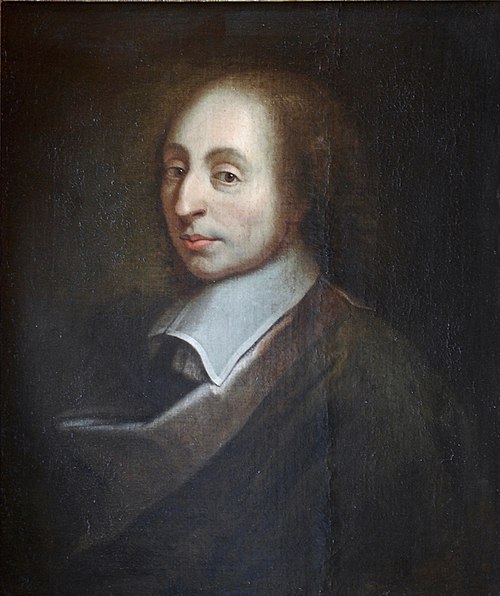
Pascal-Fermat Correspondence
Blaise Pascal and Pierre de Fermat exchange letters solving the problem of points, laying the foundation for probability theory. #probability #mathematics
Pascal-Fermat Correspondence By unknown; a copy of the painting of François II Quesnel, which was made for Gérard Edelinck en 1691[réf. nécessaire]. - Own work, Public domain, https://commons.wikimedia.org/w/index.php?curid=12193020
1657 CE
Huygens' De Ratiociniis
Christiaan Huygens publishes De Ratiociniis in Ludo Aleae, the first printed book on probability, introducing expectation. #probability #mathematics
Huygens' De Ratiociniis By Caspar Netscher - http://ressources2.techno.free.fr/informatique/sites/inventions/inventions.html, Public domain, https://commons.wikimedia.org/w/index.php?curid=44047
1662 CE
Graunt's Bills of Mortality
John Graunt analyzes London death records, pioneering statistical demography and the use of probability in social science. #probability #statistics
1713 CE
Bernoulli's Ars Conjectandi
Jacob Bernoulli's posthumous work includes the Law of Large Numbers, formalizing the relationship between probability and frequency. #probability #mathematics
Bernoulli's Ars Conjectandi By Jakob Bernoulli - http://nsm1.nsm.iup.edu/gsstoudt/history/images/arsconj.html, Public domain, https://commons.wikimedia.org/w/index.php?curid=4099411
1733 CE
De Moivre's Normal Distribution
Abraham de Moivre approximates binomial distribution with the normal curve, discovering the normal distribution. #probability #statistics
De Moivre's Normal Distribution By Joseph Highmore - https://prints.royalsociety.org/products/portrait-of-abraham-de-moivre-1667-1754-rs-9548, Public domain, https://commons.wikimedia.org/w/index.php?curid=167394521
1763 CE
Bayes' Theorem Published
Thomas Bayes' essay on inverse probability is published posthumously, establishing Bayes' theorem for conditional probability. #probability #statistics
1774 CE
Laplace's Principle of Insufficient Reason
Pierre-Simon Laplace formulates the principle of indifference, a key concept in classical probability. #probability #mathematics
Laplace's Principle of Insufficient Reason By James Posselwhite - www.britannica.com, Public domain, https://commons.wikimedia.org/w/index.php?curid=11128070
1812 CE
Laplace's Analytical Theory
Laplace publishes Théorie Analytique des Probabilités, unifying probability theory and applying it to astronomy and statistics. #probability #mathematics
1837 CE
Poisson Distribution
Siméon Denis Poisson introduces the Poisson distribution for rare events in his work on probability. #probability #statistics
Poisson Distribution By Skbkekas - Own work, CC BY 3.0, https://commons.wikimedia.org/w/index.php?curid=9447142
1843 CE
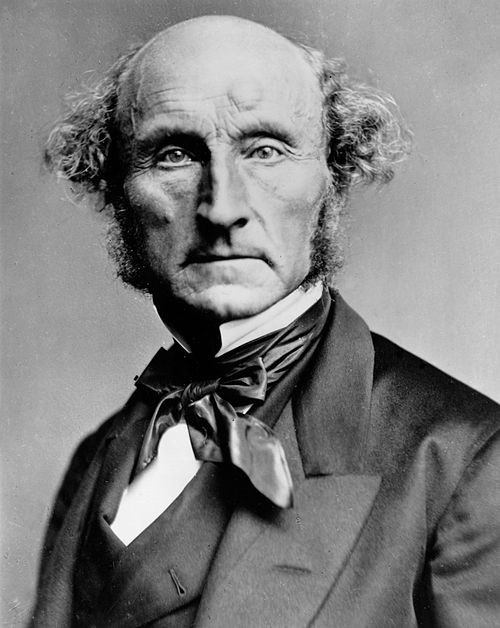
Mill's System of Logic
John Stuart Mill discusses probability and induction in his influential work, impacting philosophy of probability. #probability #philosophy
Mill's System of Logic By London Stereoscopic Company - Hulton Archive, Public domain, https://commons.wikimedia.org/w/index.php?curid=30913285
1854 CE
Boole's Laws of Thought
George Boole publishes The Laws of Thought, linking logic and probability, laying groundwork for Bayesian networks. #probability #logic
1866 CE
Galton's Regression
Francis Galton introduces regression to the mean, a key statistical concept related to probability. #probability #statistics
Galton's Regression By w: Francis Galton - https://books.google.ru/books?id=vL0hq80XXqMC&pg=PA183. Transferred from en.wikipedia to Commons. by User:Chaosconst, Public domain, https://commons.wikimedia.org/w/index.php?curid=4796196
1889 CE
Peirce's Frequentist Probability
Charles Sanders Peirce develops a frequentist interpretation of probability and random sampling. #probability #philosophy
Peirce's Frequentist Probability By Charles_Sanders_Peirce_theb3558.jpg: NOAA Office of NOAA Corps Operations derivative work: Ori.livneh (talk) - Charles_Sanders_Peirce_theb3558.jpg, Public domain, https://commons.wikimedia.org/w/index.php?curid=10310713
1900 CE
Bachelier's Random Walk
Louis Bachelier's doctoral thesis models stock prices as a random walk, anticipating Brownian motion and stochastic processes. #probability #finance
Bachelier's Random Walk By Louis_jeune_.gif - http://www.york.ac.uk/depts/maths/histstat/people/sources.htm, Public domain, https://commons.wikimedia.org/w/index.php?curid=15679520
1906 CE
Markov Chains Introduced
Andrey Markov publishes the first results on Markov chains, analyzing dependent random variables. #probability #stochastic
Markov Chains Introduced By Joxemai4 - Own work, CC BY-SA 3.0, https://commons.wikimedia.org/w/index.php?curid=10284158
1913 CE
Borel's Normal Numbers
Émile Borel introduces the concept of normal numbers and the strong law of large numbers. #probability #mathematics
Borel's Normal Numbers By Agence de presse Mondial Photo-Presse - Bibliothèque nationale de France, Public domain, https://commons.wikimedia.org/w/index.php?curid=15265004
1921 CE
Keynes' Treatise on Probability
John Maynard Keynes publishes A Treatise on Probability, proposing a logical interpretation of probability. #probability #philosophy
Keynes' Treatise on Probability By John Maynard Keynes - https://archive.org/details/treatiseonprobab0000john_t3h1/page/n9/mode/2up, Public domain, https://commons.wikimedia.org/w/index.php?curid=174523016
1925 CE
Fisher's Statistical Methods
Ronald Fisher publishes Statistical Methods for Research Workers, advancing frequentist inference and experimental design. #probability #statistics
Fisher's Statistical Methods By Unknown author - https://www.adelaide.edu.au, Public domain, https://commons.wikimedia.org/w/index.php?curid=42616717
1931 CE
Kolmogorov's Probability Foundations
Andrey Kolmogorov publishes Foundations of the Theory of Probability, establishing the measure-theoretic axioms of probability. #probability #mathematics
Kolmogorov's Probability Foundations By Ainali - Own work, CC BY-SA 3.0, https://commons.wikimedia.org/w/index.php?curid=3141713
1933 CE
Wiener's Brownian Motion
Norbert Wiener constructs a rigorous mathematical model of Brownian motion, defining the Wiener process. #probability #stochastic
Wiener's Brownian Motion By Unknown author, CC BY-SA 4.0, https://commons.wikimedia.org/w/index.php?curid=146079160
1937 CE
Kolmogorov Forward Equation
Kolmogorov publishes equations for diffusion processes, foundational for stochastic differential equations. #probability #stochastic
1940 CE
Feller's Probability Textbook
William Feller begins his influential probability textbook series, popularizing modern probability theory. #probability #education
1944 CE
von Neumann-Morgenstern Utility
John von Neumann and Oskar Morgenstern publish Theory of Games and Economic Behavior, applying probability to decision theory. #probability #economics
1948 CE
Shannon's Information Theory
Claude Shannon publishes A Mathematical Theory of Communication, using probability to quantify information. #probability #information
Shannon's Information Theory By Claude E. Shannon and Warren Weaver - https://archive.org/details/in.ernet.dli.2015.503815/page/n5/mode/2up, Public domain, https://commons.wikimedia.org/w/index.php?curid=171159167
1951 CE
Kac's Feynman-Kac Formula
Mark Kac derives the Feynman-Kac formula, linking stochastic processes and partial differential equations. #probability #physics
1953 CE
Metropolis Algorithm
Nicholas Metropolis et al. publish the Metropolis algorithm, a Monte Carlo method for sampling from probability distributions. #probability #computation
Metropolis Algorithm By Jaewook Lee Woosuk Sung Joo-Ho Choi - Metamodel for Efficient Estimation of Capacity-Fade Uncertainty in Li-Ion Batteries for Electric Vehicles June 2015Energies 8(6):5538-5554 DOI:10.3390/en8065538, CC BY 4.0, https://commons.wikimedia.org/w/index.php?curid=130401255
1954 CE
Doob's Stochastic Processes
Joseph Doob publishes Stochastic Processes, a comprehensive text on martingales and Markov processes. #probability #stochastic
Doob's Stochastic Processes By Konrad Jacobs - https://opc.mfo.de/detail?photo_id=919, CC BY-SA 2.0 de, https://commons.wikimedia.org/w/index.php?curid=6089596
1960 CE
Kalman Filter
Rudolf Kalman publishes the Kalman filter, a recursive algorithm for state estimation in stochastic systems. #probability #engineering
Kalman Filter By Petteri Aimonen - Own work, CC0, https://commons.wikimedia.org/w/index.php?curid=17475883
1961 CE
Cox Process
David Cox introduces the Cox process, a doubly stochastic Poisson process used in point process modeling. #probability #statistics
1965 CE
Blackwell's Information Theory
David Blackwell publishes work on comparison of experiments and gambling, linking probability and decision theory. #probability #statistics
Blackwell's Information Theory By George Bergman - Scanned via Epson Perfection V370; see also https://opc.mfo.de/detail?photo_id=9294, CC BY-SA 4.0, https://commons.wikimedia.org/w/index.php?curid=91164848
1970 CE
Black-Scholes Model
Fischer Black and Myron Scholes publish the Black-Scholes model for option pricing, based on stochastic calculus. #probability #finance
1977 CE
EM Algorithm
Arthur Dempster, Nan Laird, and Donald Rubin formalize the Expectation-Maximization algorithm for maximum likelihood estimation with missing data. #probability #statistics
EM Algorithm By Chire - Own work, CC BY-SA 3.0, https://commons.wikimedia.org/w/index.php?curid=20494862
1982 CE
Gelfand's Bayesian Statistics
Adrian Raftery and others advance Bayesian computation, leading to the rise of Markov chain Monte Carlo methods. #probability #statistics
1984 CE
Hopf's Ergodic Theory
Eberhard Hopf's work on ergodic theory influences stochastic processes, linking probability and dynamical systems. #probability #mathematics
1990 CE
Geman's Stochastic Relaxation
Stuart Geman and Donald Geman publish on Gibbs sampling and simulated annealing, key MCMC methods. #probability #computation
1993 CE
Gordon's Particle Filter
Neil Gordon introduces the bootstrap particle filter for nonlinear state estimation. #probability #engineering
2000 CE
Probabilistic Graphical Models
Daphne Koller and Nir Friedman publish Probabilistic Graphical Models, unifying Bayesian networks and Markov random fields. #probability #AI
2006 CE
Random Matrix Theory
Terence Tao and Van Vu make breakthroughs in random matrix theory, with applications in probability and statistics. #probability #mathematics
2013 CE
Deep Learning and Probability
Variational autoencoders and generative adversarial networks integrate probability into deep learning, revolutionizing AI. #probability #AI
Deep Learning and Probability By EugenioTL - Own work, CC BY-SA 4.0, https://commons.wikimedia.org/w/index.php?curid=107231101